
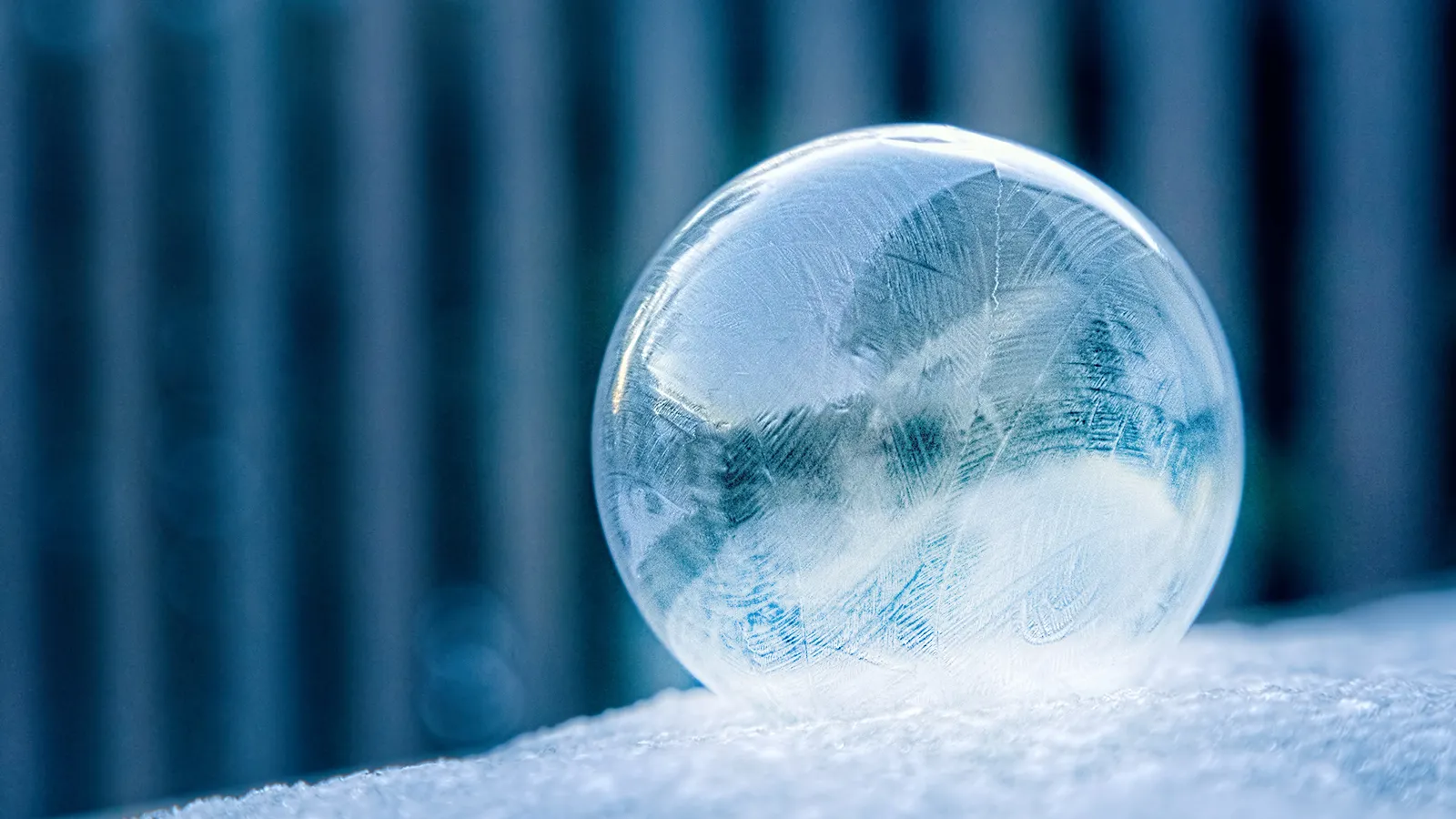
Freezing soap bubbles are a mysterious natural phenomenon visible only on subzero mornings, creating buzz on social media with comments like “It’s like magic!” and “I want to try this with my kids.” The sight of soap bubbles freezing in midair or on the ground, with ice crystal patterns spreading across their surface, is a beautiful experience unique to winter.
Without any special equipment, anyone can try this at home by following the right conditions and techniques, making it a valuable activity to experience nature’s changes with all five senses. This article provides detailed, beginner-friendly explanations of how freezing soap bubbles work, recipes for success, tips for safe enjoyment with children, and photography methods to capture these moments.
Table of Contents
What Is the Magic of “Freezing Soap Bubbles” That Only Appear on Frigid Mornings?
As winter’s cold intensifies, many families tend to stay indoors, thinking “It’s too cold to play outside.”
However, did you know that on such freezing mornings, a magical phenomenon occurs that seems straight out of a fairy tale? That’s what we’re introducing today: “freezing soap bubbles.”
Many of you may have seen Instagram Reels showing rainbow-colored soap bubbles whose surfaces are crawled over by white snowflake-like patterns, quickly transforming into glass-like spheres. The sight is truly a work of art created by nature itself, deserving to be called “winter magic.”
This article will share all the know-how needed to experience that fantastical world seen in videos as an actual parent-child activity.
Trending on Social Media! The Appeal of “Freezing Soap Bubbles” Like Snow Globes
Right now, “freezing soap bubbles” are creating major buzz on social media. Why do they captivate people so much? The main reason lies in the “coexistence of fragility and beauty.”
While ordinary soap bubbles burst and disappear within seconds, freezing soap bubbles show dramatic changes during their short lives. Ice crystals (the technical process of “solidification”) race across the transparent membrane, drawing geometric patterns as if alive.
It’s like watching a palm-sized snow globe naturally create itself right before your eyes without anyone’s help. The completed frozen soap bubble is delicate like thin glasswork, shattering with a crisp sound when touched, or shriveling like thin vinyl. This beauty lasting until the very end captures viewers’ hearts.
Another appeal is being an “ultimate rare experience.” It can’t be done anytime, anywhere. It’s natural art that appears only when several conditions—specific temperature, absence of wind, right lighting—miraculously align. That’s why the joy of success is all the greater. The surprise and discovery that “something this beautiful can be made in the park in front of our house or on our balcony!” stirs many parents’ desire to “try it ourselves!”
More Than Just Play? The Ultimate Natural Science That Draws Out Children’s “Why?”
It would be a waste to end with just “beautiful” and “amazing”—freezing soap bubbles hold tremendous educational value. This can be considered the highest-level “STEAM education” material available at home.
Children observe liquid transforming into solid before their eyes, learning about the “three states of matter (solid, liquid, gas)” as experience rather than from textbooks.
“Why does water freeze?”
“Why does transparent liquid turn white when frozen?”
“Why do fern-like patterns form?”
The numerous “why? (Why?)” questions that naturally fly from children’s mouths are proof that the door to scientific curiosity has opened.
Memorizing in school that “water freezes at 0 degrees” as mere knowledge differs completely from witnessing the moment soap bubbles freeze in a -10-degree world with reddened noses, in terms of memory retention and depth of understanding.
This experience goes beyond mere winter play, becoming seeds that cultivate awe for nature’s laws and “inquiry mindset”—the drive to pose questions and seek answers independently. With parents providing just a bit of scientific knowledge support, this play can elevate into a proper independent research project.
Success Keys Are “Temperature” and “Solution”! Three Critical Points to Learn in This Article
“I tried it before, but it burst immediately and didn’t work well.”
“It didn’t form beautiful crystals like in the videos.”
Some of you may have had such experiences. Actually, simply blowing bubbles randomly isn’t enough to succeed with freezing soap bubbles. It’s no exaggeration to say that success rate is 90% determined by preparation and environment selection. Thinking of it as an extension of ordinary soap bubble play can lead to repeated failures in the cold, breaking both parent and child spirits.
This article explains centered on the following three pillars to avoid failure:
- Environment setup (when and where to do it)
- Special solution recipe (what to use)
- Technique (how to photograph)
Even moms and dads who struggle with science experiments will be fine if they just grasp these points. Let’s brave the cold and go capture that miracle shot together as a family.
Weather and Timing Conditions to Successfully Achieve Crystallization
Even when enthusiastically heading outside thinking “It’s cold today, so we can do it!”, they surprisingly often don’t freeze. Actually, there’s a slight gap between the “coldness (perceived temperature)” we feel physically and the “conditions” physically necessary for soap bubbles to freeze.
Let’s start by looking at the secrets of environment selection practiced by professional photographers and science instructors.
What Subzero Temperature to Aim For? Best Temperature for Creating Video-Like Crystals
Generally, water begins freezing at 0°C, but because soap bubble membranes are extremely thin and contain impurities like detergent, a phenomenon called “freezing point depression” occurs, preventing freezing at exactly 0°C. The temperature at which soap bubble solution begins freezing is lower than pure water.
-3°C to -5°C: “Slow Observation Mode”
In this temperature range, crystallization proceeds slowly. Crystals start extending from the bottom several seconds to tens of seconds after creating the bubble. Because the speed is slow, it’s suitable for observing together with children, pointing and saying “Look! It’s freezing from there!” “Over here too!” However, there’s also risk of the bubble bursting before completely freezing as the membrane’s moisture evaporates.
-10°C to -15°C: “Best Conditions”
To create beautiful crystals like those seen in videos, this level of cold is ideal. Crystals race across as soon as you create the bubble, visible to the naked eye like watching a fast-forward video. While this is routine in cold regions like Hokkaido, Tohoku, and Nagano, even in Kanto and Kansai regions, it’s sufficiently achievable during major cold waves in early morning.
What’s important isn’t just the minimum temperature in weather forecasts, but “temperature near ground level.” Air near the ground at foot level accumulates cold air and is often colder than at adult face height.
Wind Is the Enemy! Location Selection to Freeze Without Bursting Bubbles
For freezing soap bubbles, an even bigger enemy than temperature is “wind.”
No matter how low the temperature, if wind speed exceeds 2m/s, bubbles burst from shaking before crystals can form. Additionally, cold wind rapidly lowers perceived temperature, causing children to quickly say “I’m cold, let’s go home.”
Location selection points are these three:
North side of buildings or shade
Direct sunlight is the enemy. Even when outside temperature is below freezing, sunlight raises the soap bubble’s surface temperature, preventing freezing through greenhouse effect.
Near walls that block wind
Look for places where wind doesn’t swirl, such as along house walls, near fences, or behind playground equipment. “Nearly windless” at 0-1m/s is ideal.
Inside forests or woods
Trees act as windbreaks, and moisture exhaled by trees often maintains humidity, creating an excellent environment.
If there’s nothing to block wind in an open park, simply having dad or mom stand upwind as a wall increases success rate. Also, if snow is piled up, digging to create a small hollow like an “igloo” and inflating bubbles inside creates a completely windless state, plus the background becomes a snow wall making for beautiful photos—highly recommended.
Doubling Beauty Through Light Staging! Choosing Sun Position and Time of Day
While crystallized soap bubbles are white, simply photographing them as white isn’t interesting. To capture that sparkling rainbow effect and emphasize ice texture, proper use of “light” is crucial.
The best time is from “just after sunrise” to “around 8 AM.” This period not only has the day’s lowest temperature due to “radiative cooling,” but the sun’s low position provides optimal light for photography.
Backlight (sun behind you)
Position the camera facing the sun and photograph the soap bubble in front. Crystal edges shine brilliantly, and transmitted light creates the most fantastical photos. The bubble’s transparency stands out, resulting in dramatic images.
Side light (light from the side)
Light from the side creates shadows, producing depth. The sphere’s roundness and surface crystal irregularities clearly emerge, creating powerful photos.
Midday sun (top light) causes overall flat brightness, making delicate ice patterns hard to see due to overexposure. The saying goes “the early bird catches the worm,” but for freezing soap bubbles, early rising is an absolute condition for success.
Preparation: Golden Ratio for “Magic Soap Solution” That’s Hard to Burst and Freezes Easily
Once the environment is set, next comes tool preparation. You might wonder “Can’t I use 100-yen shop soap bubble solution?” but unfortunately, commercial solutions are made assuming “fun play at room temperature.” To withstand the harsh physical changes of drying winter air while freezing requires somewhat special formulation.
Why Commercial Solution Doesn’t Work? Important Roles of “Laundry Starch” and “Sugar”
Commercial soap bubble solution’s weaknesses are “membrane too thin” and “evaporates quickly.” You may know that when water becomes ice, volume increases. If the membrane starts freezing while thin, it can’t withstand ice expansion and bursts. So we add two household materials for “reinforcement.”
Laundry starch (PVA)
Laundry starch containing PVA (polyvinyl alcohol) component, familiar from slime-making. Mixing this increases soap solution’s “viscosity (thickness).” Thick, viscous membranes don’t tear even as ice crystals grow, supporting ice growth with rubber-like elasticity.
Sugar (or simple syrup)
This is a surprising point, but sugar has high “water retention.” Winter air is dry, and soap bubble moisture constantly evaporates from the surface, thinning the membrane. Adding sugar makes sugar molecules hold water molecules, preventing evaporation and buying time for “freezing without bursting.”
Recreate from Videos! “Special Heavy-Duty Soap Solution” Recipe Using Household Items
Now let’s actually make it in the kitchen. Mixing together as “experiment preparation” with children is also fun. Enjoy it like a witch making a secret potion.
【Basic Heavy-Duty Soap Solution Recipe】
- Lukewarm water: 400ml (tap water is OK, but cooled boiled water with chlorine removed is even better)
- Dish soap: 50ml (check ingredient label and choose one with “surfactant” 30% or higher. Concentrated types like “Magica” or “JOY” are recommended)
- Laundry starch (PVA): 100ml (available at 100-yen shops or drugstores)
- Sugar: 2-3 tablespoons (easily dissolvable granulated sugar, or 3-4 simple syrup packets as substitute)
【Preparation Steps】
- Put lukewarm water in container, add sugar and gently mix until completely dissolved.
- Add laundry starch and mix further to create viscosity.
- Finally add dish soap and slowly mix without creating foam.
★Important Point
Never create foam. If foamed, the foam interferes and prevents making clean single-membrane bubbles. The trick is gently stirring from the bottom with a spoon. Ideally, make it the night before and let it sit overnight—components blend making an even stronger, harder-to-burst solution.
Practice: “Blowing Method” and “Placement Method” for Growing Beautiful Crystals
Once solution is ready, finally head outside! But here too there are techniques different from ordinary soap bubble play. Blowing toward the sky with “whoosh” is NG. They’ll drift away in wind before freezing.
Gently Place on Snow! “Landing-Type Bubble” Technique Using Straws
The basic principle of freezing soap bubbles is “place and freeze.” Rather than floating in air, fix on a platform for observation.
- Dip the straw tip generously in solution.
- Bring the straw tip close to a cold location like on snow, on a railing, or on fleece gloves.
- Gently blow while touching the solution to the placement surface.
- Inflate to form a hemisphere (dome shape).
- When reaching desired size (tennis ball to softball size), quickly yet gently pull out the straw.
When placing on snow, fluffy fresh snow makes bursting easy, so pack the snow slightly by hand to create a flat platform. Also, on synthetic fiber fuzzy gloves (work gloves or fleece), bubbles easily rest without being repelled, creating the mysterious experience of freezing on your hand. Wool gloves have fibers too thick causing easy bursting, so be careful.
Shallow, Long Breaths! Straw Operation to Avoid Melting Crystals with Warm Breath
The biggest enemy here is actually “your own exhaled breath.” Human exhaled breath is around 36°C, acting like “hot air” in frigid outdoor air. Blowing vigorously raises internal bubble temperature too much, melting from inside the freezing process trying to start on the surface.
Use longer straws: Short straws transmit warm breath directly. Use longer straws or connect two straws—breath cools slightly while passing through.
Rather than blowing strongly “Whoosh!”, send breath thinly and long like “Sssss…” Imagine pushing out only air in your mouth rather than from your belly. Also, unconsciously inhaling “suck” when separating the straw deforms and bursts the bubble. After finishing blowing, press the straw opening with your finger to block air, then gently separate for better success.
Don’t Miss the Moment Crystals Start Racing! Best Position and Timing for Observation
Once successfully placing the bubble, finally observe. Tell children “This is the real part! No blinking allowed!”
Crystallization usually begins “from the bottom touching ground or placement surface.” Or it begins from points where microscopic ice particles invisible in the air hit the bubble surface.
The best observation position is “squatting to bring eyes level with the bubble.” Looking down from above makes patterns hard to see due to light reflection. Viewing from the side lets you witness the dramatic scene of ice spreading upward from bottom like plants growing.
If temperature is near extremely cold -15°C, it rapidly becomes completely white before your eyes, but around -5°C, you can enjoy the slowly advancing territorial battle, saying “Oh, it’s coming from here!” “From here too!” Cheering the crystals together with children saying “Go! Go!” is also the real pleasure of this activity.
Photography: OK with Smartphones! How to Take “Instagram-Worthy” Frozen Soap Bubble Photos
You want to beautifully preserve this beautiful sight, right? “Is it impossible without a DSLR camera?” Not at all. Recent smartphones can take professional-quality videos and photos with just one setting.
Darker Background Is Correct? Background Selection to Make Ice Patterns Stand Out Clearly
Photographing transparent soap bubbles in white snowy landscapes makes everything whitish, making the crucial ice crystal patterns hard to see. This is called “overexposure.” The biggest trick to making crystals stand out is “bringing dark colors into the background.”
- Blackish building walls
- Deep green of coniferous forests
- Dark-colored down coat backs of dad or mom
Choosing these as background makes white crystal lines running across transparent membranes clearly emerge with sharp contrast. If there’s no suitable background, bringing black construction paper or felt cloth and simply standing it behind dramatically improves photo quality. When placing on snow, choosing locations where soil is visible or wooden benches makes patterns stand out.
Lowering Focus Difficulty: “Macro Photography” and “AE/AF Lock” Utilization
Smartphone cameras are “too smart,” tending to focus on background scenery. Focusing on transparent soap bubbles is extremely difficult. So use the “AE/AF lock” function.
- Launch camera and hold your hand over where you plan to place the bubble (or try creating one bubble).
- Long-press the bubble (or hand) part on screen.
- When yellow “AE/AF lock” display appears, it signals focus and brightness are fixed.
With this state, inflating bubbles keeps the camera focused on bubbles from the start without confusion.
Also, if iPhone’s “Macro mode” or Android’s “Close-up mode” “Super Macro” is available, actively use them. They can capture microscopic ice geometric patterns invisible to naked eyes, like a microscope.
Want to Shoot Like Reel Videos! Record Crystallization Dramatically with Time-Lapse Function
To shoot “rapidly freezing videos” seen on Instagram, smartphone’s “time-lapse” function is optimal. Time-lapse records time in fast-forward (frame-by-frame). The actually 30-second to 1-minute slow freezing is condensed into several seconds in video, making crystals appear to move like living things.
Handheld shots blur, losing time-lapse quality. Using a tripod is best, but without one, pack snow to create a platform and insert smartphone there for fixing.
Next press record, then blow bubble into frame. Be careful not to appear in frame yourself. Also, on snow it’s too bright, so tap the filming screen and lower the sun mark slightly, darkening exposure to make crystal whiteness stand out.
Troubleshooting Q&A for When Things Don’t Work
Even with perfect preparation, troubles are inevitable when dealing with nature. Here’s a compiled cheat sheet of common on-site failures and solutions. Use it when stuck.
When Bubbles Burst Immediately? Review “Humidity” and “Impurities” Relationship
Q. They burst while inflating.
A. Humidity may be too low, or straw may have dirt attached.
Winter clear weather brings extreme air dryness. Humidity is higher in locations near ground (near snow surface), so try blowing at lower positions.
Also, if straw tips are jagged or mixed with impurities like saliva or oils, those become weak points causing easy bursting. Change to a new straw or cleanly recut the tip with scissors.
If still unsuccessful, increase “sugar” or “glycerin” slightly in solution formulation to enhance moisture retention.
Doesn’t Freeze At All! Recheck “Radiative Cooling” and “Time of Day”
Q. Thermometer shows minus but doesn’t freeze at all.
A. Are you doing it in sunlight (hinata)? Or the ground may be warm.
Thermometers show air temperature, but when direct sunlight hits, greenhouse effect occurs inside the transparent bubble membrane, making surface temperature positive. Always move to shade.
Also, concrete or asphalt surfaces may be warm from storing daytime heat. Choose locations that have cooled thoroughly with high thermal conductivity, like on snow or on metal railings.
If it absolutely won’t freeze, there’s a trick of placing super-cold ice packs from the freezer under black cloth and experimenting on top.
Solution Too Thick to Blow? Cold Region-Specific Solution Management Methods
Q. It’s so cold that the solution itself in the cup is freezing.
A. Solution temperature management is also important.
In environments below -10°C, soap solution itself can become sherbet-like. When this happens, clean membranes don’t form and burst immediately.
Keep solution to be used in a thermos, or divide into small containers and keep warming with hand warmers in pockets until just before use. The trick to making beautiful thin membranes is creating temperature difference of “warm solution, cool after blowing.” Conversely, if solution is too warm the membrane becomes too thin, so body temperature (lukewarm) is best.
Summary
How was that? The science and magic art of “freezing soap bubbles” permitted only on frigid mornings. To succeed requires reading temperature and wind direction, concouring special solution, blowing with delicate touch… written out like this, it may feel like master craftsmanship. But that’s precisely why the joy of success is exceptional.
Children’s expressions with shining eyes forgetting even the cold should shine more beautifully than diamond dust. Even if unsuccessful, time spent worrying and devising together as parent and child wondering “Why did it burst?” “Is the wind too strong?” becomes irreplaceable memories. Failure is also the first step in science.
