

The transition from the end of the fiscal year to the new one in spring (March to April) is the most chaotic time for many Japanese workplaces, marked by personnel transfers and organizational restructuring. Many expectant mothers worry: “I just found out I’m pregnant, but won’t reporting it during the busiest season cause trouble?” or “Will this negatively affect my performance review or transfer?” This article provides practical tips for communicating smoothly with your workplace, while also making sure you can secure the leave and support you need.
[Key Points in This Article]
- Best Timing: Rather than waiting for the traditional “stable period” (five months), informing your direct manager before the spring internal transfer notices (naiji) are issued (early to mid-March) makes it easier for the company to adjust staffing.
- What to Say and Scripts: When reporting, combining three elements—your current physical condition, your desired maternity leave start date, and your plan to come back along with a rough handover plan—helps the workplace accommodate you during the busy season.
- Support Systems You Can Actually Use: If you experience severe morning sickness or high stress, do not push yourself. Use official frameworks like the “Maternal Health Care Contact Card” to prioritize your health and your baby’s safety.
Table of Contents
Timeline Guide: When to Announce Your Pregnancy During the Spring Transfer Season
While the general rule of thumb in Japan is to wait until the “stable period” (around the fifth month of pregnancy) to announce, the spring season often requires a different approach. Factoring in the workplace’s schedule, specifically the timing of personnel transfers, is a highly practical strategy. Let’s look at a timeline.
Early to Mid-March: Why Before the “Naiji” (Internal Notice) is a Useful Guideline
One of the easiest times to tell your workplace is “before internal transfer notices (naiji) are issued (early to mid-March).”
Managers and HR departments are actively building their staffing plans for the new fiscal year, deciding who goes to which department. If they know about your pregnancy and estimated leave before finalizing these plans, they can easily factor it in: “She will take leave from autumn, so let’s adjust the headcount now.” This significantly reduces the burden on the team. If your doctor has confirmed the baby’s heartbeat (usually around the third month), consider telling your direct manager early.
Late March to Early April: Announcing During Peak Season or Just After Restructuring
What if you find out you are pregnant from late March onward, when internal notices are already out or the new April structure has just begun?
During this period, both managers and colleagues are usually overwhelmed with handovers and launching new projects. However, delaying your announcement could make things harder for the team if you suddenly need to take time off due to severe morning sickness.
Use a softening phrase like “I apologize for the personal news during such a busy time,” and inform your direct manager promptly. Disclosing early gives the workplace more time to manage workload adjustments.
Etiquette and Practical Scripts for Telling Your Boss
Simply saying “I’m pregnant” to a busy manager might leave them unsure of how to respond or wondering, “How do we allocate the work?” and “When does her leave start?” Here are practical points and scripts for smooth communication.
Three Essential Items (Health, Leave Timing, Return Plans) and Cushion Words
To help your boss plan ahead, organize your announcement around these three points:
- Current health and immediate work style: (Any necessary accommodations)
- Desired timing for maternity/childcare leave: (When you will step away)
- Whether you hope to return after leave and handover plan: (Your plan to come back)
[Script: What to Say to Your Manager]
If all goes well, I plan to take maternity leave starting in early [Month], followed by [X] months of childcare leave, and I would like to return to work around [Month] of next year.
I am experiencing some morning sickness right now, which may cause some concern, but I plan to draft the handover documents for my tasks early while monitoring my health. Could we discuss the upcoming schedule?”
The Value of Expressing Your Desire to Return
It is particularly important to communicate your plan to come back early on. Showing a clear desire to continue working at the company after childbirth helps management view your workload adjustments and post-leave positioning much more positively.
What to Do If a Transfer or Promotion Happens at the Same Time
Spring often brings promotions or department transfers. Here is how to handle a pregnancy that coincides with these changes.
How to Communicate If You Find Out After a Transfer Notice
Finding out you are pregnant immediately after receiving an internal notice (naiji) for a new department is highly stressful. However, forcing yourself to transfer without saying anything can make handovers and workload adjustments in the new department extremely difficult.
In this case, report to your current direct manager as your top priority. Honestly explain that you discovered the pregnancy after the notice was issued. It is usually much smoother to have your current manager consult with HR and the new department head regarding how to proceed (e.g., whether the transfer should still happen).
When and How to Greet Your New Manager (From April)
If you proceed with the transfer to a new department in April, in most cases, it is best to tell your new manager within the first few days.
Start with, “I apologize for bringing this up so soon after joining the team, but…” and explain your pregnancy and your hopes for your work schedule. Sharing this information from the very beginning makes it easier to discuss task allocation and secure support for any days you feel unwell in your new environment.
Support Systems and Consultation Services You Can Use
Spring is a time when the stress of a new environment often overlaps with the physical toll of first-trimester morning sickness. To protect your and your baby’s safety, it is vital to understand the official systems available to secure a supportive work environment in Japan.
Using the “Maternal Health Care Contact Card” to Request Accommodations
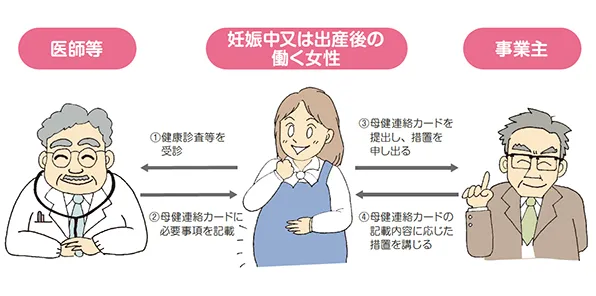
When filled out by your attending physician and submitted to your employer, this card serves as an official medical certificate. Under Japanese law, employers are required to take the necessary measures requested by the doctor on the card (such as staggered commuting hours, extended breaks, or reduced working hours). Before you push yourself to the point of exhaustion, use this essential right available to working pregnant women in Japan.
(Source: Maternal Health Care Measures and Protection Regulations for Working Women, MHLW)
Create a “Quick Handover Memo” for Sudden Sick Days
Physical condition during early pregnancy is highly unpredictable, and you may need to take sudden days off. To ensure work continues smoothly in your absence, create a “Quick Handover Memo” on your computer desktop or a shared folder. This should include a list of your current tasks, where files are saved, and contact information for relevant stakeholders. This small preparation can greatly reduce your stress and anxiety.
Basic Knowledge to Prevent Unfair Evaluations (Matahara Prevention)
Treating an employee unfairly (such as demotion, pay cuts, or unwanted transfers) due to pregnancy, childbirth, or taking maternity/childcare leave is known as “Maternity Harassment” (matahara), which is strictly prohibited under Japan’s Equal Employment Opportunity Law.
If you experience unreasonable treatment at work, know that you do not have to face it alone. You can consult your company’s HR department, the comprehensive labor consultation corner, or the Employment Environment and Equal Opportunity Department of your prefectural labor bureau.
(Source: Workplace Harassment Prevention Measures Regarding Pregnancy, Childbirth, Childcare Leave, and Family Care Leave (MHLW))
Frequently Asked Questions (FAQ)
Q. When should I tell my colleagues and team members?
A. The widely accepted cultural standard in Japan is to announce it to the broader team once you enter the “stable period” (around the fifth month of pregnancy).
However, since March is often chaotic due to the fiscal year-end, it might be easier for everyone to digest the news if you wait until April, once the new organizational structure has settled in. Consult with your direct manager to determine the best timing for a team-wide announcement.
Q. Will reporting to my boss before the stable period negatively affect my performance review?
A. It is illegal in Japan to give an employee an unfair evaluation because of pregnancy.
In fact, reporting early so the company can “adjust workloads accordingly” is often viewed positively as a sign of professional responsibility. Please prioritize your physical health and consult with management at a time that feels manageable for you.
Announcing a pregnancy during the unique spring transition period requires a lot of care and can be physically and mentally exhausting.
However, understanding the proper protocols and knowing where to go for support will give you peace of mind. Please put your health first and take each step at a pace you can manage.
