If your child has suddenly started using words you’ve never heard before, you’re not alone. “Brain rot,” “noob,” “Tung Tung Tung Sahur” — when phrases like these start coming out of nowhere, the first question most parents have is: “Should I be worried?”
A lot of this language traces back to Roblox, the game platform that has become part of everyday life for elementary-school-age kids around the world. That said, Roblox is rarely the only source — YouTube gameplay videos and TikTok are just as much a part of how this language spreads.
This guide breaks down the slang, memes, and trending words children commonly use around Roblox, including how to tell which ones deserve attention and which ones are just passing playground trends. The goal isn’t to alarm you. It’s to help you move from “I have no idea what that means” to “I understand enough to keep an eye on it.”
What you’ll find in this article
- The meaning of common words and phrases used on Roblox
- How to recognize language or situations that warrant a closer look
- Practical guidance on parental monitoring and safety settings
Table of Contents
Why More Parents Are Noticing Their Kids’ Roblox Language
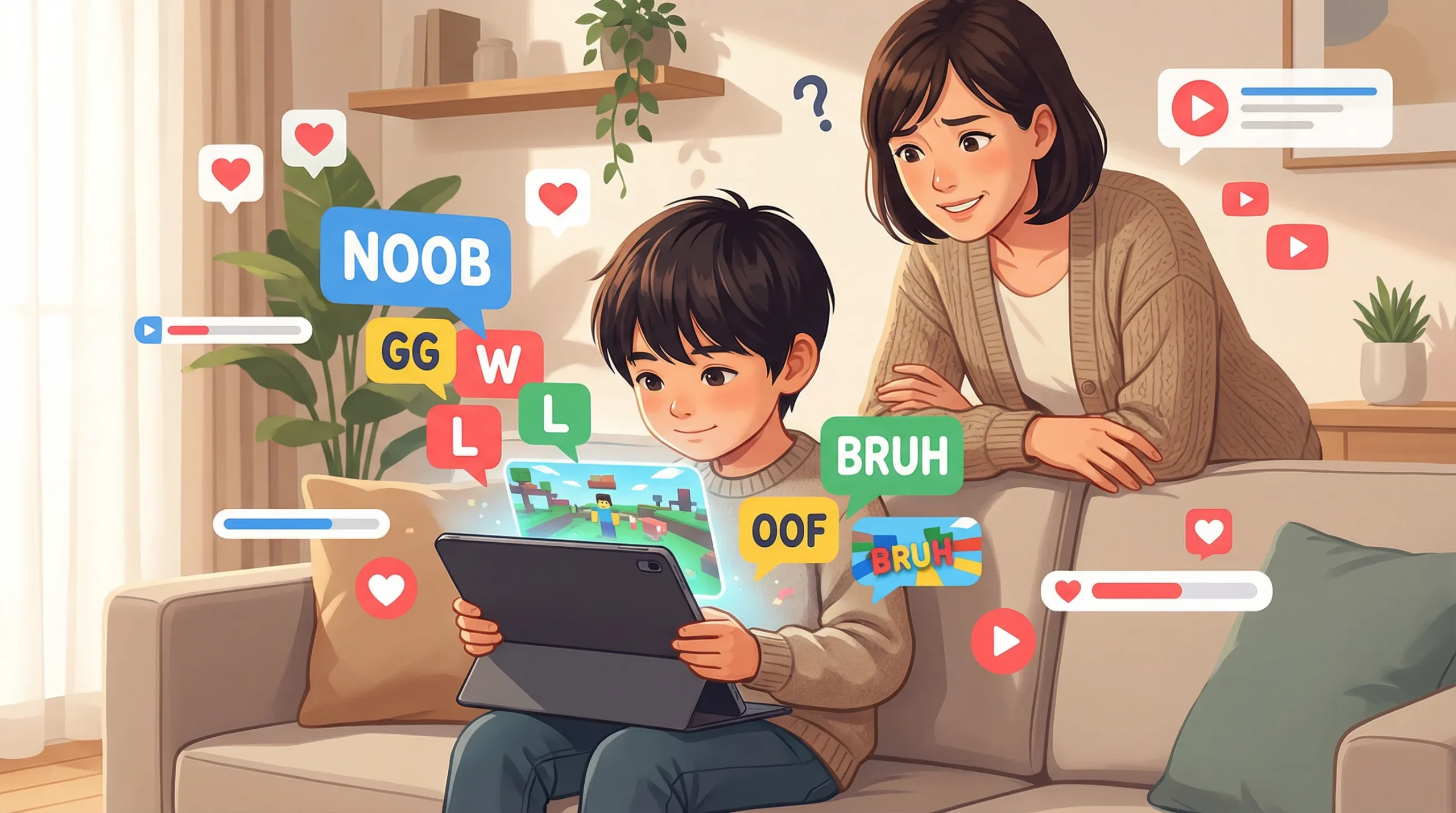
Plenty of parents find themselves caught off guard by words their children pick up through gaming. Here’s what’s actually going on.
Children start using words that seem to come from nowhere
“What does noob mean?” “They keep saying ‘brain rot’ and laughing — what is that?” When these phrases come up, asking your child where they heard it often gets a short answer: “On Roblox” or “from a video.” Getting a fuller explanation from them can be surprisingly difficult.
Gaming and video culture come with their own vocabulary, and if you’re not in that world, it genuinely doesn’t make sense from the outside. When parents ask and don’t get a real explanation, children sometimes feel it’s too complicated to explain — or that you won’t get it anyway. Over time, a small but real communication gap can quietly open up.
The language doesn’t stay inside the game
Roblox slang and memes don’t stay on-screen. They show up at recess, in casual conversation, and in offhand comments at home.
Children who don’t even play Roblox often know the words, because they’ve seen them on YouTube or TikTok. That’s one of the defining features of today’s meme culture — a word or phrase can travel far beyond its original platform. A child can pick up the language entirely through video-watching without ever loading the game.
Not knowing what a word means makes it feel risky — and that’s understandable
When your child uses a word you don’t recognize, it’s natural to wonder whether it’s something you should be concerned about. That instinct comes from wanting to keep them safe.
But it’s worth separating the genuinely concerning from the merely unfamiliar. Most of this language comes from gaming and video culture and functions like generational slang — not a danger signal. This article isn’t here to amplify worry. It’s here to give you enough context to read the situation clearly and respond thoughtfully.
What Is Roblox? What Parents Need to Know First
To understand why Roblox generates so much of its own language and culture, it helps to understand what kind of platform it actually is.
Roblox is a platform, not a single game
Roblox isn’t one finished game — it’s a platform where users create and publish their own games. It’s sometimes described as “YouTube, but for games.” Adventure games, escape rooms, simulations, horror experiences — millions of games are available for free. Roblox has grown into one of the most-used platforms among children globally, with users under 13 consistently making up a large share of its player base.
Roblox also includes friend and chat features, so children can join the same game as friends, play together, and exchange messages — giving it a social media dimension alongside the gaming one.
Why it catches on so strongly with younger children
Several things make Roblox particularly sticky for elementary-school-age kids. The base experience is free. Friends can join the same server and play together. The sheer variety of games means children rarely run out of things to try. And popular creators post gameplay videos on YouTube, meaning Roblox is also a passive entertainment choice — you can enjoy it without ever picking up a controller.
The way playing and watching are woven together is one of the things that sets Roblox apart from most other games.
Language spreads through three overlapping channels
Roblox words and memes move through in-game chat, gameplay videos, short-form video platforms, and everyday conversations at school. A child can encounter a phrase on TikTok, hear it confirmed by a classmate, and start using it at home — without ever having played the game it came from.
By the time a word reaches that stage, it has often become something close to a shared language among kids in that age group, regardless of whether they play Roblox at all.
Common Roblox Words and Memes — What They Actually Mean
This is the core of the article. Below are the words children most commonly use in and around Roblox, organized with their meaning, how they’re used, and a sense of their general tone. The majority are not cause for concern — most function as generational slang and in-group shorthand.
The short answer
Most words used around Roblox are trend vocabulary from gaming and video culture. They don’t require alarm across the board — but who is saying them, to whom, and in what context does matter.
The basics: words every Roblox parent will encounter
The following are standard gaming slang terms that appear widely in Roblox chat and in children’s everyday conversation. Most are shared across English-language gaming culture generally, and the majority are used without any harmful intent.
- noob: Short for “newbie” — someone new to a game or not yet skilled at it. Used to lightly tease a beginner, but also used self-deprecatingly (“I’m still a noob at this”). The tone depends heavily on context and delivery.
- gg: Short for “good game.” Used at the end of a match as a mutual acknowledgment, like saying “well played” in sports. Generally a positive, low-friction phrase.
- W: Short for “win.” Used to mean something is great, went well, or deserves praise. “That’s a W,” “total W move” — it’s a shorthand positive reaction.
- L: Short for “loss” or “fail” — the opposite of W. “That’s an L” means something went badly or was a poor decision. Used about situations, choices, and outcomes, not usually as a personal attack on its own.
- oof: An exclamation for when something goes wrong or turns out badly. It became widely recognized through Roblox’s original death sound effect, which made it especially memorable for younger players.
- bruh: A variation of “bro,” used to express disbelief, mild exasperation, or “I can’t believe that just happened.” Often more tone than content — something between a sigh and a raised eyebrow.
Meme-origin words that have drifted into everyday use
Some words circulating in children’s conversation came in through gaming YouTube channels and short video platforms. They aren’t Roblox-specific, but they show up in the same cultural space and appear in children’s speech often enough to be worth knowing.
- skill issue: “That’s a skill issue” — meaning “the problem is your own ability, not bad luck.” Used as gentle ribbing, but also self-mockingly (“yeah, that was definitely a skill issue on my part”). Can edge into dismissive if overused toward someone who’s already frustrated.
- touch grass: “Go touch some grass” — a way of telling someone (or yourself) they’ve been on screens too long and need to go outside. More wry self-awareness than genuine insult in most cases.
With meme-origin words, the energy and delivery matter more than the literal meaning. Children often use them more for the tone they carry than for what they technically say.
Brain rot — and why it keeps showing up in Roblox conversations
One phrase parents ask about more than almost any other is “brain rot.”
Literally “decay of the brain,” it’s used online to describe the mental state of someone who has spent too much time on videos and games — a kind of affectionate self-diagnosis for internet-overload thinking. In 2024, Oxford University Press named it their Word of the Year.
(Source: Oxford University Press, “Brain rot named Oxford Word of the Year 2024”)
In the Roblox space, “brain rot” gets used as self-deprecating humor or light teasing — “that’s pure brain rot content” means something is wonderfully, absurdly silly.
The term has also become closely associated with a viral meme trend known as “Italian Brainrot” — a category of AI-generated absurdist characters with mock-Italian names like “Tralalero Tralala,” “Bombardiro Crocodilo,” and “Tung Tung Tung Sahur.” These characters spread through short video platforms and fed directly into a popular Roblox game called Steal a Brainrot. A 2025 Japanese survey of elementary school trends found “Italian Brainrot” ranked first among younger girls and second among boys for trending words of the year — a data point that reflects just how widely this particular meme cluster has traveled among children internationally.
(Source: PR Times, Shogakukan JS Research Institute & CoroCoro Comics Research Institute Joint Survey, “2025 Elementary School Annual Trends”)
The takeaway for parents: “brain rot” language — including the Italian Brainrot characters and associated Roblox games — is a connected cluster of memes that has become genuinely widespread among children in this age group. In many school-age peer groups, hearing children repeat these names or phrases is less unusual than it may sound at first.
Children often use words for the sound, not the meaning
Whereas adults tend to learn a slang word’s meaning before adopting it, younger children — particularly those in the early elementary years — frequently pick up words because they sound funny, feel satisfying to say, or because everyone around them is saying them.
When a child repeats “Tung Tung Tung Sahur” or “Tralalero Tralala,” it’s almost always about the rhythm and the shared joke, not any deeper meaning. The word is a social token, not a statement. Keep that in mind before reading too much into what’s being said.
Why you don’t need to treat every unfamiliar word as a red flag
The picture that emerges from all of the above is that Roblox-adjacent slang is largely peer bonding language, emotional shorthand, and generational trend vocabulary. Treating all of it as suspicious creates a different problem: children start to feel that their interests are being judged rather than understood, and they stop bringing these things up with parents at all.
A simple “what does that mean?” asked with genuine curiosity does more good than an anxious reaction. The next section focuses on the smaller category of language and situations that genuinely deserve a parent’s attention.
Language and Situations Parents Should Keep an Eye On
Most Roblox language is benign, but there is a smaller category of expressions and patterns worth knowing about. The goal here is calibration — being able to recognize what actually matters.
When teasing crosses into targeted mockery
“Noob” and “L” are neutral in isolation, but in practice they can be used to put someone down. A child being told repeatedly “you’re such a noob” or “everything you do is an L” — especially directed at a specific person over time — is closer to online bullying than playful banter.
The line between joking and hurting usually comes down to whether the other person is bothered, and whether it keeps happening. If your child mentions being on the receiving end of this kind of comment, take the time to hear them out.
English abbreviations where the meaning is harder to see
Some abbreviations in circulation carry significantly heavier meanings when spelled out. “kys,” for example, stands for “kill yourself” — and while children sometimes use it without fully understanding what it means, that doesn’t make it something to leave unaddressed. It should be taken seriously even if a child says they were “just joking.” If you come across it, it’s worth having a calm, direct conversation.
That said, this is genuinely a small category. The presence of English abbreviations or gaming shorthand doesn’t mean a problem exists — most of it is completely innocuous.
Chat features: text and voice
Roblox supports both text chat and voice chat. With text chat in particular, there are well-documented risks around personal information — name, address, school — being shared or solicited in conversations.
In November 2025, Roblox announced an age-verification system designed to limit chat between different age groups, with global rollout starting in January 2026. Younger users’ communication features are subject to age-appropriate restrictions under this system.
(Source: Roblox Official Newsroom, “Roblox Requires Age Checks, Limits Minor and Adult Chat”)
These platform-level safeguards have improved considerably, but they don’t eliminate risk entirely. Reminding children not to share personal information, and to be cautious about interacting with people they don’t know, remains important regardless of what the platform’s settings allow.
Watch the child, not just the words
Monitoring language is only part of the picture. If you notice a shift in your child’s mood or behavior around Roblox, that’s worth paying attention to in its own right.
Coming away from a session noticeably upset, becoming secretive about the screen, being reluctant to say who they were playing with — these kinds of changes can be a sign that something uncomfortable is happening, even if you can’t see it directly. Paying attention to your child’s state, not just their vocabulary, is the most reliable form of oversight.
Signs that are worth checking in about
- Coming away from Roblox noticeably upset or irritable
- Starting to hide or cover the chat screen
- Being reluctant to say who they’re playing with
- A sudden shift toward more aggressive language
Why Do Children Want to Use This Language?
Understanding what motivates children to use gaming slang gives you a more complete picture — and makes it easier to respond proportionately.
It’s a shared code with their peers
Knowing words like “gg,” “noob,” and “W” signals to other Roblox-familiar children that you’re part of the same world. Using the right language creates a sense of belonging — “this person gets it.”
When a child starts using gaming slang, it’s often a straightforward expression of wanting to be part of their social group. That’s not unique to Roblox — it’s how in-group language has always worked among children.
The words are short, flexible, and easy to drop into conversation
Words like “W,” “L,” and “gg” are compact and convey a lot with almost no effort. They slot easily into normal sentences — “that was such an L moment,” “gg on that test” — which is part of why they persist outside of gaming contexts. A word that travels well is a word that spreads.
Gaming and video-watching are part of the same experience
Roblox content doesn’t stop at the game itself — watching YouTubers and creators play it is a genuine part of the culture. The phrases popular creators use become the phrases their viewers use. Children absorb language through watching just as readily as through playing.
This is why a child who has never loaded Roblox can still come home using Roblox slang. The video side of the ecosystem is as influential as the game itself.
Sometimes it’s just about how a word sounds
The spread of Italian Brainrot character names through classrooms has less to do with meaning than with the fact that the names are simply fun to say out loud. “Tung Tung Tung Sahur” gets repeated because saying it makes people laugh — full stop. Children have always played with language this way. It doesn’t need a deeper explanation, and it rarely needs intervention.
How to Stay Involved as a Parent
Here’s a practical framework for approaching all of this: understand the words, ask questions, agree on some ground rules, and check the settings.
Start with curiosity, not concern
If you hear an unfamiliar word, try asking about it without the energy of someone investigating a problem. “What does that mean?” asked with genuine interest usually gets a better response than the same question asked with visible worry.
Something as simple as “I keep hearing Roblox words but I genuinely don’t understand them” can open up a real conversation. Children often enjoy explaining their world to a parent who seems actually interested.
Focus on how words are used, not just what they are
A word isn’t a problem or not a problem in isolation — it depends on how and toward whom it’s being used. “Noob” between friends who are joking around is different from “noob” used repeatedly to mock a specific person.
Rather than banning words, asking “is anyone feeling bad because of how that word is being used?” encourages children to think about impact rather than just following a rule. That kind of thinking travels further than a list of prohibited terms.
Set household agreements around safety — not just restrictions
Children are more likely to follow rules they had a hand in making, and that feel like they make sense rather than just coming down from above. The goal is to avoid situations where children hide their activity — which is when genuine risks tend to increase.
Some practical agreements worth establishing together: no sharing personal information (name, school, address) with people online; check with a parent before any in-game purchases; come to a parent if something makes you uncomfortable. Screen time and where in the house Roblox is played are also worth discussing as a household, with the reasoning explained rather than simply announced.
Use the official parental controls
Roblox offers a parent-linked account system with a meaningful set of safety controls. As of April 2025, three new features were added: the ability to restrict who a child can connect with, a view of which games they play most, and controls over which games they can access at all.
(Source: Roblox Official Newsroom, “New Parental Controls on Roblox to Personalize Your Child’s Experience”
)
Parents can also set monthly spending limits, manage friend and communication settings, and turn chat features on or off. For setup guidance, Roblox’s support pages are available in English at en.help.roblox.com.
Pay particular attention to the connections settings
On Roblox, adding someone as a friend makes it easier to chat and join the same games together. It’s worth checking the connections section of your parental dashboard periodically to see whether your child has friended people they don’t know in real life.
Settings worth reviewing
- Whether chat settings are appropriate for your child’s age
- Whether friends and connections include anyone unfamiliar
- Whether spending limits or game access restrictions are needed
- Whether the household has a shared agreement on time and place for playing
Putting It Together
Most of what children pick up from Roblox — the slang, the memes, the Italian Brainrot character names — is generational trend language, not a warning sign. A smaller category of expressions is worth knowing about, and chat-related risks around personal information are real and ongoing. Both of those things are true at the same time.
The two things that matter most are knowing enough about the platform to understand what your child is talking about, and keeping the kind of relationship where they’ll actually tell you when something feels off. When you know what “gg” and “brain rot” mean, you have a genuine entry point into their world — and children are more likely to open up to a parent who seems to get it, even a little.
Roblox memes and slang don’t have to be a source of anxiety. With a bit of context and some practical safeguards in place, they’re something you can follow along with — and even occasionally talk about together.