
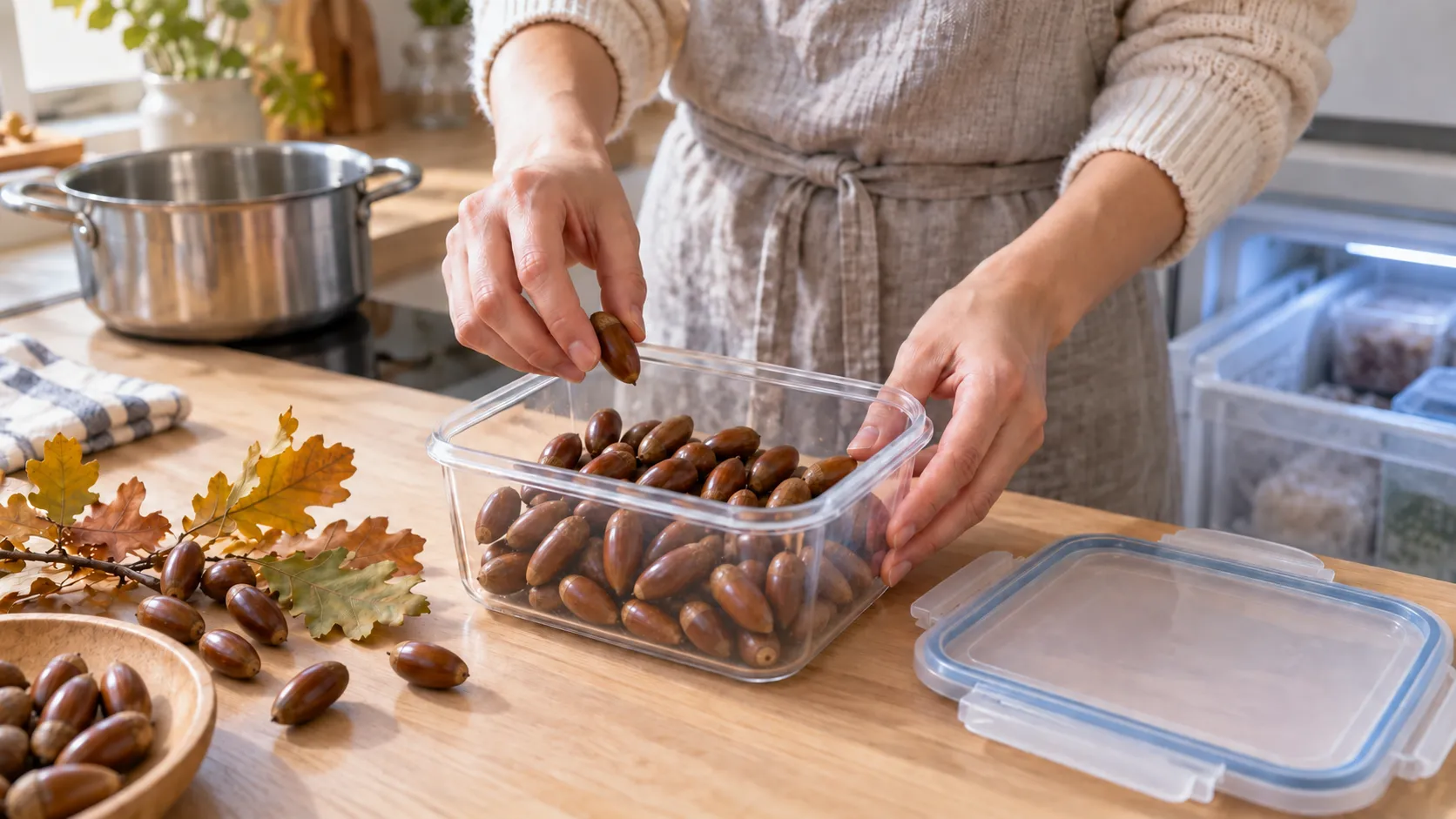
If you’d rather not use your cooking pots, sealing acorns in bags and freezing them is a workable alternative. That said, a home freezer can’t be relied on to finish the job in a fixed number of days, so you’ll need to check your freezer’s actual temperature and dry the acorns afterward.
Your child comes home from the park or the daycare yard with a pocketful of acorns. Even when they say they want to use them for crafts and don’t want to throw them away, the thought of grubs crawling out a week later makes it hard to simply leave them sitting in the house.
The method usually recommended for dealing with those larvae is boiling. The process itself is simple enough, but some families are understandably reluctant to boil acorns — carrying soil and possibly insects — in the same pots they cook with.
This article walks through freezing as the realistic alternative to boiling, covering sorting, packaging, freezing, bringing the acorns back to room temperature, drying, and storage, in that order.
Please read this first
We were not able to find any established, universally applicable treatment period for acorns in a household freezer. This article draws on public cold-treatment documentation and examples from park facilities, while keeping what can be confirmed separate from what is simply a reasonable approach for home use.
Table of Contents
If you don’t want to use your cooking pots, freezing is the first option to consider
For households that would rather avoid boiling, freezing is easy to adopt because the acorns can be packaged separately from food. But it isn’t a matter of putting them in the freezer and calling it done.
Parenting information from the City of Yokohama describes using nuts and seeds that have been frozen or boiled in advance for nature play. Biwako Bunka Park likewise publishes a procedure in which washed acorns are bagged, frozen, and then dried.
On that basis, freezing can be treated as one realistic alternative to boiling. The sources do not, however, all specify the same freezer temperature or the same length of time.
What matters is treating the following as three separate steps.
- Washing: removing soil and dirt from the surface
- Cold treatment: reducing the chance that larvae inside will emerge later
- Drying: preventing mold caused by condensation and residual moisture
Washing alone does nothing about insects inside the nut, and freezing alone won’t prevent mold if the acorns are not dried properly afterward. Treat everything from collection to storage as a single connected process.
(Source: Let’s play with fallen leaves and nuts! | City of Yokohama parenting media)
(Source: How to treat acorns | Biwako Bunka Park)
Editor’s note
It’s easy to conclude that if you don’t want to use a pot, you should just freeze them instead. But a freezer is also a place where food is stored. It seems inconsistent to assume that a pot is unacceptable while a spot next to the ice cream and the baby food is automatically fine.
Keeping nature play going isn’t about forcing yourself to ignore that discomfort. It’s about separating the question — is it the pot you object to, or is it having them in the same space as food? — and then choosing the approach your household can actually live with.
What’s the difference between freezing, boiling, and doing nothing?
Freezing and boiling differ in the equipment they need, the time they take, and the state the acorns are left in. Floating them in water, or simply letting them air-dry, cannot be confirmed as a reliable way to deal with insects.
| Method | Cooking pots | Freezer | Role | Main points to watch |
|---|---|---|---|---|
| Freezing | Not used | Used | A realistic option other than boiling | Check actual temperature, duration, condensation, and drying |
| Boiling | Used | Not used | Practiced at parks and educational facilities | Reluctance to use cooking pots, burns, drying after heating |
| Heating with dedicated equipment | Cooking pots not used | Not used | An option if you can set aside a separate pot | Confirm the heating conditions and the safety of the equipment |
| Floating in water | Not used | Not used | Not insect treatment — a supplementary way to check condition | Acorns that sink may still contain insects |
| Air-drying only | Not used | Not used | Only if you accept that insects may emerge and want to watch for them | Does not count as insect treatment for crafts or long-term storage |
| Microwave | Not used | Not used | Not recommended in this article | No official conditions confirming it is safe and effective |
You can’t conclude that floating means infested and sinking means safe. Acorns that float may be insect-damaged, dried out, cracked, or deteriorating inside, but there is no way to check the interior of a sinking acorn by appearance alone.
Treat the float test as a way to weed out acorns that are obviously in poor condition, and follow it with freezing or heating.
If you don’t want acorns in your freezer either, rather than substituting methods whose reliability can’t be confirmed, such as soaking or leaving them alone, it’s easier to decide between setting aside a dedicated pot for acorns, checking the procedure used by your child’s daycare or preschool, or buying craft materials that have already been treated.
In what order should you handle acorns before freezing?
Work through sorting, washing, removing moisture, packaging, and labeling with the date, in that order. It also matters that you never mix treated acorns with untreated ones.
Step 1: Check whether collecting is allowed there
Rules on taking plants and nuts vary from one park or facility to another. The City of Yokohama states that fallen nuts and seeds may be taken home, while asking visitors to be considerate — not collecting large quantities, and not picking fruit still attached to branches.
These are not nationwide rules. National parks, nature conservation areas, botanical gardens, private land, and shrine and temple grounds may prohibit or restrict collecting. Check the signage on site or ask the facility staff.
(Source: May I take nuts, fruit, or bamboo shoots from a park? | City of Yokohama)
Step 2: Check for holes, cracks, softness, and odd smells
Sort the acorns you’ve collected as follows.
- A round hole in the shell
- The shell is cracked
- Soft when pressed
- Sprouting
- Visible darkening or mold
- An unusual smell
A hole may be where a weevil larva has already exited. However, the absence of a hole is not proof that there are no insects or eggs inside.
Rather than trying to judge infestation from appearance alone, treat this as sorting out the acorns that are clearly in poor condition.
(Source: There are small, round holes in many of the acorns on the ground. What made the holes? | Iowa State University Extension)
Step 3: Wash off surface soil and dirt
If an acorn is in good enough shape to wash, rinse the soil and dirt off the surface with water. If you’re uncomfortable using your usual bowls or colanders, set aside separate ones that you don’t use for food.
Once washed, wipe the surface moisture off with a cloth or kitchen paper. Don’t leave them wet for long periods, and don’t seal them up damp and leave them at room temperature.
Washing removes surface dirt. It is not a step that deals with insects inside the nut.
Step 4: Put them in a freezer bag or container
Put the acorns into a freezer-safe bag, spreading them flat so they don’t pile up too much. Writing the following on the bag keeps batches from going untreated or getting mixed up.
- The date collected
- The date freezing started
- Where they were collected
- Whether they are untreated or already treated
If you’re uneasy about contact with food, double-bag them or place the sealed bag inside a lidded freezer-safe container. Double packaging helps keep them separate from food and contains any dirt, but it does not make the treatment any more effective against insects.
Step 5: Check your freezer’s temperature setting
The Ministry of Agriculture, Forestry and Fisheries describes household freezer compartments as normally running at around -18°C (0°F). The actual temperature varies with the model, the setting, how much food is inside, how often the door is opened, and where items sit in the compartment.
Check your freezer’s temperature in the manual, and use a freezer thermometer if you can. Don’t overpack the freezer, and don’t let the acorns sit in a thick pile in one spot.
(Source: Points to note when home-freezing food | Ministry of Agriculture, Forestry and Fisheries)
How many days do you need to freeze them in a home freezer?
Duration can’t be settled by days alone. You need to consider your freezer’s actual temperature, the quantity of acorns, how long it takes for the center of each nut to reach that temperature, and the species and developmental stage of the insects.
The Tokyo National Research Institute for Cultural Properties gives the following reference conditions for cold treatment of cultural property and similar materials.
- -30°C (-22°F) for one week or more
- -20°C (-4°F) for two weeks or more
To keep materials from getting wet through condensation, it also advises sealing them in a waterproof bag and waiting until the material and the surrounding air are at a similar temperature before opening the bag.
Note, though, that these are cold-treatment conditions for pests affecting cultural property, not experimental values obtained specifically for insects inside acorns collected at home.
(Source: Low-temperature treatment | Tokyo National Research Institute for Cultural Properties)
Guidance published by NARO on food pests also lists general cold conditions for killing insects, but again, this covers food pests in general. The same conditions do not necessarily transfer directly to insects inside acorns.
(Source: Food pest site, past questions | NARO Institute of Food Research)
If you can confirm -20°C (-4°F) or below
If you can confirm that your freezer holds at -20°C (-4°F) or below, the two weeks or more given by the Tokyo National Research Institute for Cultural Properties is a useful reference point.
Even then, this is not a guaranteed condition for acorns specifically. Don’t assume that two weeks means larvae definitely won’t appear — keep checking during the drying period and while the acorns are in storage.
If your household freezer runs at around -18°C (0°F)
You can’t apply a -20°C (-4°F) treatment condition directly to a household freezer running at around -18°C (0°F). Nor could we find any official standard for acorns stating how many days would be sufficient in a home freezer.
Park facilities do publish examples of freezing for a week or more, but this is not a nationally established, research-backed standard.
If reliability is your priority, consider one of the following.
- Use a freezing environment where you can confirm the actual temperature
- Heat-treat the acorns using equipment kept separate from your cookware
- Buy craft materials sold as already treated
- Follow the procedure set by your child’s daycare or preschool
A direct answer to “how many days?”
Can you hold -20°C (-4°F) or below? Then two weeks or more, the figure used for cultural property pest treatment, is a useful reference. A typical household freezer sits nearer -18°C (0°F), and complete treatment at that temperature can’t be guaranteed. Check what your freezer actually reads, and keep looking for insects and mold while the acorns dry and afterward in storage.
After freezing, bring them back to room temperature in the bag and dry them thoroughly
If you take acorns straight out of the bag after freezing, moisture in the air readily settles on their cold surfaces. Keep the bag closed first, and wait until the acorns have warmed up.
Open the bag only after it reaches room temperature
Put the bag somewhere out of reach of babies and toddlers, away from direct sunlight and direct heating. Wipe off any condensation that forms on the outside of the bag.
Once the acorns have come back to room temperature, open the bag and spread them out in a single layer to dry.
Dry them in a shaded, well-ventilated spot
How long drying takes depends on how wet they got during washing, the size of the acorns, the temperature, the humidity, and the airflow. Don’t fix on a set number of days — check their condition daily.
Here’s what to look for while they dry.
- Whether moisture remains on the surface or underneath
- Whether there are white, green, or black mold-like changes
- Whether there is a sour or rotten smell
- Whether the shells have gone soft
- Whether new holes, powder, or insects have appeared
- Whether rapid drying has caused large cracks
Keep checking them after they’re dry
Once thoroughly dry, put the acorns into a paper bag or breathable box labeled with the treatment date, and store them somewhere with low humidity.
If they are left in a plastic bag or sealed container while still not fully dry, moisture may remain inside. For long-term storage, don’t rely on the type of container alone — check regularly for mold, smells, and insects.
The National Diet Library’s Collaborative Reference Database includes references from published sources on storing acorns, noting that they should be dried after heating and should not be sealed in plastic bags, to avoid mold.
(Source: Acorns get infested with insects when kept for a long time — is there a good way to store them? | National Diet Library Collaborative Reference Database)
Can you use a microwave, or just pour boiling water over them?
Microwaving, and simply pouring boiling water into a heatproof container, are not recommended in this article, because neither the safety nor the treatment conditions can be confirmed.
We don’t recommend the microwave
We could not find any official conditions from appliance manufacturers or public bodies for treating acorns safely and effectively in a microwave.
The National Institute of Technology and Evaluation warns that overheating food in a microwave can cause charring or fire, and that foods with shells or membranes may burst. That warning was not based on testing acorns. But the absence of acorn-specific testing is not a reason to heat a natural material at your own discretion when safe conditions cannot be confirmed.
Don’t assume that short bursts with a careful eye make it safe. Avoid using a microwave for purposes not described in its own instruction manual.
(Source: Use cooking appliances correctly | National Institute of Technology and Evaluation)
Pouring boiling water doesn’t let you confirm what happens inside
Even if you pour boiling water from an electric kettle over acorns, it’s difficult at home to confirm what temperature the inside of each nut reaches and how long it stays there.
It avoids using a pot, but it can’t be said to have the same effect as boiling. You also need to make sure the container is heat-resistant, and to watch out for scalding.
If you choose to heat them, use equipment set aside for the purpose, follow procedures you can confirm from public or specialist sources, and have adults do it without children involved.
Before children use them, check for choking risk, mold, and cracks
Even once insect treatment is finished, acorns are a size that can lead to swallowing or choking in small children. Being treated and being safe as a plaything are two separate questions.
The Consumer Affairs Agency notes that a young child’s mouth is about 4 cm in diameter, warning that anything smaller can fit inside the mouth and may be swallowed.
(Source: Beware of accidents where children swallow toys and other small items | Consumer Affairs Agency)
Safety checks before use
- No mold or unusual smell
- No cracked, sharp-edged shells
- No glued parts coming loose
- You can supervise so children don’t put them in their mouth, nose, or ears
- You can store them out of reach of babies and younger siblings
- You can count them and check the floor area after play
Where there is visible mold, a smell suggesting the inside has rotted, or a badly cracked shell, the safe call is not to use them for children’s crafts.
Acorns are not prepared as food. Tell children clearly that they are for crafts and must not be put in the mouth. Adults should stay nearby, adjusting supervision to the child’s age and development.
Conditions differ between homes and childcare settings
At Japanese daycare centers and preschools — hoikuen and yochien — kitchen equipment and food freezers may not be available for treating natural materials. Don’t apply an article written for home use as-is; follow the facility’s own rules on hygiene, safety management, and storage.
A checklist for the day you collect acorns
Finishing the sorting and date labeling on the same day you collect makes freezing and drying easier to keep track of.
- Checked that collecting is allowed there
- Took only fallen acorns, only as many as needed, not picking from branches
- Checked for holes, cracks, softness, mold, and unusual smells
- Washed off surface soil and dirt
- Wiped off moisture after washing
- Put them in a freezer-safe bag or container
- Wrote down the collection date and the date freezing started
- Checked the freezer’s temperature setting
- Kept treated and untreated acorns separate
- Brought them back to room temperature in the bag after freezing
- Dried them in a shaded, well-ventilated spot
- Rechecked for mold, smells, cracks, and insects before use
- Decided how to supervise based on the child’s age
Common questions about treating acorns for insects
Here are the points people most often get stuck on — freezing time, washing, floating acorns, mold, microwaves, and storage.
- How many days in the freezer is enough to feel confident?
- No official standard for acorns sets a sufficient number of days in a home freezer. At -20°C (-4°F) or below, the two weeks used for cultural property pest treatment is a reasonable benchmark. Most home freezers run nearer -18°C (0°F), so don’t treat the two figures as equivalent — verify your own temperature and inspect the acorns afterward.
- Should you wash acorns before freezing?
- If there’s soil or dirt on the surface, rinse them with water and wipe the surface moisture off before packaging. Washing alone, though, does nothing about insects inside the nut.
- Should you throw away every acorn that floats?
- Floating isn’t caused by insect damage alone — drying out, cracks, and internal deterioration can also be behind it. At the same time, sinking doesn’t prove there are no insects. Use the float test as supplementary sorting, and also check for holes, cracks, softness, and unusual smells.
- If there’s no hole, is insect treatment unnecessary?
- Not necessarily. If a larva is still inside, there may be no visible exit hole yet. Don’t rely on appearance alone to judge what’s happening inside.
- Is it all right to put them in the freezer with food?
- If that makes you uncomfortable, put the acorns in a freezer-safe bag, then place that sealed bag inside a second bag or a lidded container. Keep them from touching food directly, and follow the hygiene rules of your household or facility.
- Can you take them straight out of the bag after freezing?
- Don’t open it straight away — keep the bag closed and let the contents come back to room temperature. Exposing cold acorns directly to indoor air makes condensation form easily on the surface.
- If mold appears, can you wipe it off and still use them?
- We don’t recommend reusing them for children’s crafts. Wiping the surface doesn’t tell you anything about the inside, so the safe call is not to use acorns with mold, a rotten smell, or softness.
- Can you microwave them a little at a time?
- Not recommended. There are no confirmed official conditions for treating acorns safely and effectively, and you can’t judge the risk of smoke, fire, or bursting from overheating at home.
- I don’t want acorns in my freezer either. Are there other options?
- You can heat them using a pot kept separate from your cookware, check the procedure used by your child’s daycare or preschool, or use craft materials sold as already treated. Soaking them or leaving them in a paper bag can’t be substituted for freezing or heating as reliable insect treatment.
- How long do treated acorns keep?
- There is no guaranteed period that applies across all home environments. Dry them thoroughly, record the treatment date, and check regularly for mold, unusual smells, cracks, and insects. Rather than assuming they’ll last until next year, it’s easier to manage if you treat only as many as you need.
Summary: insect treatment isn’t just freezing — drying and checking are part of the set
If you don’t want to use your cooking pots, freezing the acorns in bags or containers kept separate from food is the easiest first option to adopt.
Just remember that a home freezer’s roughly -18°C (0°F) isn’t the same thing as specialist cold treatment built around -20°C (-4°F) or colder. Instead of trusting that a few days will do it, look at your freezer’s temperature, how many acorns you’re treating, and what condition they’re in when they come out.
After freezing, bring them back to room temperature in the bag and dry them thoroughly in a shaded, well-ventilated spot. Before use, check once more for mold, unusual smells, cracks, and insects.
And remember that even treated acorns can be swallowed by small children. Adults should supervise, and check the floor and the storage spot once play is over.
