

Having income from abroad does not, on its own, make your childcare fees higher. But when a municipality cannot confirm your household’s income from resident tax records alone, it will ask for additional documents showing your overseas income and deductions.
Families returning from an overseas posting, families moving to Japan for the first time, and households where one parent has been working abroad often encounter the phrase “overseas income declaration” for the first time when they apply for daycare or open a fee notice.
That raises some reasonable questions. Is this a nationwide procedure, or something specific to one city? Is this form unique to Yokohama? And are you expected to convert your overseas earnings into yen yourself?
The short answer is that the basic mechanism — childcare fees set according to household income — exists across Japan, but the name of the form, how it is filled in, what proof is accepted, and how foreign currency is handled all vary by municipality. This article compares official municipal materials as of September 11, 2026, then uses the City of Yokohama’s overseas income declaration form as a worked example: which year applies, how to complete it, what to attach, and what to check before you submit.
Table of Contents
How does overseas income affect childcare fees?
Information about overseas income is one of the things a municipality uses to confirm your household’s income. But “overseas income means higher fees” is not how the system works.
Under Japan’s Child and Childcare Support System (子ども・子育て支援新制度), childcare fees are set by each municipality within a national ceiling, and are calculated using figures such as the municipal resident tax income levy assessed on the parents. In practice, this means the actual amounts and the fee tiers differ from city to city.
(Source: Understanding the Child and Childcare Support System | Children and Families Agency)
For children in the 3–5 age classes at kindergartens (yochien), daycare centers (hoikuen), and certified integrated centers (nintei kodomoen), the basic fee is waived. For the 0–2 age classes, households that are exempt from resident tax qualify for the waiver. Costs such as meals, extended-hours care, and teaching materials may still be charged separately.
(Source: Free early childhood education and childcare | Children and Families Agency)
The issue is not overseas income itself, but whether income can be confirmed
For households assessed for resident tax in Japan, the municipality can look up that tax information and calculate the fee. But if you were living abroad during the year used for the calculation, or if you have overseas income that is not taxed in Japan, ordinary resident tax records may not show the full picture of your household’s income.
This is why municipalities use tools such as annual income declaration forms, overseas income declaration forms, employer salary certificates, and tax returns filed in the country concerned to fill in the periods they cannot verify from Japanese records. The purpose is not to penalize overseas income. It is to confirm your income situation using the same standard applied to households that earned their income in Japan.
Household situations to check first
Nationality alone does not determine whether you need to file. Japanese families returning from abroad can be asked for these documents, and foreign nationals whose tax information the municipality can already access may be asked for something different.
- You worked abroad for part of the income year used to calculate your fees
- You were living outside Japan on January 1 of that income year
- You have overseas income that is not reflected in Japanese resident tax records
- Only one parent was living or working abroad
- You returned to Japan partway through that income year and have income from both inside and outside Japan
- You had no income, but the municipality cannot confirm your tax information
If any of these apply, contact the municipality handling your application — or the one where your child’s facility is located — and ask whether additional overseas income documents are required.
How overseas income is declared differs by municipality
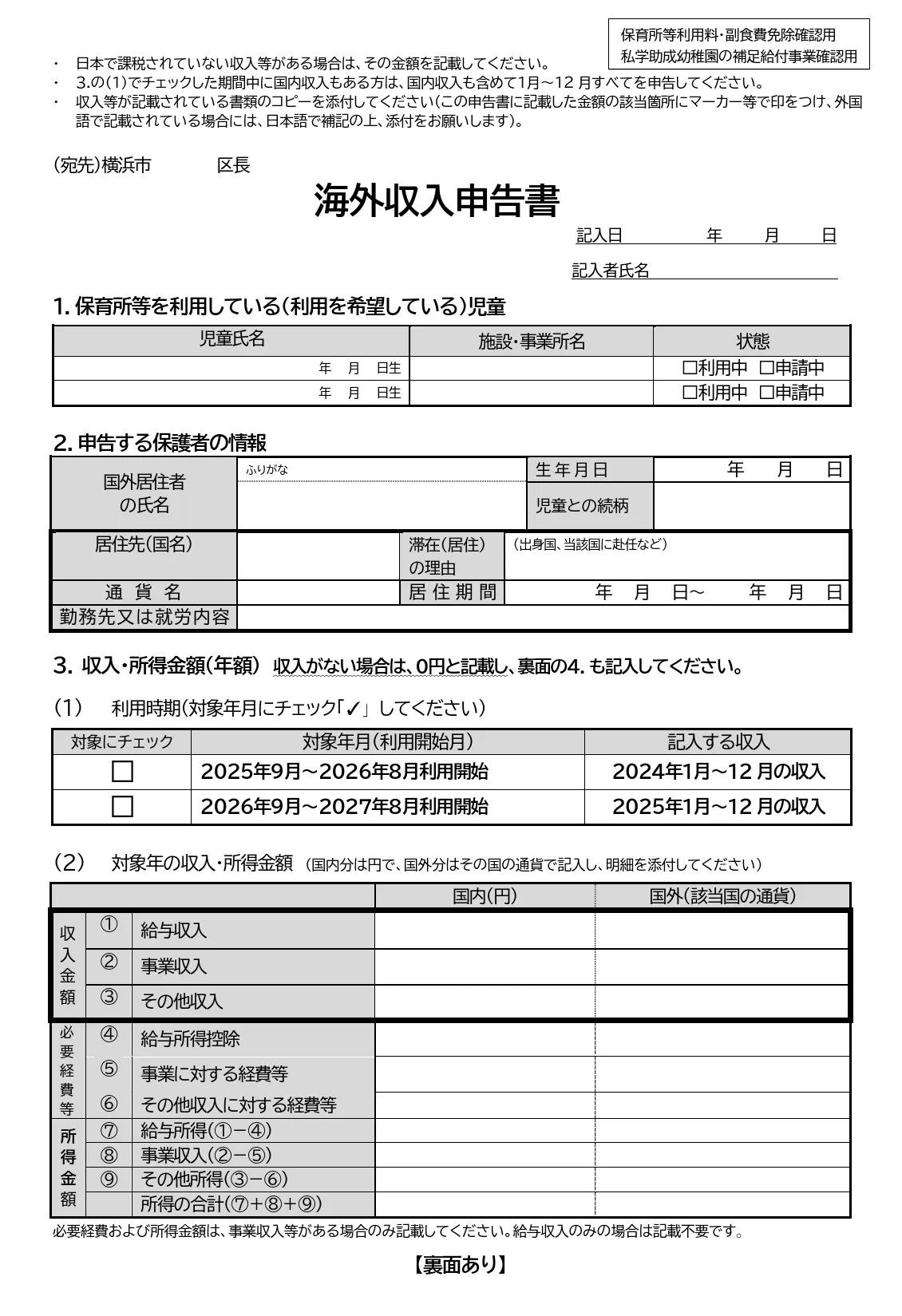
There is no single nationwide overseas income declaration form. Beyond the name of the document, you need to check the currency, translation rules, the year covered, and how to explain periods with no income — municipality by municipality.
Looking at the official materials published by Yokohama, Kawasaki, Setagaya, and Minato, all four explain how income is confirmed when overseas income or overseas residence is involved. What they actually ask you to submit, and how to complete it, is not the same.
| Municipality | Documents named in official materials | Guidance on currency and translation | Distinctive points |
|---|---|---|---|
| Yokohama | Overseas income declaration form, plus documents proving income and deductions | Overseas amounts entered in the currency of the country concerned. Foreign-language documents annotated in Japanese | Domestic and overseas income are entered separately, and the form itself shows which income year matches each enrollment period |
| Kawasaki | Overseas income declaration form, plus salary payment certificates, tax returns filed in that country, and similar documents | Use yen if a yen figure is stated; use the local currency if only foreign currency is shown. A Japanese translation or annotation must carry the translator’s address and name | Income and no-income periods are entered separately, and if overseas work did not cover the full year, the January–December period including income earned in Japan is declared |
| Setagaya | Documents showing income earned outside Japan and the associated deductions | The published guidance centers on checking documents case by case | Presented alongside the tax documents required when a household is not assessed for resident tax |
| Minato | Annual income declaration form, plus documents proving income and deductions | The form is completed in local currency, and the ward converts the figures into yen | Documents covering more than one year may be requested, depending on the relevant date or year |
This table is not a ranking of these municipalities’ systems as a whole. Even within the same city, required documents change according to the month care begins, the application year, and your household situation. Always confirm against the official guidance in effect when you apply.
(Source: Information for families applying to use daycare in FY2026 | City of Yokohama)
(Source: Daycare application procedures (FY2026) | City of Kawasaki)
(Source: Applying for enrollment or transfer | Setagaya City)
(Source: Documents required for enrollment applications (FY2026) | Minato City)
What they share: filling gaps with supporting documents
Municipalities differ, but they have one thing in common. Income and deductions from abroad that resident tax records cannot show are confirmed through declaration forms and supporting documents instead.
So avoid submitting the form you used in a previous municipality to your new one, or converting currency the same way you did before. “It was accepted where we lived before” is not evidence that your current municipality will handle it the same way.
It is not only the name of the form that changes
Pay particular attention to three things: whether you enter amounts in local currency or convert them to yen, whether a Japanese translation needs the translator’s details, and how many years of income you are asked to cover. Some municipalities do not use a dedicated form at all, and instead ask for documents that show your overseas income and deductions.
Start from the year-specific guidance published by the municipality you are actually applying to, rather than a filled-in example from another city that turns up in search results.
Who is asked for Yokohama’s overseas income declaration form?
Yokohama’s form is for people with overseas income, and for people whose municipal resident tax information the city cannot confirm because they were living abroad, to declare the income needed to determine childcare fees and exemptions from fukushokuhi, the fee charged for side dishes and other non-staple meal items.
Where overseas income exists, Yokohama combines income earned inside and outside Japan to decide the fee and whether the fukushokuhi exemption applies. The current form states that without supporting documents, the household is placed in D27, the highest fee tier, and is not eligible for the fukushokuhi exemption.
This does not mean Yokohama charges more for childcare than other municipalities. It also does not mean that a fee notice higher than expected is necessarily caused by a missing overseas income declaration form, or that filing one will always reduce the amount. Start by confirming which tax information and which submitted documents the city actually has.
(Source: Overseas income declaration form | City of Yokohama)
Think in terms of each parent’s residence, income, and tax records — not nationality
“Foreign nationals need it, Japanese nationals don’t” is not a workable rule. Go parent by parent and sort out the country of residence during the income year used for the calculation, the period of overseas employment, income earned inside and outside Japan, and whether municipal resident tax information exists.
| What to check | What to sort out |
|---|---|
| Which parent is covered | Which parent has overseas residence or overseas income |
| Period of residence | The start and end dates of living abroad |
| Period of income | Which parts of that income year the money came from abroad and from Japan |
| Type of income | Employment, business, or other income |
| Currency | The currency shown on the documents proving your income |
| Tax records | Whether the City of Yokohama can access municipal resident tax information |
Childcare fee paperwork is not a tax filing
Yokohama uses the overseas income declaration form to determine childcare fees and fukushokuhi exemptions. It is not an income tax or resident tax return, and it does not settle how your overseas income is taxed.
Direct questions about fee calculation to the Child and Family Support Division (こども家庭支援課) at your ward office, and questions about income tax and resident tax filing obligations, foreign tax credits, and similar matters to the tax office, the municipal tax counter, or a tax accountant.
Which year’s income do you enter in Yokohama?
Don’t go by instinct about “this year’s income” or “last year’s income.” Match the month your child’s care begins against the January–December income year printed on the form.
On the form Yokohama had published as of September 11, 2026, enrollment periods and income years correspond as follows.
| Enrollment period shown on the form | Income to enter |
|---|---|
| Care beginning September 2025–August 2026 | Income from January–December 2024 |
| Care beginning September 2026–August 2027 | Income from January–December 2025 |
The childcare year runs from April to the following March, but the period used to confirm income runs from January to December. On top of that, Yokohama updates fees and fukushokuhi exemptions each September, in line with when resident tax amounts are determined. Because the years involved look so similar, keeping the fiscal year and the calendar year separate matters.
(Source: How childcare fees and fukushokuhi exemptions are determined | City of Yokohama)
When the year you returned includes income from both countries
Yokohama’s form asks that, where there is also income earned in Japan during the covered period, you declare all income from January to December, including the Japanese portion.
For example, if you worked abroad from January to June and in Japan from July to December, prepare documents for both, not only the overseas portion. If there are months with no income in between, being able to explain that gap will help the review move along.
When the overseas tax year doesn’t line up with January–December
Depending on the country and the employer, an annual salary certificate or tax year may not match Japan’s calendar year. Avoid presenting such a document as covering January–December in Japan without explanation.
Check the period your certificate actually covers, and prepare monthly pay statements or an employer breakdown if needed. Ask your ward office which documents can cover any gaps in your income records.
How to fill in Yokohama’s overseas income declaration form
Work through the form by matching field numbers, covered periods, currencies, and the amounts on your supporting documents one at a time — not just by reading the item names. The reverse side needs checking too.
Details of the child and the parent declaring income
Field 1 covers the child who is using or applying for daycare: name, date of birth, name of the facility, and whether the child is currently enrolled or applying.
Field 2 covers the parent declaring the income: name, date of birth, relationship to the child, country of residence, reason for the stay, currency, period of residence, and employer or type of work. Note that this is the person whose overseas situation and income are being declared, not simply the person filling in the form.
The income, expenses, and net income fields
In field 3, you select the income year and enter income earned inside and outside Japan separately. Japanese amounts go in yen; overseas amounts go in the currency of the country concerned.
| Field | Item on the form | What to check |
|---|---|---|
| ① | Gross employment income | The amount received as salary, before deductions |
| ② | Gross business revenue | The amount received from business activity, before expenses |
| ③ | Other income | Income other than employment or business income |
| ④ | Employment income deduction | The deduction corresponding to employment income |
| ⑤ | Business expenses | Necessary expenses corresponding to business income |
| ⑥ | Expenses for other income | Necessary expenses corresponding to other income |
| ⑦–⑨ | Net income | Each income figure after its corresponding deduction or expenses |
Yokohama’s form states that necessary expenses and net income are to be entered only where there is business income or similar, and are not required where there is employment income alone. Avoid entering take-home pay, or a yen figure you converted yourself, when you are unsure what a field means.
(Source: Overseas income declaration form | City of Yokohama)
Deductions on the reverse side, and explaining a year with no income
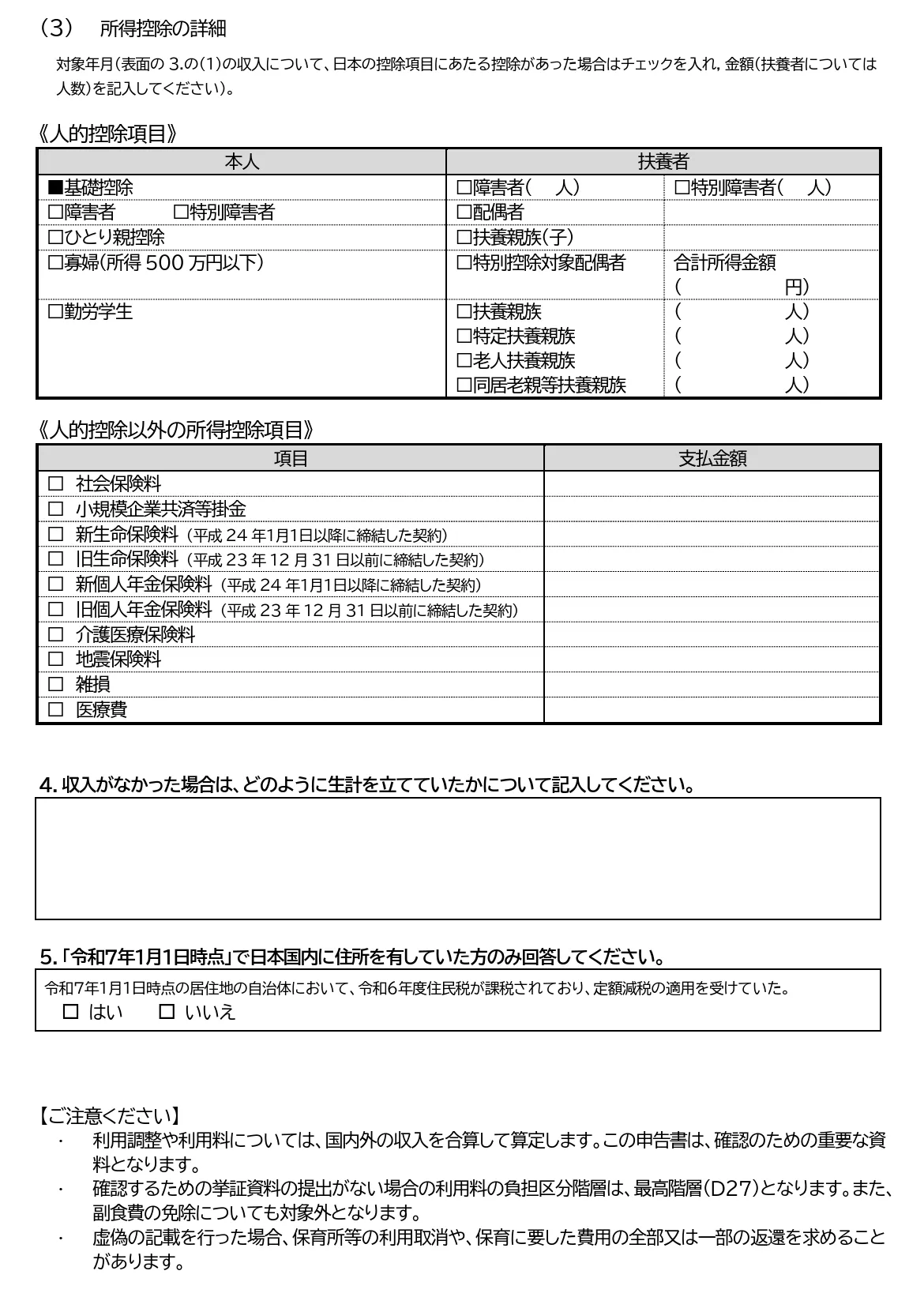
The reverse side has fields for items that correspond to Japanese deductions: personal exemptions, social insurance premiums, life insurance premiums, medical expenses, and so on. Don’t map an overseas scheme or insurance policy onto a Japanese deduction just because the names resemble each other. If the correspondence isn’t clear, show the document and ask.
If you had no income during the income year covered, enter zero on the front and use field 4 on the reverse to describe how you supported yourself. Rather than leaving it blank, briefly set out what applied to you — a spouse’s income, savings, employer-provided housing, and so on.
Which supporting documents do you attach? Match the amounts before you file
Choose attachments based on whether they show the person, the period, the amount, and the currency — not on what the document is called. Connecting each field on the form to the relevant part of your proof is what matters.
Yokohama’s form asks you to attach copies of documents showing your income and to mark the relevant figures, with a highlighter or similar, so they match the amounts you entered. Foreign-language documents should be annotated in Japanese.
Organize your documents by type of income
For employment income, supporting documents may include an annual salary certificate or pay statements from your employer; for business income, documents showing revenue and necessary expenses; for other income, documents showing what it was and how much. That said, a document is not guaranteed to be accepted simply because of what it is called.
Note on each document who it covers, the period, the currency, what the amount represents, and which field on the form it corresponds to. A note such as “form field ①, overseas portion = annual total on page 2 of the salary certificate” makes it easier for both you and the reviewer to follow.
Leave foreign-language documents intact and add Japanese notes
Don’t cover the original text. Near the parts you have marked, add short notes in Japanese for items such as the employer’s name, the period covered, the currency, and the gross salary.
The Yokohama form reviewed here does not state that a notarized translation is required for every page. That said, short annotations will not always be enough. If your documents are long, use unusual accounting terms, or make the covered period hard to identify, ask your ward office how much translation is needed.
If your documents won’t arrive in time, ask before the deadline
If an annual certificate from your overseas employer hasn’t arrived, don’t wait until the deadline has passed. Tell your ward office which documents are missing, when they are expected to be issued, and what you can submit right now. Whether alternative documents or a later submission are possible is decided case by case.
Editor’s note
The genuinely difficult part of this procedure isn’t converting a foreign language into Japanese. It’s the matching: which year, whose income, which document, which amount, and which field on the form it belongs in.
Because the requirements differ by municipality, presenting this as though a single nationwide answer existed would be misleading rather than helpful. What a practical publication can do is explain the shared mechanism, set out the local differences, and break what’s left into questions clear enough to put to a municipal office.
What to do when your fee notice is higher than expected
Don’t assume the cause from the amount alone. Check which year was used, which parent’s information was included, and whether your documents were received. Recalculation and refunds after a late submission are not automatic either.
Start by gathering your notice and your submission copies
Yokohama sets fees using resident tax amounts, the certified hours of care your child needs, sibling status, and household circumstances. The tax you pay and the income levy used for the fee calculation don’t always match, so “our income is the same but the fee is higher” isn’t enough to identify the cause.
- Which income year and which resident tax year were used
- Which parent’s information was included in the calculation
- Whether the overseas income declaration form and attachments were received
- Whether anything was missing, unclear, or outside the covered period
- Which fee tier was applied, and the reasoning behind it
- Whether it covers April–August or September onward
In Yokohama, contact the Child and Family Support Division at the ward office where you live if your application is in progress, or at the ward where your child’s facility is located if your child is already enrolled.
(Source: How childcare fees and fukushokuhi exemptions are determined | City of Yokohama)
Ask about recalculation, the month it applies from, and how differences are settled
Submitting additional documents does not guarantee that your fee will fall or that past payments will be refunded. Yokohama explains that where household circumstances change, the revised fee applies in principle from the first day of the month after the change is confirmed. On its own, though, that guidance doesn’t tell you how far back a late submission of overseas income documents can be applied in every case.
Ask your ward office whether your case qualifies for recalculation, which month any change takes effect from, and how a difference would be settled.
If asking in Japanese is difficult
Yokohama’s multicultural consultation center takes questions about daily life in 12 languages and provides telephone interpretation for ward offices and similar services. The number is 045-222-1209, open Monday to Friday, 10:00 a.m. to 4:00 p.m. Final decisions on your documents rest with your ward office, so use an interpreter to confirm details where you need one.
(Source: Multicultural consultation center | City of Yokohama)
Checklist before you submit or make contact
- Checked the latest year’s official guidance from your own municipality
- Downloaded the form your municipality specifies
- Matched the month care begins against the income year to declare
- Sorted out each parent’s period of overseas residence and employment
- Sorted income earned inside and outside Japan by period
- Confirmed how to enter or convert currency using municipal materials
- Matched the amounts on the form to the relevant parts of your proof
- Confirmed the rules on translating or annotating foreign-language documents
- Checked the reverse side and any attached sheets for blanks
- Kept copies of the form, the attachments, and the answers you received
Frequently asked questions about overseas income and childcare fees
Here is a question-and-answer summary, keeping the nationwide principles separate from Yokohama’s specific handling.
- Q1. Do childcare fees go up if I have overseas income?
- Not for that reason alone. Fees are determined by your municipality’s criteria, based on household income including income earned inside and outside Japan, and figures equivalent to municipal resident tax.
- Q2. Is declaring overseas income the same everywhere in Japan?
- No. The underlying approach to confirming income has common elements, but the name of the form, the year covered, the currency, translation rules, and where you submit it differ by municipality.
- Q3. Is Yokohama the only city that uses an overseas income declaration form?
- No. Kawasaki has a form with the same name, and Minato City and Shibuya City publish an annual income declaration form. Some municipalities, such as Setagaya, instead ask for documents showing overseas income and deductions.
- Q4. Do all foreign national parents have to submit this?
- Nationality alone doesn’t decide it. Whether you need to file is based on overseas income, any history of living abroad, and the tax information your municipality can access.
- Q5. Do I convert my overseas income into yen myself?
- It depends on the municipality. Yokohama asks for overseas amounts in the currency of the country concerned, and Minato City also asks for local currency. Don’t convert on your own judgment — follow the form used where you are submitting.
- Q6. Can I submit a foreign-language salary certificate as it is?
- Yokohama asks for annotations in Japanese. Kawasaki requires a Japanese translation or annotation plus the translator’s address and name. Check the required scope with the office you are submitting to.
- Q7. If my income for the income year covered was zero, can I skip the declaration?
- A zero income does not necessarily mean the declaration can be skipped. Yokohama’s form asks you to enter zero and describe on the reverse side how you supported yourself.
- Q8. If I submit the documents, will my fee drop and past payments be refunded?
- Not necessarily. Check with your ward office about the result of the calculation, the month it applies from, whether it can be backdated, and how any difference is settled.
- Q9. If my child is in a 3–5 age class, is confirming overseas income unnecessary?
- Not as a blanket rule. The basic fee is waived, but income information may still be needed to determine fukushokuhi exemptions and municipal support schemes.
The relationship between overseas income and childcare fees can’t be explained by the nationwide mechanism alone, or by Yokohama’s form alone. What matters is keeping the shared income-verification mechanism and each municipality’s own documents and practices separate in your mind.
Start by sorting out whose income it was, which year it covers, and which country it came from, then check that against the latest guidance from the municipality where you live. Being left with unanswered questions isn’t a failure of understanding on your part. Breaking a procedure that differs from city to city into pieces you can ask about directly is the fastest route to an answer.
If you’d like to look into the free education system for the 3–5 age classes, and the costs it doesn’t cover, the following article covers that ground.

