


For international families raising children in Japan, situations come up often enough: “I’d like to leave my child for just a short while,” “I want to find a babysitter I can communicate with in English,” “I’d like to use temporary childcare other than daycare.”
But in Japan, the practice of casually asking a neighborhood student or an acquaintance to babysit — common in some countries, including many English-speaking ones — isn’t yet the norm, and the types of services, the pricing, how to book, the contract relationships, and the points for checking safety can be hard to figure out.
On top of that, the services that are easy to use differ between international families living in Japan and international families visiting Japan as travelers. Municipal temporary childcare and subsidy programs are, as a rule, often designed for families who live in Japan, so they need to be thought of separately from private services for travelers.
This article organizes, for international families and multicultural households living in Japan, the types of babysitting and temporary childcare services available in Japan, rough pricing, points to check in the terms of use, safety checks, and how to choose by purpose. The services mentioned below are examples to help you understand the kinds of options available; availability, fees, and conditions may change, so always check each provider’s official information before booking.
Table of Contents
Can international families use babysitters in Japan too?
In Japan as well, there are babysitting services that international families can use. Especially in major cities such as Tokyo, Osaka, and Kyoto, there are several options — English-speaking and multilingual babysitters, hotel-visit services for travelers, and matching-type services for residents.
But the first thing to sort out is that the services that are easy to use differ between “international families living in Japan” and “international families visiting Japan as travelers.”
For residents, on the premise of continued use, you can compare bilingual matching services, Japanese-language babysitter apps, nanny services, and municipal temporary childcare and subsidy programs. For families visiting Japan, meanwhile, the most practical options are English-speaking sitters who can visit your hotel or accommodation, sightseeing-companion or theme-park-companion services, and arrangements made through a hotel concierge.
CareFinder is a bilingual matching service for families living in Japan, where you can search for sitters in languages such as English, Japanese, French, German, and Chinese. Its site offers explanations aimed at international families and at households looking for a babysitter for the first time in Japan.
(Reference:CareFinder|CareFinder)

Tokyo Little Hands, on the other hand, provides a service in which English-speaking babysitters visit hotels and accommodations, aimed at international families visiting Tokyo. It’s designed to be used during meals, sightseeing, business meetings, and the like while traveling.
(Reference:Tokyo Little Hands|Tokyo Little Hands)

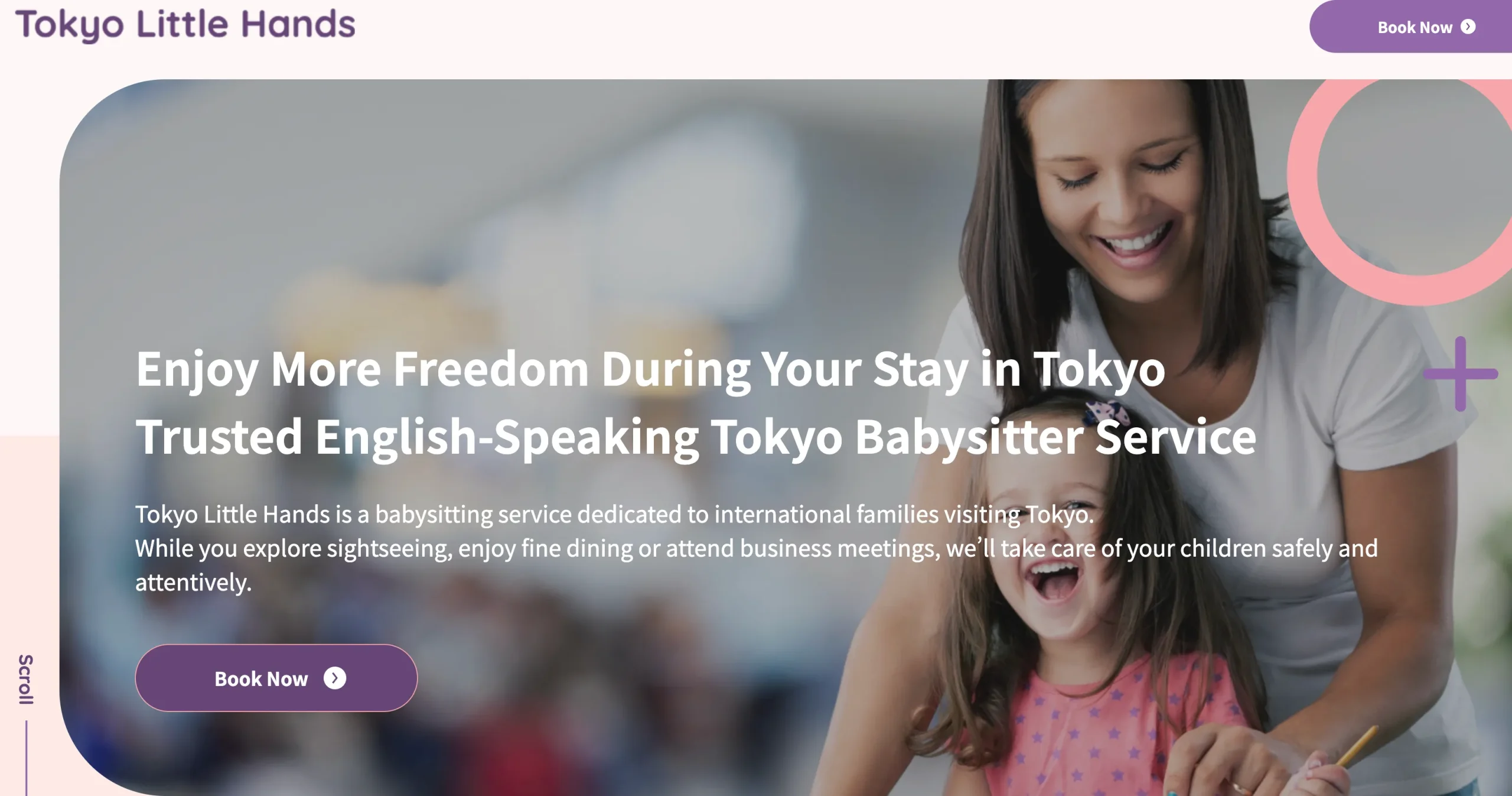
In short, the answer to “can international families use them” comes out as this: among private services, there are ones offered for international families. But the conditions differ depending on whether they’re for residents, for travelers, or under municipal programs.
Types of babysitting and temporary childcare services available in Japan
Rather than lumping Japan’s babysitting services together as “babysitting,” it’s easier to choose by sorting them by purpose. Broadly, there are English-speaking specialist services, bilingual matching-type services, Japanese-centered matching-type services, nanny/dispatch-type services, hotel arrangements, facility-based temporary childcare, and municipal temporary childcare programs.
English-speaking specialist babysitting services
English-speaking specialist babysitting services assume foreign residents and visiting international families as their main users, so language support is usually easier to confirm.
For example, babysitters & company describes itself as an “English/foreigner specialist babysitting service,” with native-English-speaking or bilingual sitters on its roster. It also clearly states that it takes one-off requests from visiting and resident international families, mainly in Tokyo, Kyoto, and Osaka.
(Reference:English/Foreigner Specialist Babysitting Service|babysitters & company)

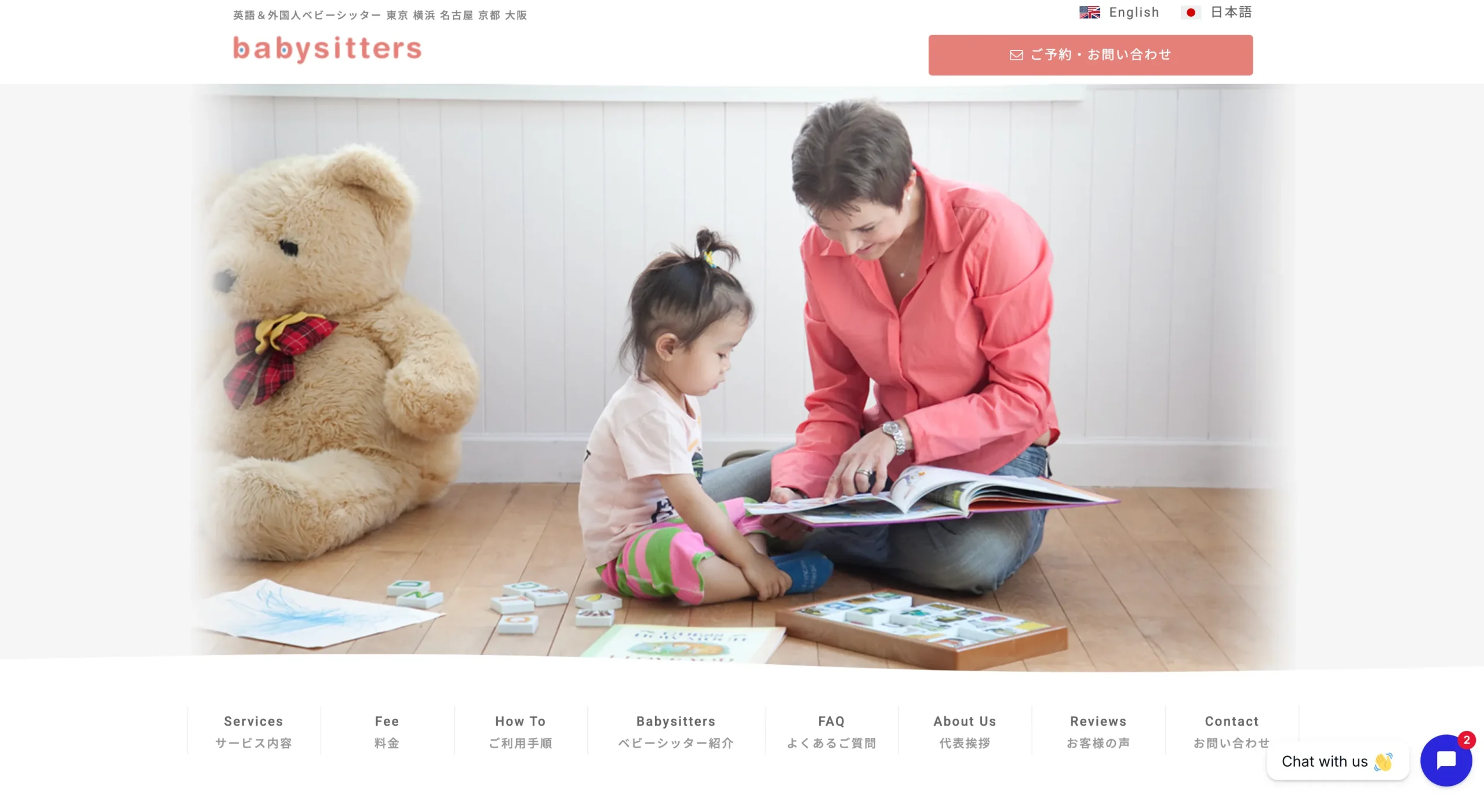
The company’s English page also mentions that it handles late-night, early-morning, and overnight care, travel, business trips, and on-location accompaniment, and that it provides service at designated places such as Tokyo, Yokohama, Kyoto, and Osaka. On the other hand, it clearly states that it does not currently offer sick-child care (byoji hoiku), so families considering use during illness need to take note.
Tokyo Little Hands is also designed as a service in which English-speaking sitters come to hotels and accommodations for visiting international families. It’s a particularly good fit for short-time use during dining out, sightseeing, or business.
(Reference:Tokyo Little Hands|Tokyo Little Hands)
Bilingual and multilingual matching-type services
When an international family living in Japan is looking for a sitter, either on an ongoing or one-off basis, bilingual and multilingual matching-type services are also an option.
CareFinder has a system where you can search for sitters in languages such as English, Japanese, French, German, and Chinese, choosing while comparing each sitter’s profile, experience, languages, and rate. With CareFinder, because sitters set their own hourly rate, it’s easy to choose to match a family’s budget and the content of the request.
The advantage of matching-type services is that it’s easy to find a person who suits your own family. On the other hand, since experience, rates, languages handled, and areas of strength differ from sitter to sitter, it’s important to read profiles and reviews and to confirm compatibility through a prior interview.
Japanese-centered matching-type services
For families who can communicate in Japanese, Japanese-language babysitter matching services may also be an option. A representative example is KidsLine.
KidsLine is presented as a matching platform where you can request babysitters and housekeeping from your smartphone. According to the description on Google Play, there’s no registration fee or monthly fee, you can choose a supporter according to your budget and request, and there are supporters with national qualifications such as childcare workers, midwives, and nurses.
(Reference:KidsLine | Babysitter Matching・Sick-Child Care/Temporary Childcare)

On the other hand, KidsLine’s terms of use clearly state that the parent and the caregiver conclude the support-service contract on their own responsibility, and that KidsLine is not a party to that contract. When using a matching-type service, you need to check what the platform provides and between whom the actual contract relationship is formed.
(Reference:Terms of Use|KidsLine)
Nanny / dispatch-type services
When you want higher-quality care, educational engagement, regular use, corporate use, or support aimed at affluent households, nanny/dispatch-type services are also an option.
Poppins introduces a nanny service on its English page, explaining that it provides an environment that nurtures children’s intellect, sensitivity, and physicality through English, sports, art, and the like. It also positions nannies as “child-rearing professionals” and mentions specialized training.
(Reference:Nanny Service|Poppins)

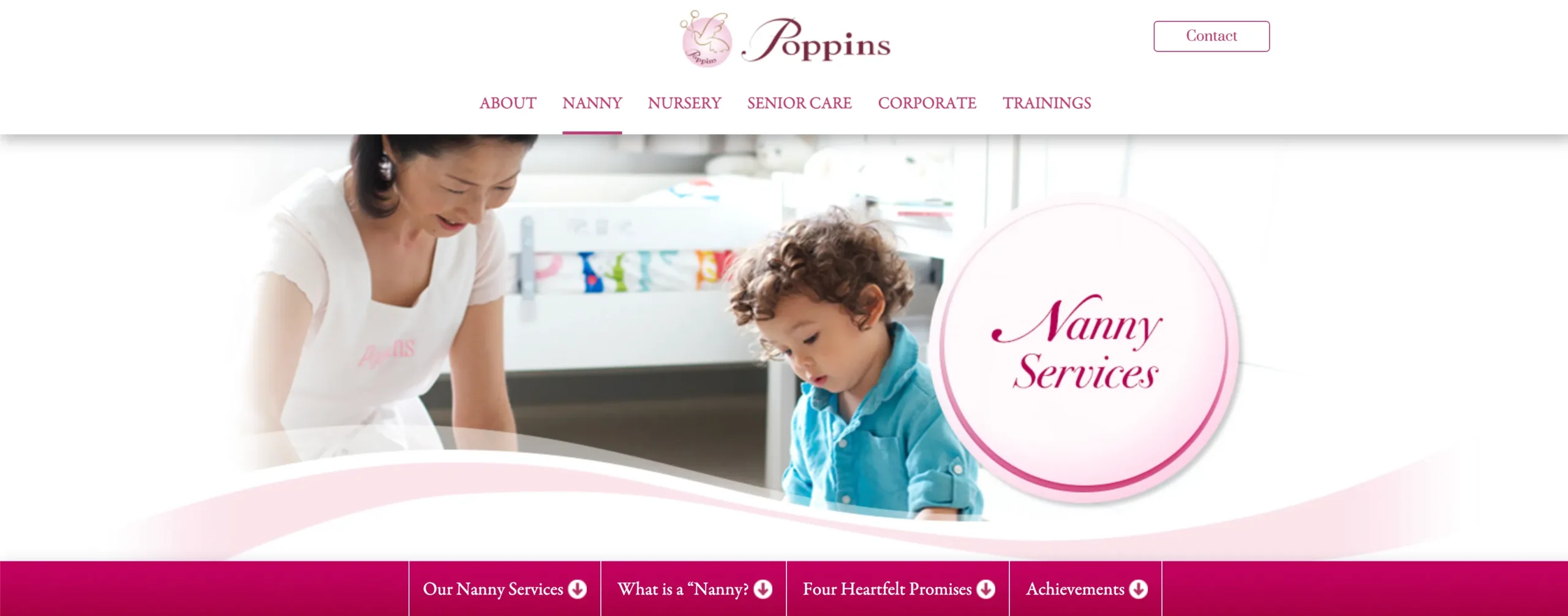
This kind of dispatch-type/nanny-type service can cost more than the matching type, but it suits families who value provider-run training and management and the ease of ongoing use. Check rates, enrollment fees, annual fees, coverage areas, and whether English is supported in advance on the official site or by inquiry.
Hotel arrangement / via concierge
For travelers visiting Japan, it’s also effective to check with your hotel first. Depending on the hotel, it may point you to an affiliated babysitting service or childcare arrangement.
That said, not every hotel handles babysitting arrangements. Also, when an outside sitter enters a hotel room, the hotel’s rules or advance application may be required. For travelers, it gives peace of mind to confirm with the hotel before booking: “Do you offer babysitting or childcare arrangement?” and “Can an external babysitter enter our room?”
Facility-based temporary childcare / kids’ clubs

Rather than calling a sitter to your home or hotel, there’s also the method of having your child looked after at a facility.
ANO-NE Kids Club is an indoor-playground-style temporary childcare facility in Yurakucho, Tokyo, that opened on April 1, 2025. The opening announcement listed hours as 2:00 PM–10:00 PM on weekdays and 10:00 AM–10:00 PM on weekends and holidays, a fee of ¥4,500 per person per hour, and a location on the 4th floor of the KOKO Building in Yurakucho. Current hours and pricing should be checked on the official site before booking, as they may have changed since opening.
(Reference:ANO-NE Kids Club|MIMARU)
Facility-based temporary childcare is convenient when a parent wants to leave a child for just a few hours during shopping, meals, sightseeing, or work. On the other hand, the eligible ages, how to book, language support, whether children who are unwell are accepted, and cancellation rules differ by facility.
Municipal temporary childcare / subsidy programs
For families living in Japan, municipal temporary childcare (ichiji azukari) and babysitter-use support programs are also options worth checking.
However, municipal programs in many cases have conditions such as resident registration, eligible ages, purpose of use, eligible providers, and application deadlines. Because they’re different in nature from private services that travelers or short-stay visitors can use, this article treats them as “supplementary information for residents.”
How much do babysitting services cost?
Costs differ greatly by service format. There are matching-type services priced in Japanese yen, and there are services that present pricing in US dollars for travelers visiting Japan. Also, beyond the hourly rate, transport costs, additional-child fees, late-night fees, extension fees, cancellation fees, theme-park admission, and so on may be added.
CareFinder’s pricing page explains that many sitters are ¥1,800–3,500 per hour, varying by experience, language ability, and number of children. It also shows an example where the employing side covers transport costs, and notes a transaction fee.
(Reference:Pricing|CareFinder)
CareFinder’s 2026 guide explains that babysitter rates in Japan generally tend to come to around ¥2,000–4,000 per hour, varying by the sitter’s experience, location, number of children, night/early-morning/holiday timing, and whether there’s language support or a homework/tutoring-type role.
(Reference:How Much Does a Babysitter Cost in Japan in 2026?|CareFinder)
Tokyo Little Hands’ terms of use list pricing in US dollars, with a basic plan of $80 for 2 hours and $200 for 6 hours. Additional costs such as early-morning, evening, late-night, and year-end/New-Year fees, additional children, overnight stays, a $20-per-trip transport fee, and taxi fares are also noted.
(Reference:Terms & Conditions|Tokyo Little Hands)
In Rainbow Kids Care’s pricing examples, for a case of watching one child for 5 hours from 10:00 to 15:00 at Tokyo Disneyland, an example is given of a base rate of $28 × 5 hours = $140, plus $20 transport, for a total of $160. For theme-park accompaniment, the sitter’s park admission ticket is the user’s responsibility and must be purchased in advance.
(Reference:Rates & Options|Rainbow Kids Care Japan)
Pricing comparison table
| Service format | Rough guide to pricing | Examples of additional costs | Families it suits |
|---|---|---|---|
| Bilingual matching type | Examples around ¥1,800–3,500/hour | Transport costs, fees, additional-child fees, etc. | Foreign residents, international families |
| General Japanese sitter market rate | Examples around ¥2,000–4,000/hour | Night/early-morning/holiday, language support, etc. | Resident families, regular or one-off use |
| Hotel-visit type for travelers | Examples such as $80 for 2 hours, $200 for 6 hours | Transport, late-night fees, additional children, taxi fares, etc. | Travelers to Japan, hotel guests |
| Sightseeing / theme-park accompaniment type | Examples such as $28/hour | Transport, admission tickets, extension fees, etc. | Disney, USJ, sightseeing accompaniment |
| Facility-based temporary childcare | Example such as ¥4,500/hour/person | Extension fees, per-facility options, etc. | Short-time use during shopping, meals, sightseeing |
Because pricing can change, before you actually book, always check the latest rates, minimum usage time, cancellation fees, transport costs, and extension fees on each service’s official site.
Can foreigners use them? Different points to check for residents, travelers, and short-stay visitors
Among private babysitting services, there are ones offered for international families. However, the usage conditions differ by service, and the points you should check change for residents, travelers, and short-stay visitors.
What international families living in Japan should check
For international households living in Japan, the first things to check are the following.
- Whether you can register an address in Japan
- Whether a Japanese phone number is required
- Whether you can communicate in English or your native language
- What the payment methods support — credit card, bank transfer, app payment, and so on
- Whether a prior interview with the sitter is possible
- Whether they can handle what you want to request — pickup/drop-off, meals, bathing, homework, English play, and so on
- If using a municipal subsidy, whether you meet the conditions for eligible providers, resident registration, and required documents
Municipal subsidy programs and temporary childcare in particular can involve conditions for resident registration and eligible children. The usage conditions of private services and the eligibility conditions of municipal subsidies need to be checked separately.
What travelers visiting Japan should check
When using a babysitter while traveling, you need to check different points from residents.
- Whether an outside sitter can enter your hotel or Airbnb
- Whether English is supported
- How many hours the minimum usage time is
- Whether they handle night or early-morning hours
- Whether there are limits on the number or ages of children
- Whether sightseeing, dining, or theme-park accompaniment is possible
- Who covers transport costs, admission fees, and taxi fares
- Whether the payment currency is yen or dollars
- From when cancellation fees apply
- How to share the child’s allergies, chronic conditions, and emergency contacts
Services premised on visiting hotels and accommodations, like Tokyo Little Hands, and services that assume hotel stays, theme parks, and sightseeing accompaniment, like Rainbow Kids Care, can be said to be a good fit for travelers’ needs.
Short-stay visitors can’t necessarily use municipal subsidies
Municipal subsidies and temporary-childcare support are, basically, often designed for families living in that municipality, and involve conditions for resident registration and eligible children.
For that reason, it’s more realistic for short-stay visitors and travelers to look for private English-speaking babysitters, hotel arrangements, traveler-oriented nannies, and facility-based temporary childcare, rather than municipal subsidy programs.
Points you must look at in the terms of use
Before using a babysitting service, you need to check not just the price but also the terms of use and cancellation rules. In particular, the contract relationship and the scope of responsibility differ between dispatch/visit types and matching types.
What to check with dispatch/visit-type services
With dispatch and hotel-visit-type services, check the following.
- Base rate
- Minimum usage time
- Early-morning/night/late-night fees
- Additional-child fees
- Transport costs
- Taxi fares
- Extension fees
- Cancellation fees
- Conditions for entering accommodations
- Insurance coverage
- Emergency response
- Whether outings, pickup/drop-off, and theme-park accompaniment are possible
Tokyo Little Hands’ terms of use price in US dollars and touch on the basic plan, transport costs, and additional fees for early-morning, evening, late-night, and year-end/New-Year timing. With services for travelers visiting Japan, the payment currency and additional fees may differ from services aimed at the domestic market, so checking before booking is necessary.
(Reference:Terms & Conditions|Tokyo Little Hands)
Rainbow Kids Care notes that the user covers the park admission ticket and transport costs when accompanying to a theme park. When using a sightseeing-companion sitter, you need to budget not just for the child’s care fee but also for the sitter’s travel costs and admission fees.
(Reference:Rates & Options|Rainbow Kids Care Japan)
What to check with matching-type services
With matching-type services, it’s important to understand the relationship among the platform, the parent, and the sitter.
- Whether the platform becomes a party to the contract
- What kind of contract is formed between parent and sitter
- Payment methods
- Fees
- Cancellation rules
- Rules prohibiting direct contracts
- The point of contact when trouble arises
- The scope of insurance and compensation
- The content of identity verification and training
- How to check reviews and ratings
KidsLine’s terms of use state that the support-service contract is concluded by the parent and the caregiver on their own responsibility, and explain that the company does not become a party to the contract. It also notes provisions regarding penalty fees and account suspension for direct contracts.
(Reference:Terms of Use|KidsLine)
The matching type is convenient, but rather than thinking “it’s safe because I can book through an app,” it’s important to check the contract relationship, cancellation, response when trouble arises, insurance, and how to make contact in an emergency before using it.
A checklist for using a service safely
When choosing a babysitter, safety checks are the most important thing — not just price and language support. For international families in particular, when there’s a language barrier, the sharing of emergency response and of the child’s condition and allergy information can end up insufficient.
The Children and Families Agency lists, as points to note when using babysitters and the like, gathering information in advance, an interview, checking the provider’s name, the person’s name, address, and contact details, checking ID, checking the care location, checking the registration certificate, and checking insurance enrollment.
(Reference:Points to Note When Using Babysitters and the Like|Children and Families Agency)
CareFinder explains that it screens each sitter and verifies government registration. Rainbow Kids Care explains that its sitters undergo an interview and ID check, and have childcare experience and CPR/First Aid qualifications.
If you aren’t confident reading Japanese terms or safety documents, ask the provider to explain — in writing, before booking — the cancellation policy, insurance coverage, emergency procedures, and who is responsible if an incident occurs.
Pre-booking checklist
- Whether the sitter’s or provider’s identity has been verified
- Whether childcare experience, qualifications, and training content can be confirmed
- Whether there’s information on emergency response such as CPR / First Aid
- Whether you’ve checked whether there’s insurance enrollment and its scope
- Whether you’ve checked reviews and track record
- Whether a prior in-person or online interview is possible
- Whether they can handle your child’s age
- Whether they can handle infants, multiple children, disabilities, allergies, chronic conditions, and so on
- Whether you’ve checked the scope of what you can request — meals, bathing, pickup/drop-off, outings, homework, and so on
- Whether you’ve checked the hotel’s/accommodation’s entry rules
- Whether you’ve shared emergency contacts, your accommodation address, and nearby medical facilities
- Whether you’ve checked cancellation fees, extension fees, transport costs, and late-night fees
Child information-sharing list
For a first-time use, it’s safer to share the following in advance.
- The child’s name and age
- Language used
- Allergies
- Chronic conditions and medication
- Dietary restrictions
- Toilet/diaper situation
- Sleep rhythm
- Things they dislike or are frightened of
- Play they like
- Emergency contacts
- Where the parents are staying / their whereabouts when out
- The policy for contacting a medical facility if needed
Editor’s note
For a first-time use, don’t decide on price and English support alone — check the prior interview, identity verification, insurance, and emergency response.
While traveling in particular, it’s important to make clear the hotel’s entry rules, the parents’ whereabouts when out, and emergency contacts.
How to choose by purpose
How you choose a babysitting service changes by purpose. Rather than choosing on price alone, sort out “where,” “for how many hours,” “in what language,” and “with what scope of responsibility” you want to leave your child.
You want to leave your child for just a few hours while traveling
When a traveler visiting Japan wants to leave a child for just a few hours for meals, sightseeing, shopping, or attending an event, hotel-visit types and traveler-oriented English-speaking services are a good fit.
Tokyo Little Hands is premised on visits to hotels and accommodations. Rainbow Kids Care also designs its service for travelers, including hotel stays and sightseeing/theme-park accompaniment.
(Reference:Tokyo Little Hands|Tokyo Little Hands)
You want to find an English-speaking sitter in Tokyo, Kyoto, or Osaka
When you place importance on English support, it’s a good idea to search mainly among English-specialist or bilingual-capable services.
babysitters & company is presented as an English/foreigner specialist babysitting service for visiting and resident international families, mainly in Tokyo, Kyoto, and Osaka. CareFinder is an option where you can search for multilingual sitters not only in Tokyo but in various places across Japan.
(Reference:English/Foreigner Specialist Babysitting Service|babysitters & company)
You’re a resident family wanting to use one regularly
For a resident family considering after-daycare, after-school, parents’ work, pickup/drop-off, or regular night support and the like, CareFinder, KidsLine, and Poppins are candidates.
CareFinder is a matching type where the family chooses the sitter, with the feature of being easy to compare languages and rates. KidsLine is a Japanese-centered platform where you can search for supporters from your smartphone, choosing according to budget and request. Poppins is an option leaning more toward nanny/educational services.
(Reference:CareFinder|CareFinder)
You also want to combine it with English education or “English at home”
There are also families who want not just childcare but to have someone play with their child in English, to create time for exposure to English at home. In this case, it’s a good idea to look for English-speaking sitters, bilingual sitters, and sitters who can handle English play.
That said, when English instruction or tutoring-type content is added, the rate can go up. CareFinder’s 2026 guide also lists the presence of language support, homework, and tutoring as factors that affect the rate.
(Reference:How Much Does a Babysitter Cost in Japan in 2026?|CareFinder)
You want to leave your child to play at a facility
When a parent wants to leave a child to play at a facility while shopping, dining, or sightseeing around Ginza and Yurakucho, facility-based temporary childcare is also an option.
ANO-NE Kids Club is presented as an indoor-playground-style temporary childcare facility close to Yurakucho Station and Ginza/Hibiya Stations. Because its hours and fees are clearly stated, it’s an easy service to compare for families considering short-time use.
(Reference:ANO-NE Kids Club|MIMARU)
You want to use one for a hotel dinner or evening plans
For evening dining out, events, time for just the couple, business dinners, and the like, you need to look for services strong in night hours or hotel visits.
Traveler-oriented services like Tokyo Little Hands and Rainbow Kids Care have offerings that assume use during a hotel stay and evening outings. However, night fees, late-night fees, minimum usage time, taxi fares, and cancellation fees may apply, so always check the price list and the terms.
(Reference:Terms & Conditions|Tokyo Little Hands)


Frequently asked questions
- Q. Can foreigners use Japanese babysitting services too?
- There are services you can use. Especially in urban areas such as Tokyo, Osaka, and Kyoto, there are English-speaking and multilingual babysitting services, hotel-visit services for travelers, and matching-type services for residents. However, the usage conditions, how to book, and payment methods differ by service.
- Q. Can travelers visiting Japan call a babysitter to their hotel?
- There are services that make this possible. There are services premised on visiting hotels and accommodations, like Tokyo Little Hands, and services that assume hotel stays and sightseeing accompaniment, like Rainbow Kids Care. However, whether the hotel permits an outside sitter to enter needs to be checked in advance.
- Q. Can you find English-speaking babysitters in Japan?
- You can. With CareFinder, you can search for sitters in English, Japanese, French, German, Chinese, and more. There are also services premised on English support, such as babysitters & company, Tokyo Little Hands, and Rainbow Kids Care.
- Q. About how much does it cost?
- It differs by service. With CareFinder, many sitters are ¥1,800–3,500 per hour, and the 2026 guide gives around ¥2,000–4,000 as a general Japanese babysitter rate. With services for travelers visiting Japan, there are also pricing examples in US dollars such as $80 for 2 hours, $200 for 6 hours, or $28 per hour.
- Q. Can temporary childcare facilities be used by children from international families too?
- It depends on the facility. There is also facility-based temporary childcare that assumes use by families while traveling, like ANO-NE Kids Club. However, the eligible ages, language support, how to book, terms of use, and response when a child is unwell differ by facility, so advance confirmation is necessary.
- Q. Can foreigners use municipal subsidies too?
- If you live in Japan and have resident registration, you may be eligible if you meet the municipality’s conditions. However, the eligible children, applicant conditions, eligible providers, application deadlines, and required documents differ by municipality. For travelers and short-stay visitors, it’s usually more realistic to look for private services or traveler-oriented services rather than municipal subsidy programs.
- Q. Can you also ask a babysitter for sick-child care?
- It depends on the service. General babysitting services may not provide sick-child care. For example, babysitters & company clearly states that it does not currently offer sick-child care. If your child has a fever or a suspected infection, always check whether sick-child care is handled, and check medical facilities or your municipality’s sick-child care information as needed.
Summary: when looking for a babysitter in Japan, first split “for residents” from “for travelers”
It’s possible for international families to use babysitters in Japan. But what matters first is to separate whether you want to use one as a resident, or just for a short period as a traveler.
If you’re an international household living in Japan, options include a bilingual matching type like CareFinder, a Japanese-centered matching type like KidsLine, a nanny service like Poppins, and municipal temporary childcare and subsidy programs. If you’re a traveler visiting Japan, candidates include services strong in English support, hotel visits, and sightseeing accompaniment, like Tokyo Little Hands, Rainbow Kids Care, and babysitters & company, and facility-based temporary childcare like ANO-NE Kids Club.
Rather than choosing on price alone, it’s important to book only after checking the languages supported, the child’s age, the place of use, minimum usage time, cancellation rules, safety checks, insurance, and emergency response.
Japan’s babysitting services still vary greatly by region, and English-speaking and traveler-oriented services tend to be concentrated in urban areas. That’s exactly why, once your plans are set, we recommend comparing candidates early, checking the latest information on the official sites, and holding a prior interview as needed.


