


“My return-to-work date is approaching, but we didn’t get a daycare spot.” “I need emergency childcare for sudden overtime or a doctor’s appointment, but babysitter fees are too high.” Driven by these anxieties, many parents begin researching subsidy programs. While financial support systems are expanding—such as Setagaya Ward planning to launch its temporary childcare support in April 2026—subsidy caps, eligible expenses, and application procedures differ a lot depending on the municipality. Assuming these benefits apply uniformly across all of Tokyo will lead to unexpected out-of-pocket costs.
Based on the latest data from public agencies, this article breaks down how to choose the right program, calculate your actual costs, and handle the application process so you can take immediate action.
Table of Contents
[Key Points in This Article]
- Tokyo’s municipal babysitter support is divided into two main categories: “For Waitlisted Children / Post-Childcare Leave” and “For Temporary Care.” Additionally, depending on your employer, you may have access to “Corporate-Sponsored Babysitter Discount Tickets.” The best place to start is by checking these three routes separately.
- Actual out-of-pocket costs fluctuate significantly based on your residential ward and the type of provider you use. Failing to account for excluded expenses—like transportation and cancellation fees—can result in high out-of-pocket bills.
- The application process varies by municipality. Some require pre-approval, while others operate on a “reimbursement basis,” where you submit receipts and requirement certificates after use. Confirming your specific ward’s rules is absolutely essential.
[Introduction] Understanding Your Options: Tokyo’s Two Systems + Corporate Discount Tickets

What is broadly referred to as the “Tokyo Babysitter Subsidy” actually consists of two distinct metropolitan programs. Adding the corporate-sponsored discount tickets provided through employers to this list helps clarify the available support. Mixing these up often leads to misunderstandings, such as assuming a corporate welfare benefit was a city subsidy, or finding out a service was ineligible after the fact.
How the Two Tokyo Subsidy Routes Differ
The Tokyo Metropolitan Government’s babysitter support business relies on two main pillars.
The first is for “Waitlisted Children and Post-Childcare Leave” (Agency-Partnered Type). This system is designed to fill the childcare gap for families whose children are waitlisted for authorized daycare (*taiki jido*), or those returning from childcare leave under specific conditions. It assumes continuous, daily use. However, it comes with strict employment requirements and cannot be used while currently on maternity or childcare leave.
The second is for “Temporary Care” (*Ichiji Azukari*). This is utilized for sudden or spot needs, such as hospital visits, overtime work, or simply to give parents a break. While many municipalities allow you to use this regardless of your waitlist status, the annual hourly caps and eligible child ages differ by ward.
(Source:Tokyo Metropolitan Government Bureau of Social Welfare: Babysitter Use Support Business)
Checking for “Corporate-Sponsored Babysitter Discount Tickets”

Which Option Fits Your Family Best?
The easiest way to narrow this down is to start with your actual needs.
- Does your municipality offer “Temporary Care Support”?
- Do you need ongoing care because you cannot secure a daycare spot before returning to work?
(If Yes → Check the “Waitlisted” requirements on your ward’s website.) - Is this a one-off need for a doctor’s visit, a sibling’s school event, or personal time?
(If Yes → Check the “Temporary Care” requirements.) - Does your employer offer the “Corporate-Sponsored Babysitter Discount Ticket” program?
(If Yes → Check with your company’s HR department for welfare details.)
How Much Will It Actually Cost? Out-of-Pocket Simulations and Ward Differences
Social media posts sometimes claim that babysitting costs “150 yen an hour” or “only a few hundred yen,” but this is not a universal reality. Your actual out-of-pocket expenses depend entirely on your ward’s policies and the provider you hire.
Cost Simulations by Household and Provider Type
Here is a comparison using the waitlisted children framework during weekday daytime hours:
- [Ward A: Base Tokyo Subsidy Only]
If you hire a certified sitter for 3,000 yen/hour, subtracting Tokyo’s base subsidy (2,500 yen/hour) leaves you with an out-of-pocket base childcare cost of 500 yen/hour. - [Ward B: Additional Ward Subsidy]
Some wards add their own funds on top of Tokyo’s base, further lowering the financial burden on parents.
Additionally, looking at Minato Ward’s “Temporary Care” program as an example: the subsidy cap for Tokyo-certified providers is 2,500 yen/hour during the day (3,500 yen/hour at night). However, if you use a Minato Ward-specific matching provider, the cap drops to 1,000 yen/hour during the day (1,500 yen/hour at night).
(Source: Minato Ward Babysitter Use Support (Temporary Care) Guide)
Beware of Excluded Expenses
Parents are often shocked when they see their final bill because they overlooked “excluded expenses.”
In most municipalities, the subsidy strictly covers the “fee for childcare services.” Registration fees, annual membership fees, the sitter’s transportation costs, cancellation fees, insurance, and actual expenses like diapers are generally entirely out-of-pocket. When reviewing an estimate, always separate the “base childcare fee” from “incidental expenses.”
A Practical Step-by-Step Guide to Using the System
Even if you understand the system, you need to prepare to ensure the actual application process goes smoothly. Here are the practical steps broken down into three phases.
[Before Use] Checking the System and Selecting an Eligible Provider
First, check your municipality’s website for eligible ages and application flows. Waitlisted care often requires pre-application (approval before use), while temporary care generally operates on a reimbursement basis (applying after use). Next, select a provider from the “certified provider” list specified by Tokyo or your ward. Inform them in advance that you plan to use the subsidy and confirm they can issue the required requirement certificate (*yoken shomeisho*).
[During Use] Managing Documents and Receipts for Reimbursement
For municipalities using the reimbursement method, saving your documentation is critical.
For example, Shibuya Ward’s guidelines state that after using the service, you must receive and submit a “Receipt,” an “Itemized Statement” (showing excluded costs), and a “Babysitter Requirement Certificate.” If you applied any other discounts or coupons, many wards require you to state the post-discount amount accurately. Make it a habit to store these documents together after every use.
(Source:Shibuya Ward Babysitter Support Business (Temporary Care))
[When Applying] Checking Deadlines and Common Pitfalls
The biggest pitfall during application is missing the deadline. Operations vary wildly—some municipalities have strict monthly deadlines, while others process them quarterly. However, some wards offer flexible grace periods, accepting applications until the final deadline of that fiscal year (e.g., must arrive by April 15 of the following year). Never give up based on assumptions; verify the exact rules on your residential municipality’s website.
How Employer Benefits Can Help: Using “Corporate-Sponsored Discount Tickets”
Combining municipal subsidies with welfare benefits provided by your employer broadens your options and further reduces the financial burden.
The Basics of Corporate-Sponsored Discount Tickets
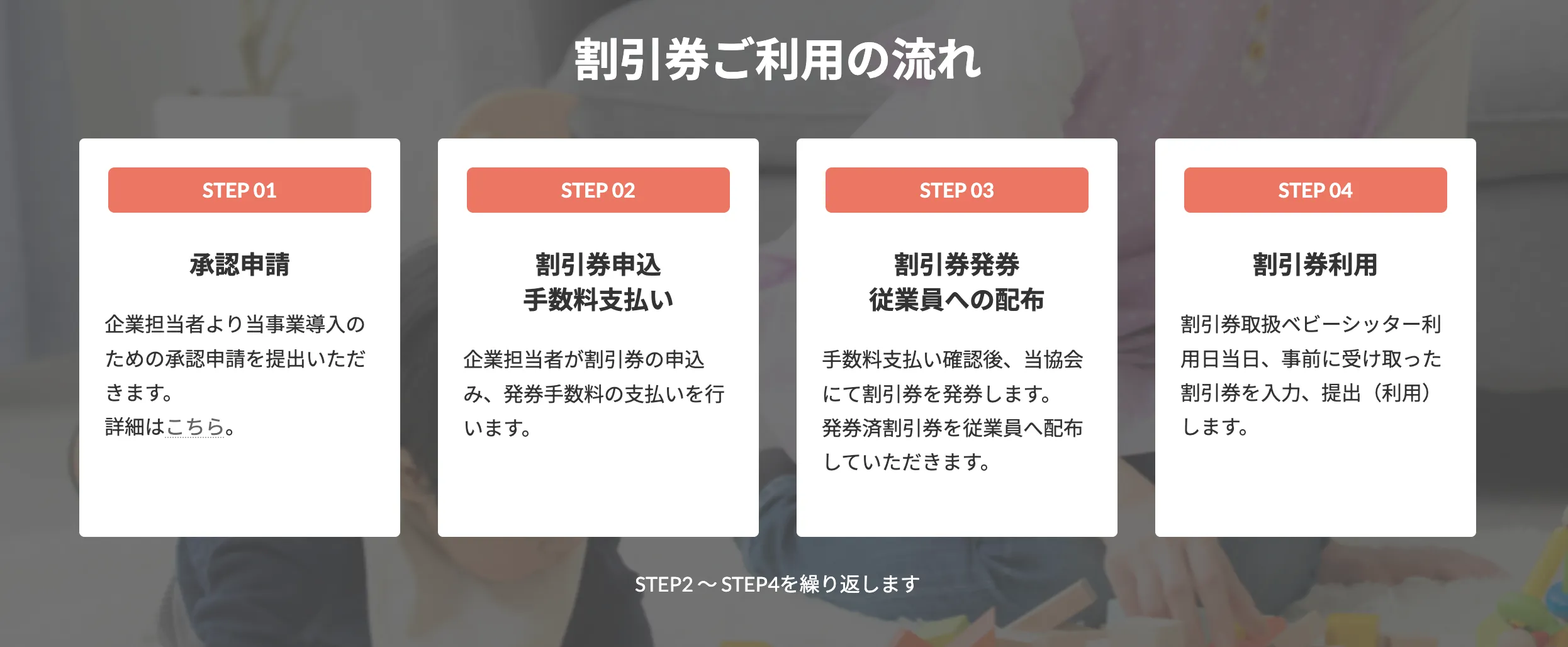
(Source: All Japan Childcare Services Association: Babysitter Dispatch Business)

Combining with Tokyo Subsidies and Tax Implications
You can often combine municipal subsidies with corporate discount tickets, provided you follow your municipality’s rules.
However, the municipal subsidy is calculated based on the childcare fee after the corporate discount tickets or coupons have been applied. You cannot receive double the full amount for the initial price. Always check your municipality’s guidelines for the exact calculation and required paperwork.
You must also pay close attention to tax implications.
According to the National Tax Agency, certain childcare subsidies provided by the national or local governments (like the Tokyo municipal subsidy) are considered non-taxable income.
Conversely, if your employer compensates you for babysitting costs (such as through the corporate ticket system), that compensation is generally treated as taxable salary income.
Because the tax treatment differs between municipal and corporate support, check with your company’s HR department or the local tax office if you have any doubts.
(Source: Subsidies for Babysitter Fees | National Tax Agency
Taxation When an Employee Receives Babysitter Cost Compensation from an Employer | National Tax Agency)
[Expert Perspective] Safety Measures When Hiring Your First Babysitter
Ensuring your child’s safety is just as important as keeping costs down. The Children and Families Agency urges parents to conduct strict safety checks when using a babysitter.
Interview Checkpoints for Safety and Peace of Mind
Always conduct a preliminary interview before the first use and verify the following:
- Presentation of childcare qualifications and a valid ID.
- Confirmation of the provider’s registration with the prefectural government.
- Emergency contact protocols and knowledge of first aid for injuries or sudden illness.
- Alignment on parenting policies (e.g., rules regarding TV or smartphone screen time).
- The level of detail in their reports (records of meals, bathroom use, and sleep duration).
Even when using a matching site, the agency advises against relying solely on internet profiles; meet the sitter in person to confirm they are trustworthy.
(Source:Points to Note When Using Babysitters | Children and Families Agency)
How to Prevent Problems During In-Home Babysitting
To ensure peace of mind inside your home, setting up a baby monitor in the living room or bedroom and using a “communication notebook” to write down detailed daily instructions is highly effective. Do not choose a sitter based solely on cheap rates or easy booking; the most important factor for continuous use is asking yourself, “Do I feel completely safe leaving my child with this person?”


Frequently Asked Questions (FAQ) and Final Checks
Here are answers to common questions regarding the subsidy systems.
Q. Can I get a subsidy if I use my regular private babysitter?
A. In most cases, no. Subsidies are restricted to “certified providers” who meet the requirements set by Tokyo or the local ward. Independent contractors or unlisted agencies are highly likely to be ineligible. Always check your municipality’s designated provider list before booking.
Q. Can I apply for a subsidy retroactively for a sitter I used before applying?
A. This depends on the municipality and the type of program (Waitlisted vs. Temporary Care). For reimbursement-type programs, you can often apply retroactively as long as it is within the application deadline. However, for programs that require pre-approval, you must complete the procedures *before* using the service. Because there is no universal rule, you must verify this directly with your local ward office or their official website.
When properly understood, Tokyo’s babysitter subsidies offer an excellent way to support your work-life balance. Start by visiting your local municipality’s official website to confirm the exact requirements for your family.


