If you have been working out your index score ahead of an application to a licensed daycare centre (ninka hoikuen), you may be wondering what happens next: what if another household ends up with exactly the same number of points?
When two applicants tie on points in Japan’s daycare admission process, the outcome is decided by the tie-break priority order that each municipality sets for itself. Both the criteria and the order they are applied in differ from one municipality to the next.
This article compares the tie-break order in Ota Ward and Setagaya Ward, using each ward’s official documents. It sets out which stage your household is likely to be assessed at, and what you can check before you apply.
The information here reflects official sources as of the publication date. Admission criteria and application schedules can change, so always check the guidance issued for the year you are actually applying for.
Table of Contents
Identical scores can produce different outcomes, because each municipality sets its own tie-break order
Because the admission process has to compare applicants whose household index scores are identical, every municipality sets a separate priority order for those cases.
At first glance, daycare admission looks as though it is settled entirely by the index score calculated from working hours and family circumstances. But when there are more applicants than places, and several households share the same score, a further tie-break order is applied on top.
For April 2027 entry, Ota Ward accepts in-person and online applications from October 1 to November 30, 2026, while postal applications must arrive by November 9. Deadlines differ by application method, so the schedule needs checking alongside your score.
(Source: Applying for April 2027 entry | Ota City)
According to figures compiled by the Children and Families Agency, 2,435 children nationwide were on daycare waiting lists as of April 1, 2026, an increase of 181 from the previous year. Applicant numbers and vacancies vary by area, by age group and by facility, so a national figure alone cannot tell you how easy it is to get a place where you live.
(Source: Status of daycare facilities as of April 1, 2026 | Children and Families Agency)
This article covers two wards: Ota and Setagaya
We compare Ota Ward and Setagaya Ward in Tokyo, both of which use the English names Ota City and Setagaya City on their own websites. Both publish their tie-break sequence as an itemised list, which makes it possible to see clearly where the two overlap and where they diverge.
If you live elsewhere, you can usually find the equivalent document on your own municipality’s official website by searching in Japanese for your municipality’s name together with 保育園 利用調整基準, or with 保育園 同点.
That said, you cannot transfer the rankings in this article to another municipality. It is not only the terminology that differs: the way index points are calculated and which factors are prioritised vary as well.
What is the difference between base index points, adjustment points, and the tie-break order?

Daycare selection is easier to follow if you think of it in three layers: the base index score, additions and deductions for specific circumstances, and the priority order that applies once households are tied.
First, a base index score is calculated from each parent’s situation — work, illness, caregiving, study and so on. Next, points are added or deducted according to the family circumstances defined by the municipality. The result is the household’s index score, and the tie-break order comes into play when several applicants arrive at the same figure.
Households with similar working patterns or comparable family situations frequently end up with identical scores. That is why it is worth knowing not just your own total, but what gets compared after a tie.
Different wards use different terms for the same concepts
One reason the admission process is hard to follow is that municipalities use different names for the same thing.
Ota Ward calls the base score calculated for each parent the riyō chōsei kijun shisū (利用調整基準指数), and the additions or deductions for individual circumstances the chōsei shisū (調整指数). Setagaya Ward calls the base score the riyō kijun shisū (利用基準指数), and the adjustments the chōsei kijun shisū (調整基準指数).
(Source: Admission adjustment methods and criteria | Ota City)
(Source: Childcare Application Guide (September 2026 edition), pp. 30–32 | Setagaya City)
Editorial note
Ota’s chōsei shisū and Setagaya’s chōsei kijun shisū both refer to additions and deductions for individual circumstances. Similar-sounding names can still cover different ground, so do not assume that what you read about another ward, or what you pick up on social media, applies to your own municipality.
| Concept | Term used in Ota Ward | Term used in Setagaya Ward |
|---|---|---|
| Base score derived from each parent’s situation | riyō chōsei kijun shisū (利用調整基準指数) | riyō kijun shisū (利用基準指数) |
| Additions and deductions for family circumstances | chōsei shisū (調整指数) | chōsei kijun shisū (調整基準指数) |
| Household score combining base points and adjustments | Household index score | The household’s index score |
| Assessment when household scores are identical | Priority order for identical index scores | Priority order for households with identical index scores |
What is the legal basis for the admission adjustment process?
Article 24, paragraph 3 of the Child Welfare Act provides that municipalities may carry out adjustment in relation to the use of daycare facilities. The specific index points and priority order are set out in the criteria each municipality publishes.
(Source: Child Welfare Act | e-Gov Law Search)
Working out your own score is only ever a rough guide. Which items apply to you, and which documents the points are based on, are assessed by the municipality from the paperwork you submit.
How many times you visit the ward office, or how forcefully you explain your situation, will not raise your priority. But if something about your application is unclear, or your family circumstances change, check with the relevant counter rather than deciding for yourself.
Ota Ward’s tie-break order has nine stages, and the first is new entry versus transfer

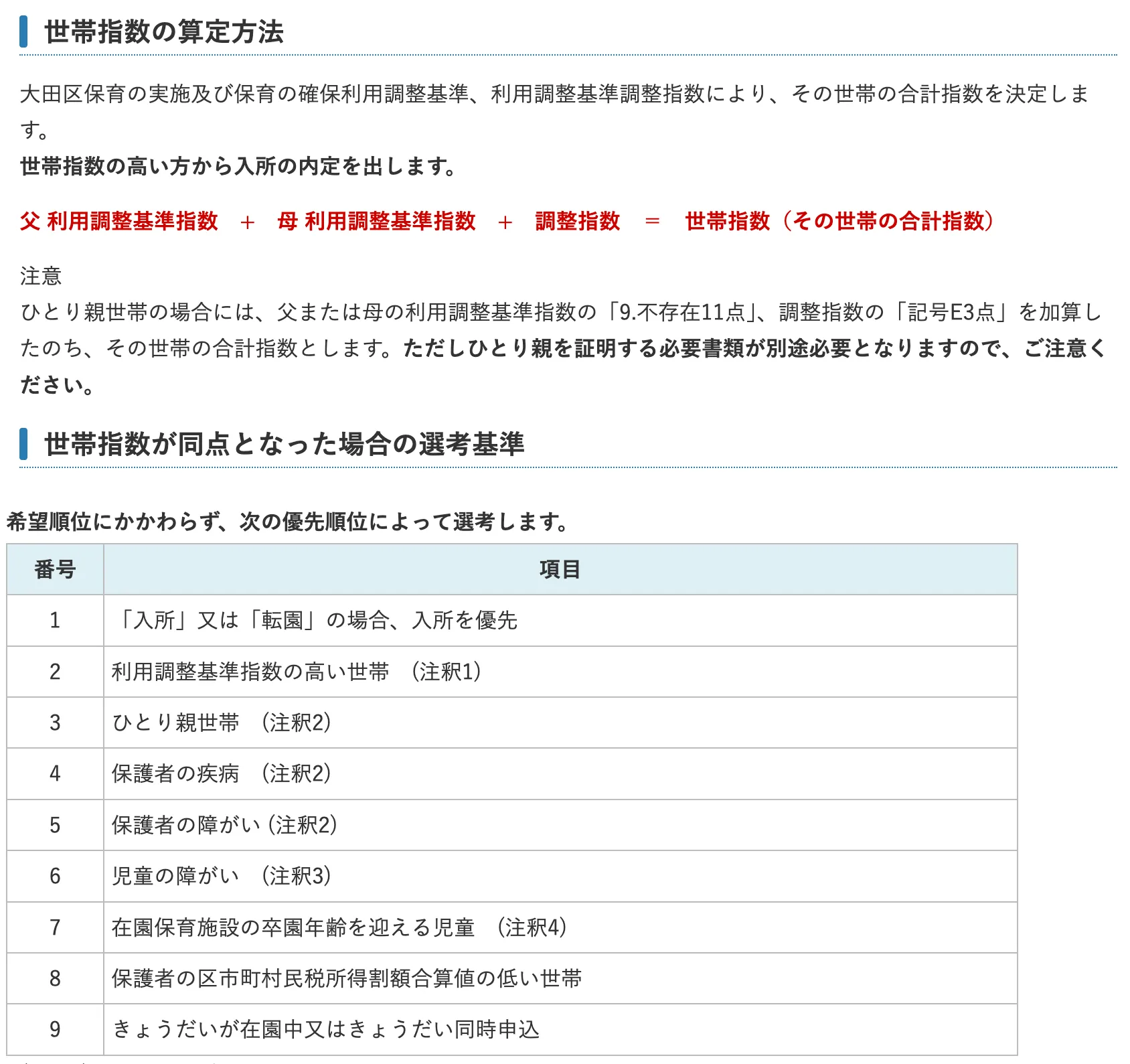
In Ota Ward, when household index scores are identical, the first comparison is whether the application is for new entry or a transfer, followed by eight further criteria applied in order.
Ota Ward calculates the household index score by adding the father’s base index score, the mother’s base index score and the adjustment points. When that figure is the same, the nine criteria published on the ward’s website are applied from the top down.
(Source: Admission adjustment methods and criteria | Ota City)
Reading the nine criteria in order
The priority order Ota Ward publishes for identical index scores is as follows.
- Where new entry and transfer are being compared, new entry takes priority
- The household with the higher base index score, not including adjustment points
- Single-parent households
- Illness of a parent
- Disability of a parent
- Disability of the child
- Children reaching the graduating age of the facility they currently attend
- The household with the lower combined municipal resident tax income levy
- A sibling already enrolled, or siblings applying at the same time
Do not judge eligibility or required documents from the name of each item alone. Check the application handbook and the admission criteria for the year you are applying.
(Source: Admission adjustment methods and criteria | Ota City)
Stage 2 is the one to watch: adjustment points are excluded
What gets compared at Stage 2 is not the household index score including additions and deductions. Ota Ward gives priority to the household with the higher base index score, excluding adjustment points.
Two families may arrive at the same household score once additions are counted, but if the combined base scores of the parents differ, their ranking can separate at this second stage.
Having more adjustment points does not automatically put a household ahead once scores are tied. It helps to keep your total score separate from the base score, which is looked at again at the tie-break stage.
What families hoping to transfer should know about Stage 1
Stage 1 in Ota Ward gives priority to new entry where a new application and a transfer application are being compared. If your family already uses a licensed facility and applies to move to another one, a tie with a new applicant can place you lower at this stage.
Even so, whether to leave your current facility, or when to apply for a transfer, is not something the priority order alone can decide. Check the current guidance, including what happens to your existing place if a transfer is offered, before you make that call.
Ota Ward publishes the lowest accepted scores from the past two years
For the first round of April admissions, Ota Ward publishes the lowest accepted index score and the number of applicants for each facility, covering the past two years. It is a useful reference for seeing how much demand a facility you are interested in has attracted in previous years.
(Source: Publication of first-round admission scores | Ota City)
These figures are not a fixed pass mark. They shift every year with the number of places available, children moving up within facilities, applicant numbers, and the combinations of facilities people list.
Scoring above last year’s minimum does not guarantee a place, and scoring below it does not mean you will be turned down. Treat the figures as one input for gauging how competitive a facility has been, rather than as an answer to “how many points do I need?”
Setagaya Ward’s order for identical scores has six stages, and the first concerns children ageing out of their current facility
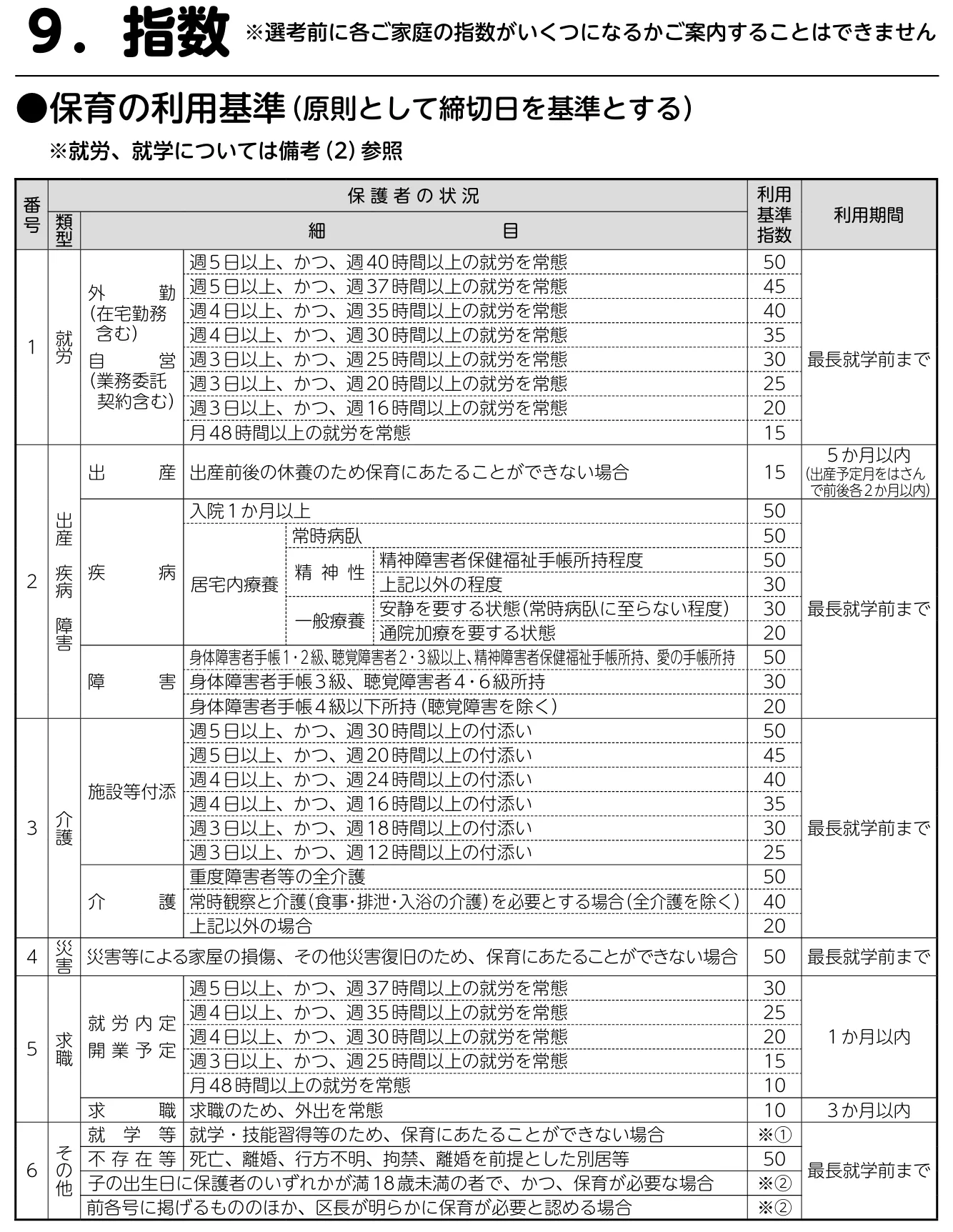
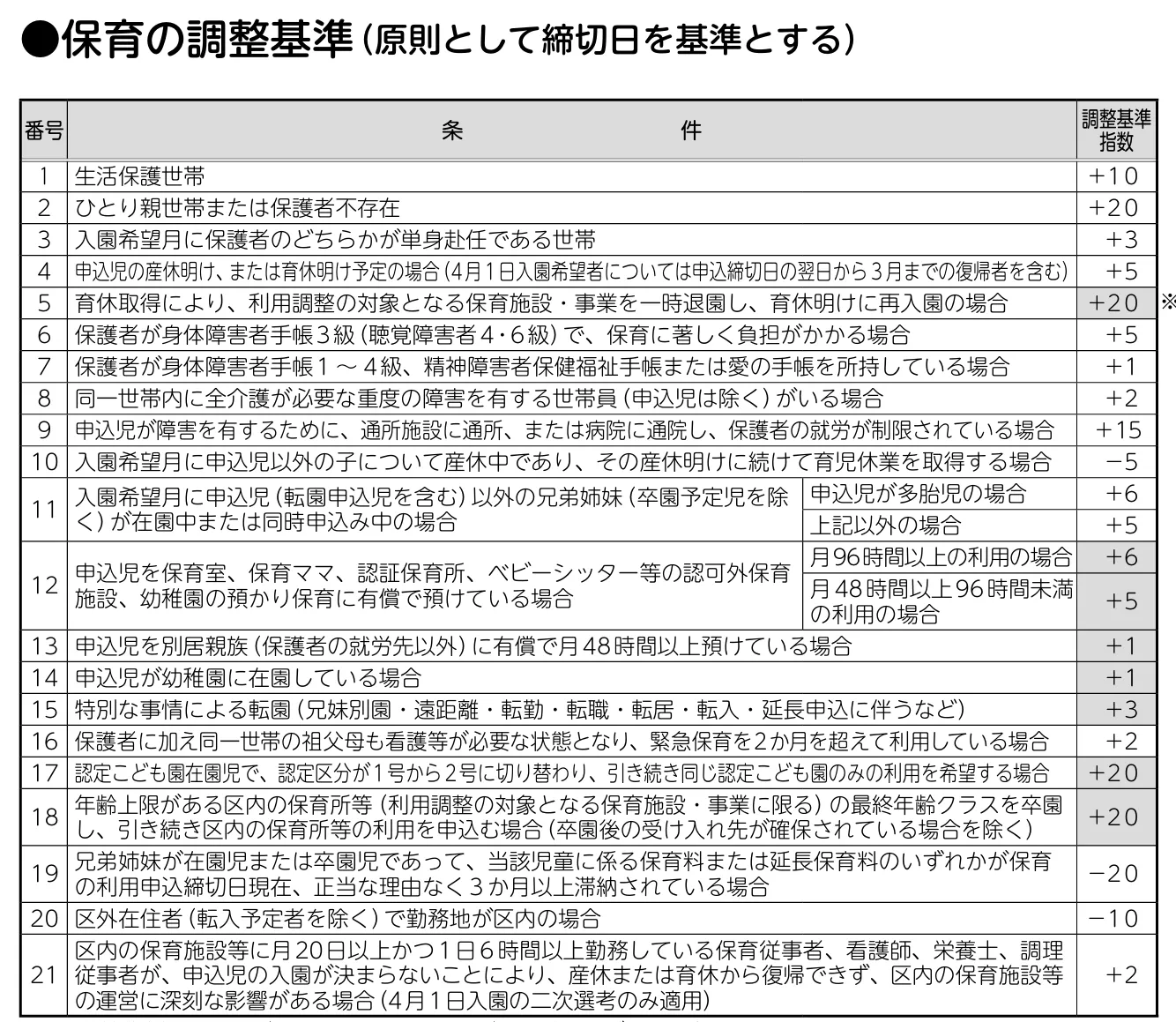


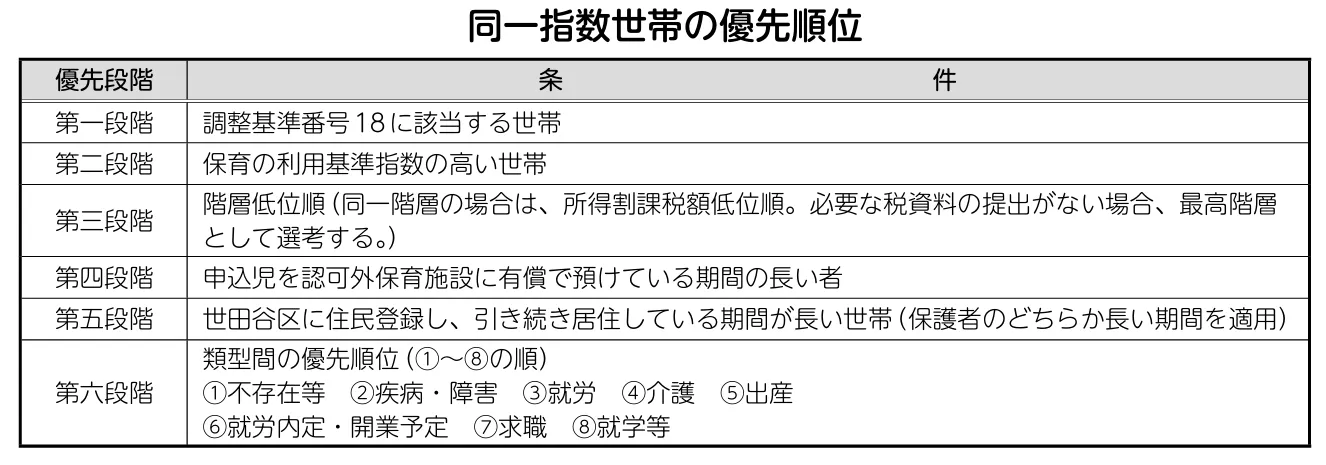

Setagaya Ward places the item covering children graduating from the oldest class of an age-capped facility within the ward at the first stage of its tie-break order.
Setagaya Ward works out a base index score for each parent and adds them together to reach the household score. Where the necessary documents have been submitted, adjustment points are then applied according to family circumstances.
For households that end up with identical scores, assessment follows the six-stage priority order published in the ward’s official Childcare Application Guide (Hoiku no Goannai).
(Source: Childcare Application Guide (September 2026 edition), pp. 30–32 | Setagaya City)
Reading the six stages in order
The priority order Setagaya Ward publishes for households with identical index scores is as follows.
- Stage 1: Households falling under adjustment criterion No. 18
- Stage 2: The household with the higher base index score
- Stage 3: Lower fee bracket first; within the same bracket, lower resident tax income levy first. Where the required tax documents have not been submitted, the household is assessed in the highest bracket
- Stage 4: Applicants who have paid the longest for a place at an unlicensed childcare facility, meaning one outside the licensed system (ninkagai hoiku shisetsu), for the child in question
- Stage 5: Households registered as residents of Setagaya Ward and continuously living there for the longest period
- Stage 6: Priority between categories of need
At Stage 6, categories are compared in this order: absence of a parent and similar situations, illness or disability, employment, caregiving, childbirth, a confirmed job offer or planned start of a business, job-seeking, and study. Check the conditions for each item in the guidance for your application year.
(Source: Childcare Application Guide (September 2026 edition), pp. 30–32 | Setagaya City)
A closer look at adjustment criterion No. 18
Adjustment criterion No. 18, which sits at Stage 1, covers children graduating from the oldest class of an age-capped daycare facility within the ward and applying to continue at another facility in Setagaya. It does not apply where a place after graduation has already been secured.
The official documents assign 20 adjustment points where this condition is met. Because it is also checked at the first stage of a tie-break, it is an item that matters in two separate contexts: the points themselves, and the assessment of households on identical scores.
(Source: Childcare Application Guide (September 2026 edition), pp. 30–32 | Setagaya City)
Using a small-scale facility does not automatically qualify every family, however. You need to check the facility you use, its oldest age class, and whether a place after graduation has been arranged.
Stage 3, fee brackets, and missing tax documents
Stage 3 gives priority to households in a lower childcare fee bracket. Within the same bracket, households with a lower municipal resident tax income levy are assessed first.
Setagaya Ward states explicitly that where the required tax documents have not been submitted, the household is assessed in the highest bracket. This applies to Stage 3 of the tie-break process; it does not mean that missing paperwork places you last in the selection process as a whole.
Even so, for a household that would have been assessed earlier at Stage 3 had its tax information been confirmed, missing documents are worth avoiding. Check the guidance for your application year, including whether you need to submit the documents yourself or whether the ward can confirm the information through the My Number individual number system.
Editorial note
Since September 2025, Setagaya Ward has waived childcare fees for all children attending licensed daycare and similar facilities in the ward. Tax information is still used, however, at points such as Stage 3 of the tie-break order. Rather than assuming that tax documents are irrelevant because fees are waived, treat them as information the selection process still needs.
(Source: Childcare fees | Setagaya City)
Stages 4 and 5 both look at elapsed time
Stage 4 compares how long the child has been placed, at the family’s own cost, in childcare outside the licensed system. Stage 5 compares how long the household has been registered and continuously resident in Setagaya Ward.
Neither is something you can change in the short run before applying. For families who have just moved in from another municipality, or who have relocated from overseas, these are factors that families have little or no ability to change before applying.
Rather than dwelling on factors you cannot change, it is more practical to prioritise what you can still check now: required documents, application deadlines, the facilities you list, and certificates for any childcare outside the licensed system that you have used.
Comparison table: the same household can be ranked differently in a different ward
Both wards compare base index scores and tax figures, but they differ in which circumstances they look at first and in the order that follows.
Bear in mind that the way index points are calculated, and the supply and demand situation itself, also differ by ward. The table below sets the two tie-break sequences side by side; it does not indicate which ward is easier to get into.
The two wards’ assessment sequences, side by side
| Stage | Ota Ward | Setagaya Ward |
|---|---|---|
| 1 | Where new entry and transfer are compared, new entry takes priority | Households falling under adjustment criterion No. 18 |
| 2 | The household with the higher base index score, excluding adjustment points | The household with the higher base index score |
| 3 | Single-parent households | Lower fee bracket first; within the same bracket, lower resident tax income levy first |
| 4 | Illness of a parent | Longest period of paid placement in childcare outside the licensed system |
| 5 | Disability of a parent | Longest continuous period of residence in Setagaya Ward |
| 6 | Disability of the child | Priority between categories of need for childcare |
| 7 | Children reaching the graduating age of the facility they currently attend | No equivalent item |
| 8 | The household with the lower combined municipal resident tax income levy | No equivalent item |
| 9 | A sibling already enrolled, or siblings applying at the same time | No equivalent item |
“No equivalent item” means that Setagaya Ward’s tie-break order contains no separate stage under that name. Related circumstances may still be taken into account elsewhere in the selection process, for example through adjustment points.
What Ota and Setagaya have in common is that both re-examine the base index score once households are tied. Where they differ is when tax figures enter the picture: Stage 8 in Ota, Stage 3 in Setagaya. The same element can be applied at very different points in the sequence.
(Source: Admission adjustment methods and criteria | Ota City)
(Source: Childcare Application Guide (September 2026 edition), pp. 30–32 | Setagaya City)
Working through some hypothetical cases
The following are invented examples, intended to show how the priority order works in practice. Because the two wards differ in how they calculate index points, which facilities are covered, how many places are available and who applies, these cases do not predict actual admission outcomes or indicate an advantage in either ward.
Case A: A household whose child is about to graduate from an age-capped facility
In Setagaya Ward, a household meeting the conditions of adjustment criterion No. 18 is assessed at Stage 1 in the event of a tie. In Ota Ward, children graduating from their current facility who meet the ward’s conditions are considered at Stage 7. The same circumstance — needing a new place after graduation — is applied at a very different point in the sequence.
Case B: A household applying to transfer from one licensed facility to another
In Ota Ward, where a new applicant and a transfer applicant have the same score, Stage 1 gives priority to the new applicant. Families applying for a transfer need to understand how transfer applications are treated in a tie before deciding which facilities to list and how to handle their current place.
Case C: A household that has recently moved into Setagaya Ward
Setagaya Ward compares continuous residence in the ward at Stage 5. If the earlier stages have not separated the applicants, households with longer residence are assessed first. Length of residence alone does not determine the outcome, however.
Editor-in-chief’s note
Reading a tie-break table tells you something about which circumstances a municipality has chosen to compare first. It does not, on its own, let you draw conclusions about that municipality’s policy aims or its underlying values.
What matters is not comparing yourself with another ward and feeling either relieved or discouraged, but knowing precisely which conditions your own municipality checks, and in what order. The less you can change about your circumstances, the more it matters not to leave avoidable disadvantages, such as missing paperwork, in place.
What can you check before you apply?
The practical focus before applying is not on finding ways to push your score higher, but on the documents that convey your family’s situation accurately and the information you submit before the deadline.
The tie-break order includes items you cannot change shortly before applying, such as length of residence or how long you have used childcare. Rather than worrying about those, it is more realistic to spend your time on what you can still check.
What you can still check, and what you cannot change at short notice
| What you can check or act on before applying | Conditions you should not plan on changing just before applying |
|---|---|
| Hours, days and contract period recorded on the employment certificate | How long you have lived at your current address |
| Whether the required tax documents have been submitted | Your resident tax income levy |
| Whether your application is correctly recorded as new entry or transfer | The fact that you currently use a licensed facility |
| Supporting documents for illness, disability, caregiving and similar circumstances | How long you have used childcare outside the licensed system |
| Certificates and eligibility conditions relating to graduation from an age-capped facility | Your family composition and whether a sibling is currently enrolled |
| Whether the facilities you list are realistically commutable, and the order you list them in | Past minimum accepted scores and past applicant numbers |
If your employment certificate is incomplete, or required documents are missing, your actual circumstances may not be fully reflected in the assessment. Where the content of a certificate does not match reality, do not amend it yourself — check with your employer or the ward office.
Length of residence and resident tax levies, on the other hand, are not things to adjust in the short term for the sake of an application. Separating what you can check from what you cannot change makes it much clearer what deserves your attention before the deadline.
Pre-application checklist (free download available)
The checklist below is free to use, with no registration required. Print it to A4 using your browser’s print function, or save it as a PDF, and work through it alongside your application documents.
- I have checked the current year’s admission criteria published by my municipality
- I have looked at the base index score and the circumstance-based additions and deductions separately
- I have read the tie-break order all the way to the final item
- I have confirmed whether my application is for new entry or a transfer
- I have checked the hours, days and contract period on the employment certificate against my actual working arrangements
- I have confirmed whether tax documents need to be submitted
- I have checked that no supporting documents for family circumstances are missing
- If we use an age-capped facility, I have checked the criteria relating to graduating children
- I have checked the deadlines for in-person, online and postal applications separately
- For postal applications, I have checked whether the postmark date or the arrival date applies
- I have listed facilities in the order we would genuinely want to attend them
- I am not treating past scores for a facility as a fixed pass mark
- We have discussed as a family what to do and what to check if the application is unsuccessful
How to use the free checklist
When printing this page, enable “background graphics” in your browser’s print dialogue so the checklist and explanatory boxes remain easy to distinguish. It is free to save and print for your own use before submitting.
Application schedule for April 2027 entry (Ota Ward)
For children due to be born by February 17, 2027, Ota Ward accepts in-person and online applications for the first round of April 2027 admissions from October 1 to November 30, 2026. Postal applications must arrive between October 1 and November 9, 2026. Note that the arrival date applies, not the postmark date.
A weekend application counter will also be open on November 8, 2026. Online application is also unavailable in some cases, such as applying simultaneously to facilities in another municipality.
(Source: Applying for April 2027 entry | Ota City)
In Setagaya Ward, the first round for April 2027 closes on November 5, 2026 for postal and online applications, and on November 10 for in-person applications. Results are announced on January 20, 2027.
The second round closes on January 27, 2027 for postal and online applications and on February 1 for in-person applications, with results announced on February 18. Deadlines differ by application method, so allow time to prepare.
(Source: From application to admission | Setagaya City)
If your family or employment situation changes after you apply, do not assume that your original application will remain valid without an update. Notify the ward promptly, following its guidance.
Frequently asked questions
Here are short answers to the points families most often puzzle over before applying, covering index scores and the tie-break order.
- Q1. Where is the tie-break order published?
- On each municipality’s official website and in its admission guidance booklet. For Ota Ward, see “Admission adjustment methods and criteria”; for Setagaya Ward, see the pages on base index points and adjustment points in the Childcare Application Guide.
(Source: Admission adjustment methods and criteria | Ota City)
(Source: Childcare Application Guide (September 2026 edition), pp. 30–32 | Setagaya City) - Q2. If I have a lot of adjustment points, does that help after a tie?
- Not necessarily. Stage 2 in Ota Ward and Stage 2 in Setagaya Ward both compare the base index score, with circumstance-based additions and deductions excluded.
- Q3. Can I improve my tie-break position just before applying?
- Some items, such as length of residence and tax figures, cannot be changed at short notice. The realistic approach is to avoid gaps in your paperwork and missing documents, so that your actual family situation is assessed correctly.
- Q4. Does listing a facility as my first choice give me an advantage?
- In both Ota and Setagaya, the order in which you list facilities does not itself create an advantage or disadvantage in the admission process. Rather than reordering your list to guess at vacancies, put them in the order you would genuinely want to attend. Always check the guidance for your application year as well.
(Source: Admission adjustment methods and criteria | Ota City)
(Source: Daycare admission adjustment methods | Setagaya City) - Q5. Does having a sibling already enrolled help in a tie?
- In Ota Ward, Stage 9 of the tie-break order covers a sibling already enrolled or siblings applying at the same time. Setagaya Ward’s six stages contain no separate item under that name, but a sibling’s situation may be relevant to adjustment points. Check the full criteria table.
- Q6. Is last year’s minimum accepted score this year’s cut-off?
- No. The past figures Ota Ward publishes are reference material. They shift each year with the number of places and the profile of applicants, so they cannot be used as a definitive pass mark.
(Source: Publication of first-round admission scores | Ota City) - Q7. Am I at a disadvantage applying for a transfer in Ota Ward?
- Where a transfer applicant and a new applicant have the same index score, Ota Ward gives priority to new entry at Stage 1. But applicants are ranked by their total index score before any tie-break criteria are applied, so a higher-scoring transfer application is still selected ahead of a lower-scoring new application. It does not mean a transfer application is always ranked lower.
Calculating your score is only the first step in understanding how daycare admission decisions are made. Once you know what gets compared after a tie, it becomes much clearer which documents and details are worth revisiting before you apply.
Ota and Setagaya have one thing in common: both take a second look at the base index score. Where they differ is the order in which they check new entry versus transfer, graduating children, tax figures, time spent in childcare outside the licensed system, and length of residence.
Differences in the priority order do not make one municipality better than another. Nor does having conditions you cannot change mean that you have failed to prepare properly.
What matters is not hunting anxiously for extra points, but reading your own municipality’s current criteria all the way through and checking that your family’s situation is reflected accurately in your paperwork. At TamagoDaruma, our aim is to work through confusing systems one step at a time and connect them to what you can do next, rather than treating the daycare search as a competition between families.
If you are still weighing up which facilities to apply for, our guide to what to check during a visit may also help.


We have also set out the procedures and options worth looking into if your application is unsuccessful.


If you would rather start with the differences between licensed daycare centres, certified centres for early childhood education and care (nintei kodomoen) and small-scale childcare, our overview of the childcare system is a good place to begin.