The hardest stages of parenting aren’t determined by your child’s age alone. While the 0–3 period and the transition into elementary school tend to pile on the pressure, what makes any given phase feel unbearable varies enormously — depending on how much sleep you’re getting, whether you feel isolated, how work is going, and what support you have at home.
“I’m almost at my limit.” “I just need to be alone.” “I need a break.” If those thoughts brought you to this article, here’s the first thing we want to say: feeling this way does not make you a bad parent.
If you can still feel tired — still feel the need to rest — that’s actually the right time to look honestly at the load you’re carrying. Parenting isn’t something you push through on grit alone. It means adjusting, drawing on the support around you — from your household, your childcare setting, your community, and public services — until both you and your child are in a safe, sustainable place.
This article breaks down the stages when parenting tends to feel hardest by child age, covers what parenting burnout actually looks like, and walks through practical ways to rest, who to talk to, and how to ask for help.
Table of Contents
Feeling overwhelmed by parenting doesn’t mean something is wrong with you
Finding parenting hard is not a sign that you don’t love your child enough. It’s a signal that your mental and physical reserves are running low — and the earlier you recognize that, the better.
“I’m exhausted.” “I need a break.” “I just want to be alone for a while.” Many parents feel guilty for thinking these things. The internal voice that says “you’re a parent, you should just handle it” or “you could try harder” can stop people from reaching out until it’s too late.
But if you are caring for someone around the clock, constantly putting your own meals, sleep, and rest at the bottom of the list, running on empty is the natural result — not a moral failure. Parents stay alert because they love their children. The longer that tension holds, the more it costs, in body and in mind.
Feeling “exhausted” is your mind and body being honest with you. Continuing to ignore that signal is what creates risk — for you and for your child.
Why wanting to be alone doesn’t make you a bad parent
“I just need some distance from my child right now.” This thought is not evidence that you love your child less. It’s a natural desire for recovery that grows out of giving a great deal of yourself over a long period of time.
People cannot restore themselves through caregiving alone. Time alone, time that is quiet, time when no one needs anything from you — these are not luxuries. They are what make it possible to show up again. That’s not weakness as a parent. It’s the breathing room you need to come back.
“I want to be alone” isn’t only about escape. It’s your body and mind saying: “I want to get back to a place where I can be genuinely present with my child again.”
At TamagoDaruma, we don’t see rest as running away from parenting. A parent who can rest is a parent who can keep their child safe and settled — and that matters.
When does parenting tend to feel hardest? A breakdown by child age

The two periods when parenting tends to feel most demanding are 0–3 years and the transition into elementary school. But how hard it actually feels depends not just on your child’s age — it depends heavily on whether you’re isolated and how much support you can access.
If someone asks “when is parenting hardest?”, there’s no single age to point to. The nature of the difficulty shifts as children grow.
In the newborn stage, the main burden is sleep deprivation, feeding, and the physical demands of holding and soothing. By 1–2 years, children are moving constantly, and the iya-iya phase (iyaiya-ki in Japanese) — the stretch when toddlers begin refusing almost everything — adds a new kind of daily friction. Between 3 and 5, children start in group settings, developmental comparisons creep in, and parental anxiety changes texture. Around the start of elementary school, the logistics of school days, after-school arrangements, and juggling work all pile on at once.
Each stage brings a different kind of difficulty. Rather than telling yourself “it’ll get easier at a certain age,” it’s more useful to look honestly at what specific pressures are stacking up in your household right now.
0–6 months — Sleep deprivation and the feeling that the end isn’t in sight
The heaviest burden in the earliest months is broken sleep. When extended, fragmented rest becomes the norm, emotional resilience shrinks and simple decisions start to feel harder than they should.
Not knowing why the baby is crying. Feeding schedules that won’t stabilize. A baby who only sleeps when held. These realities wear down parents more than they look from the outside.
The postpartum period is also one where physical recovery and infant care run in parallel. If you are experiencing persistent low mood, intense anxiety, tearfulness, or an inability to sleep even when your baby is asleep, please don’t carry this alone — speak with your doctor, midwife, public health nurse, or your local municipal support service.
7–12 months — A wider world and constant vigilance
Once crawling, pulling up, and cruising begin, a baby’s reach expands almost overnight. Places that were out of reach yesterday become accessible today — and the risk of falls, small object ingestion, and furniture collisions rises accordingly.
There’s real joy in watching this development, but it runs alongside a steady undercurrent of “I can’t take my eyes off them.” Whether you’re doing dishes or trying to eat lunch, part of your attention is always tracking your child. Parents in this phase are often technically “resting” without actually recovering.
1–2 years — The iya-iya phase and the frustration of not getting through
Between 1 and 2, self-assertion ramps up and many families hit the iya-iya phase — the stretch when toddlers begin refusing almost everything. “Won’t get dressed.” “Won’t eat.” “Won’t come home.” “Won’t stop crying.” The accumulated weight of these small daily battles grinds parents down.
One important thing to hold onto during this phase: the frustration of not being understood is not purely a problem of how you’re communicating. Children at this age are still developing the capacity to regulate their feelings and express themselves in words.
Knowing that doesn’t make it easier to live through. Understanding something developmentally and feeling better as the parent going through it every day are two very different things.
3–5 years — Starting preschool, developmental comparisons, and growing anxiety
Between 3 and 5, children enter group settings — hoikuen (nursery school), yochien (kindergarten), or nintei kodomoen (certified children’s centers) — and differences between children start to become more visible. “Is my child the only one who can’t do that yet?” “Are they causing problems for the other kids?” These worries are common and real.
The difficulty in this phase isn’t primarily physical anymore. It’s listening to your child, keeping track of how they’re doing in their childcare setting, and trying not to measure them against every other child you hear about. Parental anxiety becomes more layered.
Children getting more independent doesn’t mean the parental burden disappears. If anything, higher expectations — your own included — can generate a new and different kind of pressure.
Around school entry — Big transitions and pressure on two fronts
Starting elementary school brings a significant shift in daily life. New school start times, supplies to manage, homework, figuring out after-school arrangements, keeping up with work — new demands tend to land all at once.
There’s a term in Japan for this: the sho-ichi no kabe, or “first-grade wall” — the point at which the support structure that worked during the nursery school years no longer applies, and parents have to navigate a very different system. For international families, this transition may carry additional complexity around school choice, language of instruction, and whether to enroll in a local Japanese school or an international school.
The difficulty around school entry is less about a child’s development and more about a significant reorganization of how your whole household runs.
The difficulty isn’t just about age — isolation and lack of support matter enormously
Having laid out those age-by-age patterns, here’s something equally important: two parents with children of exactly the same age can experience radically different levels of difficulty.
The biggest factor driving that difference is whether you’re isolated, and whether you’re actually able to access support.
Handling everything at home on your own. No one to talk to. No family nearby after the birth. A partner who comes home late. The relentless juggle of work and childcare. These circumstances increase parental exhaustion regardless of how old your child is.
Rather than telling yourself “this is just how it is at this age,” it’s worth asking: what specific things are stacking up in my household right now?
| Child’s Age | Main Sources of Difficulty | Common Emotional Experiences | Support Options to Consider |
|---|---|---|---|
| 0–6 months | Sleep deprivation, feeding, physical postpartum recovery | Anxiety, exhaustion, loneliness | Postnatal care services, Child and Family Support Center, your public health nurse |
| 7–12 months | Expanding movement, constant vigilance, no real downtime | Burnout, tension, inability to rest | Temporary Childcare Program, Family Support Center (Famisapo), community child-rearing support hub |
| 1–2 years | Iya-iya phase, frustration of not getting through | Exhaustion, anger, guilt | Temporary Childcare Program, community child-rearing support hub, talking with your child’s teacher or municipal family support service |
| 3–4 years | Starting group childcare, developmental concerns, comparison anxiety | Anxiety, worry, isolation | Child and Family Support Center, talking with your child’s teacher, your public health nurse |
| 5–6 years (school transition) | Environmental change, first-grade wall, after-school arrangements | Confusion, pressure, overwhelm | Elementary school, after-school childcare clubs (gakudo), municipal family support desk |
Support content, eligibility criteria, fees, and age ranges vary by municipality and facility. Check the official information from your local city or ward office for details on what’s available where you live.
Recognizing the signs of parenting burnout before they overwhelm you
When you notice signs of parenting burnout, take them seriously. If multiple signs are persisting, or if you have concerns about safety, reach out for support sooner rather than later.
Parenting burnout rarely arrives all at once. More often it accumulates — sleepless nights layering into weeks, an inability to eat properly, heightened irritability, unexpected tears, the sound of your child’s voice becoming genuinely hard to bear. These signals may be your mind and body saying: “I can’t keep going like this.”
To be clear: this article cannot make any medical assessment. Conditions such as postpartum depression, depressive episodes, or parenting burnout are evaluated by physicians and qualified professionals. What matters is not self-diagnosing, but recognizing when something feels consistently off and reaching out — whether to a doctor, a midwife, a public health nurse, or a local family support service.
What’s the difference between “tired” and “at the limit”?
There’s no clean line between everyday parenting fatigue and the point where professional support would help. As a rough guide: if rest isn’t restoring you, if the difficulty is ongoing, or if you have concerns about safety — please consider reaching out sooner rather than later.
If a full night’s sleep brings even a little relief, if an hour alone helps you settle, if talking to someone lifts some of the weight — there may still be recovery capacity available to you.
On the other hand: if rest isn’t bringing you back, if you feel a deep heaviness every day, if you’re afraid you might lose control with your child, or if thoughts of harming yourself arise — please don’t carry this alone.
Japan’s Ministry of Health, Labour and Welfare runs a mental health support portal called “Mamorou yo Kokoro” (まもろうよ こころ), which lists phone and SNS-based support lines. It’s not specific to parenting, but it can be a useful starting point when you’re in distress and need to find somewhere to turn.
Source: Mamorou yo Kokoro | Ministry of Health, Labour and Welfare
Self-check list (a guide for deciding whether to reach out)
This is not a clinical diagnostic tool. Use it as a rough guide for deciding whether to seek support. If several of the following apply and have been persisting, or if you feel unsafe or in danger, please contact your doctor, your local municipal service, or a support line — regardless of how long it has been going on.
Parenting Burnout — Self-Check List
- You haven’t been able to sleep for a meaningful stretch for days
- Even when your child is sleeping, you can’t sleep
- You feel strong irritation or aversion when your child cries or makes demands
- You have almost no contact with other adults
- There is no one you feel you can talk to
- Your appetite has dropped significantly, or you can’t stop eating
- You sometimes feel as though neither you nor your child really matters
- Things you used to enjoy hold almost no interest for you
- The thought “I’m a failure as a parent” comes up repeatedly
- You’re frightened you might lose control with your child, or it has already happened
- Thoughts of disappearing, escaping, or making it all stop cross your mind
If the items about losing control with your child, wanting to disappear, or concerns about your own or your child’s safety apply to you — please don’t wait and watch. Make reaching out your immediate priority.
Ways to rest — starting today. Taking temporary distance from your child is not giving up
Arranging for your child to be temporarily cared for by someone else is not abandoning your parenting. Giving yourself time to recover is part of what keeps you able to care for your child safely.
Many parents feel guilt about using outside childcare, even briefly. “Shouldn’t I be the one looking after them?” “Is what I’m going through really serious enough to justify this?” These doubts are understandable.
But a parent running on empty who keeps pushing is hard on everyone — on the parent and on the child. Knowing your child is safely looked after while you sleep, rest, sort out a task, or simply clear your head — that time is not indulgent. It’s part of keeping your household intact.
Some support options can be accessed with a phone call today. Others require pre-registration or advance booking. Before you hit a wall, it’s worth finding out what’s available in your area — not when you’re already in crisis, but now, while you still have a little capacity to look into it.
Japan’s Temporary Childcare Program (一時預かり事業)
Japan’s Temporary Childcare Program (ichiji azukari in Japanese) provides short-term care for infants and young children at certified children’s centers, kindergartens, nursery schools, and other facilities when home-based care is temporarily difficult. According to the Children and Families Agency’s explanation of the Child and Child-Rearing Support System, the program is available not only for urgent needs or short-term work situations, but also when parents simply need time to rest and recharge.
Source: Understanding the Child and Child-Rearing Support System | Children and Families Agency
That said, available facilities, eligible ages, fees, usage limits, and booking methods all differ by municipality and facility. You may not be able to book on the day you need it — so when you have a little breathing room, check with your local city or ward office or contact facilities directly.
Short-Term Child Care Support Program (子育て短期支援事業) — Short Stay and Twilight Stay
Japan’s Short-Term Child Care Support Program provides temporary residential care for children at child welfare facilities when parents are temporarily unable to care for their child at home — due to illness, work commitments, or parenting exhaustion.
The Children and Families Agency describes this program as providing a period of care and protection at child welfare facilities when a parent’s illness or other circumstances make it temporarily impossible to raise their child at home.
Source: Short-Term Child Care Support Program | Children and Families Agency
The program includes overnight placements (Short Stay) and evening or nighttime support (Twilight Stay). Availability, eligibility, fees, and whether pre-registration is required all vary by municipality. It’s worth checking early whether your area offers this — so it’s a real option if and when you need it.
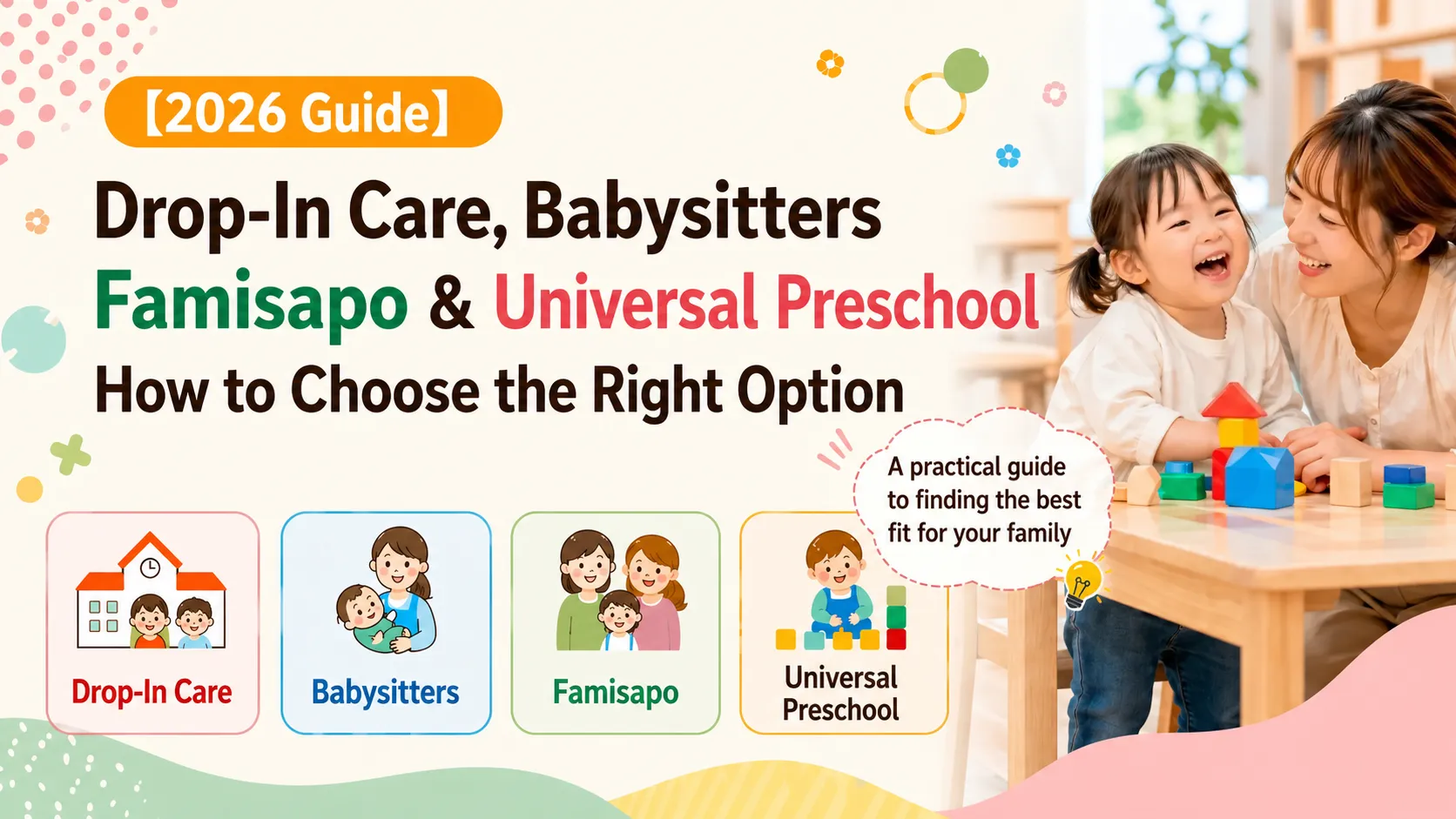
Family Support Center (Famisapo / ファミリー・サポート・センター)
The Family Support Center — known in Japan as Famisapo — is a community-based mutual aid program that connects families who need help with childcare with local volunteers who are willing to provide it. According to the Children and Families Agency, the program works by matching parents of infants and school-age children who need support with registered community helpers.
Source: Family Support Center | Children and Families Agency
Depending on the area, Famisapo helpers can assist with kindergarten or nursery school pick-ups, short-term childcare while a parent runs errands, and other practical daily care needs. Registration and an initial meeting with your helper are generally required before using the service — so this is one to set up during a calmer period, not only when you’re already in crisis.


Creating small pockets of alone time — starting now
Sometimes you don’t need a formal support program. You just need to breathe for a moment.
Decide during your child’s nap that you won’t touch the housework. Tell your partner specifically: “I need thirty minutes to myself — can you take over?” Sit on a park bench and let your mind go blank without looking at your phone. After your child falls asleep, lie down instead of starting on the dishes.
Even a short stretch of time when no one is calling your name can bring something back. It doesn’t have to be a major reset.
If the idea of making even that happen feels impossible right now, that’s exactly the point where outside support — a Temporary Childcare Program, Famisapo, or a call to your local family support service — becomes worth looking into. Don’t wait until you have no bandwidth at all before starting to explore your options.
Support lines you can reach today — by phone, online, and in person
Choose your support line based on the nature of your concern and how urgent it feels. Even at the stage of “I’m not sure this is serious enough to call about” — it is.
When you’re exhausted from parenting, the most common barrier to reaching out is not knowing what to say. You don’t have the words. Tears come before sentences. You’re not even sure what you need. All of that is fine. You can still call.
The first sentence can be: “Parenting has become really hard for me.” Or: “I don’t know where I’m supposed to turn.” Support lines are not only for people who have their situation neatly organized. They’re for people in the middle of it.
Phone support lines for parenting

Among the major phone support options, the Yorisoi Hotline and the child consultation center lines are particularly well-known.
Yorisoi Hotline (よりそいホットライン)
Phone: 0120-279-338
Listed on the Ministry of Health, Labour and Welfare’s “Mamorou yo Kokoro” portal, the Yorisoi Hotline takes calls on a broad range of concerns — loneliness, financial anxiety, emotional distress, and more. It can also help connect callers to more specific services. The line primarily operates in Japanese; multilingual support availability varies, so check the official site for current language options.
Source: Mamorou yo Kokoro | Ministry of Health, Labour and Welfare
Child Consultation Center Abuse Response Line (“189”)
Phone: 189
This is a nationwide number in Japan for immediate reporting and advice regarding suspected child abuse. The Children and Families Agency notes that anonymous reporting is accepted and confidentiality is protected. This line operates in Japanese; interpretation support may not always be available.
Source: Child Consultation Center Abuse Response Line “189” | Children and Families Agency
Child Consultation Center General Inquiry Line
Phone: 0120-189-783
This number handles general questions related to child welfare, parenting, and young carers. It serves a different role from the abuse response line 189 — for general parenting support, this is the more appropriate starting point. This line operates primarily in Japanese.
Source: Related Service Contact Information | Children and Families Agency
If the situation is urgent and you have concerns about your own or your child’s physical safety, please consider contacting emergency services — 119 for ambulance, 110 for police — in addition to the support lines listed above.
Reaching out to a Child and Family Support Center — what to say when you get there
Child and Family Support Centers (Kodomo Katei Senta) are municipal hubs that combine maternal and child health functions with child welfare support, serving pregnant women and families raising children. According to the Children and Families Agency, their purpose is to provide continuous, comprehensive support from early in pregnancy through the child-rearing years.
Source: Child and Family Support Center | Children and Families Agency
These centers can be a place to raise a wide range of concerns: parenting feels unmanageable, you haven’t physically recovered since the birth, you’re not sure how to engage with your child, you have no one to rely on at home, or you want to know what support is available to you. Foreign residents living in Japan are generally able to use these municipal services; multilingual support availability varies by municipality, so it is worth checking with your local center in advance.
The name, location, phone number, and available hours vary by municipality. Searching your city or ward name alongside “Child and Family Support Center” or “kosodate sodan” (parenting support) should bring up the official contact for your area.
Online and LINE-based support options
If speaking on the phone is difficult, or if forming words out loud feels like too much right now, messaging-based options exist.
The Children and Families Agency lists the “Oyako no tame no Soudan LINE” (Parent-Child LINE Support) as a messaging service for children and parents with concerns about parenting and parent-child relationships. It operates anonymously and confidentiality is protected. Note that this service currently operates in Japanese.
Source: Oyako no tame no Soudan LINE | Children and Families Agency
Some municipalities offer their own LINE or chat support channels. Hours and coverage areas differ — always check the official information to confirm what’s available where you live.
When you’re not sure whether what you’re feeling is “serious enough” to reach out
Many people hesitate, wondering whether what they’re going through justifies a call. But trying to judge that alone is part of what keeps people from getting support.
If you’re unsure, treat that uncertainty as your green light to reach out.
If you call and hear that your situation can be monitored for now, that’s useful information. If you call and find that connecting with support sooner makes sense, you’ve given yourself a head start.
Frequently Asked Questions
- Q. When is parenting hardest?
- A. There’s no single answer, but the 0–3 period and the transition into elementary school tend to pile on the pressure. How hard it actually feels depends not just on your child’s age, but on your sleep, your level of isolation, your work situation, and the support you have at home. If you feel it’s hard right now, that’s enough to start thinking about rest and support.
- Q. Is it normal to want to be alone, away from your child?
- A. Yes. Extended caregiving depletes anyone. Wanting time alone doesn’t mean you’ve stopped loving your child — it usually means your mental and physical reserves are running low and need restoring.
- Q. What’s the difference between parenting burnout and postpartum depression?
- A. This is something to assess with a doctor or qualified professional, not on your own. If rest isn’t bringing relief, if intense anxiety or low mood persists, if you can’t sleep or eat, or if thoughts of self-harm arise, please don’t try to identify the cause yourself — speak with your doctor, OB/GYN, midwife, public health nurse, or your local municipal service.
- Q. If I’ve hit my limit with parenting, what should I do first?
- A. Talk to someone. It can be a family member, a childcare teacher, a municipal service, a Child and Family Support Center, a phone line, or a messaging service — whatever feels most accessible right now. If you have immediate concerns about your own or your child’s safety, consider whether 189, 119, or 110 is appropriate given the urgency.
- Q. I feel guilty about using temporary childcare. Is that normal?
- A. Very common, and understandable. Japan’s Temporary Childcare Program can be used by parents who need rest — not only in emergencies. Giving yourself time to recover is part of being able to keep going. Eligibility, fees, and availability vary by municipality and facility, so check the details in advance.
- Q. My partner doesn’t understand how hard it’s been. What can I do?
- A. Rather than leading with emotion alone, try pairing the feeling with concrete facts and a specific request: “I’ve been getting up multiple times every night, I have almost no time to myself, and I’m really struggling. Starting this week, I’d like one or two hours to myself once a week — could you take over on Saturday mornings?” If this still doesn’t lead anywhere, bringing in an outside party — a municipal service or a Child and Family Support Center — can help make the situation visible in a way words alone sometimes can’t.
- Q. Are there free parenting support services in Japan?
- A. Yes. Talking with staff at facilities like the Child and Family Support Center is generally free of charge. However, fees for services you’re referred to will vary depending on the program and municipality. Phone and messaging support lines also vary — always confirm current terms on the official source.
Finding the words to ask for help — from your partner and the people around you
When asking for help, separating your current emotional state, the concrete facts of your situation, and your specific request makes it easier for the other person to act on what you’re saying.
For many parents, asking for help at all is the hardest part. “It won’t change anything.” “It’ll just cause tension.” “I don’t want to look like I’m not coping.” Years of swallowing those words may have followed.
But the difficulty of parenting is largely invisible if you don’t name it. Feeding, settling, meals, getting dressed, drop-offs and pick-ups, responding to every cry, keeping up with communication from the childcare setting, tracking your child’s health — the invisible accumulation of all of this is exactly why the people around you often can’t see what you’re carrying.
How to communicate your current state to your partner
When speaking to your partner, it helps to separate three things: the feeling, the facts, and the request.
An example of how to frame it
“Lately I’ve been up multiple times every night, and during the day I’m mostly on my own without much adult contact. My mood has been really low. Starting this week, I’d like to carve out one or two hours a week just to rest — could you take the kids on Saturday morning?”
“I’m struggling” on its own can leave a partner unsure what to do. Adding “when,” “what,” and “how much” gives them something concrete to act on.
Of course, even clear communication doesn’t guarantee understanding. If that happens, please don’t turn it inward and blame the way you said it. Reaching out to a municipal service, a family support line, or your child’s childcare center to bring in outside help is always a real option.
How to ask for help from family, in-laws, and your community
Whether you’re reaching out to grandparents, neighbors, or local services, a specific request travels further than a vague one.
Rather than “I could use a bit of help,” try: “Could you come over on Wednesday evening for an hour and watch the kids?” or “Just for this week, could you bring one dish for dinner?” or “Could you do one school pick-up for me?”
If asking for anything at all feels like too much, start small. Ten minutes of cover while you step outside. One errand delegated. A single pick-up passed to someone else. You can begin there.
Asking for help is not a sign of weakness. It’s what happens when the weight inside the household becomes more than one or two people can hold alone — and you start, carefully, to move a little of it outward.
【Free Download】Workload mapping sheet for parenting households
A single A4 sheet built around four prompts: who is doing what and how much; when the day feels hardest; which support options haven’t been tried yet; and who you most want to talk to right now. Fill it in on your own, or hand it to your partner and work through it together to make the current situation visible.
We are preparing a downloadable worksheet and will add it here once it is available.
A parent who knows when to rest is a parent who can protect their child
Editor’s Note
Many people who search “when is parenting hardest” are looking for information on the surface — but underneath, what they may really want is for someone to acknowledge how hard things are right now. That thought stayed with me throughout putting this article together.
Parenting content can easily drift toward “here’s how to get through it” or “here’s what good parents do.” I don’t think that’s enough on its own. The difficulty of raising a child cannot be resolved through personal effort alone.
Wanting a break is not wrong. If tears come while you’re scrolling through search results, that might be a sign that it’s okay to rest — okay to tell someone. You’re allowed.
The fact that you can still feel “I need a break” means you’re still trying to protect yourself. Before that feeling goes numb — before you stop feeling anything — please talk to someone, now, while you still can.
This is a platform that wants to be useful not just after someone has already hit a wall, but at the earlier “something feels off” stage. Support lines, temporary childcare, family support programs — all of these exist so that parents don’t have to carry everything alone.
You don’t have to do all of this by yourself. That’s TamagoDaruma’s message.
Summary
The hardest stages of parenting are shaped by both your child’s age and the environment around you. The goal isn’t to muscle through the difficulty — it’s to start distributing the load before it becomes too heavy to carry.
Parenting tends to feel most demanding during the 0–3 period and around the transition into elementary school. But actual difficulty isn’t determined by age alone. Sleep deprivation, isolation, work demands, family cooperation, and access to local support all play a significant role.
“I need to be alone.” “I need a break.” These are natural feelings for any parent. Instead of judging yourself for having them, ask honestly whether the load you’re carrying has grown too heavy for one person — or one household — to hold.
Some support is available immediately — phone lines you can call today. Others — Japan’s Temporary Childcare Program, Short-Term Child Care Support, Family Support Centers (Famisapo) — require advance registration or booking. When you have a little room to breathe, use it to find out what’s available where you live.
TamagoDaruma cares about more than organizing information. We want parents to reach the support that exists before things become urgent. We hope this article is one small step toward carrying a little less alone.