


For children at daycare (hoikuen) or preschool (yōchien), heat illness prevention becomes clearer when you split it into three stages: before drop-off, during the day at daycare or preschool, and after pick-up. Breaking it down this way shows exactly what your family can prepare for at home.
From late May into June, as hot days become more frequent, plenty of parents feel “this is the year I’ll really get prepared.” In reality, though, the first thing that comes up is usually uncertainty: “How much should I actually do?” “How much is okay to ask the teachers?” “Is that unusual tiredness after pick-up just fatigue, or something more?”
This article is for parents of children at daycare or preschool, and it organizes the heat-illness prevention you can do at home along the flow of a single day — before drop-off, during the day, and after pick-up. We’ve also prepared free downloadable checklists, so it’s all in a form you can start using today. (In this article, we use “heat illness” as a broad term that includes both heat exhaustion and heatstroke.)
Table of Contents
Think about children’s heat illness prevention in “three stages”

When you separate the day into before drop-off, during the day, and after pick-up, it becomes clear what parents can check, what to leave to the staff, and what to watch for after pick-up.
When we hear “heat illness prevention,” our attention tends to go first to preparing things — staying hydrated, sun protection, managing the cooling. But for parents of children at daycare or preschool, there’s another important angle: the fact that across the day, “the time parents can be involved” and “the time you leave to the staff” are clearly separated.
Before drop-off is the time parents can check things directly. During the day, you can’t see how your child is doing. After pick-up is when parents can observe again. Just separating these three stages makes it much clearer what you should be doing right now. You don’t have to manage everything yourself — and at the same time, it’s not as if there’s nothing you can do.
Before drop-off, during the day, and after pick-up: the parent’s role changes
Many parents who feel “I’m worried about heat illness” haven’t, in practice, clearly separated “what’s my responsibility” from “what’s the daycare or preschool’s responsibility.” This is partly a sign of how seriously they take it, but it can also lead to the excessive anxiety of “I have to do all of it myself.”
When you sort out the roles across the day, the home takes the lead before drop-off, the daycare or preschool staff take the lead during the day, and the home takes the lead again after pick-up. What parents can do is reliably handle “the part you’re responsible for” in each phase.
First, see the whole picture in a table
| Timing | What you can do at home | What to ask the teachers | Signs to watch for |
|---|---|---|---|
| Before drop-off | Check condition, clothing, water bottle, weather | How to pass on notes about their condition | Energy, appetite, sleep |
| During the day | You can’t manage things directly | Outdoor play, hydration, breaks, how time indoors is spent | Reports from the staff |
| After pick-up | Look for differences from usual | Check how active the day was | Unusual tiredness, skin color, how well they drink |
This table is also meant to help you let go of the assumption that “I have to do everything myself.” When the daycare or preschool and the home each take responsibility for their own part of the day, you cover the child’s whole day together.
Why do young children need extra care around heat illness?
Young children find it hard to put heat or feeling unwell into words, and they spend their time closer to the ground, so observation by adults matters.
Heat illness happens when the body’s temperature regulation stops working well in hot, humid conditions. The Ministry of Health, Labour and Welfare explains it as a state where, in a high-temperature environment, temperature regulation through sweating and other mechanisms doesn’t work well and heat builds up inside the body.
(Reference: Information and resources site for heatstroke prevention|Ministry of Health, Labour and Welfare)
Dizziness, weakness, and impaired consciousness are typical symptoms, but for young children there’s a major difference from adults: it’s hard for them to notice and put symptoms into words. The Children and Families Agency explains that infants and young children have immature temperature-regulation function and an underdeveloped ability to sweat, so heat builds up in their bodies easily. Materials from the Japan Pediatric Society also show that children are more affected by heat because of their physical characteristics.
(Reference: Let’s watch out together and prevent “children’s heatstroke”!|Children and Families Agency)
(Reference: Heatstroke (injury prevention in children)|Japan Pediatric Society)
Children may not be able to say “I’m hot” or “I feel sick” well
Younger children may not yet be able to fully put discomfort like “I’m thirsty” or “I feel sick” into words. Even at four or five, a child who’s absorbed in play, or one who’s patient by nature, may not say anything about feeling unwell.
That’s why the signs of heat illness in children need to be read not from “words” but from “changes in behavior, expression, appetite, and energy.” Differences from usual — “quieter than normal,” “no appetite,” “seeming dazed” — become important clues.
It’s not just temperature: humidity, sunlight, and activity level all matter


“At what temperature is it dangerous?” is a common question, but the reality is that it’s hard to judge by temperature alone. Even at the same temperature, the body builds up heat more easily on humid days or days with strong sun. It also varies a great deal with sun and wind, the day’s activity level, and the child’s condition.
The Ministry of the Environment recommends using the “heat index (WBGT),” which combines the surrounding thermal environment — temperature, humidity, solar and radiant heat. WBGT is an internationally used standard, not unique to Japan. On top of checking the morning temperature, getting into the habit of keeping the heat index in mind leads to more appropriate judgments.
(Reference: What is the heat index?|Ministry of the Environment Heatstroke Prevention Information Site)
Don’t overlook heat exposure on the way to and from daycare
There’s also a heat-illness risk while traveling to and from daycare or preschool at drop-off and pick-up. The situations that need particular care are below.
- Strollers and the rear seat of a bicycle: temperatures tend to be higher the closer you are to the ground, with reflected heat from the asphalt added on top.
- A car interior just after parking: the temperature inside a car rises sharply even in a short time. Never leaving a child alone goes without saying, but it’s also important to air out the car before getting in.
- Traveling on foot: moving along a road with no shade can put more strain on a child’s body than an adult realizes.
As a way to avoid the state of “already tired by the time we arrive,” don’t forget heat protection during the commute either.
What should you check at home before drop-off?

Before drop-off, it’s important to quickly check your child’s condition, clothing, water bottle, and the weather, so they’re ready for the day ahead.
Getting ready before drop-off happens in the rush of the morning. That’s exactly why narrowing down the “items to check every day” and turning them into a habit is the trick to keeping it up. Keep the items to a minimum — narrowing it to three, “the child’s state,” “what they’re carrying,” and “the weather,” keeps it simple.
For the morning condition check, look at “differences from usual”
Taking their temperature matters too, but from the standpoint of heat-illness prevention, what’s important is developing an eye for “differences from usual.” Did they sleep enough the night before? Are they eating breakfast? How’s their mood? These aren’t direct causes of heat illness, but they affect the body’s ability to recover and to cope with heat. The points to check are below. This isn’t a check “to make a diagnosis,” but one “to know today’s baseline for their body.”
- Energy and mood: quieter than usual, seeming dazed?
- Appetite: are they able to eat breakfast?
- Sleep: did they sleep enough the night before?
- Sweating and color: is their face already red, or are they sweating too much?
Check clothing, hat, water bottle, and a change of clothes
Choose breathable clothing, and it helps to prepare a change of clothes so they can change when they’ve sweated. A hat with a brim is preferable, and some daycares and preschools have a specified type.
For the water bottle’s contents and capacity, check your daycare or preschool’s rules first, then prepare something your child finds easy to drink. Some specify or recommend water or barley tea (mugicha). If the water bottle tends to run out, it’s reassuring to check in advance whether refills are available there. Sending along a change of clothes for after they’ve sweated also helps reduce discomfort after pick-up.
Check the Heat Stroke Alert and the heat index
The Ministry of the Environment issues a “Heat Stroke Alert” and a “Heat Stroke Special Alert.” These are calculated based on the heat index (WBGT), and you can use them as a guide for your morning prep and what to pack. Whether or not to go in should be judged together with your daycare or preschool’s or municipality’s policy and your child’s condition.
Official information is available on the Ministry of the Environment’s heatstroke prevention information site. Getting into the habit of checking it each morning alongside your weather app naturally builds the awareness that “today, let’s be even more careful than usual.”
(Reference: What is the Heat Stroke Alert?|Ministry of the Environment Heatstroke Prevention Information Site)
Free download: 30-second before-drop-off checklist
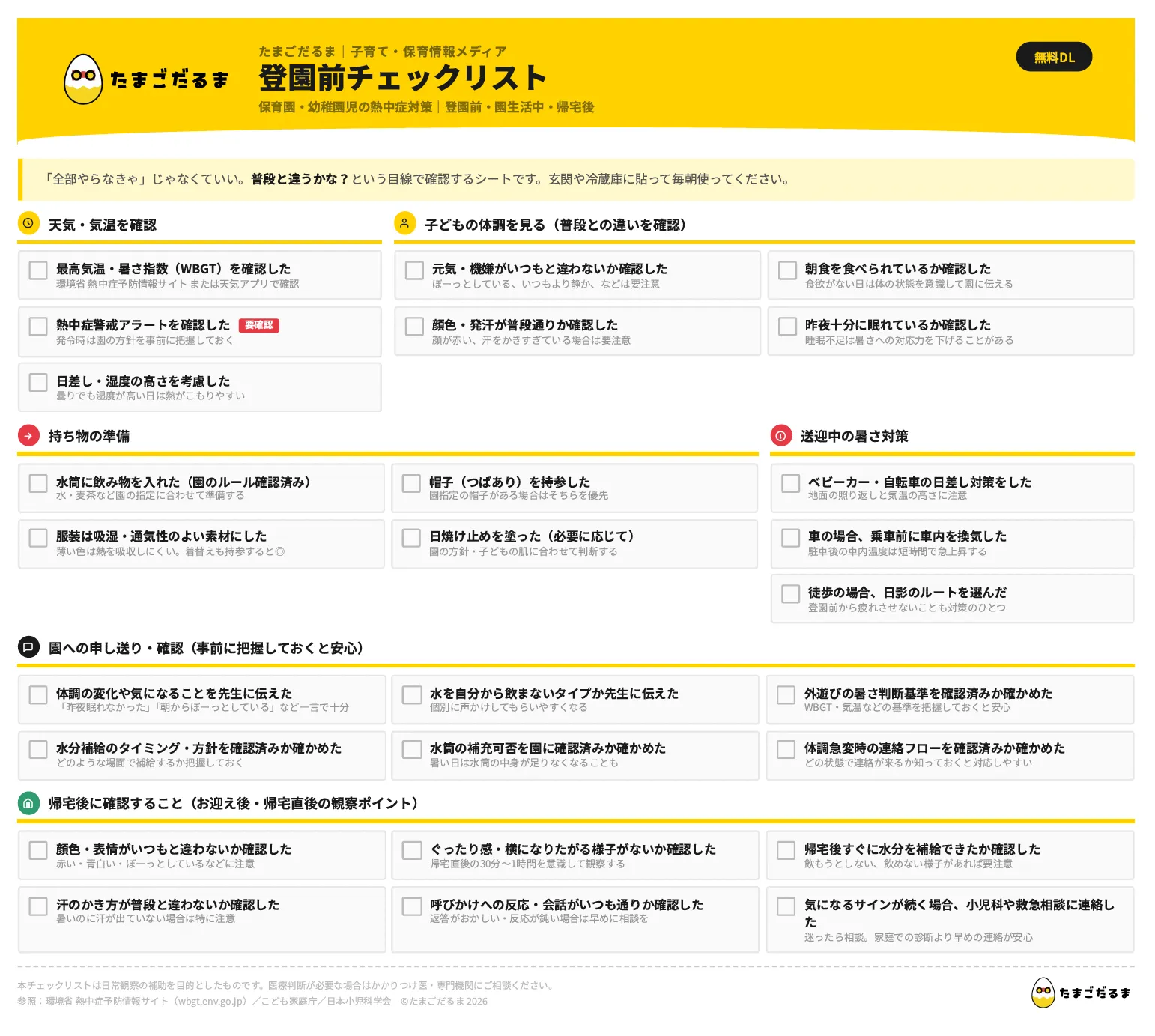


An A4-size PDF you can post on the entryway or fridge and use every morning. Rather than “I have to do everything,” it’s narrowed to items you can check in 30 seconds each morning.
You can’t watch directly during the day, so checking ahead brings peace of mind
Heat protection at daycare or preschool is hard to see from home, so it’s reassuring to check on outdoor play, hydration, breaks, how time indoors is spent, and the criteria for contacting you.
While your child is at daycare or preschool, parents can neither watch directly nor step in. That’s exactly why knowing “how they handle things” before drop-off is a big source of reassurance for parents. This isn’t about “monitoring” the teachers. It’s the idea of sharing information so that the home and the staff can look out for the child facing the same direction.
Five things worth checking with the teachers
Many parents hold back, wondering “is it okay to ask?”, but the following five points are worth checking once before summer. A parent sharing how their child is doing at home can, in some cases, give the teachers a clue for noticing changes.
- The criteria for outdoor play: referring to the heat index and so on, under what conditions do they switch to indoor activities?
- The timing of hydration: in what situations and how often do they drink, and is it an environment where the child can speak up themselves?
- Whether water bottles can be refilled: will they top up the water?
- The approach to indoor activities and breaks: how time indoors is spent, breaks, and their thinking on cooling and ventilation.
- The criteria for contacting you when their condition changes: at what point will they contact a parent?
Just knowing this kind of information considerably eases the vague anxiety of “it was a hot day today — I wonder how they were doing.”
A natural way to ask the teacher
“How should I even ask?” is, in fact, a common worry. Especially for families who’ve just started at a daycare or preschool, or where there’s not much back-and-forth in the communication notebook (renrakuchō), it can be hard to find the right moment to ask.
As one example, here’s a way you might phrase it.
“Now that hot days are increasing, how do you handle outdoor play and hydration? I’d like to be careful at home in the same way.”
Conveying a stance of “I’d like to think about this together” rather than “an order” tends to make conversations with the teacher go more smoothly. Try making use of a one-on-one meeting before summer, the communication notebook, or drop-off and pick-up times.
Editor’s note|Checking isn’t about blaming the teachers — it’s about looking from the same side
TamagoDaruma Editor
Every year before summer, we hear a lot of voices saying “I’m worried about how the daycare or preschool handles things.” I think that feeling is very natural. But what I always feel is that “worry” and “distrust” are different things.
Checking with the teachers isn’t because you don’t trust them. If anything, it’s to create a state where, by holding the same information as the teachers, the home and the daycare or preschool can look out for the child as a team.
Where staff watch over many children, information shared from home can sometimes help in noticing the small changes in each individual child. Telling them “my child tends to show these kinds of signs” or “they’re the type who won’t ask for water themselves” gives the teacher a clue for watching your child’s state more closely too.
You don’t need to worry that checking will make you “look like a difficult, demanding parent” — the kind of worry many parents in Japan feel about being seen as a so-called monster parent. Adding a few words like “thank you for your help” before summer is a first step toward building a good relationship.
What signs don’t you want to miss after pick-up?

After pick-up, look at unusual tiredness, skin color, how well they drink, appetite, and differences from usual, and if something concerns you, consult early.
Plenty of parents feel the worry that “even if they look fine after pick-up, can I really relax?” That feeling isn’t wrong. But rather than making “observation after pick-up” a source of anxiety, try shifting it to a more positive view: “after pick-up is the moment when it’s easiest to notice differences from usual.”
The after-pick-up check isn’t for diagnosing things at home. It’s a guide for noticing differences from usual and, if needed, consulting the teachers or a medical institution.
Points to look at after pick-up
Get into the habit of observing your child right after you get home. Check the following seven points with an eye for “whether it’s different from usual.” There’s no need to brace yourself with “I have to check all of them.” A parent who knows their child well noticing “this is different from usual” is an important clue that can lead to a consultation.
- Expression and color: red, pale, or staring blankly?
- Unusual tiredness: slumping down, wanting to lie down, and so on.
- Whether they can take in fluids: any sign they won’t try to drink, or can’t drink?
- Appetite: their reaction to a snack or dinner.
- How they sweat: despite having been in a hot environment, sweating differently from usual, or not sweating at all.
- Response when called: do they respond when you call their name?
- Differences from usual: value noticing things like “they’re quieter than usual today” too.
Quick-reference chart: easy-to-miss signs by age
How visible the signs of feeling unwell are differs by the child’s age. The quick-reference chart below is not a medical diagnostic standard but a guide to support everyday observation. It’s based on materials from the Children and Families Agency and the Japan Pediatric Society.
| Approximate age | What’s hard to see | What adults should look at | Note |
|---|---|---|---|
| 0–2 years | Hard to put heat or discomfort into words | How they cry, how they drink, color, response when called | If something concerns you, consult early |
| 3–5 years | May not mention discomfort when absorbed in play | Energy, appetite, how much they talk, mood | Look at the difference from usual |
| Lower elementary grades | May push through and put up with it | How tired they are after getting home, how they drink, expression | Don’t rely on the child’s words alone |
(Reference: Let’s watch out together and prevent “children’s heatstroke”!|Children and Families Agency)
(Reference: Heatstroke (injury prevention in children)|Japan Pediatric Society)
Make it a check for leading to a consultation, not a diagnosis
The checks above are only “a trigger for noticing.” They’re not for deciding at home that “they’re worn out, so it’s heat illness.” If there’s a sign that concerns you, we recommend contacting your regular pediatrician, or getting in touch with your local emergency consultation line. Even when you think “it might not be serious enough to see a doctor,” don’t hesitate to consult when you’re unsure.
When you see signs like these, consider consulting or seeing a doctor early
The Children and Families Agency advises that states like the following are danger signs, and to see a medical institution right away.
- A weak response when called, or odd replies
- Unable to drink fluids, or hard to get them to drink even when you try
- Color or skin clearly different from usual
- Despite having been in a hot environment, sweating that seems off, or not sweating at all
- Worn out and not returning to their usual self
In cases like these, don’t judge at home — consult a medical institution or an emergency consultation line.
(Reference: Let’s watch out together and prevent “children’s heatstroke”!|Children and Families Agency)
Common questions about drop-off on hot days
We answer the questions parents tend to get stuck on — water bottles, outdoor play, clothing, checking with the teachers, and how they seem after pick-up.
- Q1. At what temperature should I start being careful about heat illness?
- It’s hard to judge uniformly by temperature alone. The effect on the body changes greatly with humidity, sunlight, the presence of wind, and the child’s activity level and condition. Getting into the habit of also checking the Ministry of the Environment’s “heat index (WBGT)” and the Heat Stroke Alert leads to judgments closer to the actual situation.
(Reference: What is the heat index?|Ministry of the Environment Heatstroke Prevention Information Site) - Q2. Should I put water or tea in the water bottle?
- There’s no rule that one is definitely better. The basic idea is to choose what your child finds easy to drink and what fits your daycare or preschool’s rules. For drinks containing salt and sugar, such as sports drinks, judge according to the child’s age and condition. If anything is unclear, it’s reassuring to ask your regular doctor or the teachers.
- Q3. Is it okay to check the daycare or preschool’s cooling and outdoor-play policy?
- It’s fine to check. If you phrase it as “I’d like to prepare in the same way at home, so please let me know” rather than “conveying a request,” it makes for natural communication. Try making use of a one-on-one meeting before summer, the communication notebook, or drop-off and pick-up times.
- Q4. When they’re worn out after pick-up, how do I tell tiredness from heat illness?
- It’s hard to confirm a diagnosis at home. What matters is “whether today’s state is different from usual.” Check whether they can take in fluids, how their color is, and whether they respond when called. If something concerns you, we recommend contacting a pediatrician or emergency consultation line without hesitation.
- Q5. On a day when a Heat Stroke Alert is issued, should I keep my child home?
- It can’t be said uniformly that you “should keep them home.” A Heat Stroke Alert isn’t a system that directly decides whether to attend; it’s information prompting caution about the heat. The judgment changes depending on your daycare or preschool’s or municipality’s policy, the child’s condition, and your means and distance for the commute. Checking in advance about how they respond when an alert is issued saves you from scrambling on the day.
- Q6. Can children get heat illness even on cloudy days?
- Yes, they can. Even when it’s cloudy, the heat index can be high on days with high temperature and humidity. Don’t let your guard down just because there’s no direct sun — be aware that on humid days in particular, heat builds up in the body easily.
- Q7. If my child doesn’t say “I’m hot,” what should I look at?
- The basic idea is to observe “differences from usual” — color, energy, mood, how they drink, appetite, how they sweat, and so on. A parent who knows their child well noticing “this is different from usual” is an important clue that can lead to a consultation. If there’s a change that concerns you, don’t hesitate to consult early.
Save the checklists and share them at home and with your daycare or preschool before summer
Heat illness prevention isn’t something you read once and you’re done — it’s reassuring to put it in a form you can check at home and with the teachers before it gets hot.
The feeling of “this is the year I’ll really do it” is easiest to summon right after reading an article. But before the heat sets in for real and you find yourself searching again for “that article had something written in it,” we recommend saving the materials today.
The free downloadable checklists
The three materials we’ve prepared this time are all in a form that’s easy to use within the flow of daily life.
- 30-second before-drop-off checklist: post it on the entryway or by the washbasin to check naturally in the morning flow.
- List of things to check with the teachers: useful when writing in the communication notebook, at a meeting, or at a parents’ gathering.
- Quick-reference chart of signs after pick-up: post it on the fridge or entryway so you can check right after getting home.
Check the official information too
This article is based on the following official information. Systems, standards, and figures may change, so please check the latest information on each official site.
- Let’s watch out together and prevent “children’s heatstroke”!|Children and Families Agency
- Heatstroke Prevention Information Site|Ministry of the Environment
- Heatstroke (injury prevention in children)|Japan Pediatric Society
- Information and resources site for heatstroke prevention|Ministry of Health, Labour and Welfare
This article is based on information as of its publication in May 2026. Systems, administrative information, and medical guidelines may change. This article has not been medically reviewed. If you are concerned about your child’s symptoms or about whether to see a doctor, please consult your regular pediatrician or another qualified medical professional.

