
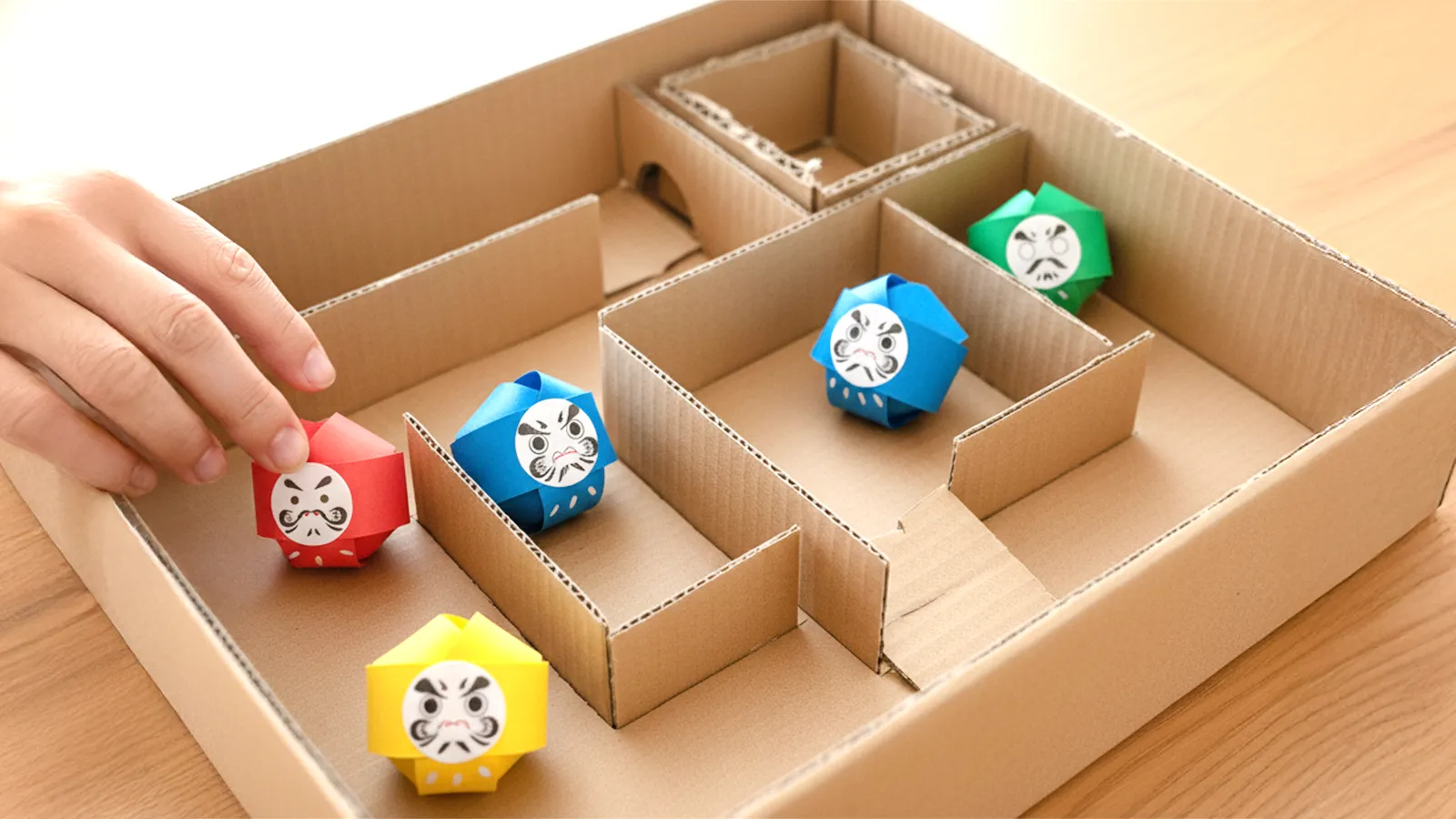
The “rolling daruma device” is a popular craft idea for children that lets them enjoy rolling movements while learning the mechanics behind them. Made from everyday materials, kids naturally understand gravity and balance principles through watching the daruma roll down slopes. By adding colors and decorations, you can arrange it into an original “rolling daruma” design. This article introduces the creation methods, play techniques, and learning benefits of slope crafts that parents and children can enjoy together.
Table of Contents
Create a “Rolling Daruma Device” with Daruma Design!
The “daruma rolling device” lets you enjoy watching balls roll while experiencing the charm of handmade crafts. It’s a slope craft featuring daruma motifs that’s simple to make using everyday materials like paper and cardboard. Beyond the satisfaction of completing a craft project, children can experience and learn about gravity and balance. Here, we introduce a rolling device that incorporates the daruma aesthetic—a craft that’s fun to watch and educational to play with.
What Kind of Craft Is It? Overview of Mechanics and How to Play
The daruma rolling device is a creative craft that uses paper or cardboard to create a “slope rolling mechanism.” You make pathways (rails) from paper and attach them to an angled base, then roll small balls like marbles or beads down the track. The fun comes from designing the path from start to finish—adding curves, tunnels, and branching paths creates varied movement instead of just straight slopes. By drawing and decorating daruma faces and patterns, you create an “auspicious artwork” featuring red and gold tones.
As children notice that changing the angle or path width affects how the ball rolls, they naturally start thinking about “what makes it work better.” This craft combines making, decorating, and rolling—blending play with discovery in one engaging activity.
Materials Needed—Paper Supplies + Path Parts + Rolling Balls
You can gather all the materials for a daruma rolling device from items at home and basic supplies. The fun part is how changing paper strength and path width affects rolling speed and movement. Here’s a basic material list to get started.
Materials List
- Base materials: Cardboard, construction paper, corrugated board (for sturdy foundation)
- Path parts: Thin paper strips, straws, folded cardboard pieces (for creating slopes and curves)
- Decorative materials: Colored construction paper, origami paper, round stickers, markers (for daruma faces and patterns)
- Adhesives: Glue, double-sided tape, wood glue
- Rolling balls: Lightweight beads, small marbles, plastic balls (slightly smaller than path width)
- Tools: Scissors, cutter, ruler, compass cutter (for curved cuts)
By combining these materials, you achieve both sturdy structure and visual beauty. While red and gold daruma are traditional, varying the colors with white or black daruma makes the entire work more vibrant.
When crafting with young children, adults should handle cutting with a cutter while letting kids do the gluing and decorating for safety. Line your work surface with newspaper or a craft mat to make cleanup easier.
How to Make a Rolling Daruma
The appeal of the daruma rolling device lies in its simple structure yet how “thoughtful construction” dramatically changes its movement. The process consists of three main stages: “creating the base,” “building the rails,” and “decorating.” Each step’s attention to detail improves the final quality.
① Create the Base
First, prepare paper or cardboard as the board and attach spacers (cardboard pieces or bottle caps) to one side to create a gentle slope. Aim for a 5–10 degree angle. Too steep and balls fly off; too gentle and they won’t roll. Test different angles to find just the right incline.
② Build the Rails
Next, install the pathway (rails). The key is raising 5mm walls on both sides to prevent balls from falling. On curves, make the inside slightly higher and secure with tape for smooth rolling. Thin paper strips or straws work well for smooth rails. The ideal path width is 2–3mm wider than the rolling ball.
③ Finish with Decoration
Finally, decorate by drawing daruma faces and patterns or adding auspicious designs and ornaments. Drawing Mt. Fuji or a sunrise in the background adds elegance, and lining up multiple daruma creates a “daruma race” effect. After decorating, test the rolling to check for stops or catches, smoothing out uneven spots and fine-tuning rail width to perfect it.
Construction Tips and Customization Ideas
While the daruma rolling device has simple construction, small details dramatically improve “rolling smoothness” and visual quality. Changes in slope angle, path width, and material hardness shift ball speed and movement, so experimenting with children is recommended.
Here are three key construction tips to remember for safe, highly original results.
Improving Rollability (Adjusting Angle, Materials, and Width)
For smooth ball rolling, slope angle and path material choice are crucial. Target a 5–10 degree slope angle; too steep causes excessive speed and derailing. Conversely, too gentle and balls stop. Test multiple times while adjusting. Smooth cardboard or coated paper reduces friction for better rolling. Ideally, make the path 2–3mm wider than the ball. Reinforce with masking tape after completion for durability.
Design Customization for “Fun to Watch” Creations
Once comfortable with courses, enjoy visual customization. Create multiple daruma faces and arrange along the course, or add auspicious themes like gate decorations, Mt. Fuji, and the Rising Sun to add seasonal charm and elegance.
Try adding “bridges,” “tunnels,” and “finish flags” along the course. Children love imagining “which path will it take?” Color schemes work best with red daruma as the base, accented by gold or white. The result is a cute decoration and charming indoor ornament.
Safe Play Precautions (Stabilization, Small Parts, and Supervision)
Since craft parts are typically small and light, safety matters during both making and playing. Back the board with cardboard for stability and check for wobbling before play. Prevent young children under 3 from touching balls or decorations, or supervise closely. When using small parts, ensure adhesive fully dries before playing.
Since course height and angle changes affect rolling speed, let adults supervise initially while explaining how to play. Careful planning makes this a secure, educational craft.
Play Methods and Advanced Variations
The completed daruma rolling device is exciting beyond construction—it improves through repeated play. Slight course changes alter rolling patterns, so children experience “the fun of inventing solutions,” naturally developing scientific thinking. Seasonal design changes create display-worthy art. Here are three development ideas combining play and learning.
Rolling Play Variations (Speed, Distance, and Racing)
The daruma rolling device contains many “experiment” elements despite its simplicity. Try changing the slope angle to compare speeds—steeper angles produce faster motion, gentler ones slower, which kids experience firsthand. This opens questions like “Why does it go faster?” and “Why does it fall if I tilt too much?”—naturally leading to learning about gravity and friction.
Changing rolling balls is also fun. Since marbles, wooden balls, and clay balls roll at different speeds with different sounds, holding “fastest ball races” excites kids. Time contests with stopwatches or create scorecards for record-keeping, building number sense and observation habits. Group play can include “daruma races” with synchronized starts. This simple yet endlessly repeating activity builds curiosity and focus.
Seasonal and Holiday Customization (New Year, Setsubun, Spring Creations)
Daruma-themed crafts become year-round enjoyable when adapted for seasons and holidays. For New Year, create red, gold, and white daruma in an “opening luck race” with Mt. Fuji or gate decorations in the background for festive atmosphere. During Setsubun, add small “demons” beside daruma or roll bean-shaped balls for holiday play fun.
Spring features “cherry blossom daruma,” summer “goldfish daruma,” and fall “maple leaf daruma”—changing themes refreshes the artwork. Using colored paper, stickers, and origami easily adds seasonal flavor. Creating “year-round daruma collections” as a family or class enables displays and presentations. Such customization sparks creativity and teaches children about holiday significance and color impressions—a two-for-one craft.
Advanced Craft Ideas (Multiple Courses, Added Features, Group Projects)
Once experienced, try “advanced rolling devices.” Create branching rails for “unpredictable maze” effects, or add “jump ramps” and “tunnels” for three-dimensional movement and dynamic play. Divide multiple children into groups—one builds the start, another the middle, another the finish—then connect them into a “team project” for shared accomplishment through cooperation.
Add “speed check zones” or “landing areas” as waypoints so children create play rules. Display completed devices as a “daruma rolling land” exhibition for visual enjoyment. These advanced activities develop creativity, structural thinking, and cooperation, guiding daily play into deeper learning.
Learning Expansion and Home and Childcare Usage Ideas
The daruma rolling device goes beyond simple craft and play—it serves as a “learning catalyst” connecting observation, discovery, and expression. The major appeal is children experiencing slope, rolling, and friction through hands-on practice. Crafting creates parent-child and peer communication with shared accomplishment afterward. Here are three advanced applications for homes, daycare, and educational settings.
As Observation and Exploration Teaching Material (Movement, Sound, Material Differences)
The daruma rolling device excels as a teaching material for experiential physics learning. Changing slope angle and path material while comparing ball movement helps kids visually understand relationships between “weight,” “friction,” and “rolling speed.” Asking questions like “What makes it faster?” and “What happens with a smooth surface?” naturally guides children through hypothesis → experiment → discovery. Notice rolling sound differences too—wooden balls go “tap-tap,” marbles “clink,” with different tones by material. Audio and sensory engagement enhance observation. Elementary school students benefit from worksheets for “observation records,” expanding simple play into comprehensive cross-subject learning spanning science, art, and language.
As Parent-Child Communication Craft (Role Division and Cooperation)
At home, enjoy as “joint creation.” Incorporate natural task division—parents cut courses with cutters while children draw daruma faces and apply decorations. Discussing together sparks dialogue like “How do we make rolling easier?” and “Let’s add a slope here!” Through this process, children develop “trial-and-error skills” and “ability to verbalize ideas.” After finishing, host family rolling competitions or record videos. Repeating the “create → play → reflect” cycle deepens family bonds and enriches home time. Displaying the creation sparks later conversations like “Let’s make this again,” fostering creative continuity.
Childcare and Educational Expansion (Collaboration, Presentation, Exploratory Learning)
In daycare and schools, develop daruma rolling devices as “collaborative creation plus exploration.” Divide into small groups assigning roles—one handles angle, another shape, another design—building teamwork and responsibility. Hold presentation sessions afterward where groups share “what innovations we made” and “what was challenging,” creating peer learning. Displaying in hallways extends interaction across classes and broadens communication circles.
For exploratory learning, try experiment themes like “what makes balls roll longest?” or “which material rolls most quietly?” Verbalizing insights gained through experience builds scientific thinking foundations. The warm, welcoming daruma design naturally inspires children’s creative drive.
Summary
The daruma rolling device is a creative craft playable with everyday materials and simple adjustments. Using paper and cardboard while adjusting slope angles and course shapes, children naturally notice “gravity, velocity, and friction” principles, experiencing learning through play. Playing with the completed device develops focus, observation skills, and inventive thinking—the desire for “what’s next?”
At home, it sparks parent-child conversations; in childcare and schools, it works for collaborative projects and presentations. The daruma motif’s auspiciousness and familiarity make creations warmer and more enjoyable. Seasonal customizations and team-building expansions are recommended. Experience the magic of the “daruma rolling device”—connecting play, learning, and art to nurture children’s creativity and smiles at home and in educational settings.
