
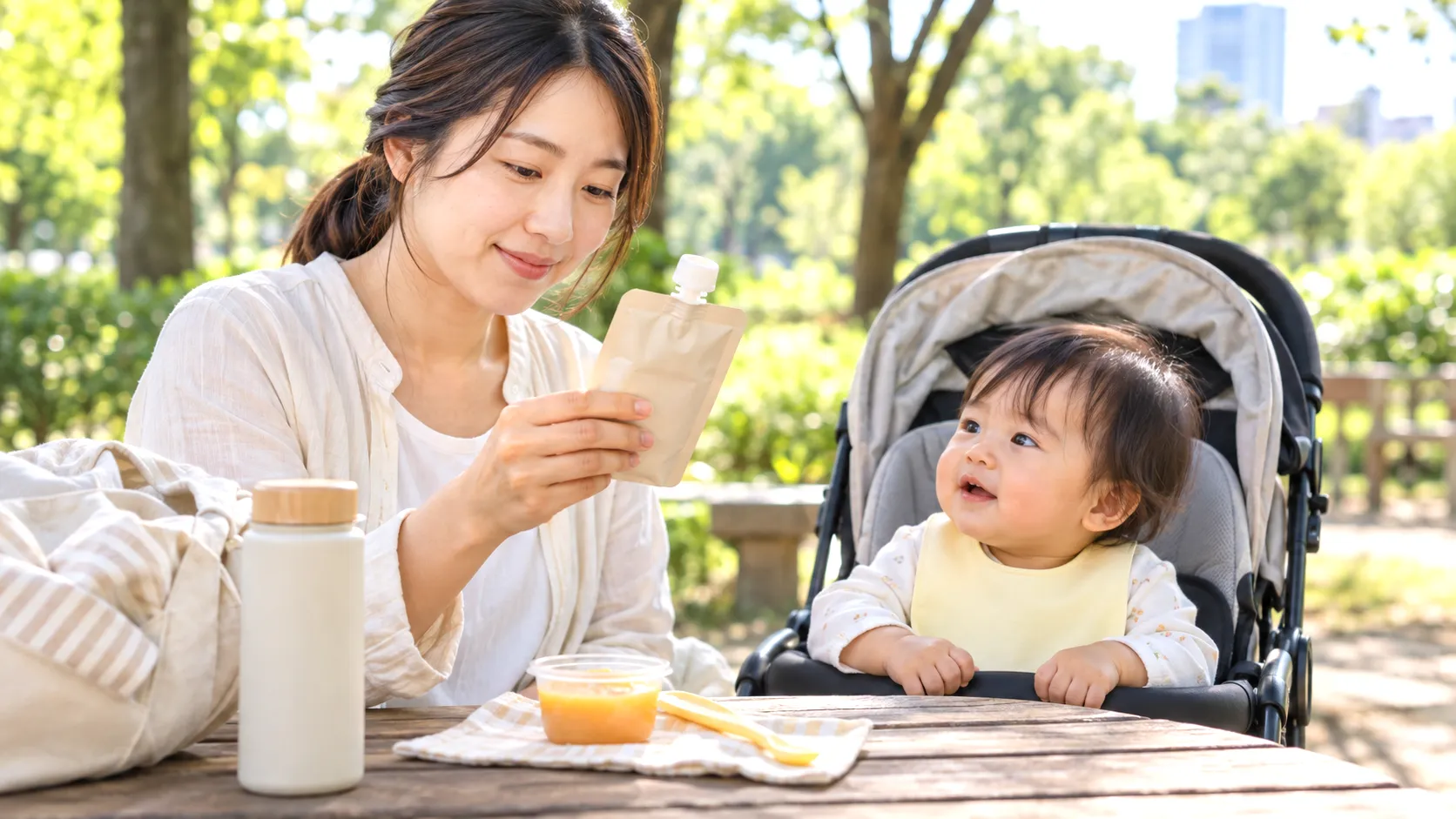
You’re on a park bench, at a jidōkan community center for children, or visiting family, about to open a package of baby food — and you stop. Does this need warming up first? Where there’s no microwave and no hot water, the small print on the package is all you have to go on.
Some commercial baby foods sold in Japan can be eaten without heating. But a package that only says 常温保存 (store at room temperature) doesn’t tell you that. You need to check the usage instructions for the individual product: wording such as 調理済み (already cooked), そのまま召し上がれます (ready to eat as is), or 必ず加熱してください (always heat before serving).
Three things to be clear about first
- 常温保存 (store at room temperature) and “can be eaten without heating” do not mean the same thing.
- Whether heating is required is shown in the usage instructions: そのまま召し上がれます (ready to eat as is) or 要加熱 (heating required).
- Once a package is opened, or food is left over, the storage method and best-before date printed for the unopened product no longer apply as written.
This article separates three things — storage method, whether heating is required, and how to handle the food after opening — so you can make the call from the package in your hand, wherever you happen to be.
Table of Contents
Some baby foods are made to be eaten without heating
A baby food that is already cooked and labeled 温めずにそのまま召し上がれます (ready to eat without heating) doesn’t have to be warmed, provided it has been stored as the label directs and the package has stayed sealed until you serve it.
Wakodo says that products in its Gu Gu Kitchen (グーグーキッチン) and Eiyo Marché (栄養マルシェ) ranges are already cooked and can be eaten as they are, without heating. Kewpie explains that its jars, cup containers, and retort pouches — sealed pouches sterilized after filling — are sterilized using heat under pressure once cooked, so they can be opened and eaten straight away.
Pigeon likewise says its retort baby foods are cooked in vessels that sterilize using heat under pressure, so they can be eaten without heating when you’re out. These are statements each manufacturer makes about its own products, though. Don’t apply them across the board to other products — check the package you’re actually holding.
(Source: Precautions when heating | Wakodo)
(Source: Q&A on baby food and related products | Kewpie)
(Source: Can retort baby food be eaten without heating when out? | Pigeon)
For some products heating is required; for others it’s optional
Warming baby food does two different jobs, depending on the product.
For some products, heating is part of the cooking. These carry wording such as 必ず加熱してお召し上がりください (always heat before serving) or 熱湯を加えてください (add boiling water). You can’t skip the heating or preparation step.
For others, the food is already cooked, and warming is only about bringing it to a temperature and texture your child finds easy to eat. With products labeled 温めずにそのまま召し上がれます (ready to eat without heating), whether to warm it is yours to decide, based on the season and your child’s preferences.
Kewpie notes that when a product has gone cold — in winter, for example — warming it can make it easier for a child to eat. In that case, heating isn’t a required step to make the food safe to eat; it’s a choice about making it more palatable.
Serving something cold doesn’t mean you’ve cut a corner as a parent. If the product doesn’t require heating and your child will eat it comfortably, using it as is while you’re out is a practical option.
Don’t decide from the container alone
The fact that something comes in a pouch or a cup tells you nothing on its own about whether it needs heating.
Pigeon’s Soft Pack Rice, from around 12 months (やわらかパックごはん 12ヵ月頃~), for instance, is a product where heating completes the cooking of the rice, and its official product page states 必ず加熱してお召し上がりください (always heat before serving).
Powdered and freeze-dried products, meanwhile, may need to be reconstituted with hot water. If you’re taking one out with you, check in advance how much water it needs, how it’s prepared, and whether you’ll be able to get hot water where you’re going.
Even among foods that look easy to carry, there are products you can eat as is, products that are only finished by heating, and products you reconstitute with hot water. Don’t judge by the container or the shelf it came from — read the usage instructions on the back.
(Source: Soft Pack Rice, from around 12 months | Pigeon)
Editor’s note
Some parents feel a small pang of guilt about serving commercial baby food without warming it.
Heating at home tends to look like two things at once: a step that makes food safe, and a way to show care.
But with a product labeled as ready to eat as is, the necessary cooking and sterilization have already been done in production. Whether you warm it further at home is mainly a question of what your child will find easy to eat.
常温保存 does not mean “no heating required”
常温保存 (store at room temperature) is mainly a condition for the unopened product. It doesn’t tell you whether the food needs heating before serving, or how to handle it once it’s open.
Check storage, heating, and handling after opening separately
When you look at a package, read the storage method, the usage and preparation instructions, and the notes for after opening as three separate items.
| What to check | What it tells you | Example wording |
|---|---|---|
| Storage method | Where you can keep it while unopened | 常温で保存 (store at room temperature), 直射日光を避ける (keep out of direct sunlight), 要冷蔵 (refrigerate) |
| Usage and preparation | Whether heating or preparation is needed before serving | そのまま召し上がれます (ready to eat as is), 必ず加熱してください (always heat) |
| Notes for after opening | How to handle the product once opened, and any food left over | 開封後は早めに (use promptly after opening), 食べ残しは保存しない (do not keep leftovers) |
The Consumer Affairs Agency’s Quick Guide to Food Labeling explains that the storage method shown on a package is the storage method before opening, in line with the characteristics of the food. Even when a package says 常温保存, you can’t carry that condition over to the product once it’s been opened.
(Source: Quick Guide to Food Labeling | Consumer Affairs Agency)
Read the storage method: 要冷蔵, 直射日光を避ける, and similar wording
Start with the 保存方法 (storage method) line, usually in the block of product information on the back.
If it says 常温で保存 (store at room temperature) or 直射日光を避けて保存 (store away from direct sunlight), those conditions apply to the unopened product. Where a food is labeled 要冷蔵 (refrigerate) or 10℃以下で保存 (store at 10°C or below), it needs to be kept at the stated temperature even while unopened.
The best-before date also assumes the product has been kept unopened, under the storage method shown. Once it’s open, don’t rely on the date alone — follow the separate instructions for handling after opening.
Outdoors in summer, or inside a car, is not the same as “room temperature” at home
A product that can be stored at room temperature isn’t one you should deliberately leave in a stroller in direct sun, or in a car that’s heated up.
Wakodo says that unopened products can be kept at room temperature even in summer, while also advising that you keep them out of direct sunlight and somewhere as cool as possible. Kewpie says the same about unopened products in summer, adding that long periods at high temperatures can affect flavor, so indoor storage somewhere cool is preferable.
For a product that has been left in a car, manufacturers’ advice varies depending on how long it was there and the condition it’s in. Rather than assuming that room-temperature storage means it will keep indefinitely in any conditions, check the official information for that product, or contact the manufacturer’s customer service desk.
(Source: Contact and baby food Q&A | Wakodo)
(Source: Q&A on baby food and related products | Kewpie)
Five places on the package tell you whether it’s ready to eat
Rather than the photo on the front or the shape of the container, check five things in order: the age range, the storage method, the usage instructions, the heating method, and the notes for after opening.
1. Age range and texture
Start with the age range, shown as ○ヵ月頃から (from around X months).
Under the voluntary standard set by the Japan Baby Food Conference, the industry body for baby food manufacturers in Japan, products are labeled with an age range in this form. That said, an age label isn’t a guarantee that every child of that age will manage the food in the same way.
Look at how your child is progressing with solid foods, the size and firmness of the ingredients, how your child is swallowing, and which ingredients they’ve already eaten.
The Ministry of Health, Labour and Welfare’s Guide for Breastfeeding and Weaning Support notes that making good use of processed foods such as baby food helps reduce the burden on caregivers preparing rinyūshoku (離乳食), the weaning meals served as a child moves onto solid foods. It isn’t a choice between homemade and store-bought — it’s about choosing to suit your child’s development and your household’s situation.
(Source: Voluntary standard for baby food | Japan Baby Food Conference)
(Source: Guide for Breastfeeding and Weaning Support | Ministry of Health, Labour and Welfare)

2. Storage method
Next, check how you can carry the unopened product to where you’re going.
- Can it be stored at room temperature?
- Does it need refrigeration or freezing?
- Does it need to be kept out of direct sunlight and heat?
- Is it within its best-before date?
- Is the packaging free of tears, leaks, dents, or unusual swelling?
Products that keep at room temperature are convenient for outings, and leaving them sealed until just before feeding makes them easier to manage.
3. Wording for そのまま, 調理済み, and 要加熱
This is the most important labeling for deciding whether heating is required.
- 調理済みです (already cooked)
- 温めずにそのまま召し上がれます (ready to eat without heating)
- 開けてすぐに食べられます (can be eaten as soon as it’s opened)
- 必ず加熱してお召し上がりください (always heat before serving)
- The section labeled 加熱調理の必要性 (whether cooking or heating is required)
Even when instructions for warming are printed, warming itself may still be optional. Check first whether the product can be eaten as is, then read how to warm it if you decide to.
4. Heating method by container type
If you are warming the food, don’t treat pouches, cups, and jars the same way.
For Wakodo’s Gu Gu Kitchen, the instructions for microwave heating say to transfer the contents to a microwave-safe container. Kewpie, on the other hand, has cup and pouch products that can be microwaved in their own container if you follow the stated procedure.
For jars, Kewpie advises transferring the portion you’re serving into a separate container to warm it, and not using the product’s glass jar for heating. Methods differ between ranges even from the same manufacturer, so check the labeling on the product you’re using now.
5. Notes on opened products and leftovers
Finally, check for notes such as 開封後はお早めに (use promptly after opening), 食べ残しは保存しない (do not keep leftovers), and instructions to portion the food into a separate container.
Kewpie advises that if you plan to keep any of it, you should portion out the amount you’re serving into a separate container when you open the product. Putting a spoon that has been in your child’s mouth back into the container exposes the food to digestive enzymes in saliva and creates a risk of bacterial growth, which is why the company advises against keeping leftovers.
Wakodo also advises that if you want to keep any of the product after opening, you should portion it out with a clean container and spoon before anyone eats from it, and not keep food that has been eaten from.
How long a product can be kept, and whether it can be frozen, differ by product and manufacturer. Don’t apply a time limit you read on one product to another.
If you can’t find the information on the package
When the package doesn’t make the heating requirement or the handling after opening clear, work through these steps in order.
- Re-read the usage instructions and cautions, including the outer box or bag
- Check the manufacturer’s official product page
- Check the manufacturer’s official FAQ
- Note the product name and net weight, and contact the manufacturer’s customer service desk
Photographing the back of the package with your phone before you throw it away means you can still check it while you’re out. Products also get reformulated, so rely on the labeling of the current product rather than old product images or other people’s accounts of what they used.
| Product status or labeling | Can it be served without heating? | How to approach it when out | Check this first |
|---|---|---|---|
| Unopened, labeled as ready to eat as is | Yes, per the labeling | Store as labeled and open just before feeding | Date, storage method, condition of packaging |
| Unopened, labeled as requiring heating | No, heating is required | Choose it for days when you can be sure of a way to heat it | The specified heating method |
| Just opened | Follow the product labeling | The room-temperature labeling for unopened products no longer applies | Notes for after opening |
| Portion set aside in a clean container beforehand | Varies by product | Don’t carry it around at room temperature; store as directed | The manufacturer’s stated time limit and method |
| Leftovers that have been eaten from | Don’t plan on reusing them | Don’t take them home to serve again | The cautions about leftovers |
| Sealed product that has been warmed once | Varies by product | Don’t assume it can simply be stored again | The manufacturer’s official guidance |
Unopened, opened, and eaten from are three different situations
Best-before dates and room-temperature storage labeling can’t be applied as they are to a product that’s been opened, or to food that’s been eaten from. Think about each state separately.
Unopened products
For an unopened product, check the storage method and best-before date printed on the package.
Before you head out, also look for tears in the bag, dents in the container, leaks, or any unusual swelling. Even with a product that keeps at room temperature, somewhere in direct sun or somewhere that gets hot isn’t a place you’d choose to store it.
Opened, but not yet eaten from
The moment a product is opened, the conditions behind the unopened best-before date and storage method have changed.
If your thinking is “my child will only eat a little, so I’d like to save the rest for next time,” portion out only what you’re serving into a clean container from the start. The opened bag or cup may not be suitable for storage, so check the cautions on the product.
Whether a product can be kept after opening, whether refrigeration or freezing is possible, and how soon it should be used all differ by product.
Portions set aside in a clean container beforehand
A portion moved into a clean container before anyone eats from it can, with some products, be refrigerated or frozen.
Manufacturers don’t all say the same thing, though. Wakodo gives refrigeration and freezing guidelines for the products it covers, while Pigeon doesn’t recommend freezing leftover retort pouch food because the flavor may suffer.
Rather than treating “baby food can be frozen” as a general rule, check the guidance for each product.
(Source: Contact and baby food Q&A | Wakodo)
(Source: Can leftover retort baby food be frozen? | Pigeon)
Food touched by a spoon that’s been in your child’s mouth
If a spoon that’s been in your child’s mouth goes back into the container, don’t save the remaining food for another meal — and check the product labeling and the manufacturer’s guidance as well.
Feeling that it’s a waste when your child ate only a mouthful is a natural reaction. But food that’s been eaten from won’t keep the way an unopened product does.
During the stage when your child eats only small amounts, one approach is to portion out a little into a separate container right after opening, then add more with a clean spoon if they want it. That keeps a spoon that’s been in your child’s mouth away from the part you might want to keep.
Products that have already been warmed once
Even if the package is still sealed, don’t assume on your own judgment that a warmed product can be stored under the same conditions as before heating.
For the products it covers, Wakodo says that a product warmed in hot water may still be used if the package has stayed sealed, but advises using it promptly regardless of the best-before date once it’s been warmed. Pigeon doesn’t recommend storing a retort product again once it’s been warmed, since flavor and quality may deteriorate.
For outings, carrying a sealed product that doesn’t need heating and opening it just before feeding can be easier to manage than warming something at home and taking it with you.
(Source: Handling baby food that has been warmed once | Wakodo)
(Source: Storing retort baby food that has been warmed once | Pigeon)
For parks and travel, plan for “before you leave” and “after you open it” separately
For outings, choosing a product that’s sealed, keeps at room temperature, and is confirmed as ready to eat without heating keeps the decisions simple once you’re there.
A checklist for before you leave
When choosing a product
- The age range and the firmness of the ingredients suit your child
- You’ve checked the ingredient and allergen information, including whether it contains foods your child hasn’t eaten before, or allergens you haven’t yet checked
- It keeps at room temperature
- You’ve confirmed it can be eaten without heating
- You’ve checked how to handle it after opening
Before you head out
- It’s within the best-before date
- The packaging is free of tears, leaks, dents, or unusual swelling
- You have a clean spoon
- You’ve packed a container for portioning out, if needed
- You have a way to clean your hands
- You can check the back of the package or the official information
Rather than trying a product for the first time on a long day out or a trip, having your child try it at home beforehand takes some of the uncertainty out of the outing.
What to check just before feeding
Before opening, look at the condition of the packaging once more. After opening, check whether anything about the appearance or smell differs from usual.
If you’ve warmed the food, stir it well so there are no hot spots, and check the temperature yourself before serving it. If you haven’t warmed it, check that it hasn’t become extremely cold — outdoors in winter, for instance — and that your child can eat it comfortably.
Materials from a Ministry of Health, Labour and Welfare study group also list checking the taste, texture, and temperature yourself before serving as a point to keep in mind.
(Source: Points to note when using baby food | Ministry of Health, Labour and Welfare)
What to do with what’s left
If your child doesn’t finish the food, check two things.
- Whether a spoon that’s been in your child’s mouth touched the remaining food
- Whether the product gives instructions for storage after opening
Don’t save food that’s been eaten from; a portion set aside before anyone ate from it is handled according to the guidance for that product.
If throwing food away is hard to do, portioning out a small amount first next time is the practical answer. Throwing away leftovers isn’t treating food carelessly — at that moment, it’s a decision that put your child’s safety first.
If your child won’t eat it cold while you’re out
Even with a product that doesn’t need heating, some children dislike food served at room temperature or cold.
You might try the product at room temperature at home beforehand, choose venues with a microwave or hot water available, or take a product that doesn’t need heating and that your child is already used to.
Try not to settle on “my child isn’t eating because it isn’t warm” — sleepiness, how hungry they are, what’s going on around them, and how they’re seated all play a part. One outing where the meal doesn’t go to plan doesn’t mean that moving onto solid foods as a whole is off track.

If you do warm it, pay attention to the container and the temperature
How to warm a product depends on the container and the range. Follow the stated method, stir after heating, and check the temperature before serving.
Pouches, cups, and jars aren’t warmed the same way
With pouches, some can’t go into a microwave in the bag, while others can be microwaved in the bag once you cut off a specified part.
Cups vary too: some can be heated in the container, others need the food transferred first. With jars, don’t assume the glass is heat-resistant — portion out what you need and warm it by the method the manufacturer specifies.
Similar shapes don’t mean similar instructions. Work from the procedure printed on the product you’re using, not from the type of container.
In the microwave, watch for uneven heating and overheating
A microwave warms food quickly, but parts of it can get very hot.
Thickened baby foods can boil suddenly and spatter, during or after heating. Wakodo advises taking the food out of the microwave gently and taking care when stirring it with a spoon.
Don’t extend the heating time based on your own judgment — check the specified wattage and time. Some products also specify not to use an auto-heat setting.
After heating, stir well so the temperature is even, and check it yourself before serving. If it’s too hot, don’t hurry to serve it — wait until it has cooled to a suitable temperature.
(Source: Precautions when heating | Wakodo)
Check the manufacturer’s labeling before storing a warmed product again
Once a product has been warmed, its flavor and quality may change even if the package is still sealed.
Rather than assuming that a sealed product can be reheated any number of times until its best-before date, check the manufacturer’s guidance. When you can’t predict what time you’ll be feeding your child, warming the food where you are, or choosing a product that doesn’t need heating in the first place, is easier to manage.
FAQ: room temperature, heating, and leftovers
Here are the points people most often find confusing — room temperature, heating requirements, and handling after opening — set against the situations you actually run into when you’re out.
- Q1. If it says 常温保存, does that mean I don’t need to warm it?
- Room-temperature storage alone doesn’t tell you. Check the usage instructions as well, for wording such as ready to eat as is, already cooked, or always heat before serving.
- Q2. Can all retort pouches be eaten as they are?
- The container alone doesn’t tell you. Some products are heat-sterilized and ready to eat as they are, while some packaged products need heating before serving. Go by the product labeling.
- Q3. Can I serve a product that’s gone cold in winter as it is?
- Some products that don’t require heating can be served as they are. That said, cold food can be harder for a child to eat, so check how your child responds and what the product labeling says.
- Q4. Is it fine to take unopened products to the park in summer?
- Unopened products that keep at room temperature can be used for outings, but keep them out of direct sunlight and away from places that get hot. For specific storage conditions, check the guidance for that product.
- Q5. How many hours can I carry it around at room temperature after opening?
- There’s no single time limit that applies across products. The room-temperature labeling for unopened products doesn’t carry over after opening, so follow the product’s instructions for handling once it’s open.
- Q6. Can I take home what my child didn’t finish?
- If a spoon that’s been in your child’s mouth went back into the food, don’t save it for another meal, and follow the manufacturer’s guidance.
- Q7. Can I use a sealed product later if I’ve already warmed it in hot water?
- Guidance differs by manufacturer and product. Use a warmed product promptly, and check the official information, since some products aren’t recommended for storage after warming.
- Q8. Can I microwave a pouch or jar as it is?
- It depends on the product. Some pouches are microwave-safe, while others need the food transferred first, and for some jars the manufacturer advises against using the product’s own jar for heating.
- Q9. What should I do if my child won’t eat it cold?
- You could try the product at room temperature at home, choose a venue with heating facilities, or take a different product your child is used to. Don’t force the issue — check how your child is feeling and whether they’re tired.
- Q10. Can I read products from other countries the same way?
- Not necessarily. Check the local product labeling and manufacturer guidance, including wording such as “ready to eat,” “serve at room temperature,” “refrigerate after opening,” and “heating instructions.”
Using baby food without warming it is one of the ways these products are meant to be used. What matters isn’t whether you managed to provide a hot meal — it’s whether you’ve separated out the product’s storage conditions, its heating requirement, and how it’s handled after opening.
Reading a label isn’t a test of how much a parent knows. It’s precisely because the information you need is small and scattered across the package that it helps to have a set order for looking at it.
When you’re out and unsure, don’t decide on the strength of the words 常温保存 alone — check three things: the storage method, the usage instructions, and the notes for after opening. That small habit doesn’t add to your load, and it makes it easier to handle your child’s meals calmly.
