


Have you ever stood in the kitchen, phone in hand, searching “can my baby eat this yet?” — only to find five different answers from five different sources?
There’s no shortage of weaning information online, but it’s rarely gathered in one place by age, texture, and quantity. So you end up searching the same foods over and over. And sometimes what you find on parenting blogs or in older baby books doesn’t quite match the most current guidelines.
This article is a reference guide — not a recipe collection — built around Japan’s Ministry of Health, Labour and Welfare (MHLW) “Breastfeeding and Weaning Support Guide (2019 revision)”, covering the full journey of introducing solid foods alongside breast milk or formula — from the early stage (around 5–6 months) through the weaning completion stage (around 12–18 months). Throughout this article, “weaning” refers to this gradual introduction of solid foods, consistent with how the term is used by the WHO and public health authorities in many countries. The guidance aligns closely with WHO recommendations and the direction taken by major pediatric associations internationally. We’ve brought it all together in one place — and included a free printable PDF you can stick on the fridge.
This guide is based on Japanese public health guidance. If you live outside Japan, use it as a general reference alongside advice from your local pediatrician or public health authority — specific timings and recommendations can vary by country.
Table of Contents
The Short Answer: Judge Every Food by Three Things at Once
Most weaning confusion comes down to one of two mistakes: checking the age but forgetting about texture and seasoning, or checking the food but forgetting to cross-reference it with your baby’s current stage.
The clearer approach is to assess ① your baby’s age and developmental stage, ② the nature of the food itself, and ③ how it’s prepared and seasoned — all three, at the same time. Only when all three line up does “yes, this is fine to offer” become a confident answer. Even if the age is right, if the texture isn’t, it’s not time yet. The same ingredient served as a smooth purée at 5 months and as soft crumbles at 9 months is a completely different eating experience for a baby.
How to Use This Guide
Using this guide takes four steps.
- Confirm your baby’s current age in months
- Find the food category in the quick-reference chart below
- Check the OK / Caution / Not Yet rating and the reason behind it
- Follow the links to detailed articles for specific foods you want to know more about
If you want to check several foods at once, the printable PDF is a convenient option. It’s also designed to be easy to share with grandparents or other caregivers who are helping with meals.
The Guidelines Behind This Article
All food assessments in this article follow the MHLW “Breastfeeding and Weaning Support Guide (2019 revision).” This was the first major update to Japan’s national weaning guidelines in 12 years, incorporating the latest research and changes in how families actually feed their children. It is currently the standard reference used by local authorities and healthcare providers across Japan.
For allergen information, we reference the Consumer Affairs Agency’s (CAA) food labeling standards, which designate 8 mandatory allergen items and 20 recommended declaration items.
Where this article differs from older parenting books or social media advice, it is usually because those sources are working from pre-2007 guidance. One notable example: under the old guidelines, egg yolk was not introduced until the middle stage (7–8 months). The 2019 revision explicitly permits introducing egg yolk from the latter half of the early stage (around 6 months).
(Reference: Breastfeeding and Weaning Support Guide (2019 revision) | Ministry of Health, Labour and Welfare)
Three Safety Rules to Know Before You Start
Before getting into the chart, there are three rules that apply regardless of age or food category.
Rule 1: No honey for babies under 12 months — ever
This applies throughout infancy, with no exceptions. The reason is explained in detail further below.
Rule 2: Don’t delay introducing allergens out of fear
Putting off allergenic foods does not prevent allergies from developing. The 2019 revised guidelines state clearly that “there is no evidence that delaying the start of weaning or the introduction of specific foods prevents food allergy.” If you have concerns about your child’s allergy risk, discuss the timing with your pediatrician — but delaying on your own is not the recommended approach.
Rule 3: The same food can be fine in one form and not another
“Sweet potato is OK” is true — as a smooth purée in the early stage. Large chunks of sweet potato are a different matter until the later stages. “Plain yogurt is OK” — but a heavily sweetened flavored yogurt is a different food entirely. The chart in this article shows food categories as a starting point. Always check texture and seasoning when you’re actually preparing a meal.
Quick-Reference Chart: Food Categories by Weaning Stage
Use this chart to get a fast read on whether a food is appropriate at your baby’s current stage. The symbols mean:
- ◎: Recommended — actively include
- ○: Fine to offer (pay attention to quantity and texture)
- △: Small amounts only / proceed with care (read the reason first)
- ×: Avoid at this stage
| Food Category | Early Stage (5–6 months) | Middle Stage (7–8 months) | Later Stage (9–11 months) | Completion Stage (12–18 months) |
|---|---|---|---|---|
| Rice / rice porridge | ◎ | ◎ | ◎ | ◎ |
| Bread / udon noodles (wheat) | × | △ (small amount, check for allergy first) | ○ | ◎ |
| Root vegetables (potato, sweet potato) | ◎ (as smooth purée) | ◎ | ◎ | ◎ |
| Dark green & orange vegetables | ◎ | ◎ | ◎ | ◎ |
| Pale-colored vegetables | ○ | ◎ | ◎ | ◎ |
| Fruit | ○ (cooked recommended) | ○ | ○ | ○ |
| White fish | ○ (small amount) | ○ | ◎ | ◎ |
| Red-fleshed fish (e.g. tuna) | × | △ (small amount) | ○ | ○ |
| Oily fish (e.g. mackerel) | × | × | △ (small amount, introduce carefully) | ○ |
| Chicken (tenderloin / breast) | × | ○ (small amount, as purée) | ◎ | ◎ |
| Pork / beef (lean) | × | △ | ○ | ○ |
| Ground meat | × | △ (small amount) | ○ | ◎ |
| Egg yolk | △ (latter half of early stage — start with a tiny amount) | ○ | ◎ | ◎ |
| Whole egg | × | △ (latter half of middle stage — small amount to start) | ○ | ◎ |
| Tofu / soy products | ○ (mashed) | ◎ | ◎ | ◎ |
| Plain yogurt | × | ○ | ◎ | ◎ |
| Cheese (low-salt varieties) | × | △ | ○ | ○ |
| Cow’s milk (as a drink) | × | × (small amounts in cooked dishes only) | × (small amounts in cooked dishes only) | △ (introduce gradually) |
| Vegetable oil / butter | ○ (small amount) | ○ | ○ | ○ |
| Seasoning (stock, salt, etc.) | △ (flavor only) | △ (very small amount) | △ | ○ (keep flavors mild) |
| Honey | × | × | × | × (absolutely no honey under 12 months) |
This chart gives broad category guidance. For specific notes on individual foods, see the sections below.
Around 5–6 Months (Early Weaning Stage): What’s OK, What to Watch, and What to Skip

The early stage is about learning to eat and swallow — nothing more. Breast milk or formula remains the primary source of nutrition, and the focus should be on introducing variety gently rather than pushing quantity.
The best foods to build on at this stage are smooth vegetable purées and 10x rice porridge — easy to digest and low in allergen risk. Pumpkin, carrot, sweet potato, and spinach are all nutrient-rich early-stage staples worth returning to regularly.
Tofu is fine from the early stage, but always heat it and mash it smooth before serving. White fish can be introduced in small amounts. Toward the end of the early stage — around 6 months — you can begin offering hard-boiled egg yolk in a very small amount, roughly the size of a grain of rice. This is one of the key changes from the 2019 revision; the previous guideline placed egg yolk in the middle stage (7–8 months).
Seasoning is not needed. A little cooking stock for flavor is enough — this is the stage for tasting food as it actually is. Under the MHLW-based progression used in this guide, wheat-containing foods such as bread and udon are generally held back until the middle stage, introduced in small amounts once earlier foundations are in place.
Around 7–8 Months (Middle Weaning Stage): What’s OK, What to Watch, and What to Skip

The middle stage moves toward textures that can be mashed with the tongue — roughly the softness of tofu is the standard benchmark.
The range of foods your baby can try expands noticeably at this stage. Plain yogurt becomes an option, udon noodles and bread (unsalted, well-rinsed) can be tried in small amounts, and ground chicken and red-fleshed fish can be introduced gradually. These are the meaningful additions that define this stage.
Whole egg can begin to be tested in small amounts toward the latter half of the middle stage — but egg yolk should already be established first. Managing this step carefully — “egg yolk confirmed, whole egg still in progress” — matters for identifying any reactions accurately.
Cow’s milk as a drink remains off the table, but small amounts used in cooked dishes — a white sauce, a milk-based soup — are fine from this stage.
Around 9–11 Months (Later Weaning Stage): What’s OK, What to Watch, and What to Skip

The later stage targets textures that can be broken down with the gums — roughly the firmness of a ripe banana or a soft meatball. Self-feeding with fingers typically begins around this time too.
Most food categories are now accessible, but size, firmness, and shape remain critical. Round, bite-sized foods (cherry tomatoes, grapes), bouncy or chewy foods (konjac, fish cake, mochi rice cake), fibrous foods (burdock root, lotus root), and foods with skins that separate easily (cocktail sausages) all carry choking risks. Always cut these into small, manageable pieces before serving.
Oily fish like mackerel can be introduced in small amounts from this stage — the general progression is white fish → red-fleshed fish → oily fish. For any food you’re introducing for the first time, keep to small amounts offered in the morning. For specific guidance on using canned mackerel in weaning meals, see our dedicated article on the TamagoDaruma site.
Around 12–18 Months (Weaning Completion Stage): What’s OK, What to Watch, and What to Skip

By the completion stage, most foods that adults eat are technically accessible — but “the same foods as adults” does not mean “the same seasoning as adults, in the same quantities.” That’s probably the most common misreading parents make at this stage.
Cow’s milk as a drink can begin in small amounts now. Keep seasonings mild, and continue to be cautious with processed foods, takeaway meals, and sugary drinks.
Even at this stage, no honey until your child is past 12 months. And the choking risk from round or small foods — cherry tomatoes, whole grapes, beans — continues until around age 3. Shape and size awareness doesn’t stop at weaning completion.
Foods Parents Ask About Most: How to Read the Tricky Ones
Even with a chart in hand, some foods still prompt a “but what about this specifically?” There are a few that come up constantly.
Eggs, Dairy, and Wheat: When Can I Start?
These three come up most often because of allergy concerns — and because many parents have been told (or quietly decided) to push them back.
Eggs: As of the 2019 revision, introducing hard-boiled egg yolk is permitted from the latter half of the early stage — around 6 months. Parents still following older advice (middle stage, 7–8 months) are working from the pre-2019 standard. Delaying introduction has not been shown to reduce allergy risk — the guidelines are explicit on this point. Start with a tiny amount of hard-boiled egg yolk and observe. Move to whole egg in the latter half of the middle stage.

Cow’s milk: As a drink, hold off until the completion stage (12 months+). Used in small amounts within cooked dishes — sauces, soups — it’s fine from the middle stage. For detailed guidance on yogurt, see our dedicated article on the TamagoDaruma site.
Under the MHLW-based progression used in this guide, wheat-containing foods such as udon noodles and bread are generally introduced from the middle stage, in small amounts. Try them on their own the first time. Bread contains salt, butter, and sometimes egg or dairy — so it carries more variables than plain noodles, and is best avoided in the early stage. For udon, rinse well after boiling to remove excess salt.
![[Weaning Basics] 20-second guide: udon noodle size by weaning stage [Tamahiyo Official]](https://i.ytimg.com/vi/vZxsKFzbjcM/hqdefault.jpg)
Canned Mackerel, Yogurt, Cornflakes, Cucumber: How to Read These Specifically
For these foods, it’s not just the ingredient itself — it’s the combination of salt content, sugar content, firmness, skin or peel, and degree of processing that determines whether they’re appropriate.
Canned mackerel in water is fine from the later stage, but many brands contain added salt. Choose a no-salt-added variety, or blanch the fish briefly in boiling water before use to reduce sodium. The bones soften in the canning process, but check visually and break the fish apart before serving. Our dedicated article on this site covers specific recipes and preparation tips.

Cucumber served raw is firm and its skin can remain in the mouth, even in the later stage. Always peel it and cook it until soft before offering.
Cornflakes are often high in sugar. If you use them, choose an unsweetened variety and start with a small amount.

Cow’s Milk, Cheese, Bread, Udon: “OK to Eat” Isn’t the Same as “OK to Drink”
Cow’s milk becomes suitable as a drink from the completion stage and beyond, but small amounts heated within cooked dishes are fine from the middle stage. Cheese tends to be high in sodium — start with a low-salt variety like cottage cheese or a thin slice of mild processed cheese, from the later stage onward.
Bread is a processed product that already contains wheat, egg, dairy, salt, and butter — the fact that it’s technically “OK” as a food category is separate from the question of whether it should be a daily staple. The same applies to udon: always rinse it well after boiling to remove the cooking salt.
When you see “XX is OK” in a weaning guide, the complete question to ask is: “OK in what form, and in what quantity?” That’s the accurate way to read any weaning food chart.
Foods That Can Still Cause Problems Even When the Age Is Right
Even within age-appropriate foods, how you introduce them for the first time matters. For any food with allergy potential or higher digestive load, follow these four principles:
- Offer in the morning: If something does cause a reaction, you’ll have time to contact your pediatrician or local doctor during regular hours.
- Start small: Around half a teaspoon is a reasonable first serving.
- Try it on its own: Don’t introduce two new foods at the same time — if there’s a reaction, you need to be able to identify the cause.
- Only when your baby is well: Avoid introducing new foods during illness or on days when your baby seems off.
These four principles apply to every new food, regardless of category.

Foods to Avoid — and Why They’re on the List
A simple “foods to avoid” list is not very helpful unless it explains why each food is on it. Understanding the reason behind each restriction lets you make better calls as your baby grows.
Foods to Avoid Before 12 Months
![[Important] Never give honey to babies — it can be life-threatening. #honey #botulism #baby](https://i.ytimg.com/vi/mRqQeLDyBi0/hqdefault.jpg)
The most critical one is honey. Honey can naturally contain spores of Clostridium botulinum. In adults and older children, these spores pass through the digestive system harmlessly. In infants under 12 months, the gut is not yet developed enough to prevent those spores from germinating — the bacteria can then produce a toxin in the intestine, causing infant botulism.
This applies to any food that contains honey — baked goods, sauces, honey-glazed products — not just honey served directly. “Just a little” is not a safe threshold, and cooking does not destroy the spores. Any product containing honey should be kept away from babies under 12 months.
The 12-month threshold is the standard public health guidance. When you do start introducing it after that point, begin with a small amount to observe how your child responds.
(Reference: Infant Botulism from Honey | Consumer Affairs Agency, Japan)
Foods That Pose a Choking or Aspiration Risk
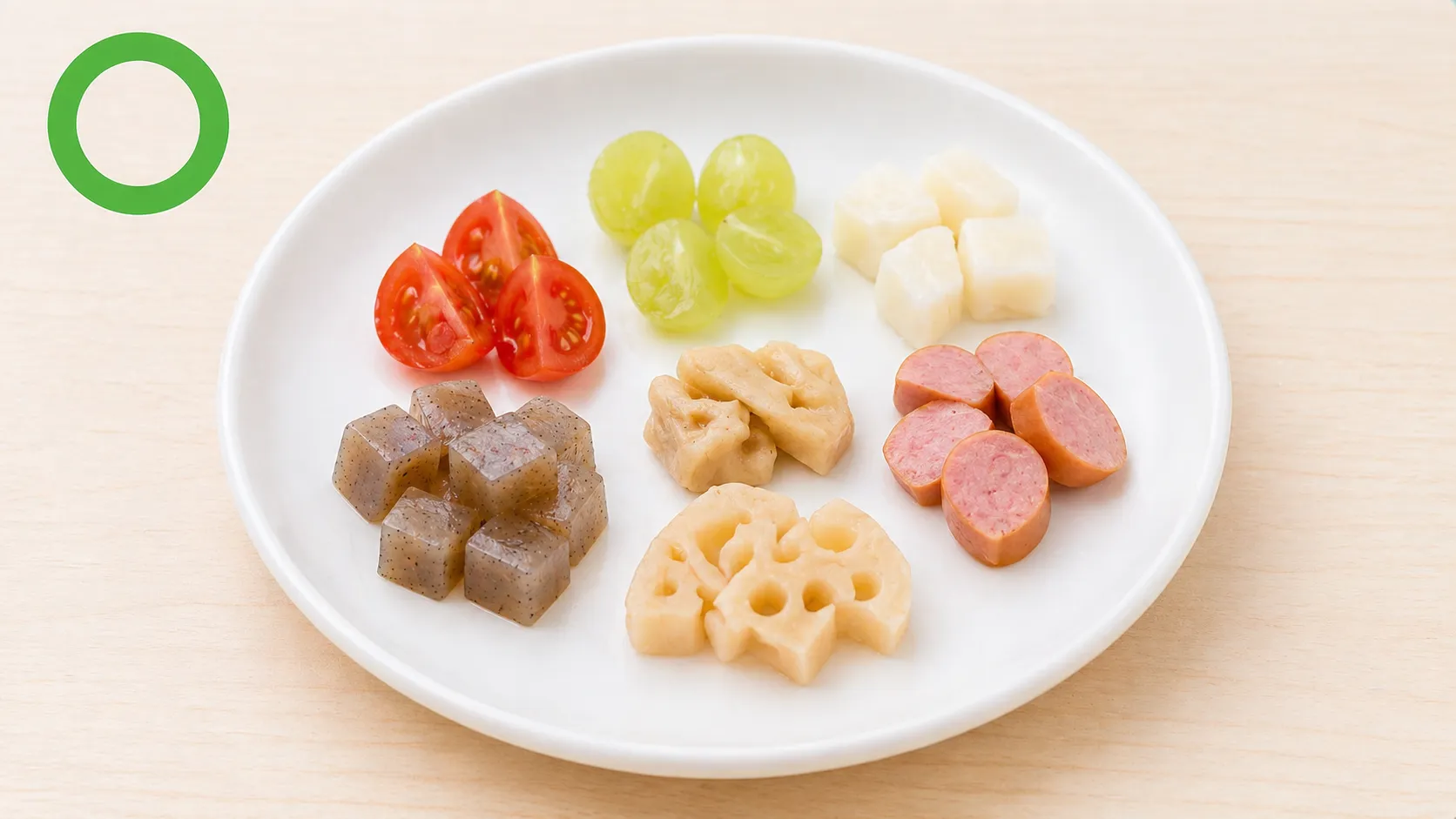

Even as your baby gets older, some foods carry an elevated choking risk depending on how they’re prepared.
The main categories to watch are small, round foods (cherry tomatoes, grapes, whole beans), bouncy or chewy foods (konjac jelly, fish cake, mochi), fibrous foods that don’t break apart easily (burdock root, lotus root), and foods with skins that separate (cocktail sausages, wieners).
None of these are permanently off-limits — they’re foods that require preparation adjustments before serving. Cherry tomatoes cut into quarters, grapes peeled and quartered, sausages cut lengthwise and then into small pieces — shape management makes these foods safe. The choking risk is about form, not the food itself.
Foods That Place Higher Demands on Digestion
Squid, octopus, and raw shellfish are hard on an immature digestive system and are generally held back until around age 2–3. This isn’t a permanent ban — it’s a question of when the digestive system can handle them without strain.
Spicy seasonings (chili, wasabi) irritate the esophagus and stomach, and are worth keeping minimal even into the completion stage and beyond. Caffeinated drinks — green tea, cola, and similar — are best avoided through the toddler years.
How to Think About Food Allergies
Japan’s food allergen labeling system designates 8 mandatory declaration items (egg, milk, wheat, shrimp, crab, buckwheat, peanuts, and walnuts) and 20 recommended declaration items (including squid, abalone, salmon roe, orange, kiwi fruit, beef, sesame, salmon, mackerel, and others).
(Reference: Food Allergen Labeling Information | Consumer Affairs Agency, Japan)
The most important practical point: don’t continue eliminating these foods based on your own assessment alone. If your child shows a reaction — rash, hives, vomiting, swelling around the eyes or lips, changes in breathing — that’s a reason to see a doctor, not to simply cut the food out indefinitely. Diagnosing a food allergy is the role of a physician, and ongoing self-imposed elimination without a diagnosis can lead to nutritional gaps and reduced variety in your child’s diet.
Common Mistakes — and How to Avoid Them
Based on the questions and feedback that reach the TamagoDaruma editorial team, here are four patterns that come up repeatedly.
Checking the Age, But Missing the Texture
A common example: “My baby is 9 months old, so I gave plain cooked rice.” Plain rice is too firm for this stage. Even through the later stage (9–11 months), fully cooked soft rice or a thick rice porridge is the appropriate texture. The move to regular cooked rice typically happens toward the latter half of the completion stage, around 12–18 months.
Age is a rough guide — it tells you where most babies are developmentally, not where your specific baby is. Watch how your child chews and swallows, and let that observation guide texture adjustments more than the calendar does.
Trying New Foods for the First Time at Night or on Weekends
The guideline is clear: try new foods for the first time on a weekday morning. The reason is practical — if your baby has any kind of reaction (rash, vomiting, sudden change in mood or behavior), you want to be able to reach your regular pediatric clinic during normal hours.
It’s easy to end up trying things on busy weekends, but the “new foods in the morning on a weekday” rule is there as much for the parent’s peace of mind as it is for the baby’s safety.
Taking Social Media or Older Books at Face Value
Weaning guidance evolves, and older information still circulates widely — including on social media. Two of the most common mismatches with current guidance are: the egg yolk introduction timing (old standard: 7–8 months; current: from around 6 months), and the idea that delaying allergenic foods prevents allergies (no longer supported by evidence, and explicitly addressed in the 2019 revision).
When grandparents say “this is how we did it with you,” they’re drawing on genuinely different guidelines. The science has moved, and so has the official guidance. Pointing to the current MHLW document tends to be more effective than a direct disagreement.
Assuming “Won’t Eat It” Means “Too Early”
Most of the time when a baby refuses something, the reason isn’t allergy or developmental unreadiness — it’s texture, temperature, or just the mood of the day. Not eating and not being ready to digest are different things. Often, a small change in how something is prepared or when it’s offered makes the difference.
A reasonable approach: if something isn’t accepted after three attempts across different days, set it aside for a couple of weeks and try again. There’s no need to push, and no need to write the food off.
Free Printable PDF and More Detailed Guides
What the Printable PDF Includes
The age-by-age OK/Avoid food chart from this article is available as a free A4 landscape PDF, formatted for printing and practical kitchen use.
Sticking it on the fridge means you don’t need to pull out your phone every time a question comes up. Parents have also found it useful for getting partners on the same page, and for sharing with grandparents or other caregivers who are helping with meals. Having it within reach changes how quickly you can make a confident call in the kitchen.
What’s in the PDF
- Age-by-stage OK/Avoid food chart (A4 landscape, print-ready): A matrix of four weaning stages against major food categories
- First-introduction food checklist: A checkbox layout covering the four principles — time of day, quantity, single ingredient, health check
- Notes section for allergy tracking: Space to write in guidance from your child’s doctor and foods you’ve already confirmed

Free download here (STORES)
Use it on your phone while cooking, or print it and keep it on the fridge — whichever fits how you work in the kitchen.
Detailed Articles for Specific Foods
The following foods have dedicated articles on the TamagoDaruma site.
Later stage through 12 months: fish, meat, and dairy
- Can you use canned mackerel in weaning meals? Stage-by-stage recipes and safe preparation guide
- When can babies have yogurt? Quantities, frequency, benefits, and what to watch out for
Later stage through 12 months: vegetables, grains, and other
- Cucumber from 12 months: benefits, safety notes, preparation methods, and storage
- Cornflakes from 12 months? How to choose the right kind, serve safely, and easy recipe ideas
- Is gratin OK for 12-month-olds? Recommended ingredients and a simple microwave recipe
- Can toddlers have garlic? Appropriate amounts, things to watch, and recipe ideas
- 3 baby-friendly ramen recipes and what to keep in mind when serving noodles to a 12-month-old
When to Contact a Doctor
The information in this article reflects general guidance. If any of the following occurs after a meal, contact your regular pediatrician rather than waiting to see what happens.
- Rash or hives on the face or body
- Swelling around the lips or eyes
- Vomiting or diarrhea that continues
- Persistent coughing that doesn’t stop
- Unusual breathing, or your baby seems limp or unresponsive
If your baby shows rapid deterioration — breathing difficulty, a sudden loss of responsiveness — contact emergency services immediately. If you are outside Japan, call your country’s emergency number or go to the nearest pediatric emergency facility.
Summary
Most of the “can my baby eat this?” questions that weaning raises can be answered reliably once you have the right framework and a complete reference in one place.
The framework stays consistent throughout: assess age and developmental stage, food properties, and preparation method — all three together. Use Japan’s MHLW “Breastfeeding and Weaning Support Guide (2019 revision)” as the benchmark. And don’t hold back allergen-containing foods longer than necessary without medical guidance.
One thing worth saying directly from the TamagoDaruma editorial side: a “perfect” weaning routine is less valuable than a weaning routine that parents can actually sustain. Looking things up every day is fine. Sharing the chart with grandparents is fine. Taking it step by step is more than enough.
We hope this article and the printable PDF make those quick kitchen judgment calls a little easier.


