
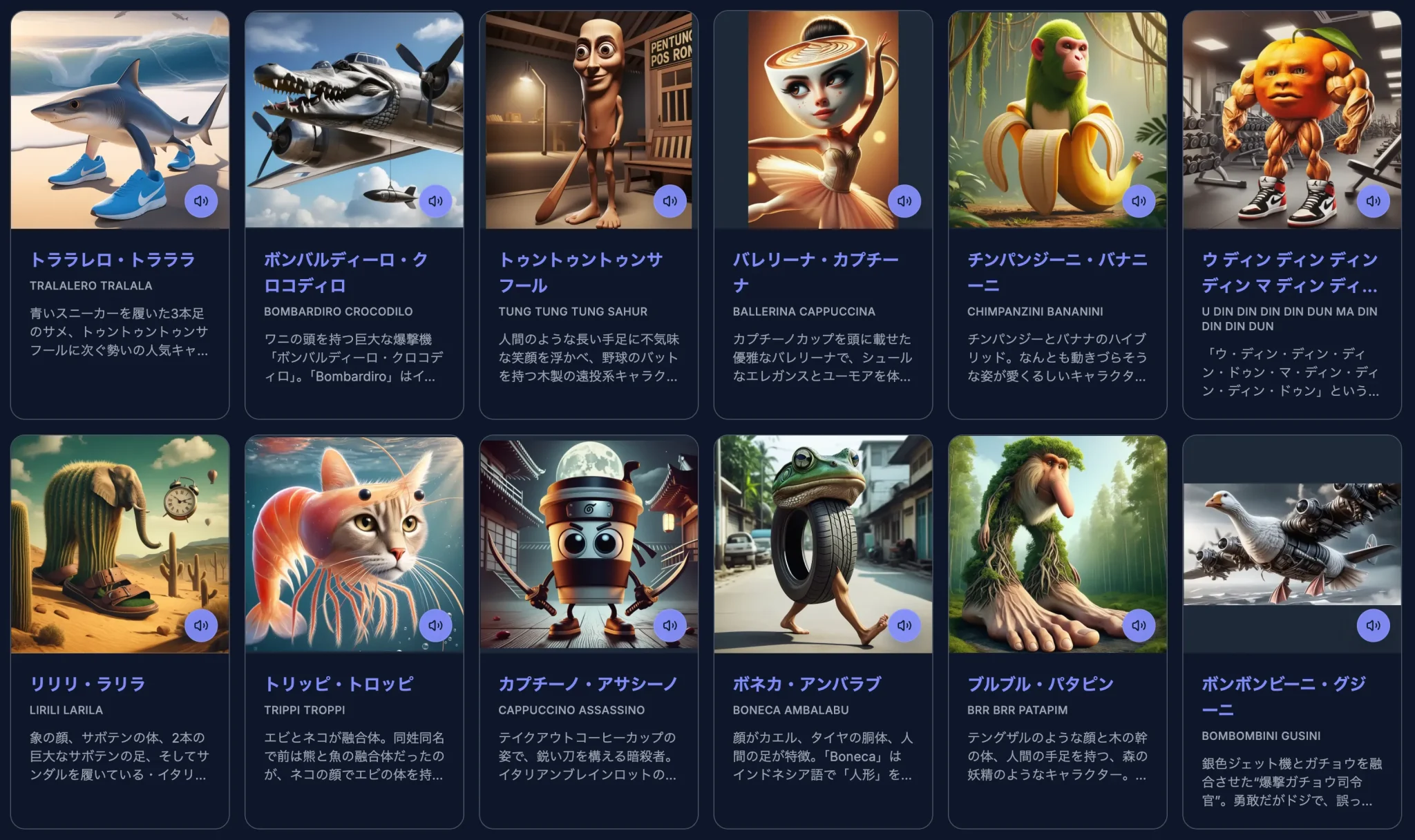
Italian Brainrot is a meme culture featuring characters with nonsensical wordplay, addictive movements, and sounds that’s currently taking the world of children by storm. Because it can be enjoyed intuitively through short videos, it has spread rapidly through social media and video sites, with the appeal being the “I don’t know why, but it’s funny” sensation.
In this article, we’ll introduce the TOP 10 ranking of Italian Brainrot characters that are particularly popular among children. We’ll also explain why kids are so captivated by them and provide perspectives that adults should know about how to approach this phenomenon.

Table of Contents
Italian Brainrot Popular Characters TOP 10
While there are numerous characters in Italian Brainrot, the ones that particularly resonate with children are those with catchy name sounds, rhythmic audio, and strong visual impact.
There’s hardly any meaningful storyline, but the “easy to remember” and “easy to imitate” aspects contribute to their popularity. Here, we’ll introduce the most representative characters that are popular with children and appear frequently, presented in ranking format.
1st Place: Tralalero Tralala
This is the quintessential character that symbolizes Italian Brainrot.
With its shark-like appearance wearing sneakers and audio that rhythmically repeats meaningless phrases, it has a strong addictive quality that “sticks in your ear even though you don’t understand it.” Many derivative videos and imitation works have been created, making it widely known as the character that children are most likely to encounter first.
2nd Place: Tung Tung Tung Sahur
@the_byan イタリアンブレインロット曲
This character is characterized by the “Tung Tung Tung” sound repeated at a steady rhythm. While the name is said to originate from Indonesian culture, it’s actually a made-up word with no clear meaning.
With its drum-like sound quality and simple structure, it’s easy for children to hum along, and they may suddenly start saying the phrase at home.
3rd Place: Bombardiro Crocodillo
This character features an impressive hybrid design combining a crocodile and an airplane.
It’s characterized by strong visual stimulation due to large movements and fast-paced videos.
The name has a funny sound quality, and the fact that you want to repeat it even without understanding its meaning is why it’s popular with children.
4th Place: Ballerina Cappuccina
A ballerina with a cappuccino cup on her head—a slightly strange and memorable character.
The Italian-style motif is visually easy to understand, and within Italian Brainrot, it’s recognized as being relatively “on the cute side.” It’s characterized by ballerina-like movements combined with meaningless audio, making it popular among children.
5th Place: Brr Brr Patapim
With an appearance that looks like a combination of a monkey and moss (or wood), this character repeats the distinctive phrases “Brr Brr” and “Patapim.” The sound itself leaves a strong impression, and there are many cases where children repeatedly say just the phrase.
Because the videos are mainly short with good tempo, they easily lead to continuous viewing, making it an entity that prominently embodies the addictive nature characteristic of brainrot.
6th Place: Lirili Larila
With an appearance that looks like a combination of a cactus and an elephant wearing slippers.
It’s characterized by repeating phrases in a monotonous rhythm, with simple and calm movements and structure. The characteristic is that it can be enjoyed without understanding the content, and it easily develops into imitation play and wordplay, with many cases of children suddenly humming it at home.
7th Place: Trippi Troppi
This character has an appearance that looks like a combination of a cat’s head and a shrimp’s body.
There are multiple derivative versions, including one with a bear-like body and fish head.
It’s characterized by rhythmically repeating the Italian-style nonsense phrase “Trippi Troppi Troppa Trippa,” and the humor of this rhythmic coined phrase is central to its popularity. It often appears as derivative videos or combinations with other characters, giving birth to various fan creations online.
8th Place: Bombombini Gusini
This character features an appearance that looks like a combination of a goose and a bomber aircraft.
There’s no meaningful story, and it can be said to be a type of brainrot that enjoys the bizarre appearance and the sound quality of the name.
Additionally, it appears in games like Fortnite and is popular in places beyond internet memes.
9th Place: La Vaca Saturno Saturnita
A space-themed character featuring a distinctive combination of a cow’s head, a Saturn-like body, and giant human feet.
It’s characterized by its very long name, with strong visual impact, and has established itself as a type of meme that enjoys the “dissonance between appearance and name.”
10th Place: Frigo Camelo
With an appearance that looks like a combination of a refrigerator and a camel, wearing Timberland-style boots. It has the characteristic of blowing cold air from its mouth. The incomprehensible combination stands out, making it popular as a symbol of brainrot-like qualities.
The very act of feeling “why?” about this absurd combination can be said to be the humor of this character.
Mini Glossary for Parents (Words That Are Easy to Stumble Over)
Italian Brainrot topics may be understood among children, but for parents, there are many unfamiliar words that can lead to “what is this, anyway?” moments.
Just getting a rough grasp of the terminology makes it easier to understand video content and children’s conversations, and also makes necessary supervision easier.
Here, we’ll briefly organize basic terms that are particularly easy to stumble over, characteristics of character names, and the difference between official and unofficial content.
Let’s prioritize perspectives useful for household management over linguistic accuracy.
What Are Brainrot / Meme / Template?
- “Brainrot” literally translates to “brain rotting,” but it’s actually internet slang that self-deprecatingly describes “content with little meaning that you end up watching endlessly” or “content that empties your head.”
Rather than something dangerous, it’s easier to understand it as a word with a strong nuance of enjoying silliness. - “Meme” refers to trending jokes or styles that spread online while being imitated. It includes video audio sources, phrases, poses, and ways of using images—things that spread on the premise of being copied.
- “Template” means a pattern, referring to posting patterns created by fitting into a fixed format. When videos with the same audio source, editing, and punchline increase, it’s a sign that templating is progressing.
Why Character Names Sound Similar and Their Characteristics
Character names sound similar because they’re created prioritizing the “sound quality” of pseudo-Italian.
Rather than names meant to convey meaning, emphasis is placed on sound rhythm, ease of pronunciation, and resonance that makes you want to repeat them. For example, alliteration (starting with the same sound), repetition (repeating the same word), and aligning vowel sequences are used to create an ear-catching effect.
As a result, names with similar rhythms like “Tralalero Tralala” and “Trippi Troppi” become common, which can sometimes confuse children. Conversely, it can be said that they’re designed to be easy for children to hum and share with friends. Parents don’t need to remember them perfectly; knowing the premise that “there are tons of names with similar sounds” makes conversations easier.
Official vs. Unofficial Differences and Safety
Italian Brainrot isn’t a monolithic “official series” as a work, but rather a meme culture where secondary creations and derivatives multiply in chains online. Therefore, even with the same character name, the design and content can differ depending on the poster, making it unclear how far the “official” version extends.
What parents should be conscious of regarding safety is the “content” rather than the “source.” Check whether there’s excessively stimulating imagery, violent or sexual expressions, discriminatory language, or contexts that attack others. For viewing, utilize child-friendly platform settings (restricted mode, etc.) and don’t just let them watch continuously. If concerned, limiting to moderate posters and safe accounts with the same name is an effective strategy.
Guide to Managing It at Home
Italian Brainrot is a type of short-form meme that’s “fun even without understanding the meaning” for children. Starting with prohibition or denial can actually cause them to watch it secretly or reduce parent-child conversation. What’s important is first understanding their interest while organizing viewing time and content with household rules.
Having mechanisms in place to naturally shift to offline play makes it less likely to become a battle of confiscation. Here, we’ll organize tips for communication, adjusting screen time, and signs that require attention.
Understanding Children’s Interests: How to Ask “What’s Funny About It?”
When asking children “What’s funny about it?”, making it like a “live interview” rather than an interrogation makes the conversation flow better. For example, start with easy-to-answer questions like “What do you like about this character?”, “How does this sound feel?”, or “Which character do your friends like?” Putting denial first with “It doesn’t make sense, does it?” tends to make them defensive, so it’s best to avoid that.
What’s recommended is letting the child become the “guide.” Treating it as an area where the child is knowledgeable, like “Make a ranking,” “Teach me how to say the names,” or “Which one do you think will be popular next?”, also satisfies their self-esteem. Parents don’t need to fully understand the humor. Just adding empathetic words like “The sound is addictive, huh?” or “Maybe the tempo feels good” can create an atmosphere where they feel comfortable talking. If you can have conversations, content checks and time adjustments become easier to accept.
Screen Time Balance: Natural Transitions to Offline
Short-form videos are structured to play one after another, making it easy for children to lose track of time. So at home, deciding not just “viewing time” but also “how to transition” as a set makes it less contentious. For example, rules like “finish after 3 videos,” “stop when the timer goes off,” or “until the next scheduled activity (bath/dinner)” should be short and specific. If parents change it based on mood, negotiations increase, so the trick is to decide in advance and implement matter-of-factly.
When moving offline, play that utilizes the same “sound, tempo, and imitation” is effective. Turn character names into tongue twisters, make rhythm clapping games, draw pictures to create an encyclopedia—translate video elements into home play.
Proposing “Let’s continue with this next” rather than “Stop it” makes children more likely to accept.
The realistic approach is to naturally position it within daily rhythms rather than reducing viewing to zero.
Signs That Require Attention: Guidelines for Continued Viewing Time and Dependency
While “how much is OK” varies by age and household situation, using “impact on daily life” as a guideline rather than time makes judgment easier.
For example, attention signs include: strong tantrums every time you try to stop them, sleep and meals being postponed, noticeably reduced interest in outdoor play and conversation, and school/daycare preparations not progressing.
Also, regularly check whether content is escalating to stimulating videos (violent, sexual, discriminatory expressions).
As a response, narrowing down “time, place, and number” is more successful than sudden total prohibition. For example, make conditions clear like “living room only,” “after homework and preparations are done,” or “weekends only.”
If you’re letting them watch on your own smartphone, viewing history and recommendations can be reinforced, so utilizing child settings or restricted mode is also effective. When concerns are strong, having the option to consult with daycare, school, or specialized services rather than handling it alone at home provides peace of mind.
Summary
Italian Brainrot is a short-form meme that fits today’s generation of children, enjoying incomprehensibility and strong sounds and tempo.
While it’s easy for adults to be bewildered, trying to understand “why they like it” rather than dismissing it outright makes managing it at home easier.
While organizing viewing time and content with rules, it’s important to naturally expand into offline play and conversation.
By observing children’s behavior and using whether it’s interfering with daily life as a guideline for supervision, it becomes easier to maintain a balance between trends and peace of mind.
