“We didn’t get a spot at hoikuen, Japan’s licensed daycare system.” “I’m working from home but can’t get anything done with a toddler around.” “I only need a few hours this afternoon — where do I even start?” These are real, pressing problems that many families in Japan face on a regular basis.
There are several ways to arrange childcare outside of standard licensed daycare enrollment: drop-in daycare at a facility (ichiji azukari), babysitting services, the municipal Family Support Center program, commonly shortened in Japanese to “Famisapo,” and the newly launched Universal Preschool Access Program (Kodomo Dare Demo Tsuen), which began nationwide implementation in 2026. Each option, however, serves a different purpose — and what works well for one family may not work at all for another.
This guide compares all four options through four practical lenses: urgency, cost, your child’s age, and ease of use. Beyond explaining the differences between each program, we also cover how subsidies work, common mistakes families make, and what you can do now to be prepared. The goal is to help you figure out which option actually fits your situation.
Table of Contents
The Right Childcare Option Depends on Urgency, Purpose, and Your Child’s Age
To put it simply: the best option changes depending on when you need care, why you need it, and how old your child is.
If you need care urgently, a private babysitting service is usually the most realistic first step, since you can often arrange someone with relatively short notice. If you want ongoing, community-based support at lower cost, Famisapo — a membership-based mutual aid program run through your local municipal office — may be a better fit. If your child is between 6 months and under 3 years old, is not yet enrolled in any licensed facility, and you want them to experience a structured childcare environment without a parental employment requirement, the Universal Preschool Access Program is worth looking into. And for short-term, facility-based care arranged through the public system, drop-in daycare (ichiji azukari) is the standard option.
Because each program has its own strengths, the most efficient approach is to clarify your needs and situation first — then match them to the right option.
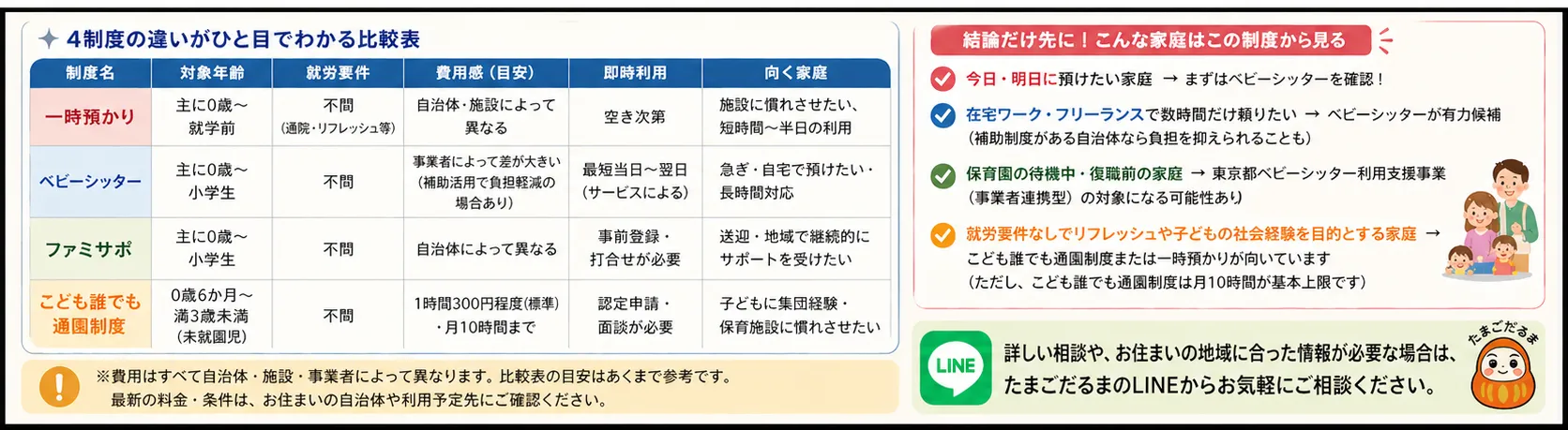
Quick Comparison: All Four Options at a Glance
| Program | Age Range | Employment Required? | Approximate Cost | Can You Use It Quickly? | Best For |
|---|---|---|---|---|---|
| Drop-In Daycare (Ichiji Azukari) | Mainly 0–preschool age | No (hospital visits, errands, personal time, etc.) | Varies by municipality and facility | Subject to availability; advance booking usually required | Families wanting a few hours at a licensed facility; gradual adjustment for the child |
| Babysitting Services | Mainly 0–elementary school age | No | Varies widely by provider (subsidies may reduce costs significantly) | Same day to next day possible depending on service | Urgent needs; working from home; families needing longer or more flexible hours |
| Famisapo (Family Support Center) | Mainly 0–elementary school age | No | Varies by municipality | Advance registration and a meeting with your support member required | Regular pickup/drop-off; ongoing community-based support |
| Universal Preschool Access Program (Kodomo Dare Demo Tsuen) | 6 months to under 3 years (not enrolled in any facility) | No | Around ¥300 per hour (standard); up to 10 hours per month | Municipal enrollment and an orientation meeting required | Families wanting early social experience for their child at a licensed facility |
※ All costs depend on your municipality, facility, and provider. The figures above are for general reference only. Always confirm current rates and eligibility directly with your local municipal office or the provider you plan to use.
Where to Start Based on Your Situation
If you need care today or tomorrow, start with private babysitting services. Most other options require advance registration or setup that takes more time.
If you work from home or freelance and need a few hours of support, babysitters are again the most practical option. In Tokyo and some other municipalities, subsidy programs can help reduce the out-of-pocket cost.
If you’re on a hoikuen waitlist or preparing to return to work, you may be eligible for Tokyo’s Baby Sitter Subsidy Program (Provider Partnership Type), which is designed specifically for families in this situation and supports ongoing monthly use.
If you’re a stay-at-home parent or work part-time and want your child to have some time in a group care setting — without a work requirement, the Universal Preschool Access Program or a facility offering drop-in daycare for personal time are both worth exploring. Keep in mind that the Universal Preschool Access Program is capped at 10 hours per month, so it is not a substitute for regular full-time childcare.
There’s no single “best” option. The question is: which one fits your family right now?
Which Type Are You? A Quick Self-Assessment
Before comparing programs, it helps to step back and think about why you need childcare. That reason — more than anything else — points you toward the right starting point.
You Need Care Today or This Week
When time is short, your first question should be: can this option actually move within a day or two?
Drop-in daycare at public facilities is a legitimate option, but spot availability can mean waiting several days to a week. Famisapo requires membership registration and a meeting between you and your support member before care can begin — that process alone rules it out for truly urgent situations.
For same-day or next-day care, a private babysitting platform is the most realistic option. These services let you check a sitter’s availability directly and in some cases arrange care for the same day or the following day.
That said, nothing is guaranteed — evenings and weekends tend to book up fast. If you have even a little lead time, use it.
You Work From Home or Freelance and Need a Few Hours to Focus
Some parents feel guilty arranging childcare while they’re physically at home. But trying to work and keep a young child occupied at the same time is genuinely difficult — and the strain affects both parent and child. Arranging a few hours of childcare support on work-from-home days is a practical choice, not something to feel guilty about.
For this situation, a babysitter is the most flexible option. Because the sitter comes to your home, your child doesn’t have to be transported anywhere, and you can get into a focused working state more easily.
Drop-in daycare requires a round trip to the facility, which can eat into the time you’re trying to free up. If you’re considering drop-in daycare for this purpose, weigh the time cost carefully. Check whether any local subsidy programs apply to your situation, and choose based on the balance between cost and convenience.
You’re on a Hoikuen Waitlist and Need Care Before Returning to Work
For families approaching a return-to-work date without a confirmed hoikuen placement, this isn’t a “nice to have” — it’s urgent. One-off, single-day solutions won’t work here; you need something that can run reliably for weeks or months.
Tokyo operates a program called the Baby Sitter Subsidy (Provider Partnership Type), which supports families on the hoikuen waitlist and parents returning from at least one year of parental leave. The subsidy helps reduce the monthly cost of using an accredited babysitting agency until a licensed facility placement becomes available. More details are in the cost and subsidy section below.
Famisapo can also work for ongoing care in some areas — particularly for regular pickups or care on set days of the week — depending on how many support members are available in your neighborhood. Contacting your local Family Support Center directly is the best way to find out what’s actually possible where you live.
You Don’t Have a Work Requirement, But Want Your Child to Have Social Experiences — or You Need Time for Yourself
Many stay-at-home parents and part-time workers find themselves wanting a little breathing room, or wanting their child to spend time with other children and adults outside the home. Both are completely legitimate reasons to use childcare.
The Universal Preschool Access Program and drop-in daycare facilities that allow personal-time use are both designed for situations like this.
One thing to be clear on: the Universal Preschool Access Program is built around giving children time in a licensed care environment, not around freeing up parental time in bulk. The 10-hour monthly cap means it won’t cover a substantial block of personal or work time. If you need more flexibility, combining it with drop-in daycare or occasional babysitter use is more realistic.
What Each Program Actually Involves: A Parent-Focused Breakdown
Now let’s look at each option more closely. Rather than just restating eligibility rules, we’ll focus on what each program is actually like to use — including the situations it fits well and the pitfalls to watch for.
Drop-In Daycare (Ichiji Azukari)
Drop-in daycare — ichiji azukari in Japanese — is a public childcare service offered at licensed hoikuen (nurseries) and nintei kodomoen (certified children’s centers). It allows parents to leave their child at the facility on a temporary basis for reasons such as medical appointments, errands, or personal time. Note that despite the “drop-in” name, most facilities require advance booking or registration rather than walk-in use. The care environment is stable and run by qualified childcare staff, which many parents find reassuring.
Costs vary by municipality and facility. Check directly with your local municipal office or the facility you’re considering before making plans. Availability depends on open spots, and at popular facilities or during peak periods — like when many parents are returning to work — spots can be fully booked weeks in advance.
Many facilities also ask first-time users to start with a short session before building up to longer stays, so that the child has time to adjust. Factor this into your timeline if you’re planning to start using drop-in daycare soon.
Best Fit
Families who need a few hours of care for a specific appointment or errand, and families who want to introduce their child to a facility environment gradually.
Common Mistake and How to Avoid It
Calling one facility and finding no availability is a common first experience. Build a short list of nearby facilities in advance, check their availability regularly, or ask to be notified if a spot opens up. Having a backup option makes a real difference.
Babysitting Services
Babysitting services send a childcare provider to your home or a location of your choice, where they care for your child one-on-one or in a small group. Because there’s no transport involved and the child stays in familiar surroundings, many families find this the most practical day-to-day option.
Costs vary significantly between providers. Subsidy programs offered by some municipalities — including Tokyo — can reduce the out-of-pocket amount, so it’s worth checking what’s available in your area before assuming the cost is out of reach.
Services generally fall into two categories: agency-dispatched, where a coordinator matches you with a sitter, and platform-based matching, where you browse and book sitters directly through an app or website. Matching platforms tend to move faster for urgent bookings, but for first-time use, allowing a bit of extra time to find someone who’s a good fit for your child is worthwhile regardless of which type you use.
Note that babysitting is not a licensed profession in Japan — providers are not required to hold a childcare qualification. When choosing a service, check whether the company conducts background screening and training for its sitters.
Best Fit
Families who need care urgently, families who need in-home support while working from home, and families on the hoikuen waitlist who need something reliable over an extended period. If a municipal subsidy applies, the cost-benefit calculation often improves significantly.
Common Mistakes and How to Avoid Them
“I assumed the subsidy applied, but the provider wasn’t on the approved list” and “I missed the application deadline” are two of the most common problems. If you’re planning to use a municipal subsidy, confirm the provider is on the approved list before booking, and let the provider know at the time of booking that you intend to apply for subsidy support.
Famisapo (Family Support Center Program)
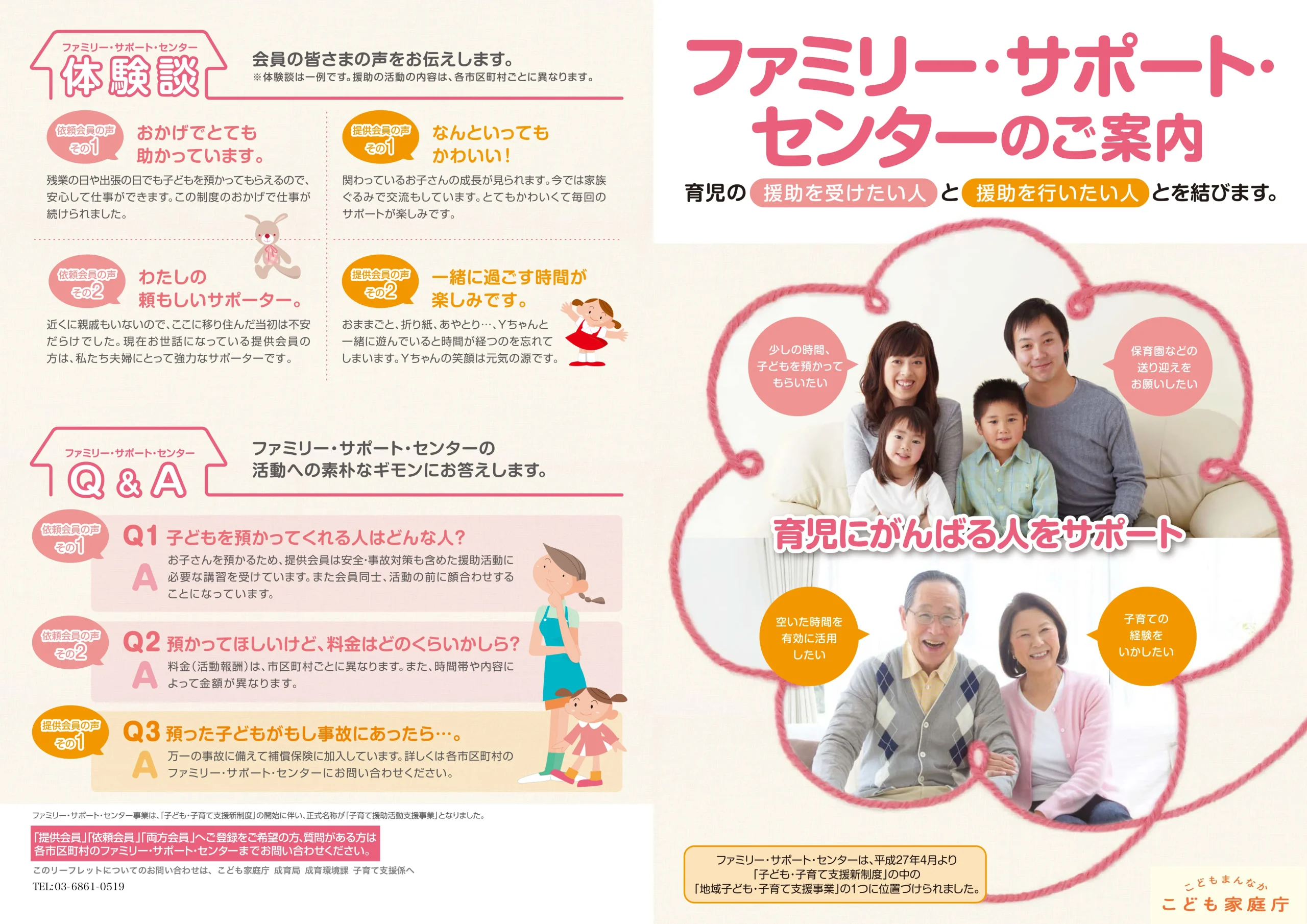
The Family Support Center program — widely known as Famisapo — is a municipal mutual aid network that connects families who need childcare support with community members who can provide it. Local municipal offices coordinate between “requesting members” (families who need help) and “providing members” (community volunteers who are available to help), creating a neighborhood-based support structure.
Support can include dropping off or picking up children from hoikuen or other facilities, looking after children while parents handle appointments, and taking children to and from extracurricular activities. Fees are set by each municipality, so check locally for the current rate. Compared to private babysitting services, the cost tends to be lower — though this varies by area.
Providing members are not required to hold childcare qualifications, but they do complete a training course set by their municipal government before they begin. Going into Famisapo with a clear understanding that this is a community volunteer program — not a professional childcare service — helps set realistic expectations.
Best Fit
Families who need regular help with pickups and drop-offs, or who want ongoing support from the same person on set days. Families who value being connected to a local support network tend to get the most out of this program.
Common Mistake and How to Avoid It
In some areas — particularly outside major cities — there simply aren’t enough providing members to meet demand. Before completing your registration, contact your local Family Support Center and ask whether there are available members in your area who can cover the days and times you need. Registering first and finding out later that no one is available is a frustrating experience that’s easy to avoid.
Universal Preschool Access Program: Nationwide Implementation Begins in 2026
The Universal Preschool Access Program — known in Japanese as Kodomo Dare Demo Tsuen — is a newly created national program introduced as part of Japan’s Child and Family Future Strategy. It allows children aged 6 months to under 3 years who are not enrolled in any licensed childcare facility to attend hoikuen or nintei kodomoen on an hourly basis, regardless of whether their parents are employed. The program was formally established under the Child and Family Support Act in 2025 and began nationwide implementation in 2026, with availability varying by municipality and facility.
Eligibility is limited to children not currently enrolled in hoikuen or kodomoen. The standard usage cap is 10 hours per month, and the standard fee is ¥300 per hour. Actual fees may vary between facilities and municipalities, and some municipalities offer reduced fees for lower-income households. Confirm the details with your local municipal office.
The most important thing to understand about this program is that parental employment is not a requirement. It was designed specifically to give children in non-working or part-time household situations the chance to spend time in a licensed care environment.
Enrollment requires municipal certification. The process involves an application, an orientation, and — in some areas — use of the national childcare support portal system (Tsuen Portal) operated by Japan’s Children and Families Agency. Check with your local municipal office for the exact steps in your area.
Best Fit
Stay-at-home families and part-time working families who want to give their child gradual exposure to a group care setting, or who want their child to become comfortable in a facility environment before eventually enrolling full-time. Used consistently within the monthly cap, it can be a meaningful part of a young child’s weekly routine.
Common Mistake and How to Avoid It
“I tried to use it as a substitute for hoikuen while working, but 10 hours a month wasn’t nearly enough.” This mismatch is easy to fall into. This program is designed as a developmental and family support resource — not a working parent’s childcare solution. If you need care to cover employment hours, applications for licensed hoikuen and supplementary use of drop-in daycare are both necessary alongside this program.

Which Option Fits Which Family? Scenario-Based Guidance
Now that the programs are laid out, let’s apply them to real situations. The goal here isn’t “which option is theoretically best” — it’s “which option should I actually move on first, given my situation right now?”
Working From Home and Need 2–3 Hours to Focus
This is one of the most common situations — and honestly, one of the least well-served by the public system.
Drop-in daycare requires a round trip to a facility, which can easily eat up an hour of the time you’re trying to recover. Famisapo can work for some things, but short in-home coverage isn’t always easy to arrange through the program depending on your area.
In practice, a babysitter who comes to your home is the most workable solution for this scenario. Getting comfortable with the booking process in advance means you can call on it without stress when you actually need it. If you’re in Tokyo, using a provider listed under the Baby Sitter Subsidy Program (Temporary Childcare Support) can help keep costs manageable.
(Reference: Baby Sitter Subsidy (Temporary Childcare Support) | Tokyo Metropolitan Government Welfare Bureau)

On the Hoikuen Waitlist and Need Care Before Returning to Work
If your return-to-work date is approaching and you don’t have a hoikuen placement yet, you need a solution that can hold up over weeks or months — not just a one-off booking.
Tokyo has operated the Baby Sitter Subsidy Program (Provider Partnership Type) since 2018, supporting families on the hoikuen waitlist and parents returning to work after at least one year of parental leave. Through this program, a portion of the monthly cost of using a Tokyo-certified babysitting agency is subsidized until the child secures a licensed facility placement.
(Reference: Baby Sitter Subsidy (Provider Partnership Type) | Tokyo Metropolitan Government Welfare Bureau)
Eligibility and conditions vary by ward and city within Tokyo, so your first step is to contact the children’s services counter at your local municipal office.
Care Needed Today or Tomorrow — Urgent
Unexpected situations happen to every family. When you’re in one, here’s a practical sequence to work through:
- First, check whether your local drop-in daycare facility has a same-day opening
- If not, search a private babysitter matching platform for sitters with same-day or next-day availability
- If the provider qualifies under a local subsidy program, check whether you can apply for partial reimbursement after the fact

Famisapo is generally not a realistic option for urgent care if you haven’t already completed registration and been matched with a providing member. If this situation has come up, it’s a good prompt to start the Famisapo registration process now — so it’s available to you in the future.
Stay-at-Home Family Wanting Early Social Experience for Their Child
The desire to give your child time around other children and adults outside the home — even if you’re not working — is something many parents share. For young children, those interactions matter.
The Universal Preschool Access Program is the option most directly designed for this. It doesn’t require parental employment, allows children to attend a licensed facility within the 10-hour monthly limit, and lets them build familiarity with a care setting gradually over time.
The catch is availability. Even as the program rolls out nationally, the number of participating facilities and available spots varies considerably by area. Contact your local municipal office sooner rather than later to find out what’s actually accessible near you.
(Reference: Universal Preschool Access Program | Children and Families Agency, Japan)
Pregnant, Unwell, or Managing Multiple Children and Need Help With Your Older Child
In the weeks around a new birth, or during pregnancy-related illness, many families suddenly need someone to look after an older child when there’s simply no capacity left at home.
In these situations, preparation done in advance is what actually protects you. When you have capacity — during pregnancy, or during parental leave — take care of the following: register with Famisapo and complete the initial meeting with a providing member, visit at least one local drop-in daycare facility and find out how they handle availability, and set up an account with a private babysitter platform even if you don’t plan to use it immediately.
Famisapo in particular can take several weeks from registration to first use. Starting the process during pregnancy is genuinely worth doing.
Costs, Subsidies, and What’s Changed in 2026
“Okay, I understand the programs — but what does it actually cost?” This is usually the next question, and it’s a fair one. Costs depend heavily on where you live, but here’s a framework for thinking about it — including a look at Tokyo’s subsidy programs as a concrete example.
Three things to confirm before you book anything:
- Is the provider on your municipality’s approved subsidy list?
- What are the application deadlines and required documents?
- Are there age limits or monthly hour caps that apply in your ward or city?
National-Level Basics Worth Knowing
Famisapo may qualify for inclusion under Japan’s early childhood education and care fee waiver program under certain conditions. However, eligibility depends on whether you hold a “childcare need certification” and on the type of facility involved. If your child is already enrolled in a hoikuen or kodomoen, Famisapo use through that program may not qualify. Check directly with your local municipal office and the facilities you’re considering — the rules have enough variation that generalizing is risky.
The Universal Preschool Access Program sets ¥300 per hour as its standard fee, but individual facilities and municipalities may set different rates. Reduced-fee options for lower-income households exist in some areas.
Drop-in daycare fees vary by facility and purpose of use. In all cases, confirm the current fee schedule directly before booking.
Why Tokyo’s Babysitter Subsidies Get So Much Attention
Tokyo’s babysitter subsidy programs attract attention because the difference between using them and not using them can be substantial.
Through the Baby Sitter Subsidy (Temporary Childcare Support), Tokyo’s welfare bureau subsidizes part of the hourly cost for parents who need short-term babysitter support for daily-life situations or social participation. The subsidy covers up to ¥2,500 per hour (or ¥3,500 per hour during late-night and early-morning hours) when using a Tokyo-certified provider — and that certification requirement is the detail that catches many families off guard.
Some wards have also been expanding eligibility. Nerima Ward, for example, extended the eligible age range to include children up to third grade of elementary school from 2026. Conditions continue to be updated at the ward and city level, so it’s worth checking current terms directly.
The Provider Partnership Type subsidy is a separate program from the Temporary Childcare Support subsidy, even though both fall under Tokyo’s babysitter support umbrella. They have different eligibility criteria and target different situations. Confirm which one applies to you before applying.
Checklist: What Varies by Municipality
When using any subsidy program, these are the items most likely to differ between municipalities. Checking them in advance will help you avoid unexpected costs or missed applications.
- Eligible age range (some programs are preschool-only; others extend to elementary school)
- Annual or monthly cap on subsidized hours
- List of approved providers (only providers on this list qualify)
- Application deadlines and required documents
- Whether same-day or urgent bookings are eligible
- Cancellation fee policies
- Whether babysitter transportation of the child qualifies for subsidy
- Whether additional support is available for families with multiples or single-parent households
Information about these programs is updated regularly. Before applying or booking, check the official page for your municipality to confirm the current rules.
Common Mistakes — and What to Do Before You Need Any of This
Japan’s childcare support programs have expanded considerably in recent years, but knowing a program exists and actually being able to use it when you need it are two different things. Here’s where things go wrong — and what you can do about it now.
Mistake #1: Assuming Registration Means You Can Start Right Away
Both Famisapo and drop-in daycare share a common pitfall: registering does not mean you can start using the service immediately.
With Famisapo, after you register, a municipal coordinator introduces you to an available providing member, and the two of you need to meet and sort out the practical details before care can begin. Depending on availability and scheduling, this process can take several weeks — and that’s assuming a suitable providing member is available in your area at all.
With drop-in daycare, many facilities ask new users to start with a short introductory session so the child can get used to the environment. If you call a facility expecting to start full sessions the following week, you may find there are more steps involved than you anticipated.
The fix is simple: start the process as soon as you think you might need the service — not when you’re already under pressure.
Mistake #2: Booking a Babysitter and Finding Out the Subsidy Doesn’t Apply
Tokyo’s babysitter subsidies apply only to providers that the metropolitan government has officially certified. Not every babysitter platform or agency qualifies. The approved provider list is maintained on the municipal government’s website and is updated periodically.
“I booked a sitter thinking the subsidy would cover it, but the company wasn’t on the list” is a mistake that happens regularly. Always verify approved-provider status before booking, and tell the provider at the time of booking that you intend to apply for the subsidy. Note also that subsidies are typically claimed after the fact — you’ll need to submit receipts and supporting documents within the required window, so keep track of those from the start.
Mistake #3: Expecting 10 Hours a Month to Be Enough for Work Coverage
The Universal Preschool Access Program’s 10-hour monthly cap is one of the most frequently misunderstood aspects of the program. Some families assume it can serve as a bridge between home care and full hoikuen enrollment while a parent returns to work — only to find that 10 hours doesn’t go very far.
This program was not designed to replace working-parent childcare. It exists to give children developmental experiences in a licensed setting, and to support families who aren’t in the standard hoikuen enrollment system. If you need coverage for employment hours, you’ll need to layer in licensed hoikuen enrollment applications and drop-in daycare alongside this program.
A Preparation Checklist Worth Working Through Now
If you’re pregnant, on parental leave, or within two to three months of a return-to-work date, working through this list while you have capacity will make things considerably easier later.
- Register with Famisapo and complete the initial meeting with a providing member
- Visit at least one local drop-in daycare facility, and find out how to check for available spots
- Set up an account with a private babysitter matching platform — even if you don’t use it yet, having an account ready saves time in an urgent situation
- Look up the subsidy programs available in your ward or city: which providers are approved, what the application process involves, and what documentation you’ll need
- Find out where the Universal Preschool Access Program is being offered near you and what the enrollment process involves
- Write a one-page summary of the options that apply to your family, so you can refer to it quickly if something comes up
Summary: When You’re Not Sure, Use These Four Filters
After comparing all four programs, here’s a simple framework to fall back on when you’re not sure where to start:
- Urgency: If you need care fast, private babysitting services are your most realistic first move
- Ongoing community support: If you want consistent, local help over time, look into Famisapo
- Cost with public system access: If keeping costs down is the priority, drop-in daycare or a subsidized babysitter arrangement is worth exploring
- Early experience for a child not yet in any facility: The Universal Preschool Access Program is designed for this
That said, every program plays out differently depending on where you live. The same program can work very smoothly in one ward and be practically inaccessible in the next, because of differences in available spots, subsidy conditions, eligible ages, and how applications are handled. Use this article to get your bearings, then confirm the current situation at your local municipal children’s services counter or on your municipality’s official website.
One thing we’d add at TamagoDaruma: try to think of these programs not as things you either “use” or “don’t use,” but as options you know about and are ready to act on. Family situations shift. Something that isn’t relevant today might become genuinely important six months from now. Knowing your options — and having already taken a few of the initial steps — is what gives you room to move when things change.
If you’d like more personalized guidance on what’s available in your area, feel free to reach out through TamagoDaruma’s LINE channel.