
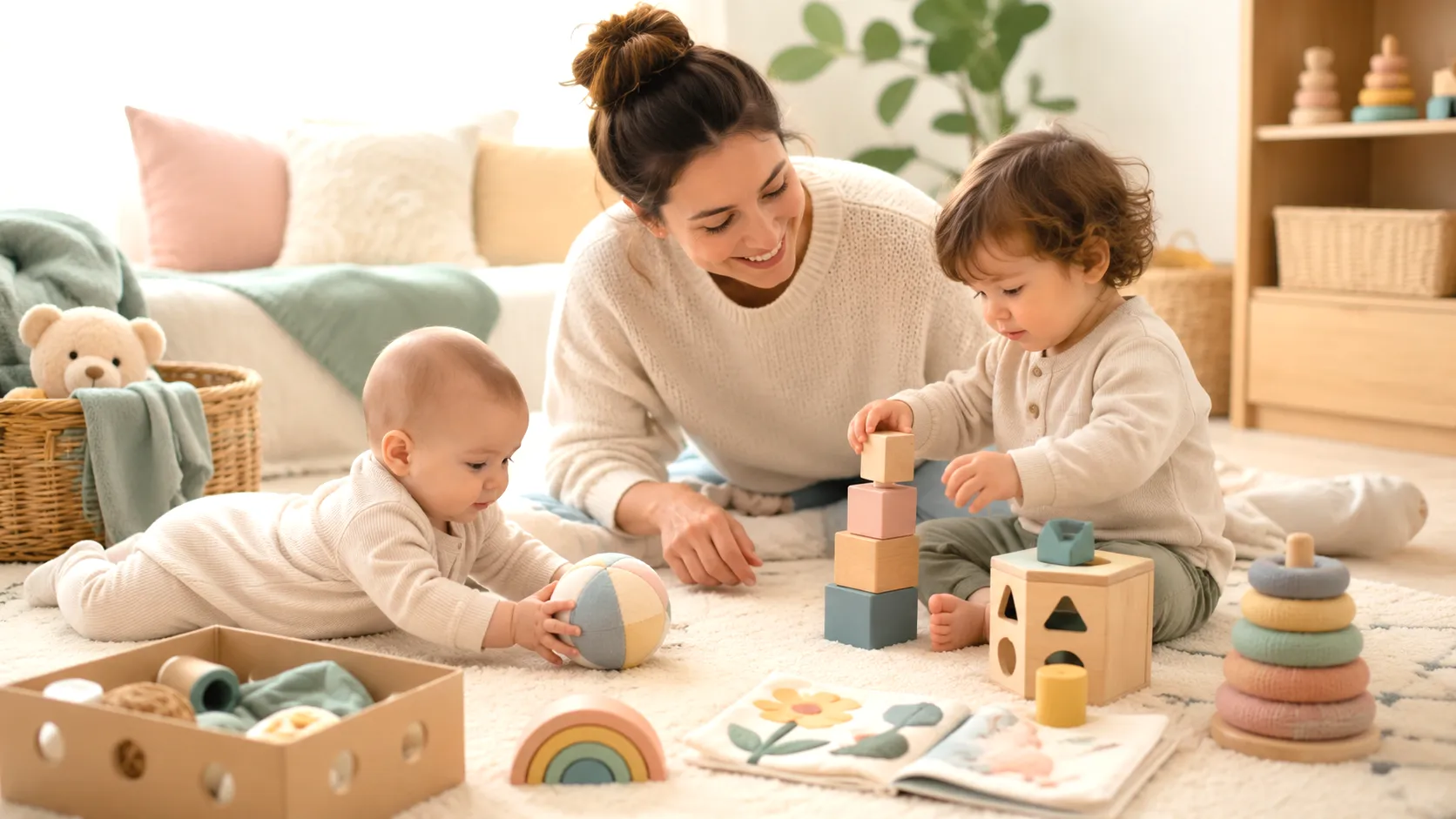
If you’ve ever thought to yourself, “I didn’t really play with my baby properly today” — this article is for you.
Play that supports development from 0 to 2 isn’t about buying expensive materials or setting aside a special program every day. The foundation is simply giving your child the chance to experience sensation, movement, language, and human connection through ordinary moments in daily life.
A baby looking at your face. Turning toward a sound. Reaching out for a soft cloth. Taking something out of a box and putting it back. What looks small to an adult can be a meaningful way for a child aged 0–2 to discover the world.
This article organizes age-appropriate play ideas and simple DIY toy suggestions by developmental stage, from birth through around age two and a half. We’ve also included guidance on choosing commercial educational toys and key safety points to check before using any homemade toy.

Table of Contents
What Should Play Look Like at Ages 0–2?
Play that supports development isn’t about buying expensive materials or making space for something special every day. The foundation is giving children the chance to naturally experience sensation, movement, language, and human connection through the flow of daily life.
For example: calling your child’s name, clapping hands together, narrating what you see, pulling on a cloth, putting things in a box. These simple, everyday interactions are genuinely meaningful play for a child aged 0–2.
What matters in age-appropriate play isn’t setting a fixed benchmark — “by this age, a child should be able to do this.” It’s watching what your child is interested in right now, what movements they’re enjoying, and making small adjustments to meet them where they are.
Educational Play Doesn’t Mean Expensive Materials
The word “educational” in “educational toys” tends to come with an implied shopping list. But for ages 0–2, play that supports development starts much closer to everyday life.
A baby looks at a caregiver’s face. Turns toward a sound. Reaches for a cloth in front of them. Puts something in a box, then takes it out again. Waves back when you wave. These accumulated experiences build the foundation for sensory, motor, language, and social development.
Commercial educational toys are a convenient option. But not having them doesn’t mean development falls behind. With safe household materials and simple parent-child interaction, you can create play that fits the age and stage — no purchases required.
Editor’s Note
One thing I keep noticing is that the more play and development information there is, the more parents feel they “should be doing more.” Play that supports your child’s development was never meant to pressure parents. It’s a way of thinking about how to gently support a child’s natural drive to engage with the world — through play and environment.
For a child aged 0–2, a parent’s face, voice, and responses are among the most important forms of stimulation. Rather than perfect materials, what matters is noticing what your child is looking at right now and responding with words and expression. At TamagoDaruma, that small act of responsiveness is something we want to keep at the center.
Four Key Areas of Development for Ages 0–2
When thinking about play for ages 0–2, four simple lenses are more useful than complex educational theory:
| Development Pillar | How It Shows Up in Play |
|---|---|
| Sensory | Seeing, hearing, touching, responding to sounds and light |
| Movement | Rolling over, tummy time, crawling, walking, grasping, putting in, stacking |
| Language | Listening to voices, imitating, responding to their name, producing first words |
| Social connection | Making eye contact, imitating, offering things, laughing together |
Japan’s national childcare guidelines, published by Japan’s Children and Families Agency (CFA), frame infant care around three orientations: growing with vibrant physical energy, connecting emotionally with the people around them, and engaging with the nearby world to develop the senses. In home play as well, it helps to find a balance between moving the body, spending time with trusted people, and touching the everyday things around them.
(Source: Childcare | Children and Families Agency)
That said, there’s no need to cover all four pillars every single day. Today, just talking to your child. Tomorrow, a little cloth play. Something more active over the weekend. That kind of relaxed rhythm is more than enough.
By Age: Play Ideas and Stimulation That Fit Right Now
Between 0 and 2, what children are naturally drawn to shifts meaningfully with age. Thinking in terms of the progression from seeing → hearing → touching → moving → imitating helps you pick play activities more easily at home.
This section organizes play ideas by age band, from birth through around two and a half. Because development varies between children, ages are guidelines only. If you have any concerns, speak with your child’s pediatrician, your local infant health checkup service, or a developmental consultation service in your area.
Age × Development × Play Purpose: Comparison Table
| Age Range | Development Focus | Play Purpose | Examples | Possible with What’s at Home? |
|---|---|---|---|---|
| 0–3 months | Vision, hearing, sense of security | Responding to faces and voices | Talking softly, singing, slowly showing a cloth | ◎ |
| 4–6 months | Reaching, grasping, responding to sounds | Touching, grasping, listening | Cloth play, soft rattles, tummy time | ◎ |
| 7–9 months | Exploring, belly crawling, sitting up | Pulling out, chasing, reaching | Pulling cloth from a box, chasing a ball, peekaboo | ◎ |
| 10–12 months | Pinching, putting in, imitating | Enjoying hand movements and interaction | Shape-posting toy (potton-otoshi), stacking and knocking down, clapping imitation | ◎ |
| 12–18 months | Walking, carrying, understanding words | Enjoying full-body movement and hands-on play | Putting things in boxes, carrying, sticking stickers, song games | ◎ |
| 18–24 months | Pretend play, imitation, role play | Expanding imagination and interaction | Pretend kitchen play, stuffed animal play, “here you go” games | ◎ |
| 24–30 months | Expression, language, simple rules | Communicating with words, enjoying taking turns | Drawing, question-and-answer with picture books, simple turn-based games | ◎ |
This table isn’t for evaluating where your child “should” be. It’s a guide for the times you’re wondering what to play today — a way to reach for something in the right general zone.
0–3 Months: When Vision and Hearing Open Up
In the first three months, babies can’t yet move around much on their own. Play at this stage is mainly about building a foundation of safety and security while slowly accumulating experiences of seeing and hearing.
What works well: getting close during alert moments and talking softly, calling their name, singing a short gentle song, slowly moving a soft cloth through their field of vision. You don’t need to rush out and buy anything — a parent’s face and voice are genuinely important stimulation at this stage.
- Get close and talk softly to your baby
- Call their name and wait for a response
- Sing a short, gentle song
- Slowly move a soft cloth through their field of vision
A safety note: don’t leave cloths or towels near a baby’s face unattended. Anything that could cover the mouth or nose must be put away by an adult after play.
4–6 Months: Hands Start Moving, Responding to Sound
Around 4–6 months, head control is developing, reaching happens more often, and babies begin bringing things in their hands to their mouths. Play involving touching, grasping, and responding to sounds becomes a natural fit.
At this stage, soft cloths, cloth books, age-appropriate rattles, and sound-making toys all work well. Tummy time can also be introduced in short sessions, going by how your baby responds.
- Grasping and pulling on a soft cloth
- Touching a cloth book
- Using an age-appropriate rattle
- Making a sound and watching your baby respond
- Short sessions of tummy time
From this age onward, assume that anything in a baby’s hands will go into their mouth. Avoid anything with small parts that could detach, materials that could tear easily, or long cords or strings.
7–9 Months: Crawling, Imitating, and Exploring Everything
Around 7–9 months, sitting up, belly crawling, and crawling help babies develop a broader curiosity about the world. You’ll see more reaching out on their own initiative, touching things, pulling things out, and chasing things across the floor.
Great options include: pulling cloth out of a box, chasing a soft ball, peekaboo (inai-inai-baa), and imitating hand waves. Activities that seem simple to adults are ones babies will repeat over and over — they’re working things out.
- Pulling large pieces of cloth from an empty box
- Rolling a soft ball
- Playing peekaboo (inai-inai-baa) repeatedly
- Imitating waving and clapping
As your baby’s range of movement grows, check the floor regularly for small objects. In homes with older children, pay particular attention to small parts from toys intended for older ages.
10–12 Months: Pointing, Imitating, and Early Communication
Around 10–12 months, pulling to stand, cruising along furniture, pointing, and imitation often appear. This is when children start trying to communicate more actively — reaching toward things, using gestures and expressions to say “look at that” or “what’s that?” — even before any words arrive.
Good options include: shape-posting toys (known in Japan as potton-otoshi, where children drop large pieces into a container), stacking and knocking down larger blocks, and looking at picture books together — asking “where is it?” while your child looks. When a child points at something and you respond “that’s right, that’s a dog,” that simple exchange connects words to objects.
- Putting larger pieces into a container
- Stacking blocks and knocking them down
- Looking at a picture book and naming what’s in it
- Imitating clapping and waving bye-bye
When using a shape-posting toy (potton-otoshi), always make sure the pieces are large enough to prevent choking. Do not use small buttons, beads, magnets, or anything similar in size to a coin.
12–18 Months: Hands-On Play and Early Words
Around 12–18 months, walking, carrying things, putting in and taking out, and imitating all become more enjoyable. Language comprehension and first words gradually expand.
At this stage, providing play where children can feel “I did it” encourages them to repeat activities on their own. Starting with things that are a little easy — before moving to more challenging activities — works well.
- Putting things into a box and taking them out
- Carrying a soft ball
- Sticking large stickers
- Singing the same song repeatedly
- Trying a simple shape sorter
Rather than “teaching” vocabulary by drilling words, the most effective approach is narrating naturally — adding words to what your child is already looking at or touching.
18–24 Months: Pretend Play and the Beginnings of Social Interaction
Around 18–24 months, pretend play and imaginative play expand naturally — feeding a stuffed animal, pretending to drink from a cup, pretending to talk on the phone.
At this stage, what matters less is teaching correct usage and more about following what your child has decided something is. A box becomes a car. A cloth becomes a blanket. This is the beginning of the capacity to imagine.
- Offering a stuffed animal something to “eat” or “drink”
- Using an empty container as a cup or plate
- Putting a doll to sleep or carrying it around
- Incorporating “here you go” and “thank you” exchanges into play
Small pretend play accessories can be a choking hazard for 0–2 year olds. Stick to larger, simpler shapes.
24–30 Months: Expression, Rules, and the Start of “Why?”
Around age 2, children become more eager to communicate in words, alongside a growing desire to make their own choices. Drawing, question-and-answer with picture books, and simple turn-based games become genuinely enjoyable.
When drawing, you don’t need to name what they’ve made. Asking “what is this?” and responding “is that right, tell me more” turns the activity into a real exchange of expression and language.
- Free drawing with crayons
- Asking “what do you think happens next?” while reading a picture book
- Taking turns rolling a ball
- Brief games with simple rules
At this age too, the experience of “I chose this” and “I did this myself” matters more than the polish of the outcome.
DIY Toys You Can Make at Home: Ideas by Age
You don’t need commercial products to create meaningful play. That said, with homemade toys for ages 0–2, the risks of choking, suffocation, breakage, cords, and magnets require careful attention.
Homemade toys have the appeal of being made from what you already have at home, tailored to your child’s current interests. But because they don’t carry the safety certifications of commercial products, checking before you make and before you play is essential.
With handmade toys for ages 0–2, prioritize these questions over how it looks: if it breaks, could the pieces be dangerous? Can any part be swallowed? Can you supervise closely throughout play?
0–6 Months: Simple Materials That Stimulate Vision and Hearing
For 0–6 months, the focus is on seeing, hearing, and touching. Homemade materials work best when they’re simple — things an adult can show to a baby, or that a baby can safely touch under supervision.
High-Contrast Cards
Draw high-contrast patterns — black and white, or black and red — on paper, and slowly show them within the baby’s visual range. Rather than handing the paper directly to the baby, keep this as a “the adult shows it” activity.
Soft Cloth Grasping Play
Let your baby briefly touch and grasp a clean, soft cloth. Avoid fabrics that fray easily, anything that could become a long cord shape, or cloths large enough to fall over the face.
Sound Play: Let the Adult Create the Sounds
If you’d like your baby to enjoy sounds, either use an age-appropriate commercial toy or keep it to having the adult make sounds from a distance — letting the baby listen and react. Do not put beans, beads, grains, or small parts inside a homemade rattle to hand directly to an infant.

7–12 Months: DIY Toys for Exploring, Grasping, and Dropping
Around 7–12 months, pulling out, grasping, putting in, and dropping all become enjoyable. The mechanism can be simple.
Cloth Pull-Out Box
Put several large pieces of cloth inside an empty box so your baby can pull them out. Check that the cloths are a manageable size and not large enough to cover the mouth or nose, and always supervise closely while playing.
Large-Piece Shape-Posting Toy (Potton-Otoshi in Japanese)
Cut a large opening in a container, and use oversized cloth balls or large blocks as the pieces to drop in. This is the basic format of the potton-otoshi — a classic infant play activity in Japan. Never use small balls, marbles, buttons, magnets, or anything similar in size to a coin.
Fixed Sensory Bag
Seal water or another safe material inside a zip-lock bag, reinforce the edges thoroughly with tape, and fix it to the floor or a table so your baby can press on it and feel the texture. Rather than handing this to your child, use it as a supervised activity — checking throughout play for any tears or leaks.
12–24 Months: DIY Toys for Pretend Play and Hands-On Exploration
Around 12–24 months, putting in, carrying, imitating, and imaginative play all expand. Homemade toys that are simple enough to use in multiple ways tend to last longer than ones with an elaborate design.
Milk Carton Building Blocks
Wash and dry a milk carton thoroughly, stuff it with crumpled paper to give it shape, and wrap the cut edges with tape so there are no sharp points. Avoid small decorations.
Paper Plate Sticker Play
Sticking large stickers onto a paper plate. Small stickers can go in the mouth, so always supervise closely and put away any remaining stickers after play.
Cloth Ball In-and-Out Play
Putting soft cloth balls or rolled-up towels into and out of a large box or basket. Easy to extend into passing, receiving, and returning — a good basis for interactive play.
Note: do not use magnets in homemade toys for 0–2 year olds. If swallowed, multiple magnets can attract to each other through the walls of the stomach or intestines and cause perforation. Japan’s Consumer Affairs Agency (CAA) warns that swallowing multiple magnets creates a risk of the magnets attracting through the stomach and intestinal walls, leading to intestinal perforation.
(Source: Vol.544 Beware of Choking Accidents from Small Toys and Objects | Consumer Affairs Agency)
DIY Toy Safety Checklist
Before giving a homemade toy to a child, always conduct a safety check.
Japan’s Consumer Affairs Agency (CAA) notes that the size of a young child’s mouth is approximately 4 cm in diameter, and that anything smaller can be placed in the mouth and become a choking hazard. The CAA also advises keeping small toys under 4 cm out of reach of infants and toddlers.
(Source: Airway Obstruction Accidents in Young Children Caused by Toys | Consumer Affairs Agency)
- No small parts or decorations that could detach
- No parts smaller than approximately 4 cm in diameter
- No sharp edges or cut points
- No magnets, button batteries, beads, or anything similar in size to a coin
- No long cords or ribbons
- No risk of tearing or fraying if put in the mouth
- Safety of any paint, ink, or adhesive can be confirmed
- An adult can supervise throughout play
With homemade toys, it’s important to check not only “will it break?” but also “would it be dangerous if it broke?”
Should You Buy Educational Toys? How to Choose
Not having educational toys doesn’t mean development falls behind. If you do buy, check the age rating, safety markings, and whether your child is actually interested in that kind of play.
Commercial educational toys have genuine advantages: they’re designed with age-appropriate use in mind, they’re easy to handle, and safety labeling is easier to verify. On the other hand, no matter how well-reviewed a toy is, if your child isn’t drawn to it, it won’t get much use at home.
When you’re unsure whether to buy, look at these three questions: “Does it match how my child plays right now?” “Can it be used safely?” “Can it be played with in more than one way?”
What Is the ST Mark? Understanding Age Ratings on Toy Packaging
The ST Mark stands for “Safety Toy” and appears on toys that have passed the safety standards of the Japan Toy Association — a voluntary industry certification. According to Japan’s Government PR Online, the ST Mark covers toys for children under 14, and involves third-party testing for shape, durability, flammability of materials, and absence of harmful substances.
(Source: The ST Mark: A Toy Industry Self-Regulatory Safety Mark | Japan Government PR Online)
When choosing toys for infants and toddlers, it’s equally important to check the age rating and any usage precautions listed on the packaging. The age rating is not just a measure of difficulty — it’s also a guide to the age at which the toy can be used safely.
(Source: Always Check When Choosing Toys for Infants and Toddlers | Japan Government PR Online)
From December 25, 2025, toys manufactured or imported for children under 3 in Japan are required to meet national safety standards and display the applicable age rating and usage precautions, with the Child PSC Mark also introduced. Please verify the latest requirements and markings at the time of purchase, as these may have changed.
Three Questions to Ask Before You Buy
These three checks reduce the risk of buying a toy that goes unused:
- Does it match our child’s current age and stage?
Check the age rating and look for something that isn’t beyond what they’re currently interested in or capable of. - Would our child naturally reach for it?
What parents think is good and what children actually want to play with can be different. Look for something that matches the materials and movements your child is already drawn to. - Can it be used in more than one way?
Toys that can be stacked, put in, lined up, and used imaginatively tend to stay in use longer.
When Not Buying Is the Right Call
In the following situations, it’s often fine to hold off and try what you already have at home first:
- Your child hasn’t shown interest in that kind of play yet
- You already have something similar
- The only reason you’re considering it is that it’s popular or another family has it
- It seems like it would create extra work to manage and store
The toys children play with longest aren’t always the most expensive ones. Boxes, cloths, paper, and containers from around the house can sometimes become surprisingly enduring favorites.
What matters isn’t “whether you bought it” — it’s “whether it matches your child’s current interests and is safe to use.”
It’s Okay If You Can’t Play Every Day
Missing a day of dedicated play doesn’t mean the parent-child connection stops. Talking to your child, holding them, and the small exchanges built into daily life all matter to a child aged 0–2.
In the middle of raising a child, you don’t have the same reserves every day. There are nights of poor sleep, days when work piles up, evenings when the dishes don’t get done, moments when all your attention goes to an older sibling.
On those days, feeling like “I need to do the age-appropriate play” can turn it into an obligation. Play is meant, at its core, to make time with your child a little lighter, and to help widen what your child is curious about.
“I Did Nothing Today” — Here’s What Actually Happened
Even on days when it feels like you “didn’t play with your child,” your child was receiving all kinds of stimulation through the flow of daily life.
- Watching the sounds and shifts in light as you move through the kitchen
- Hearing “just a moment” and “that’s yummy” said in passing
- Being picked up, having a diaper changed
- Sensing the expressions and tone of voice of the people nearby
- Experiencing language and sequence during meals and getting dressed
Development doesn’t happen only during designated play time. Throughout all of daily life, children are watching, listening, touching, and responding.
Under 5-Minute Play Ideas for Days When You Have Nothing Left
On low-energy days, zero-preparation play is enough. Even a short exchange is a real connection.
0–6 Months
- Call their name while looking at their face
- Gently touch their palm
- Sing one short song
7–12 Months
- Play peekaboo a few times
- Slowly move a large cloth in front of them
- Roll a soft ball gently
12–24 Months
- Look out the window together and say “I wonder what that is?”
- During dressing, offer a choice: “which one do you want?”
- Offer a stuffed animal something to “eat”
None of these are elaborate. And yet every one of them involves seeing, hearing, choosing, imitating, or exchanging — all genuinely meaningful experiences.
Editor’s Note
Play and development information can be useful — and it can also put pressure on parents. At TamagoDaruma, rather than “do dedicated play time every day,” we want to hold onto “ways of connecting that still work even when you don’t have much left.”
What matters for children is not perfect play, but a safe space to try things. And what matters for parents is being able to keep going without blaming themselves too much.
Frequently Asked Questions
A look at the questions parents of 0–2 year olds most often ask — covering when to start, safety, developmental differences, screens, and more.
- Q1. When does a baby “need” educational toys?
- There’s no set age when they become necessary. From 0–3 months, a parent’s face and voice are the starting point; from 4–6 months, soft cloths and age-appropriate rattles. Everyday interaction is the beginning. If you do buy toys, check the age rating and safety marking rather than going by the child’s age alone.
- Q2. Are homemade toys less effective than commercial ones?
- Whether homemade or commercial isn’t the deciding factor. What matters is whether the play fits the age, whether it’s safe, and whether the child is drawn to it. That said, homemade toys require more careful checking for choking, breakage, and suffocation risks than commercial products.
- Q3. Will my child’s development be affected if I can’t play with them every day?
- Not being able to make space for dedicated play time every day doesn’t mean development stops. Talking to your child, holding them, and the exchanges around meals and getting dressed all continue. Try not to worry too much — a short play session on days when you do have energy is plenty. If concerns about development persist, speak with your pediatrician, your local infant health checkup service, or a developmental consultation service.
- Q4. Does screen time count as educational play?
- The WHO’s 2019 guidelines state that seated screen time is not recommended for children under 1, and for 2-year-olds should be no more than 1 hour per day — with less being better. If you do use screens at home, aim to avoid long passive sessions and combine them with conversation and physical play.
(Source: Guidelines on physical activity, sedentary behaviour and sleep for children under 5 years of age | WHO) - Q5. What is the difference between Montessori education and general play for development?
- Montessori education is known as an approach that emphasizes children choosing for themselves and working at their own pace. It differs from general play in both philosophy and environment design. For families with children aged 0–2, taking inspiration from “watching carefully what your child is interested in” and “stepping back and observing rather than stepping in” is more than enough.
- Q6. How do I make a homemade toy that a baby under 1 is less likely to choke on?
- Avoid any part smaller than approximately 4 cm in diameter, anything that detaches easily, magnets, button batteries, and beads. For cloth materials, check that nothing frays or tears. For babies under 1, keeping it to simple interactions where the adult shows, sounds, or lets the baby touch — rather than handing the object directly to them — is the safest approach.
- Q7. What should I watch for in play if I’m worried about developmental delays?
- In play, useful things to notice include: whether they make eye contact, whether they respond to your voice, whether they imitate, and whether there’s any play they’re particularly drawn to. That said, developmental assessment is the work of specialists. If you have concerns, speak with your child’s pediatrician, your local infant health checkup service, or a developmental consultation service.
Summary + Free Download: Play Check Sheet by Age
What ages 0–2 need for play isn’t perfect materials. It’s knowing roughly what interests your child at their current stage and being a little intentional about play and conversation in daily life — that’s the form of play that’s most sustainable at home.
Play for ages 0–2 is an accumulation of small experiences: seeing, hearing, touching, moving, imitating. There’s plenty of play that can happen without any expensive toys — with cloth, a box, paper, a container, your voice, and your expressions.
At the same time, safety checking is essential with homemade toys. Avoid small parts, magnets, button batteries, beads, and long cords, and make sure an adult can supervise throughout play.
What TamagoDaruma wants to say is: don’t let this become “homework for parents.” A day when you couldn’t manage it? Tomorrow is fine. Children being safe to try things, and parents being able to keep going without blaming themselves — both of those matter, and in our view, they are the most important things in play for ages 0–2.
Free Download: “Play Check Sheet by Age” — Use It Starting Today
The content of this article can be organized as a “Play Check Sheet by Age.” The sheet covers:
- Age guideline
- What your child is like right now
- Play ideas for today
- Materials to use
- Purpose of the play
- Safety checks
- How much effort it takes for the parent
The check sheet isn’t a tool for evaluating yourself or your child. Think of it as something to reduce the time you spend wondering “what should we play today?”

Primary Sources Referenced
- (Source: Childcare | Children and Families Agency)
- (Source: Vol.544 Beware of Choking Accidents from Small Toys and Objects | Consumer Affairs Agency)
- (Source: Airway Obstruction Accidents in Young Children Caused by Toys | Consumer Affairs Agency)
- (Source: Always Check When Choosing Toys for Infants and Toddlers | Japan Government PR Online)
- (Source: The ST Mark: A Toy Industry Self-Regulatory Safety Mark | Japan Government PR Online)
- (Source: About the Toy Safety Program (ST Mark) | Japan Toy Association)
- (Source: Guidelines on physical activity, sedentary behaviour and sleep for children under 5 years of age | WHO)
This article is based on information available at the time of publication. Development varies between children, and the age guidelines in this article are not a substitute for professional developmental assessment or diagnosis. If you have any concerns, please speak with your child’s pediatrician, your local infant health checkup service, or a developmental consultation service.
