
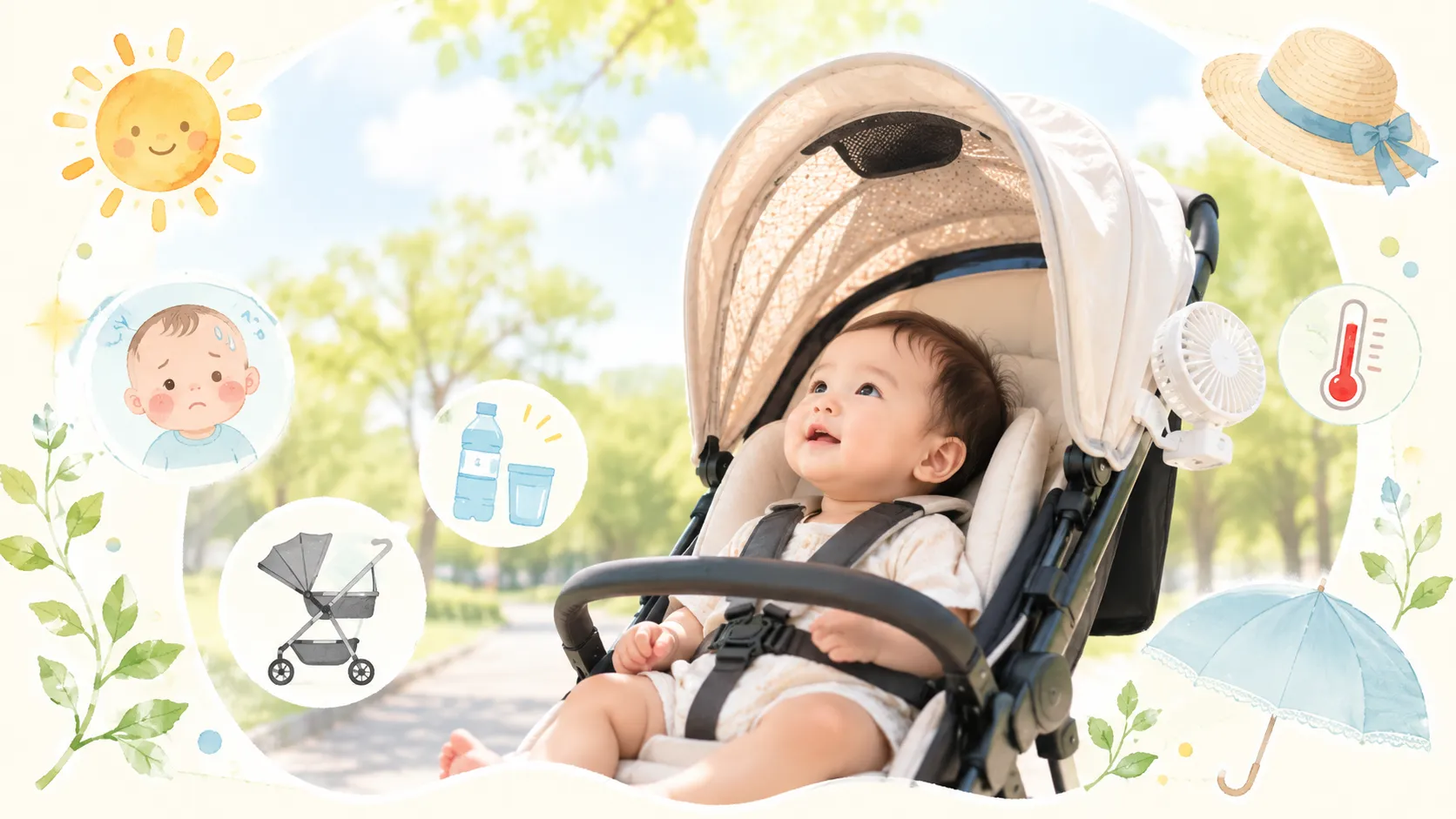
More and more days now, you step outside and think “it’s already hot” the moment you leave the house. Pushing a stroller, carrying your baby in a carrier—wondering “is my child actually okay right now?” is a common worry when you’re raising a child between 0 and 3.
For heat-related illness in babies and toddlers, the basic approach is to watch for changes in face color, sweating, behavior, urination, and responsiveness—and when in doubt, stop outdoor play or stroller outings.
Babies and young children can’t fully put “I’m hot,” “I feel sick,” or “I want to stop” into words on their own. That’s exactly why having a set of things to watch for and a clear point at which to stop, decided in advance, is the most important kind of preparation an adult nearby can have.
This article covers heat-related illness warning signs seen in babies and young children ages 0 to 3, criteria for stopping outdoor play on extremely hot days, heat safety for strollers, preventing children from being left in cars, and first-aid steps you can take at home.
This article is not a substitute for medical diagnosis. If a child is not responding normally, is difficult to wake, can’t take in fluids on their own, or isn’t clearly alert, don’t keep watching and waiting at home—call 119 (Japan’s ambulance and fire number) right away.
Table of Contents
What Are Heat-Related Illness Warning Signs in Babies? Why Young Children Are More at Risk Than Adults
Warning signs of heat-related illness in babies and young children show up as changes in face color, sweating, behavior, urination, and responsiveness.
A red face, heavy sweating, a listless appearance, and fewer or smaller-volume wet diapers are the main things to watch for. That said, these alone aren’t enough to judge by. You also need to check how they respond when you call their name, whether they can take in fluids on their own, and whether anything looks off in how they walk or hold themselves.
Japan’s Children and Families Agency points out that children are shorter and more exposed to heat reflected off the ground, that they have a harder time voicing that they’re hot or feeling unwell, and that they can lose track of the heat once they’re absorbed in play. Babies in strollers especially may be in a different heat environment than what the parent or caregiver is feeling at standing height.
(参照:Let’s All Watch Out and Prevent “Child Heatstroke”!—Children and Families Agency)
Materials from the Japan Pediatric Society similarly explain that children are more prone to heat-related illness because their body temperature rises easily and they’re often unable to take preventive steps on their own. Dizziness, fainting, headache, nausea, listlessness, not responding when called, difficulty walking straight, and a high body temperature are listed as symptoms that suggest possible heatstroke.
(参照:Preventable Childhood Injuries and Countermeasures: Heatstroke—Japan Pediatric Society)
Editor’s Note
Just telling parents to “be careful” does almost nothing in the reality of day-to-day parenting. What parents actually want to know is what to look at, at what point to stop, and what to do when they’re not sure. At TamagoDaruma, we care about laying out heat safety as concrete decision criteria, rather than treating it as a matter of willpower or endurance.
Easy-to-Miss Signs at Different Ages
Even lumped together as “babies and toddlers,” the signs that are easy to miss change by age. These age groups are only a general guide—a child’s usual behavior matters as much as their age. For babies under 1, watch their crying and feeding; around age 1, their behavior and the way they walk; for 2- to 3-year-olds, whether they keep playing without slowing down, even while saying they’re “fine.”
| Age | Risk Situations | Easy-to-Miss Signs | What to Check |
|---|---|---|---|
| Under 1 year | Stroller rides, being carried in a carrier, car trips, naptime | A weaker cry, sleepier than usual, poor feeding, less urine | Face color, sweat on the neck or back, how well they’re nursing or taking a bottle, how wet diapers are, response when called |
| Around age 1 | Walking outdoors, moving between the stroller and walking, being carried | Fussiness that’s easy to mistake for “sleepy” or “tired” | Redness in the face, amount of sweat, unsteady walking, whether they accept fluids normally, whether they’re insisting on being held |
| Ages 2-3 | Parks, outdoor play, water play, outdoor activities at childcare or home | They may be near their limit even while saying “I’m fine” | Face color, heavy sweating, slow responses, unsteadiness, resistance to taking a break, sudden fussiness |
The older a child gets, the more tempting it is to rely on what they say. But even at 2 or 3, accurately describing their own condition is genuinely difficult. Even if they say “I want to keep playing,” if you notice a red face, a blank or dazed look, unsteadiness, or slow responses, the adult should stop the activity and move the child somewhere cool.
4 Things to Watch For to Notice “Something’s Different”
Checking face color, sweating, behavior, and urine before heading out, during the outing, and after coming home makes it easier to catch a change.
Trying to memorize every possible warning sign tends to make you more anxious, not less. In everyday life, it’s more realistic to narrow down what you’re watching for, so you can notice when something is different.
- Face color: Watch for changes like redness, paleness, or a dazed look
- Sweating: Watch for either heavy sweating or, despite the heat, unusually little sweat combined with a child who seems unwell
- Behavior: Watch for sudden fussiness, a listless state, or losing interest in play
- Urine: If diapers are less wet than usual or urination is less frequent, watch for dehydration
Japan’s Children and Families Agency explains that when a child’s face is red and they’re sweating heavily, their core body temperature may already be significantly elevated, making it important to let them rest fully in a cool environment.
(参照:Let’s All Watch Out and Prevent “Child Heatstroke”!—Children and Families Agency)
It’s easier to keep up if you split the timing of these checks into three points: before heading out, during breaks while you’re out, and right after getting home. Deciding to “check at set points” rather than “watch constantly” is the more realistic approach for day-to-day parenting.
What’s the Cutoff for Stopping Outdoor Play or Walks? Deciding by WBGT
For outdoor play with babies and toddlers, the decision should factor in WBGT together with the child’s condition, not just the air temperature.
What matters on an extremely hot day isn’t asking “can we go outside if we take precautions,” but first asking “is today actually a day for outdoor play at all.”
WBGT, or Wet Bulb Globe Temperature—a heat-stress index used internationally, not something specific to Japan—factors in humidity and radiant heat from sunlight along with air temperature, as a measure for heat-illness prevention. Japan’s Ministry of the Environment runs a heatstroke prevention information site where you can check the current WBGT reading by region.
(参照:About the Heat Index (WBGT)—Ministry of the Environment Heatstroke Prevention Information Site)
The Ministry of the Environment’s own exercise guidelines classify a WBGT of 31 or higher as “dangerous,” at which point exercise should, as a rule, stop entirely—especially for children. TamagoDaruma’s editorial team applies this exercise guideline to outdoor play decisions for babies and toddlers as well, erring on the side of caution, and treats a WBGT of 31 or higher as the general threshold for stopping outdoor play.
(参照:Heatstroke Environmental Health Manual—Ministry of the Environment)
| WBGT | Ministry’s Exercise Guideline | TamagoDaruma’s Cautious Guidance for Ages 0-3 | Alternative Actions |
|---|---|---|---|
| Under 21 | Mostly safe | Even at a normal pace, check condition and hydration | Outdoor play is fine; shorten it if sleep or condition are off |
| 21 to under 25 | Caution | Plan on short outings with frequent breaks | Pair it with shade, a hat, water, and rest breaks |
| 25 to under 28 | Alert | Assume shade, short duration, and breaks; avoid long stretches of outdoor play | Also consider switching to indoor play |
| 28 to under 31 | Severe alert | Avoid outdoor play in direct sun; prioritize indoor time | Prioritize indoor play, indoor facilities, or changing the time of day |
| 31 and above | Dangerous | Stopping outdoor play as a rule is the reasonable call | Spend time in an air-conditioned indoor space |
This table was put together by TamagoDaruma’s editorial team for outdoor play decisions with babies and toddlers, based on the Ministry of the Environment’s own heat-illness prevention exercise guidelines—it isn’t an official pediatric standard. The official exercise guidelines themselves don’t set a uniform “walk time” for babies and toddlers. In practice, base your decision on WBGT together with the child’s condition, sleep, appetite, distance to be covered, availability of shade, and how closely the caregiver can supervise—and stop earlier than WBGT 31 if the child seems unwell, sleep-deprived, or is feeding poorly, even on a day that doesn’t reach that threshold. Keep in mind, too, that the air right around a stroller seat can be hotter than the WBGT reading for your general area.
What Should You Do on a Day With a Heatstroke Alert?
A Heatstroke Alert is information issued in Japan when the risk of heat-related illness is predicted to become extremely high, calling attention to dangerous heat and urging preventive action. When the risk is even higher, a Heatstroke Special Alert is issued instead.
(参照:Heatstroke Alert—Ministry of the Environment Heatstroke Prevention Information Site)
For households with babies and toddlers, it’s more realistic to treat a day with an alert as a reason to reconsider or cancel outdoor plans, not simply as a reminder to be more careful. Consider canceling or significantly shortening outdoor play, park visits, long walks, and stroller trips in direct sun.
If you absolutely need to go out, prepare by keeping it to a short window in the early morning or evening, choosing an indoor route where possible, checking ahead for a place to cool off near your destination, and regularly checking for trapped heat in the stroller or baby carrier.
How to Spend a Day Without Going Outside
A day when you cancel outdoor play doesn’t need to become “a sad day” for your child. Choosing not to go outside on an extremely hot day isn’t neglecting your parenting duties—it’s a safe choice made to protect your child.
For babies and 1-year-olds, gentle touch games, picture books, sound play, fabric play, and rolling a ball are good fits. For 2- to 3-year-olds, an indoor obstacle course, sticker play, simple crafts, hand-clapping games, and a short dance session can offer a change of pace.



A day you can’t go outside tends to build up stress for the parent as well as the child. You don’t need to try to make playtime perfect. In a safe indoor environment, prioritize creating even a small window of time for a change of pace.
What’s Dangerous About Strollers in Extreme Heat? Steps You Can Start Today
Because strollers sit close to the ground and are more exposed to reflected heat, prioritize shade, airflow, and short travel times.
Search for “stroller heat safety tips” and you’ll find plenty of information about ice packs, portable fans, cooling sheets, and sunshades. Using these tools well obviously matters.
That said, we think it’s risky to make choosing the right gear the whole center of stroller heat safety. The first questions to ask are whether you actually need to be out with the stroller at that time of day, how quickly you can get back to somewhere cool, whether you can see your child’s face, and whether heat is building up inside.
Materials from the Japan Pediatric Society list strollers—because of heat reflected off the ground—as one of the environments where heat-related illness is more likely.
(参照:Preventable Childhood Injuries and Countermeasures: Heatstroke—Japan Pediatric Society)
- Shorten travel time: Avoid long-distance walks on extremely hot days
- Choose shaded or indoor routes: Reduce direct sun and reflected heat
- Keep the child’s face visible: Don’t drape a sunshade or cloth over the stroller in a way that blocks airflow or your view of the child
- Check sweat on the back and neck: Check whether heat is building up on the seat
- Treat gear as a supplement: Don’t assume ice packs or a fan alone make things safe
Cooling Products That Need Extra Caution
Many families use cooling gear as a heat-safety measure. But depending on how it’s used, it can lead to a different kind of accident.
The Tokyo Metropolitan Government’s Kodomo Safety Project explains that a cooling sheet applied to the forehead can shift and end up covering a baby’s nose or mouth, and that neck-wrap cooling gear can risk constricting an infant’s neck—which is why it advises against fastening either type of product on infants.
(参照:Protecting Children From Heatstroke—Tokyo Kodomo Safety Project)
Cooling the body itself is an effective measure, but getting “where” and “how” you apply it wrong can turn a heat-safety step into a different kind of danger. When using an ice pack, avoid direct, prolonged contact with the skin—wrap it in a towel or similar, and check the skin often, stopping if it looks very pale or feels unusually cold.
What About Baby Carriers?
A baby carrier isn’t close to the ground the way a stroller is. On the other hand, because it presses the child close against the adult’s body, heat can build up more easily, and the child is more exposed to the caregiver’s own body heat and sweat—something worth paying attention to.
If you use a baby carrier on an extremely hot day, dress both yourself and the baby in lightweight, breathable clothing, regularly check your child’s face color and sweat, avoid long continuous stretches of use, and take breaks in an air-conditioned space.
Neither a stroller nor a baby carrier can be called categorically safer at all times. It’s more realistic to choose between them based on travel distance, road conditions, your child’s age and development, and your own condition.
Never Leave a Child in the Car, Even for “Just a Few Minutes”—Why It Happens and How to Prevent It
Don’t leave a child alone in the car even briefly, and always check the back seat before you walk away.
The danger inside a car doesn’t happen because a parent doesn’t love their child enough. It happens as an extension of ordinary life—being busy, a mistaken assumption, not wanting to wake a sleeping child, planning to be back in a few minutes, accidental lock-ins or misplaced keys, or simply forgetting to check.
Japan’s Consumer Affairs Agency calls for never leaving a child alone in a car even briefly, and for being careful about being locked in due to keys left behind or accidental operation.
(参照:Protect Children From Accidents! Project Vol. 593—Consumer Affairs Agency)
Japan’s Children and Families Agency similarly notes that children have been left behind even in family cars, that a child should absolutely never be left alone in a car even briefly, and that if you come across a child who’s been left in a car, you should report it to the police and fire department.
(参照:Let’s All Watch Out and Prevent “Child Heatstroke”!—Children and Families Agency)
The prevention step a household can actually take isn’t relying on willpower—it’s turning the check into the same physical habit every single time.
- Before getting out of the car, always open the back-seat door
- Put something you need in the back seat, so checking it becomes part of your routine
- Send a quick message to family after each drop-off or pickup
- Make “never leave a child alone in the car” a household rule
- Don’t leave keys within a child’s reach or inside the car
Not “it’ll be fine today,” but “check every single time.” On the days you’re tired, in a hurry, or your plans have changed, having a system in place is exactly what helps.
What to Do If You Think It Might Be Heatstroke: First Aid and When to Call 119
Move to a cool place, loosen their clothing, and cool the body down. If they’re not responding normally or can’t drink, call 119 immediately.
If you think a child might have heatstroke, the first thing to do is get them away from the hot environment. Move them to a cool place first—an air-conditioned room or a well-ventilated shaded spot.
Japan’s Ministry of Health, Labour and Welfare identifies moving to a cool place, loosening clothing to cool the body, and rehydrating as first-aid steps when heatstroke is suspected. For first aid, cool the sides of the neck, the armpits, and the groin using a wrapped cold pack or a cool, wet cloth.
(参照:If You Encounter Someone With Suspected Heatstroke: First Aid—Ministry of Health, Labour and Welfare)
- Move to a cool place
- Loosen their clothing
- Cool the neck, armpits, and groin
- If they’re clearly alert and able to drink, have them take fluids little by little
- If they’re not responding normally or can’t drink on their own, call 119 immediately
Don’t give anything by mouth if a child isn’t clearly alert or isn’t responding well when called. The Ministry of Health, Labour and Welfare advises calling an ambulance right away if a child can’t drink water on their own or isn’t conscious—these are signs that call for 119, not a wait-and-see approach.
(参照:If You Encounter Someone With Suspected Heatstroke: First Aid—Ministry of Health, Labour and Welfare)
If your child is responsive and drinking normally, but you’re unsure on a weekend or at night whether a symptom needs medical attention, Japan’s child medical telephone consultation service, #8000, is another option—for situations short of the emergency signs above, not as a substitute for them. The Ministry of Health, Labour and Welfare describes #8000 as a system that lets you call and consult with a pediatrician or nurse by phone about how to handle a child’s symptoms outside regular hours, and whether a hospital visit is needed.
(参照:For a Child’s Symptoms, Call #8000—Ministry of Health, Labour and Welfare)
Similarly, if your child is responsive but you’re unsure whether to call an ambulance, #7119 may be available depending on where you live. The Fire and Disaster Management Agency describes #7119 as a system for getting phone advice when you’re unsure whether to call an ambulance or go to the hospital right away. Since it’s only available in certain areas, check whether it covers where you live—and remember that for the emergency signs described above, 119 comes first.
(参照:What Is the Emergency Safety Center Service (#7119)?—Fire and Disaster Management Agency)
On Extremely Hot Days, Changing Your Plans Is Also a Safety Measure
On days you can’t go outside, it matters to use indoor play, splitting duties within the family, and temporary childcare, rather than carrying everything alone as a parent.
What’s hard about parenting on an extremely hot day is that even when you know it’s safer not to go outside, daily life doesn’t stop. Grocery shopping, driving an older child to and from activities, daycare drop-off and pickup, doctor visits, work, and a child with restless energy stuck indoors—you can’t get through it all on principle alone.
That’s exactly why extreme-heat precautions need to include not just “staying hydrated,” but also “how to rearrange your schedule.”
On days you absolutely need to go out, it helps to have more options ready: getting errands done early in the morning, avoiding walking in direct sun, choosing a route through somewhere cool like a train station or shopping center, splitting responsibilities if another caregiver can take a turn, and considering delivery services or temporary childcare where it’s available.

Editor’s Note
What I feel strongly about parenting on extremely hot days is that too much of the judgment call ends up resting on the parent alone. Parents may know that staying indoors is safer, while still having to manage work, appointments, shopping, and childcare drop-offs. Young children may also become restless after long periods indoors.
What I want to say isn’t pressure to “be more careful.” Staying indoors during dangerous heat is not a parenting failure or a sign of laziness. Changing your plans, switching up how you play, relying on someone else, or retreating to somewhere cool—all of these are legitimate decisions made to protect your child.
A Pre-Outing Extreme-Heat Checklist for Babies and Toddlers
Having a checklist you spend just 30 seconds on before heading out makes your judgment more consistent on extremely hot days.
You don’t need to prepare everything perfectly every time. But on an extremely hot day, a small check can help you make a clearer, more consistent decision. It helps to share the items below with family, grandparents, and childcare providers too.
| What to Check | Details |
|---|---|
| Heat information | Checked the Heatstroke Alert, WBGT, and weather forecast |
| Child’s condition | No unusual changes in sleep, appetite, behavior, urine, or face color |
| Time outside | Avoided long stretches in direct sun; planned to be back quickly |
| Cooling-off spot | Confirmed a place to rest in air conditioning or shade |
| Stroller | Not over-covered; child’s face stays visible |
| Fluids and spare clothes | Prepared age-appropriate fluids, a change of clothes, a towel, and any cooling items needed |
| Car travel | Won’t leave the child alone in the car; will check the back seat when getting out |
| Who to contact | Shared with family what to do if unsure—#8000, your regular doctor, or 119 (Japan’s emergency number) for the signs described above |
At TamagoDaruma, we place importance on shaping checklists like this into a form that’s easy to use both at home and in childcare settings. For childcare and family-support facilities, this can also be developed into a “hot-day drop-off and outdoor play check sheet” to hand out to parents, or a “prevent leaving children in cars” poster for display on-site.
For information on content and printed materials for organizations and facilities, see the page below.
Frequently Asked Questions (FAQ)
Here are answers to the questions parents tend to have about hydration, walk timing, ice packs, waiting in the car, and emergency consultation.
- Q1. What are the early warning signs of heat-related illness in a baby?
- Watch for changes in face color, sweating, behavior, urination, and responsiveness. A red face, heavy sweating, a listless appearance, and less urine are the main signs, but also check how they respond when called and whether they can take in fluids.
- Q2. If a child is sweating, does that mean they don’t have heat-related illness?
- Heat-related illness is still possible even if a child is sweating. If you notice heavy sweating along with a red face, listlessness, fussiness, or slower responses, move them to a cool place and check how they’re doing.
- Q3. At what point should you stop walks or outdoor play?
- Decide by WBGT, not air temperature alone. A WBGT of 31 or higher is classified as “dangerous,” at which point exercise should stop as a rule, especially for children. For babies and toddlers, treat a WBGT of 31 or higher as the cue to stop outdoor play, erring on the side of caution—and stop earlier if your child seems unwell, regardless of the reading.
- Q4. Should you cancel walks on a day with a Heatstroke Alert?
- For babies and toddlers, consider canceling or significantly shortening outdoor time. If you absolutely need to go out, prioritize a short duration, shade, and having an indoor place to retreat to.
- Q5. In extreme heat, which is safer—a stroller or a baby carrier?
- Both have their own risks. A stroller sits close to the ground and picks up reflected heat, while a baby carrier’s close contact traps heat—so choose based on travel distance and how your child is doing.
- Q6. How should ice packs or cooling sheets be used during first aid, and are they safe for infants?
- For cooling the body, target areas like around the neck, the armpits, and the groin, using a wrapped cold pack or a cool, wet cloth. Separately, be careful with forehead cooling sheets and neck-wrap cooling gear marketed for everyday use—these carry a risk of shifting out of place or constricting an infant’s neck, and shouldn’t be fastened onto a baby.
- Q7. Is it okay to leave a child in the car for just a few minutes?
- No. Never leave a child alone in the car, even briefly. Make it a habit to always check the back seat when you get out of the car.
- Q8. If you suspect heatstroke, when should you call an ambulance?
- Call 119 immediately if a child doesn’t respond when called, isn’t clearly alert, or can’t drink water on their own. If your child is responsive and you’re only unsure whether medical care is needed, that’s when #8000 or #7119 are worth using instead.
- Q9. Do breastfed or formula-fed babies need extra fluids?
- This depends on age and condition, so don’t decide on a blanket rule yourself—consult your child’s doctor or your local public health nurse. On hot days, pay close attention to changes like poor feeding, reduced urine, or a listless state.
- Q10. If you stay indoors, is there no risk of heat-related illness?
- Heat-related illness can happen indoors too. Use air conditioning and fans appropriately even inside, and check for changes in your child’s face color, sweating, behavior, and urine.
In Summary
Babies and young children can’t fully tell you they feel overheated or unwell. That’s exactly why it matters for the adult nearby to have a set of things to watch—face color, sweating, behavior, urine, and responsiveness—and to decide whether outdoor play is okay using WBGT and the Heatstroke Alert, not just a general sense of the weather.
Extreme-heat precautions for babies and toddlers aren’t about seeing how much heat a child can tolerate. Stopping early, moving somewhere cool, changing your plans, relying on someone else—these decisions are also part of parenting to protect your child.
At TamagoDaruma, we want to offer information that goes beyond ending with “be careful”—decision-making material that parents and childcare providers can actually use in the moments they’re genuinely unsure. Whether you decide to go outside or not, if it’s a decision you made using a clear standard, it’s not something to be blamed for. We hope this article can serve as a practical guide for reading how the child in front of you is doing this summer, and for deciding when to stop, cool down, or seek help.
