
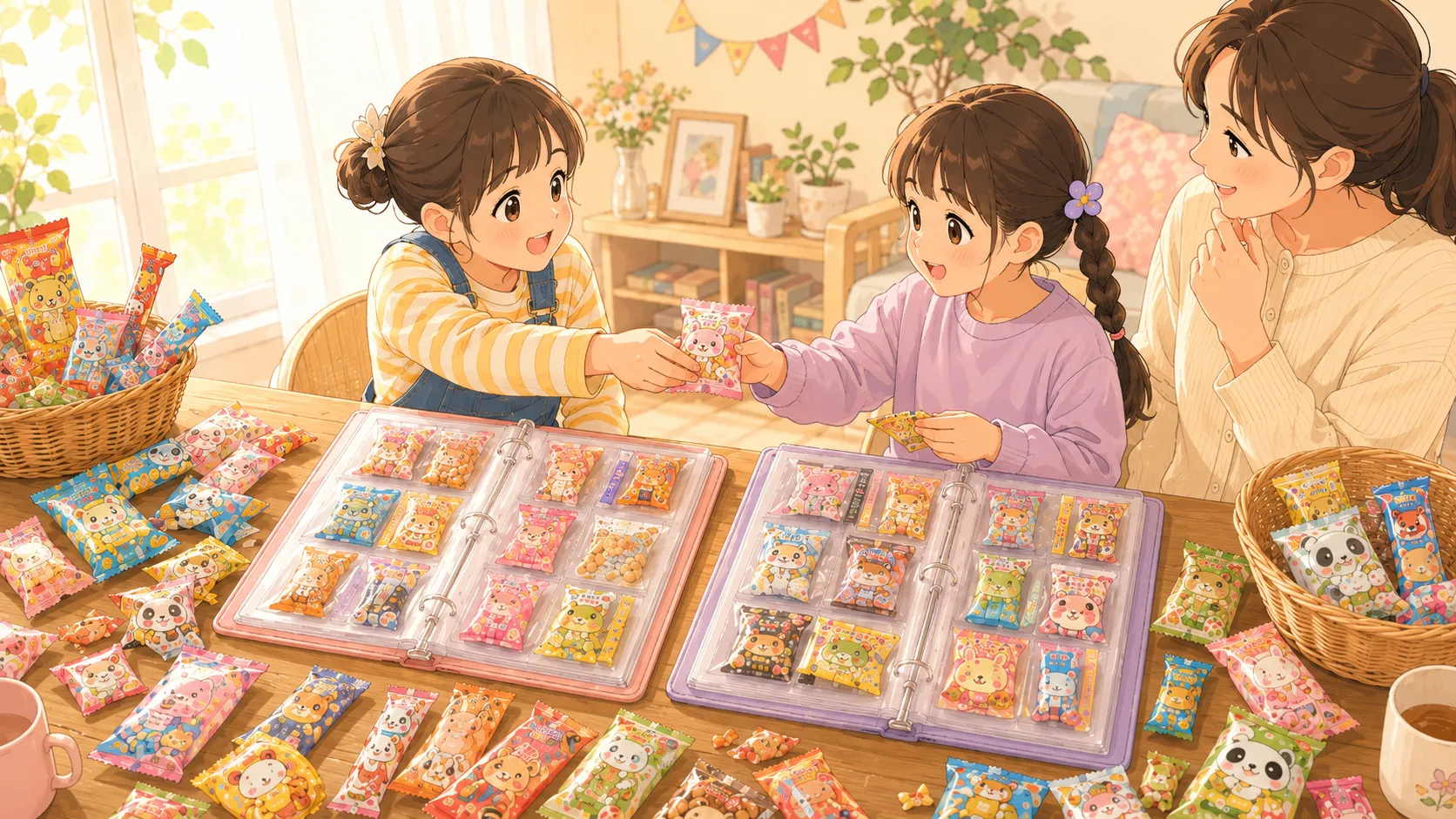
A “snack book” is a collecting game that started on social media in Japan: kids arrange unopened snacks or snack packaging in a clear-pocket binder or notebook, the same way they might with a sticker album. If you’re doing this with your child, it helps to agree on the rules first—whether the snacks get eaten, traded, or just kept on display.
If your child has recently asked to make a “snack book,” you may not be sure what that involves. Sticker albums are familiar territory for most parents, but collecting and displaying real snacks raises different questions—hygiene and safety chief among them—and it’s natural to wonder about both.
This article covers the basics—what a snack book is and how to make one—along with the points parents should check before doing this with preschool or elementary-age children.
The short version: “unopened” doesn’t automatically mean “safe” with this activity. But if you and your child agree on rules around choking hazards, allergen labels, date labels, tooth decay, and storage, it’s manageable as a family craft project.
Table of Contents
What Is a “Snack Book”? The Social Media Trend Inspired by Sticker Albums
In Japan, a “snack book” is a collection made by taping or slipping unopened packaged snacks into a binder or notebook.
In February 2026, Japanese broadcaster TBS’s news site TBS NEWS DIG ran a feature titled “After sticker albums, it’s snack books,” covering how kids can make one on a small allowance and how they negotiate trades with friends. Rather than saving packaging after eating, the version trending now is arranging unopened snacks directly in a binder.
(参照:“After Sticker Albums, It’s ‘Snack Books'”—TBS NEWS DIG)
Lifestyle sites have also covered how to make one using binders, refill pages, and removable tape from 100-yen shops. Because it needs no special equipment, the activity is easy for families to try, which may be part of why it has spread.
(参照:“After Sticker Albums, the New Trend Is ‘Snack Books'”—macaroni)
The key difference from sticker albums is what’s being collected: food, not stationery. For many children, collecting, displaying, and swapping colorful snack packaging is part of the appeal. But even when unopened, storage condition, date labels, allergen information, choking hazards, and trading with friends all need a closer look.
Editor’s Note
My first impression of the “snack book” trend was that it’s not just a passing social media fad—children are curating the colors, lettering, flavors, characters, and packaging designs they encounter in everyday life. What looks to an adult like “just lining up snacks” is, for a child, also about conversation with friends and a bit of self-expression. That’s exactly why it’s worth building household safety rules around it rather than dismissing it outright.

“Snack Books” vs. “Snack Sticker Books”
The terms “snack book” and “snack sticker book” aren’t strictly fixed yet. Different posters and outlets sometimes use them almost interchangeably.
In general, arranging unopened snacks in a binder or notebook tends to be called a “snack book,” while collecting and trading snack packaging like a sticker album tends to be called a “snack sticker book.” Since there’s no strict definition, this article uses “snack book” in the broader sense.
(参照:“Trending on Social Media: How to Make a Snack Sticker Book”—Okashi to Watashi)
| Type | What It Involves | Best For | Key Considerations |
|---|---|---|---|
| Unopened-snack version | Putting unopened snacks into a binder or taping them in place | Families wanting to recreate the version seen on social media | Date labels, storage temperature, trading, choking hazards |
| Packaging or photo version | Pasting in clean packaging or photos after the snack is eaten | Families wanting to limit hygiene concerns or overeating | Sticky packaging, keeping ingredient labels, cleaning up torn edges |
| Snack sticker book | Collecting small snack bags or packaging like sticker-album pages | Families who want a trading experience like sticker swaps | Making sure it doesn’t turn into trading the actual food |
Our suggestion at TamagoDaruma is to pick the type that fits your household. The unopened-snack version is closer to the current trend and fun to look at, but it means keeping real snacks on hand. For families with younger siblings around, or where allergies need extra care, the packaging-or-photo version can be an easier fit.
How to Make a “Snack Book”: Materials and Steps
Making a snack book isn’t complicated. Get a binder, some tape, and snacks your child likes, then arrange and attach them so they’re easy to see.
That said, when making one with a preschooler or a child in the early grades of elementary school, deciding “what to use,” “where to store it,” and “whether it gets eaten later” matters more than the assembly itself.
What You’ll Need
Basic supplies from a 100-yen shop are enough. Rather than aiming for a polished look, choose a format that’s easy for your child to handle and easy for you to keep track of.
| Material / Tool | How It’s Used | What to Look For |
|---|---|---|
| Clear-pocket binder | Holds and displays the snacks | Too many thick snacks can make it hard to close |
| Refill pages / pockets | Separates snacks by page | Choose pocket sizes small snacks won’t fall out of |
| Removable tape | Holds snacks or packaging in place | Tape that’s too strong can tear the bag |
| Masking tape / stickers | Decorates the pages | Too much decoration can cover up labels |
| Notes / labels | Records flavor, date added, date label, and impressions | Keeps information you can look back on later |
If scissors are involved, an adult should supervise according to the child’s age. Guidance from Japan’s Ministry of Education, Culture, Sports, Science and Technology (MEXT) on arts-and-crafts materials notes points such as choosing scissors sized to a child’s hand and dominant hand, checking that hinges aren’t loose, and being careful with sharp tips. The same thinking applies when cutting packaging for a snack book.
(参照:Materials and Tools in Arts and Crafts: Scissors—MEXT)
Tips for Attaching Snacks Without Mistakes
For the unopened-snack version, cut small pieces of double-sided tape and use them lightly on the back or edge of the snack to hold it in place. Pressing too hard can crack the contents or tear the bag, so a light touch is enough.
If the date label or ingredient list is on the back, one option is to tape only one side instead of the whole surface, so it can still be flipped up. That way the label stays easy to check later.
Following these steps makes it easier for parent and child to work through the process together.
- Choose the snacks to use
- Check date labels and storage instructions
- Check ingredient labels and allergen information
- Decide where each one goes in the binder
- Fix them in place lightly with tape
- Note the date, flavor, and why it was chosen
- Decide on a storage spot and when it will be eaten
For the packaging-or-photo version, use the clean outer wrapper or a photo taken after the snack is eaten. Skip packaging that’s sticky or has crumbs on it—a photo is often easier to manage for hygiene.
Is It Safe for Preschoolers? What Parents Should Check
A snack book can be a manageable family activity, but because it involves food, small items, tape, and sometimes scissors, preschoolers need close adult supervision.
The main things to watch for are choking hazards, allergen labels, tooth decay, and hygiene. Snack books are often introduced as a “display, don’t eat” activity, but to a child, it’s still a snack sitting right in front of them. They may want to eat it later, and a younger sibling may pick it up.
Choking Hazards and Managing Small Snacks
Small snacks and scraps of packaging carry a choking risk. Even if the child making the snack book is old enough themselves, households with younger siblings need to be careful about where things are placed during both the crafting and the storage.
Japan’s Government Public Relations Online site highlights the importance, in preventing choking and swallowing accidents among babies and children, of keeping anything that could fit in a child’s mouth out of their reach. This isn’t specific to snack books, but it’s relevant to any family activity involving small food items or bits of packaging.
(参照:Protecting Babies and Children from Choking and Swallowing Accidents—Government Public Relations Online)
- Do the work only at a table
- Don’t leave small snacks or scraps on the floor
- Store the finished binder somewhere younger siblings can’t reach
- Don’t mix snacks meant for keeping with snacks meant for eating
- Check under the table and the floor after finishing
If a child may have swallowed something or is showing signs of choking, don’t try to judge the situation yourself—contact a doctor, poison control, or emergency services right away.
When Allergen Labels Get Covered Up
Because snack books display the front of the packaging, the ingredient list and allergen information on the back can end up hidden.
Japan’s Consumer Affairs Agency publishes information on food allergen labeling, requiring packaged processed foods to indicate the presence of specified allergens as a way to prevent health harm. If your child, or a sibling or friend, has an allergy, it helps to check the label before taping anything down and keep a photo of it as a backup.
(参照:Information on Food Allergen Labeling—Consumer Affairs Agency)
There are three ways to keep allergen information on hand in a snack book.
| Method | Benefit | Good For |
|---|---|---|
| Tape so the back can be flipped up | Keeps the ingredient label directly checkable | When using unopened snacks |
| Photograph the label separately | Balances a good-looking file with easy label-checking | When you want the design side to stand out |
| Use only photos, not the snacks themselves | Easier to manage for hygiene and allergen-label checks | Childcare or after-school settings, or households with younger siblings |
Trading with friends also calls for caution when it involves the snacks themselves. Since allergies, dietary policies, and rules about bringing food differ from household to household, it’s safer to limit any trading to non-food materials, such as photos or cut-outs of the packaging.
Tooth Decay and Hygiene Considerations
Even if a snack book starts out as “display, don’t eat,” it’s natural for a child to later decide they do want to eat it. That’s why it helps to decide on timing and amount from the start.
Japan’s Ministry of Health, Labour and Welfare (e-Health Net) explains that, for tooth decay prevention, reducing both the total amount and the frequency of sugar intake is effective. Keep the snack book within your household’s existing snacking rules, rather than buying extra snacks just to fill the binder or letting it turn into constant grazing.
(参照:Proper Sugar Intake—Ministry of Health, Labour and Welfare e-Health Net)
On hygiene, even unopened snacks need attention to temperature, humidity, and direct sunlight. Chocolate, candy, and oily snacks in particular can melt, warp, or turn sticky. Rather than planning to keep them long-term, build in regular check-ins.
- Don’t place it in direct sunlight
- Don’t leave it in a car or anywhere that gets hot
- Note the date labels
- Check the storage condition of anything you plan to eat
- Let a parent decide whether something displayed for a long time is still okay to eat
Another option is separating “for display” from “for eating” entirely. In some households, it may be more reassuring to build the binder out of packaging photos rather than the real snacks.
Enjoying It Together: Tips for Keeping It Manageable
A snack book is easier to keep up when the focus is on setting rules together and enjoying it gradually, rather than competing over how polished it looks.
Trying to build an elaborate page from the start tends to mean buying more snacks and more work for parents. It works better to start with a loose theme—”red packaging edition,” “snacks I’d take on a school outing,” “what we ate this weekend”—and go from there.
To turn the activity into a bit of observation and conversation, try asking a few questions after each snack goes in.
- What flavor was this?
- Which color stands out the most?
- Are there other snacks with the same flavor?
- Would you want to eat it again?
- What do you like about this packaging?
For kids, snack packaging doubles as an everyday design lesson. Color, lettering, photos, characters, and limited-edition labeling are all part of how a product communicates. A few questions from a parent can turn plain collecting into a bit of observation and conversation.
Checklist Before You Start
- Decided whether to use unopened snacks or the packaging/photo version
- Decided whether to separate “for eating” from “for display”
- Checked date labels and storage instructions
- Checked ingredient labels and allergen information
- Chosen a storage spot younger siblings can’t reach
- Set a rule against trading the snacks themselves with friends
- Decided to review it regularly instead of storing it long-term
This checklist is also useful for hoikuen (daycare centers), yochien (kindergartens), or gakudo (after-school childcare programs) considering the activity. Group settings need more care around allergies and food-related rules than a single household does. In a facility setting, it’s safer to design it as a collage activity using photos or printed material rather than real snacks.
Frequently Asked Questions
Here are answers to the questions parents tend to ask about snack books.
- Q. What is a snack book?
- A snack book is a collecting game that started on social media in Japan, where kids arrange unopened snacks or snack packaging in a binder or notebook.
- Q. What’s the difference between a snack book and a snack sticker book?
- There’s no fixed definition. Arranging unopened snacks tends to be called a snack book, while collecting packaging like stickers tends to be called a snack sticker book, though the two terms are sometimes used interchangeably.
- Q. What kind of snacks should I choose?
- Thin, individually packaged snacks labeled for room-temperature storage tend to be the easiest to fit in a binder. Be careful about where you store items that melt easily, like chocolate or candy.
- Q. Is it safe for preschoolers?
- It can be enjoyed with adult supervision. That said, choking hazards, scissors, tape, and managing small snacks all call for attention. Parents should judge what’s appropriate based on their child’s age and stage of development.
- Q. Can unopened snacks be eaten later?
- A parent should decide after checking the date label, storage instructions, seal, and overall condition. Anything displayed for a long time, or kept somewhere hot, should be checked carefully before eating.
- Q. Can a child with allergies take part?
- Always check the ingredient and allergen labels, and keep a photo of them if needed. If you have concerns, follow your household’s approach to allergies and any guidance from a doctor or allergy specialist.
- Q. Is it okay to trade with friends?
- Trading the snacks themselves calls for caution, since it involves allergies and rules that differ between households. If you do trade, it’s safer to limit it to non-food materials like photos or cut-out packaging.
- Q. Can this be used at hoikuen, yochien, or gakudo?
- Checking the facility’s own rules comes first. Designing it as a collage activity using photos or printed material, rather than bringing in real snacks, makes it easier to manage safely.
- Q. Is it fine to store it long-term hygienically?
- It’s safer not to plan on long-term storage. Even unopened, condition can change with temperature, humidity, and direct sunlight. Review it regularly.
In Summary: A “Snack Book” Works Best With Shared Rules
A snack book combines the pleasure of collecting, familiar from sticker albums, with the pleasure of looking closely at snack packaging—an activity that fits how kids engage with things today.
At the same time, because it involves food, it can’t be treated with quite the same mindset as a sticker album. Even when unopened, a few things are worth keeping in mind together: choking hazards, allergen labels, date labels, storage condition, tooth decay, and trading with friends.
At TamagoDaruma, we don’t think a snack book needs to be ruled out as “too risky.” But rather than assuming “unopened means safe,” it matters to translate that into rules specific to your own household.
Before starting, talk with your child about whether the snacks are for display or eating, whether trading is allowed, and where everything will be stored. With that conversation in place, a snack book becomes more than just a social media trend—it’s a chance for kids to start thinking about design, food labeling, and safety in things they encounter every day.
