
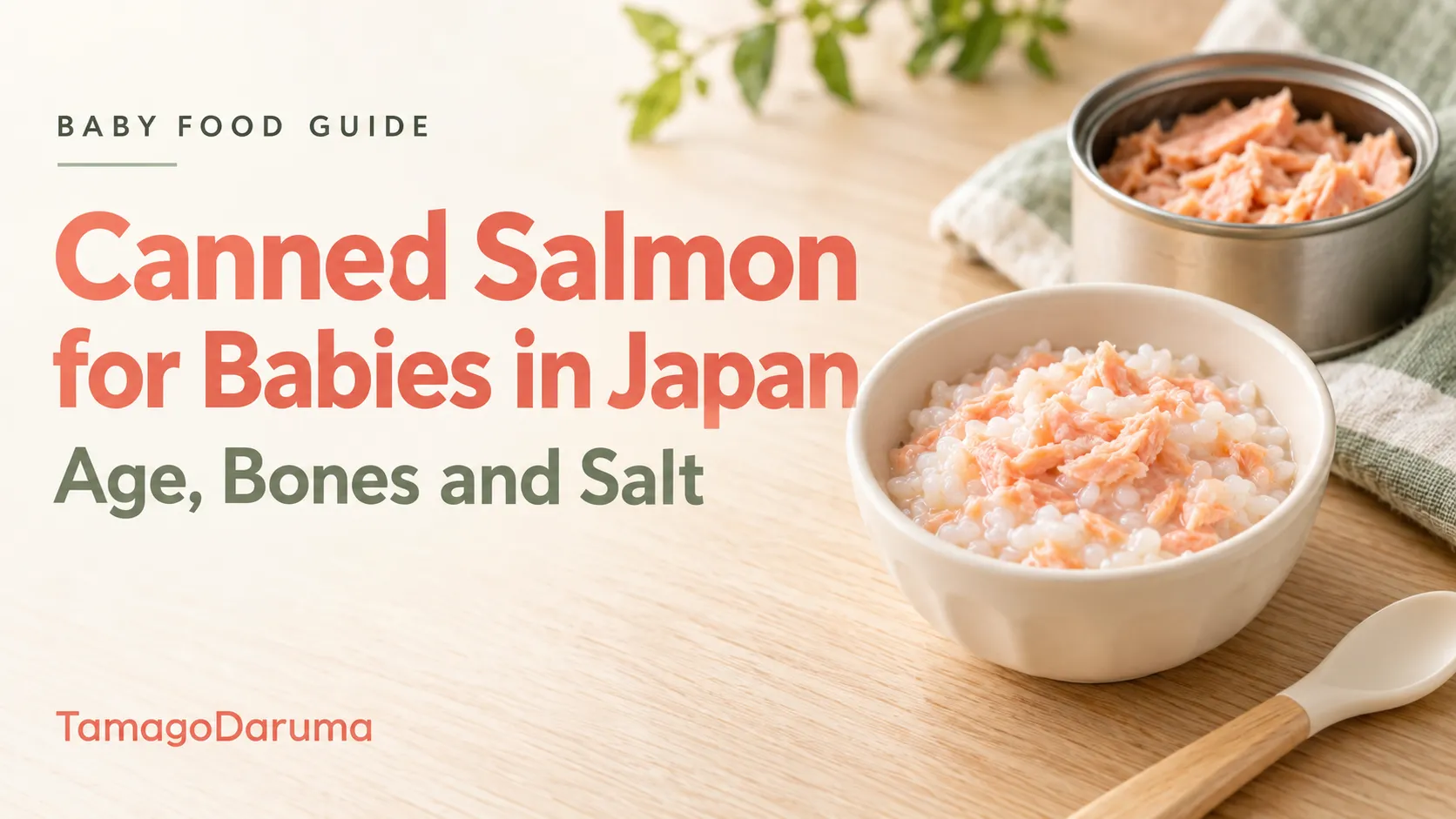
In Japan, canned salmon packed in water is often suggested for babies from around 7–8 months, the middle stage of Japan’s weaning framework.
When choosing a can, the TamagoDaruma editorial team suggests this approach: if you want to keep salt down, look for “no salt added” (食塩不使用) water-packed salmon, and check the salt equivalent and ingredients on the label. Even a no-salt-added can contains some salt, though. Whichever can you choose, remove the bones and skin and adjust the texture to your baby’s feeding skills.
This guide is based on products sold in Japan and on Japanese guidance for introducing solid foods. It covers:
- When to start, and how much to offer
- How to read the labels, using three cans from the same maker
- Preparation steps, including removing bones and skin and boiling to reduce salt
- How to store unused portions after opening and after preparing
Key points
- Japanese sources suggest using canned salmon from around 7–8 months, but Japan’s national weaning guide does not set a starting age for canned salmon
- To keep salt down, consider no-salt-added water-packed salmon. It still contains some salt
- On the label, check which amount the figures refer to and whether they include the liquid
- Even though canned bones are soft, remove the bones and skin before serving to your baby
- You cannot reliably tell how much salt remains after boiling, so check the label before you buy
Table of Contents
When Can Babies Have Canned Salmon? Consider Both Age and the Product
Japanese sources describe using water-packed canned salmon from around 7–8 months. Alongside your baby’s age, consider their experience with solid foods and ability to manage different textures, check what the product contains, and prepare the fish so it is easy to eat.
Separate “When to Start Salmon” From “Which Can to Use”
“When can my baby start eating salmon?” and “Is this particular can suitable?” are two separate questions. In Japan, introducing solid foods (離乳食, rinyushoku) is usually described in four stages: early (around 5–6 months), middle (around 7–8 months), late (around 9–11 months), and the final stage (around 12–18 months).
For salmon in general, Palsystem, a Japanese consumer co-op, advises on its parenting site that salmon has more fat than white fish. It suggests introducing salmon from around 7–8 months, once your baby is used to fish such as sea bream or flounder.
(Source: Salmon | Cooking Tips for Baby Food | Palsystem Kosodate 123 (Japanese))
For canned salmon specifically, a recipe on the Japanese parenting site Tomonite, supervised by a registered dietitian, is aimed at babies “from the middle stage (around 7–8 months).”
(Source: Canned Salmon Baby Food: Middle-Stage (7–8 Months) Recipe, Method, and Storage | Tomonite (Japanese))
Japan’s national weaning guide, published in 2019, sets out an order for introducing fish: white fish first, then red-fleshed fish, then oily blue-skinned fish such as mackerel. However, it does not specify an age for starting canned salmon.
(Source: Guide to Supporting Breastfeeding and Weaning (March 2019) | Children and Families Agency (Japanese))
So “around 7–8 months” is a guideline for introducing salmon. If you use canned salmon, also check the salt content of the specific product and the condition of the fish once the can is open.
How Much Should You Offer?
The national guide recommends starting any new food with one baby spoonful, then increasing the amount while watching how your baby responds.
Once your baby is used to fish, the guide’s chart of weaning stages gives 10–15 g of fish per meal as a guideline for the middle stage.
(Source: Guide to Supporting Breastfeeding and Weaning (March 2019) | Children and Families Agency (Japanese))
Keep these points in mind when using that 10–15 g figure:
- It is a general guideline for fish, not a recommended amount or safety limit for canned salmon
- It does not mean you should offer this amount the first time
- The listed contents of a can include the liquid, so they do not match the weight of the prepared fish
In Japan, salmon is among the allergens that manufacturers are encouraged to declare on packaged food labels. The guide advises not to handle suspected food allergy symptoms on your own, and to proceed based on a doctor’s diagnosis. If your baby has already been diagnosed, or you have specific instructions from a doctor or dietitian, follow those instructions first.
Water-Packed, No Salt Added, or Seasoned: How Do the Labels Differ?
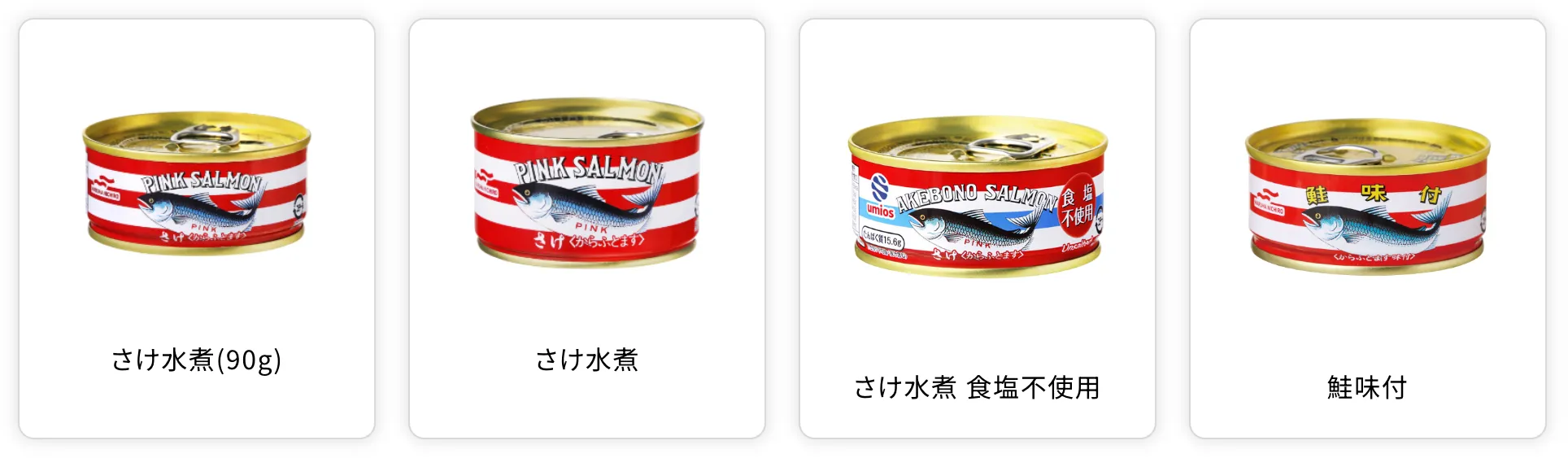
“Water-packed” (水煮) does not necessarily mean salt-free. Rather than judging by the product name, check the ingredients list and the “salt equivalent” figure (食塩相当量) on the label, and also which amount that figure refers to. Japanese labels list “salt equivalent,” which expresses the sodium content as an equivalent amount of salt.
Check the Ingredients for Salt and Seasonings
Ingredients are listed in the labeling panel on the can, the box outlined in black. Check that panel on your can to see whether salt or seasonings were used.
If the ingredients list says からふとます, it means pink salmon. The maker explains that pink salmon is classified as a salmon species, so the product is sold as canned salmon.
(Source: Product Q&A (Canned Foods) | Umios (Japanese))
“No salt added” (食塩不使用) means that no sodium salt was added. It does not mean the product contains no salt. A “no salt added” label also tells you nothing about whether the bones and skin have been removed.
(Source: About Nutrition Labeling | Consumer Affairs Agency (Japanese))
Comparing Three Canned Salmon Products Sold in Japan
We compared the nutrition information on the official product pages of Umios (formerly Maruha Nichiro) for three 90 g cans. These are examples to show how to read the labels, not a ranking.
| Product | Contents | Salt equivalent (per can) | Per 100 g (approx.) | Labeling basis |
|---|---|---|---|---|
| Salmon, water-packed (90 g) | 90 g | 0.8 g | approx. 0.9 g | Per can. Does not state whether liquid is included |
| Salmon, water-packed, no salt added | 90 g | 0.1–0.3 g | approx. 0.1–0.3 g | Per can, including liquid |
| Salmon, seasoned | 90 g | 1.7 g | approx. 1.9 g | Per can, including liquid. Seasoned with sugar and soy sauce |
Note 1: JAN codes, from top: 4902165300062, 4901901009979, 4901901010036.
Note 2: Information is current as of October 2024 for the standard water-packed can (90 g) and January 2026 for the other two. Pages viewed October 19, 2026.
(Source: Salmon, Water-Packed (90 g) | Umios (Japanese))
(Source: Salmon, Water-Packed, No Salt Added | Umios (Japanese))
(Source: Salmon, Seasoned | Umios (Japanese))
If you want to keep salt down, the no-salt-added can has the lowest salt equivalent of the three. That is why we suggested it at the start of this guide. The maker explains that the no-salt-added figure is given as a range to allow for natural variation in the fish.
We include the seasoned product only to illustrate how labels differ; it is not a recommendation for use in baby food.
When in Doubt, Look at the Labeling Basis, Not the Name
All three products come from the same maker in the same 90 g can. Even so, the salt equivalent ranges from 0.1–0.3 g for the no-salt-added can to 1.7 g for the seasoned one. All three pages give figures per can, but only two explicitly state that the figures include the liquid. You can’t tell any of this from the word “water-packed” alone.
If you’re unsure in the store, our editors suggest checking three things: Is it no salt added? What amount do the figures refer to? Do they include the liquid? You don’t need to read every line of the nutrition panel. These three points make it much easier to compare products.
Per Can, Per 100 g, and Including Liquid
The per-100 g figures are approximate, calculated as “salt equivalent ÷ 90 × 100.” They are useful for comparing cans of different sizes, but they do not indicate how much your baby should eat or how much salt is appropriate.
According to the maker, the listed contents of water-packed fish cans are the total weight, including the liquid.
(Source: Product Q&A (Canned Foods) | Umios (Japanese))
The figures for the no-salt-added and seasoned cans include the liquid, so you can’t calculate the salt in the drained fish alone. The standard water-packed label does not state whether liquid is included, so it can’t be compared with the other two on exactly the same basis.
What About the Bones and Skin? Don’t Rely on General Product Descriptions
The bones in canned fish are softened during processing, but that doesn’t mean a baby can eat them as they are. Once the can is open, check the bones, skin, and flesh, and prepare the fish for your baby.
Follow Baby-Food Guidance for Bones and Skin
The maker explains that high-temperature processing under pressure softens the bones in canned fish so they can be eaten whole. This advice is intended for the general public, not a guarantee for babies.
(Source: Product Q&A (Canned Foods) | Umios (Japanese))
Baby-food sources describe removing the bones and skin. Tomonite’s canned salmon recipe removes them before chopping the fish, and Palsystem also advises removing the skin and bones from salmon and flaking the flesh.
(Source: Canned Salmon Baby Food: Middle-Stage (7–8 Months) Recipe, Method, and Storage | Tomonite (Japanese))
(Source: Salmon | Cooking Tips for Baby Food | Palsystem Kosodate 123 (Japanese))
Canned salmon can sometimes contain struvite, crystals that look like fragments of glass. The maker notes that they dissolve in the body and are harmless, but larger ones can injure the mouth. When flaking the fish, check for any hard particles left alongside the bones and skin.
(Source: Product Q&A (Canned Foods) | Umios (Japanese))
Canned Salmon Backbones Are a Different Product
Cans labeled 中骨 (backbone) contain mainly backbones rather than fish flesh, so they can’t be used the same way as the regular canned salmon covered in this guide. Bone quantity and hardness vary by product, so we have not compared them here.
Check That the Flaked Fish Is Easy to Eat
The national guide describes the middle-stage texture as “soft enough to mash with the tongue.” It also notes that thickening food can help babies swallow at this stage.
(Source: Guide to Supporting Breastfeeding and Weaning (March 2019) | Children and Families Agency (Japanese))
Tomonite’s recipe chops the fish finely and, at first, mashes it lightly in a mortar or similar tool, aiming for “jam with small lumps.” If the flaked fish seems dry, mix it into rice porridge or soup your baby already eats, adjusting to your baby’s feeding skills.
Can Boiling Reduce the Salt in Canned Salmon?
One way to prepare canned salmon is to boil it to reduce the salt. However, you cannot reliably determine how much salt remains after doing this at home. Check the product label first.
How to Prepare Water-Packed Salmon That Contains Salt
Tomonite’s dietitian-supervised recipe prepares salted water-packed salmon in this order:
- If a reduced-salt product is available, choose that
- Boil in hot water for about 2–3 minutes to reduce the salt, then drain
- Remove the bones and skin
- Chop finely; at first, mash lightly
- Because some salt may remain, mix the prepared fish into foods your baby already eats and offer a small amount
(Source: Canned Salmon Baby Food: Middle-Stage (7–8 Months) Recipe, Method, and Storage | Tomonite (Japanese))
This method boils the fish for a set time. It is different from simply pouring hot water over it.
These steps don’t tell you whether no-salt-added cans need the same boiling step. Even with no-salt-added salmon, however, you still need to remove the bones and skin and prepare the fish so it is easy to eat.
No Claims of “X% Less Salt” or “Now It’s Safe”
The sources reviewed for this guide do not provide product-specific figures for how much salt boiling removes. You also can’t calculate the remaining salt from the can’s label.
Mixing the fish with other foods makes each mouthful taste less salty. However, the salt in the canned salmon you added doesn’t disappear. Even if it tastes mild to an adult, that alone doesn’t tell you it is suitable for a baby.
The national guide states that no seasonings are needed when babies first start solid foods, and that any seasoning used later should be light. Boiling to reduce salt is one option when using a product that contains salt. Use it together with checking the label before you buy.
(Source: Guide to Supporting Breastfeeding and Weaning (March 2019) | Children and Families Agency (Japanese))
A Convenient Option With a Few Preparation Steps
Japan’s national guide notes that using commercial baby food and other processed foods well can be a reasonable option if it reduces the burden of preparing meals for babies. Separately, our editors see canned salmon as a convenient way to include fish without cooking a bony fillet from scratch, as long as you take a few preparation steps.
The sources we reviewed did not show how much salt remains after boiling at home. That’s why we think the practical approach is not to rely on a single answer about “how many months is OK,” but to make a two-step check a habit: read the label before you buy, and check for bones, skin, and hard particles after you open the can.
(Source for the national guide: Guide to Supporting Breastfeeding and Weaning (March 2019) | Children and Families Agency (Japanese))
Before You Use It: Check the Label, Preparation, and Storage
Before buying, check the label. After opening, check the bones and skin and whether the texture is easy to eat. Think about storage separately for opened contents and for food you have prepared for your baby.
Checklist Before Buying and Before Cooking
Before buying
- Have you checked the type of product: water-packed, no salt added, seasoned, backbone, etc.?
- Have you checked the ingredients and salt equivalent on the labeling panel?
- Have you checked what amount the nutrition figures refer to, and whether they include the liquid?
Before and after cooking
- Is the preparation suitable for your baby’s feeding skills?
- If it’s the first time, are you ready to start with one spoonful?
- Have you removed bones, skin, and hard particles, and made the fish easy to eat?
- Have you checked how to store unused portions after opening and after preparing?
Storing Unused Portions: Follow the Guidance That Matches the Situation
Storage times are guidelines that assume clean handling. Tomonite notes that prepared food should not be left at room temperature for long periods and that you should use clean storage containers.
(Source: Canned Salmon Baby Food: Middle-Stage (7–8 Months) Recipe, Method, and Storage | Tomonite (Japanese))
After Opening, Before Preparing as Baby Food
The maker advises transferring any unused contents to a separate container, refrigerating them, and eating them by the next day. It does not recommend freezing the contents in the can.
(Source: Product Q&A (Canned Foods) | Umios (Japanese))
After Preparing It as Baby Food
Tomonite’s recipe gives the following storage guidance for prepared salmon that has been set aside before serving:
- Refrigerated: eat the same day
- Frozen: wrap in plastic wrap, place in a freezer bag, and use within about one week
- Reheat before serving
- Do not refreeze after thawing
(Source: Canned Salmon Baby Food: Middle-Stage (7–8 Months) Recipe, Method, and Storage | Tomonite (Japanese))
If anything seems even slightly off in smell or color, throw it away. Reheating is not a substitute for proper storage.
Frequently Asked Questions About Canned Salmon for Babies
- Q. If it says “no salt added,” can I give it as is?
- “No salt added” means no sodium salt was added. It does not mean the product contains no salt. The product in our example still lists 0.1–0.3 g salt equivalent per can, including liquid. A “no salt added” label also doesn’t tell you whether bones and skin have been removed. Check the fish after opening, remove any bones and skin, and adjust the texture to your baby’s feeding skills.
- Q. If the bones are soft, do I still need to remove them?
- The maker’s statement that canned bones are soft is intended for the general public. Baby-food recipes describe removing the bones and skin, and this guide assumes you remove them before serving.
- Q. Can I use the liquid from the can?
- The maker says canned fish can be eaten with its liquid, but this is general guidance. In Tomonite’s steps for reducing salt, the fish is drained after boiling. Since the label doesn’t tell you how much salt is in the liquid alone, using only the fish makes it easier to judge if you’re unsure.
- Q. How much salt does boiling remove?
- The sources reviewed for this guide do not provide figures for this. The amount can also vary with boiling time and the amount of water, so we can’t give a single percentage. If you want to keep salt down, start by choosing a product with a lower salt equivalent when you buy.
- Q. Can I use seasoned salmon flakes or canned salmon backbones the same way?
- Seasoned salmon flakes sold in jars or packets (鮭フレーク) and canned salmon backbones differ from water-packed salmon in ingredients, seasoning, and form, so this guide doesn’t apply to them directly. If you plan to use them, check each product’s label and ask at a local nutrition consultation, such as one offered by your city or ward, to be sure.
- Q. Can I freeze unused canned salmon?
- The maker does not recommend freezing it in the can. After opening, transfer contents you haven’t prepared as baby food to a clean separate container, refrigerate, and use by the next day. For salmon you have already prepared for your baby, with the salt reduced and the bones removed, Tomonite’s recipe gives about one week in the freezer as a guideline. Reheat before serving, and don’t refreeze after thawing.
Start by Checking the Label on Your Can
Canned salmon is a convenient food, but whether it suits your baby isn’t decided by age alone. Before you buy, check the ingredients, salt equivalent, and what amount the figures refer to on the product you have in mind.
If you’re unsure about timing or how to make it easy to eat, take the product name or a photo of the label to a local nutrition consultation, such as one offered by your city or ward office.
