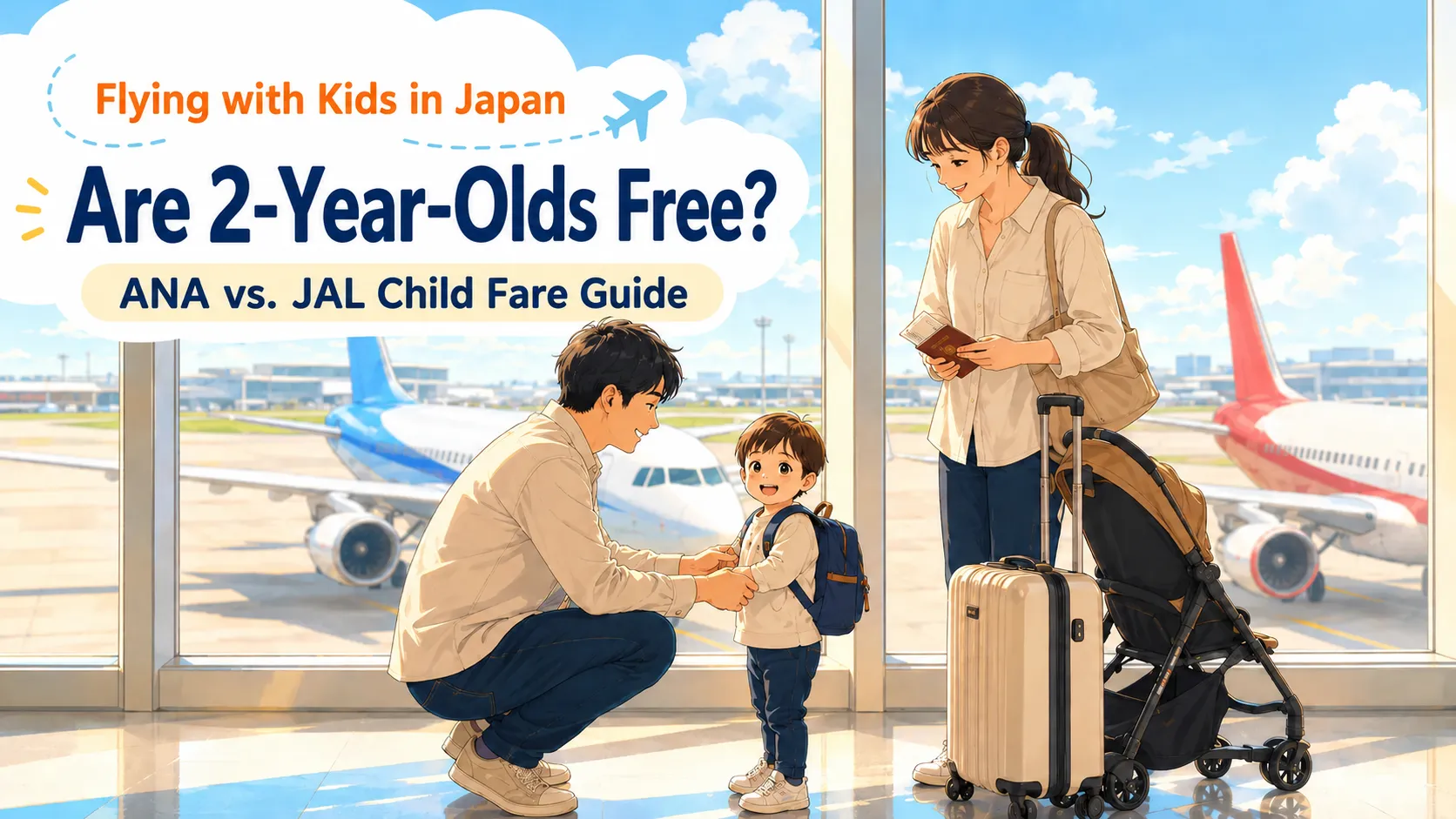
The cost of a plane ticket for a child depends on three things: the child’s age on the day of travel, which airline you’re flying, and whether they sit on an adult’s lap or in their own seat. Both ANA and JAL generally accept infants from 8 days old on domestic flights, but whether that means travel without a separate fare depends on the airline’s infant age category and whether a seat is used.
Ahead of Obon (Japan’s mid-August holiday travel season), summer vacation, or trips home for the year-end and New Year holidays, a lot of parents search questions like “how much does it cost to fly with a child,” “how old does a baby have to be to fly,” or “is a 2-year-old free or not.” For families with children between 0 and 3 years old especially, it’s easy to get stuck staring at the booking screen, unsure where the line between “infant” and “child” actually falls.
This article focuses on ANA and JAL domestic flights, covering child airfare, the age brackets for “infant” and “child,” lap-infant travel, reserving a seat, ear pressure, meltdown prevention, and what to pack.
Airline rules can change. This article is organized around official information as of publication, but always check the airline’s official website for the latest details before booking.
Table of Contents
So How Much Does a Child’s Plane Ticket Actually Cost?
It’s easier to keep straight if you think of it this way: a child classified as an “infant” who travels on an adult’s lap can sometimes travel without a separate fare, while reserving a seat for a child means a fare applies.
The point to watch for is not assuming “any child on a lap flies free.” The age that qualifies for lap-infant travel differs by airline. And because ANA and JAL classify 2-year-old passengers differently, it’s safer not to rely only on an old article or a past experience.
At TamagoDaruma, our suggestion is not to focus only on getting the cheapest fare, but to weigh your child’s age, size, flight length, how much luggage you’re carrying, and how much margin you’ll have on the day. Understanding how the fares work isn’t just about saving money—it’s part of preparing to feel less anxious on travel day.
The “Infant” and “Child” Age Brackets Actually Differ Between ANA and JAL
On ANA domestic flights, for travel on or after May 19, 2026, the age brackets are announced as child: ages 2 to 11, infant: 8 days old to under 2 years old. One infant per accompanying adult can travel on their lap without a separate fare, but if two infants are traveling with one adult, a seat must be reserved for one of them.
(参照:Child Reservations—ANA)
On JAL domestic flights, by contrast, infant status is based on age at the time of travel and covers 8 days old to under 3 years old, while child status covers ages 3 to 11. JAL also allows one infant per accompanying adult to travel on a lap without a separate fare, and up to two infants can accompany one adult, though a seat must be reserved for one of them.
(参照:Reservations for Children (Infants and Children)—JAL)
In other words, a 2-year-old falls into the child bracket on ANA but the infant bracket on JAL. This is the single most confusing point in child airfare for family travel.
JAL also states that, for travel on or after May 19, 2026, codeshare flights operated by Oriental Air Bridge (ORC) treat children age 2 and up as the child bracket. Even if you’ve booked under a JAL flight number, the rules can differ depending on the operating carrier, so check who’s actually operating the flight, not just which airline sold the ticket.
(参照:Reservations for Children (Infants and Children)—JAL)
How Do ANA and JAL’s Child Fares Compare? [Comparison Table]
ANA and JAL differ in both their infant/child age brackets and how they calculate fares when a seat is used. If you’re traveling with a 2-year-old in particular, check the rules for whichever airline you’re flying.
| Item | ANA domestic flights | JAL domestic flights |
|---|---|---|
| Infant age bracket | 8 days old to under 2 years old | 8 days old to under 3 years old |
| Child age bracket | Ages 2 to 11 | Ages 3 to 11 |
| Lap-infant travel | Free for one infant per adult | Free for one infant per adult |
| Traveling with two infants | One on a lap, the other requires a reserved seat and applicable fare | One on a lap, the other requires a reserved seat and applicable fare |
| Fare when an infant has a reserved seat | A ticket must be purchased at a fare applicable to ages 2 through 11, such as the child discount | The same fare structure that applies to children is used |
| How child fares are calculated | Eligible fares are priced at approximately 25% below the adult fare; the shareholder discount fare follows a separate ~50% reduction, while Biz fares, island-resident discounts, and award tickets are priced the same as an adult ticket |
The child discount is calculated separately for each base fare type |
| Key age difference | Age 2. Falls into the child bracket, so check seat and fare requirements | Age 2. Usually infant bracket, but ORC codeshare flights treat age 2 and up as child bracket for travel on or after May 19, 2026 |
(参照:Child Reservations—ANA)
(参照:Using Domestic Fares—ANA)
(参照:Reservations for Children (Infants and Children)—JAL)
A Note on ANA’s Rule Change for Travel From May 19, 2026
ANA renewed its domestic fare rules for travel on or after May 19, 2026. The child discount now applies to passengers age 2 and up but under 12, with fares such as Flex, Standard, Simple, and Sale priced at approximately 25% below the base fare.
(参照:ANA Is Renewing Japan Domestic Fares for Travel From May 19, 2026—ANA)
The passengers most affected by this change are 2-year-olds. If you’re going by the old assumption that “kids fly free through age 2,” ANA’s booking screen may show something different from what you expect.
Editor’s Note
What really matters in an article about flying with kids isn’t only how much you can save. It should also help parents feel less stuck in front of the booking screen, and less pressured on the day of travel. Age 2 in particular sits right on the fare boundary, and it’s also around when many children shift from settling down when held to wanting to sit and move on their own. That’s exactly why it’s worth weighing both the airline’s age bracket and how your child is doing at this stage.
Lap Infant or a Reserved Seat: Which Works Best for Your Family?
Looking at cost alone, keeping an infant on your lap is cheaper. In practice, though, it’s worth deciding based on flight length, your child’s size, your own stamina, and safety as well.
For a short domestic flight with a baby who’s still small and settles easily when held, many families choose lap travel. Around age 2, though, children get bigger, and some find it hard to spend the whole flight on a lap.
Reserving a seat costs money, but it can give the accompanying adult more freedom to move and manage belongings, and makes it easier for your child to change position. On longer flights, early-morning or night flights, or a trip home with a lot of luggage, it can be worth thinking of a reserved seat as “buying yourself some breathing room on the day.”
- For a short flight with a baby who settles easily when held, lap travel is worth considering
- Around age 2, if your child is bigger or wants to move around, a reserved seat is also an option
- If one parent is traveling alone with a lot of luggage, weigh your own stamina, not just the cost
- If you’re traveling with two infants, one of them needs a reserved seat
JAL provides guidance on using a child safety seat for children under 3 who have a reserved seat. After booking, passengers who plan to use a child safety seat must contact JAL no later than three days before departure.
(参照:Customers Traveling with Babies—JAL)
What Should You Check When Booking?
There are three things to check when booking: your child’s age on the day of travel, whether they’ll be on a lap or in a reserved seat, and which airline actually operates the flight.
A child’s age is based on the day they actually fly, not the day you make the reservation. If a birthday falls between your outbound and return flights, the age bracket can change from one leg of the trip to the other.
Even when you book under the same airline name, codeshare flights or flights operated by a partner carrier can have different infant age limits, passenger counts, and seat conditions. JAL states that flights operated by J-AIR, JAC, RAC, and codeshare partners have limits on how many infants can be on board per aircraft.
(参照:Reservations for Children (Infants and Children)—JAL)
- How old will your child be on the day of travel?
- Are you flying ANA, JAL, an LCC, or a codeshare flight?
- Will your child be on a lap or in a reserved seat?
- If you’re traveling with two infants, does one need a reserved seat?
- If you’re using a child safety seat, do you need to contact the airline in advance?
- Can this be completed through online booking, or do you need to call?
Watch Out for Trips That Span a Birthday
If your child’s birthday falls between the outbound and return flights, the age bracket can change. For example, a child who is 1 year old on the outbound flight but turns 2 before the return flight may fall into ANA’s child bracket for that return flight.
Because trips and visits home often mean booking a round-trip ticket in one go, it’s easy to check the fare as a single round-trip figure. But a child’s fare is judged by their age on each specific day of travel. If a birthday is close, check the outbound and return flights separately.
How Do You Prepare for Ear Pressure, Fussiness, and Crying?
When flying with kids, ear pressure and the worry of “what if they cry” tend to loom just as large as the fare. What matters more than aiming to prevent crying altogether is preparing so you, as a parent, don’t feel too rushed if it happens.
Cabin pressure changes during takeoff and landing. Babies and young children can’t put the feeling in their ears into words, so the discomfort can show up as crying, fussiness, touching their ears, or refusing to nurse or drink.
The CDC notes that nursing during takeoff and landing may help ease the ear discomfort babies can feel from pressure changes while flying. If you’re not nursing, offering an age-appropriate drink, pacifier, or feeding may help in the same way.
(参照:Travel Recommendations for Nursing Mothers—CDC)
- Prepare a drink or nursing for landing, not just takeoff
- For babies under 1, use nursing, formula, or a pacifier depending on how they’re doing
- For 1- to 2-year-olds, prepare a drink or a familiar soft snack
- For preschool-age children, tell them ahead of time, “if your ears feel funny, take a sip of your drink”
- Don’t decide on medication on your own—check with a pediatrician or another qualified professional
When a child cries, it’s natural for a parent to worry about the people around them. But crying itself isn’t a failure on the child’s part, or the parent’s. In the unfamiliar environment of an airplane, a child may cry simply because they’re experiencing ear pressure, they’re tired, or they can’t move around.
At TamagoDaruma, we’d rather frame preparing for a flight with kids not as “measures to guarantee they never cry,” but as preparation that helps a parent respond a little more calmly if they do.
What Should You Pack in Your Carry-On When Flying with Kids?
As a general rule, keep your carry-on down to things you’ll need right away. Pack only the items that would be a problem if they ended up in your checked luggage, and keep them somewhere easy to reach.
ANA states that folding strollers, portable cradles, and child safety seats are checked free of charge, as long as they’re for the traveling child’s own use. It also notes that infants under 2 who don’t have their own seat have no free baggage allowance.
(参照:Baggage for Children (Infants and Children), Strollers and Wheelchairs (Domestic)—ANA)
JAL similarly states that strollers, cradles, and child safety seats are checked free of charge when they’re for the traveling child’s own use.
(参照:Checked Baggage, Domestic Flights—JAL)
- Diapers
- Baby wipes
- 1–2 changes of clothes
- Burp cloths (gauze), towels
- Formula, baby bottle, and a nursing cover if you use one
- Drinks
- Familiar snacks
- Plastic bags, odor-sealing bags
- A light cardigan or extra layer
- Health insurance or medical coverage information, and your child’s Maternal and Child Health Handbook (boshi kenko techo)
- Quiet toys, sticker books, small picture books
For 2- to 3-year-olds or preschool-age children, keeping them entertained matters too. A smartphone or tablet can be a practical tool for keeping a child settled during a limited stretch of travel time. Just remember to check the volume, pack child-safe headphones, download content in advance, and fully charge the device.
Planning Extra Time at the Airport: Strollers, Nursing Rooms, and Restrooms
When flying with kids, it helps to head to the airport based on “enough time to handle a hiccup without rushing,” rather than just “enough time to make the flight.”
At the airport, there’s check-in, checking luggage, handling the stroller, security screening, nursing, diaper changes, restroom stops, and the walk to the gate. Things that take barely any time for adults alone can take far longer than expected with a child along.
How long you can keep using your stroller, whether the airport has strollers to lend, and whether you can bring one all the way to the gate varies by airline and airport. It’s worth checking the official website of the airport you’re using for nursing rooms, diaper-changing areas, kids’ spaces, and stroller rental availability.
- After arriving at the airport, locate the nursing room and restrooms first
- Before checking your luggage, set aside what you’ll need on the plane
- Keep in mind that the facilities available after security may differ from those in the public area
- Even after reaching the gate, double-check drinks, diapers, and anything for ear pressure
- Also check ahead of time how you’ll get your stroller back and what your next transportation will be after arrival
Most moments where a parent feels rushed come down to not knowing where something they need actually is. Packing light matters, but deciding in advance what order you’ll pull things out helps even more.
Frequently Asked Questions About Flying with Kids
Here are answers to the fare, age-bracket, seating, and ear-pressure questions parents tend to have before flying with a child.
- Q1. At what age does a child need a paid ticket on ANA or JAL?
- If a child falls into an airline’s infant bracket and travels on an adult’s lap without a seat, no separate fare applies. If a seat is reserved, or the child falls into the child bracket, a fare applies.
- Q2. From what age can a baby fly?
- ANA defines the infant bracket as 8 days old to under 2 years old, and JAL as 8 days old to under 3 years old. ANA and JAL generally do not accept infants younger than 8 days old on domestic flights, so always check the airline’s official information for exceptions.
- Q3. Is a 2-year-old free?
- On ANA domestic flights, a 2-year-old falls into the child bracket. On JAL domestic flights, a 2-year-old is normally classified as an infant and can travel on an adult’s lap without a separate fare. However, even on JAL, ORC codeshare flights treat age 2 and up as the child bracket for travel on or after May 19, 2026.
- Q4. Does a 3-year-old always need a seat?
- JAL’s child bracket covers ages 3 to 11, and ANA’s covers ages 2 to 11. Children in these age categories must have their own reserved seat and a paid ticket.
- Q5. Can one adult travel with two infants?
- Both ANA and JAL state that up to two infants can accompany a single adult. However, only one of them can travel on a lap without a separate fare—the other needs a reserved seat and applicable fare.
- Q6. Can a stroller be checked for free?
- Both ANA and JAL state that a stroller, cradle, or child safety seat for the traveling child’s own use can be checked free of charge. Check each airline for whether it can be brought into the cabin and any size conditions.
- Q7. What should you do about ear pressure?
- One approach is to encourage swallowing during takeoff and landing through nursing, a bottle, a drink, or a pacifier. Adjust to how your child is doing, and don’t force them to drink if they don’t want to.
- Q8. What should you do if your child cries on the plane?
- Try to stay as calm as you can, and work through possible causes one by one—tiredness, ear discomfort, being too warm, thirst, boredom. Crying itself isn’t something to see as a parenting failure.
- Q9. Is it okay to fly with a fever or an ear infection?
- Avoid deciding this on your own. If your child has a fever, ear pain, severe congestion, or an existing health condition, check with a pediatrician or other qualified professional as well as the airline.
- Q10. How should I interpret “Infant” / “Child” on an English booking screen?
- On Japan domestic flights, the age brackets behind “Infant” and “Child” can differ by airline and by operating flight. Don’t rely on the English labels alone—check the airline’s specific age definitions for your flight and travel date, or contact ANA’s or JAL’s customer service desk directly if anything is unclear.
What to Prepare Before Departure [Checklist]
Once you’ve got the fare rules sorted out, the next step is preparing before departure. With kids, splitting your checks into before booking, the day before, and the day itself can help you catch things you might otherwise miss.
| Timing | What to Check |
|---|---|
| Before booking | Child’s age on the day of travel, airline, operating carrier, lap vs. reserved seat, infant/child bracket |
| The day before | Health condition, fever, ear pain, congestion, change of clothes, diapers, drinks, charging devices |
| After arriving at the airport | Nursing room, diaper-changing area, restrooms, handling the stroller, checking luggage |
| Before boarding | Drinks for ear pressure during takeoff/landing, items to use on the plane, your child’s restroom needs/diaper |
| On the plane | Drinks, snacks, quiet activities, a change of clothes, bags, a layer to put on |
| After arrival | Picking up the stroller, nursing/a break, your next mode of transportation |
This checklist works well as a printable PDF or a saved image. If a downloadable version isn’t available yet, bookmark this article and come back to it before booking and the day before departure.
When flying with a child, the first two details to confirm are “age on the day of travel” and “lap or reserved seat.” Because ANA and JAL use different age brackets—and ANA now places 2-year-olds in the child bracket for travel from May 19, 2026 onward—checking these details in advance can prevent surprises at booking time.
That said, at TamagoDaruma, we think it’s worth not reducing family flights to just finding the lowest possible fare. Fare, seating, your child’s condition, luggage, and how much time you have at the airport are all connected when you’re traveling with a child.
Knowing a child’s airfare correctly isn’t just about saving money—it’s preparation that helps a parent feel less rushed on the day. Always check the airline’s official site for the latest information before booking, and plan in a way that reduces avoidable stress on the day.
If you’d also like to compare traveling with kids by Shinkansen or in a Green Car, the article below may help.