

From October 1, 2026, employers in Japan must provide more information when they hire a part-time or fixed-term employee, or when they renew that person’s contract. Childcare providers should start by updating the written notice of working conditions, then designating a contact person and preparing materials that explain how pay, benefits, and other employment terms differ from those of regular staff.
There is no need to rush to a conclusion such as “do we have to sign fresh contracts with every part-time employee?” or “do all allowances now have to be the same amount?” Once you separate what the revision newly requires, what was already required, and what the guidelines describe as desirable, the preparation becomes much clearer.
This article sets out the documents, the employees covered, the way explanations are given, and the review steps that principals, head offices, and HR staff will want to work through at private hoikuen (licensed daycare centers), nintei kodomoen (integrated centers for early childhood education and care), and small-scale childcare facilities. Whether an individual employment contract or a specific difference in treatment is lawful depends on the facts, so if you are unsure, check with your Prefectural Labour Bureau or a professional such as a labor and social security attorney (sharōshi).
Table of Contents
October 2026: what to put in writing, what to explain, and what to review
Preparing for October 2026 breaks into three jobs: adding the new wording to your notice, getting ready to explain differences in pay and benefits, and reviewing those differences themselves. Start by separating what changes from what was already required.
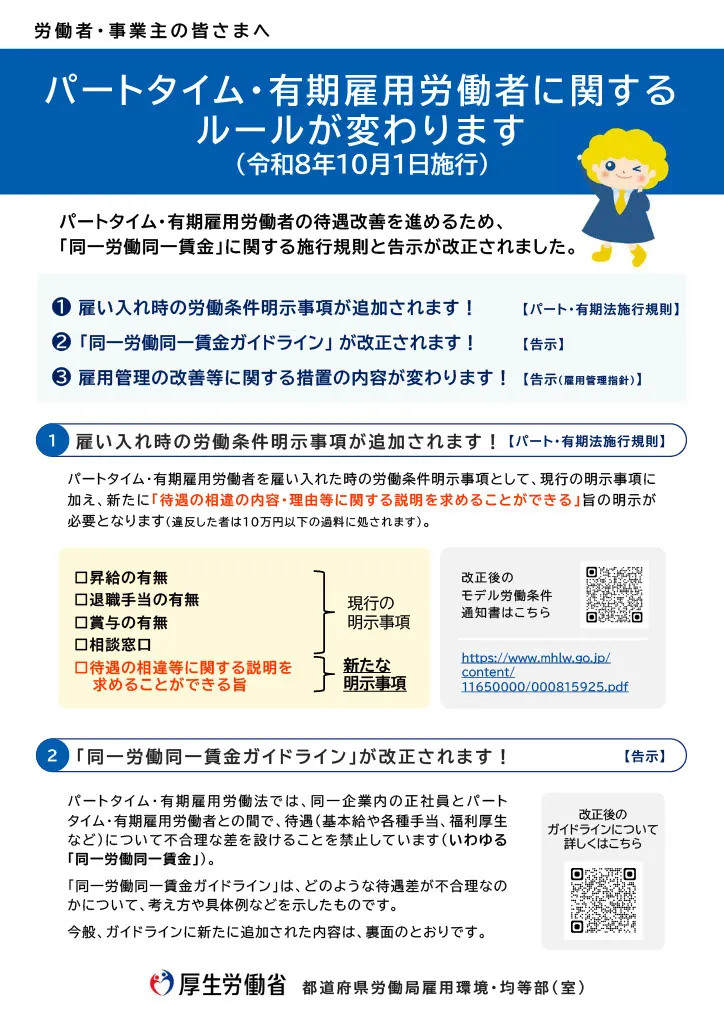
The effective date is October 1, 2026. The main group covered is part-time employees and fixed-term employees directly employed by the operator, such as a private center. The Ministry of Health, Labour and Welfare lists three pillars of the revision: additional information that must be stated when hiring, a revision of the equal pay for equal work guidelines, and a revision of the employment management guidelines.
(Source: Equal Pay for Equal Work special page | Ministry of Health, Labour and Welfare, in Japanese)
What is new, and what was already required
What the revision adds is a requirement to tell part-time and fixed-term employees, in writing, that they may ask the employer to explain the nature of and the reasons for any differences in treatment compared with regular employees (the Act’s own term is “ordinary workers”).
The duty to explain those differences, and the matters taken into account in deciding treatment, when an employee asks for it, already exists under Article 14, paragraph 2 of the Part-Time and Fixed-Term Employment Act. It has also long been necessary, at hiring and at contract renewal, to explain the employment management improvement measures the employer takes: wages, training, welfare facilities, and measures for converting to regular employee status.
In other words, October 2026 is not the point at which explaining differences begins. It is more accurate to see it as creating a clear written route to a right employees already have.
(Source: The rules for part-time and fixed-term employment change from October 2026 | Ministry of Health, Labour and Welfare, in Japanese)
Editor’s note
Pay and benefits are usually the product of budgets, staffing patterns, and how a system has been run in the past. Even when nothing about them was designed to disadvantage anyone, the reasons can become hard to put into words over the years. Rather than letting this change end with one added sentence on a form, it is worth treating it as a chance to get your center to a point where it can say why each element of treatment is set the way it is.
See every document you need to change in one list
Not every item carries the same weight. When you share this inside the center, distinguish between legal obligations, obligations that already existed, steps that follow the guidelines, steps the guidelines call desirable, and practices we recommend as an editorial team.
| Item | Where it stood before, and what changes now | Who and when | Documents to check at the center | Status of the response |
|---|---|---|---|---|
| New written disclosure | The right to request an explanation already existed; what is added is telling employees they may request one | Hiring and contract renewals on or after October 1, 2026 | Written notice of working conditions; combined contract and notice form | Legal obligation |
| Explanation at hiring and renewal | Explaining the employment management improvement measures in place | Hiring and contract renewal | Materials used at hiring and renewal | Existing legal obligation |
| Explanation of differences in treatment | On request, explaining the nature of and reasons for the differences | When an employee asks for an explanation | Work rules, wage tables, job comparison materials | Existing legal obligation |
| How the explanation is given | An oral explanation supported by materials, or materials clear enough to cover every required point | Explanations at hiring, and responses to requests | Explanatory materials, explanation procedure | Follows the revised guidelines |
| Informing staff when nobody asks | Providing materials at renewal, and letting staff know an explanation can be requested | When no request is made | Notices to staff, renewal interview invitations | Called desirable in the guidelines |
| Records and follow-up | Recording receipt, response, and unresolved points | From receiving a question to answering it | Question and response record sheet | Recommended by our editorial team |
| Review of pay and benefits | Matching the purpose of each item against actual duties | When revising the system, and at regular reviews | Rules on allowances, leave, and welfare benefits | Review based on the law and the guidelines |
An MHLW leaflet states that failing to provide the new disclosure may be subject to an administrative fine of up to 100,000 yen. Still, rather than emphasizing the penalty, the practical purpose of the change is to create an environment where employees can raise questions and receive clear answers.
(Source: The rules on part-time and fixed-term employees are changing | Ministry of Health, Labour and Welfare, PDF in Japanese)
Determine who is covered by checking the employer, the contract, and the working hours
Do not decide who is covered from the word “part-timer.” Check the employer, the contract period, and the prescribed working hours. List hiring dates and renewal dates as well.
Short hours, fixed-term full-time, childcare assistants: how to tell who is covered
Under the Act, a part-time worker is an employee whose prescribed weekly working hours are shorter than those of a regular employee working for the same employer. Workplace labels such as “part,” “arubaito” (casual work), “non-regular,” or “childcare assistant” do not settle the question.
A childcare assistant on an indefinite-term contract, for example, is still covered if their prescribed weekly hours are shorter than those of regular employees. Someone on a fixed-term contract who works the same prescribed hours as regular staff, often described as fixed-term full-time, is covered as a fixed-term employee. What decides it is the contract and the working pattern, not whether the person holds a hoikushi (certified childcare professional) qualification.
Non-regular employees with no fixed contract period who work the same hours as regular employees, often described as indefinite-term full-time, may not fall directly within the definitions in the Act. That said, the MHLW Q&A on the revision notes that the intent of the equal pay for equal work guidelines extends to these workers as well. It is important not to read “may not be directly covered by the Act” as “no need to review their pay and benefits.”
(Source: Q&A on communicating the revised ministerial ordinance and notification | Ministry of Health, Labour and Welfare, PDF in Japanese)
Sort your staff into new hires, renewals, and existing staff with no renewal due
MHLW explains that “when hired,” the point at which the new disclosure is required, includes the renewal of a labor contract. So the new form applies not only to covered employees hired on or after October 1, 2026, but also to employees whose fixed-term contracts are renewed on or after that date.
(Source: The rules for part-time and fixed-term employment change from October 2026 | Ministry of Health, Labour and Welfare, in Japanese)
For employees already working at the center on the effective date who have no hiring or renewal date coming up, the official materials we checked do not say that a notice must be reissued to everyone simply because of the revision. If you are unsure about an individual case, such as an indefinite-term part-time employee, check with your Prefectural Labour Bureau rather than redrafting the current contract on your own.
In practice, and separately from whether reissuing is required, telling existing staff about the contact point and about the right to request an explanation keeps anyone from being left out of the loop. A general notice of this kind is not the same as a statutory reissue, and belongs in the category of desirable practice in line with the guidelines.
Dispatched staff and public centers follow a different set of rules
For a dispatched hoikushi, the employer is the dispatching agency. From October 1, 2026, the requirement to state that an explanation of the nature of and reasons for differences in treatment may be requested also applies when a dispatched worker is hired and when they are dispatched. Rather than the host center revising its notice on its own, confirm the division of roles and the flow of information with the dispatching agency.
(Source: Equal pay for equal work for dispatched workers | Ministry of Health, Labour and Welfare, in Japanese)
Local government employees at public centers fall outside the Act under Article 29 of the Part-Time and Fixed-Term Employment Act. Staff such as fiscal-year appointed employees should be checked against the municipality’s ordinances and regulations and the guidance from its personnel department. Where a center is publicly established but privately operated, or run under a designated manager arrangement, and the staff are employed by a private corporation, the judgment rests on the actual employer rather than on the name of the facility.
(Source: Act on Improvement of Employment Management for Part-Time Workers and Fixed-Term Workers | e-Gov Law Search, in Japanese)
What to check on the written notice: the new wording and the contact point
On the notice, check the wording that tells employees they may request an explanation, and a contact point they can actually reach. Put the official model form next to your current one and work through it.
Compare the new fields in the official model against your own form
MHLW has published a model written notice of working conditions for use from October 1, 2026. Place it alongside your current notice and check at least the following.
- Whether pay raises are provided
- Whether a retirement allowance is provided
- Whether bonuses are provided
- A contact point for consultation on employment management improvement
- A statement that an explanation may be requested about the nature of and reasons for differences in treatment compared with regular employees
Written for a center, this might read: an employee may ask the following contact to explain the nature of and reasons for any differences in treatment compared with regular staff, followed by the department, the position responsible, and the contact details. If your center says “regular staff” rather than the statutory “ordinary worker,” the notes to the official model allow you to substitute your own wording.
(Source: Model written notice of working conditions | Ministry of Health, Labour and Welfare, PDF in Japanese)
It is efficient to review your response to the April 2024 changes at the same time. Confirm that the form you use correctly reflects the renewal limit for fixed-term contracts, the opportunity to apply for conversion to indefinite-term employment and the conditions that apply afterward, and the scope of change in workplace and duties.
(Source: The rules on stating working conditions change from April 2024 | Ministry of Health, Labour and Welfare, in Japanese)
How to list a head office contact alongside someone on site
Where the head office decides pay and benefits, naming the head office HR department as the contact point is one option. But a number staff cannot use in practice, or a shared address with nobody assigned to it, does not work as an entry point for consultation.
Even when the head office is the formal contact, decide who passes questions on within the center, whether the employee can contact the head office directly, and by when a first response will come. Avoid treating steps such as submitting a question form or getting the principal’s approval as if they were legal conditions for requesting an explanation.
Confirm how notices are delivered on paper and electronically, and retire the old form
MHLW explains that written notification of working conditions can be given by fax, email, webmail, or certain social media and messaging services if the employee requests it. The condition is that the record received can be printed out to create a written document.
(Source: Notification of working conditions | Ministry of Health, Labour and Welfare, “Check Your Working Conditions”, in Japanese)
When switching to electronic delivery, confirm what the employee wants, and take care not to rely only on formats they cannot open or on links that expire before the employee can save the document. Whichever method you use, track down old versions still sitting in recruitment systems, shared folders, and the computers at each center, so none of them is used by mistake on or after October 1, 2026.
Prepare clear evidence before you explain differences in pay and benefits
When you explain a difference, convey not only what the difference is but the reason for it and the information used to decide. Prepare materials and choose a method the employee can follow.
Separate the explanation given at hiring from the one given when somebody asks
Article 14 of the Part-Time and Fixed-Term Employment Act covers two different kinds of explanation. At hiring and contract renewal, the employer explains the employment management improvement measures it has in place: what wages are based on, what training is provided, which welfare facilities can be used, and what routes exist for converting to regular staff status.
When an employee asks after being hired, the employer explains the nature of and reasons for the difference in treatment compared with the regular employee used for comparison, together with the matters taken into account in deciding it. An abstract answer such as “the employment type is different” or “those are the corporation’s rules” is not enough. Go back to the circumstances that relate to the nature and purpose of the item in question: job content, the scope of change in duties and placement, experience, and ability.
(Source: Q&A on the duty to explain differences in treatment | Ministry of Health, Labour and Welfare, in Japanese)
Treating an employee unfavorably in contract renewal, shifts, placement, or evaluation because they asked for an explanation is prohibited. The starting point is to treat the question as the exercise of a legal right, not as a complaint about the center.
Explain with materials in hand, or hand over materials that cover every required point
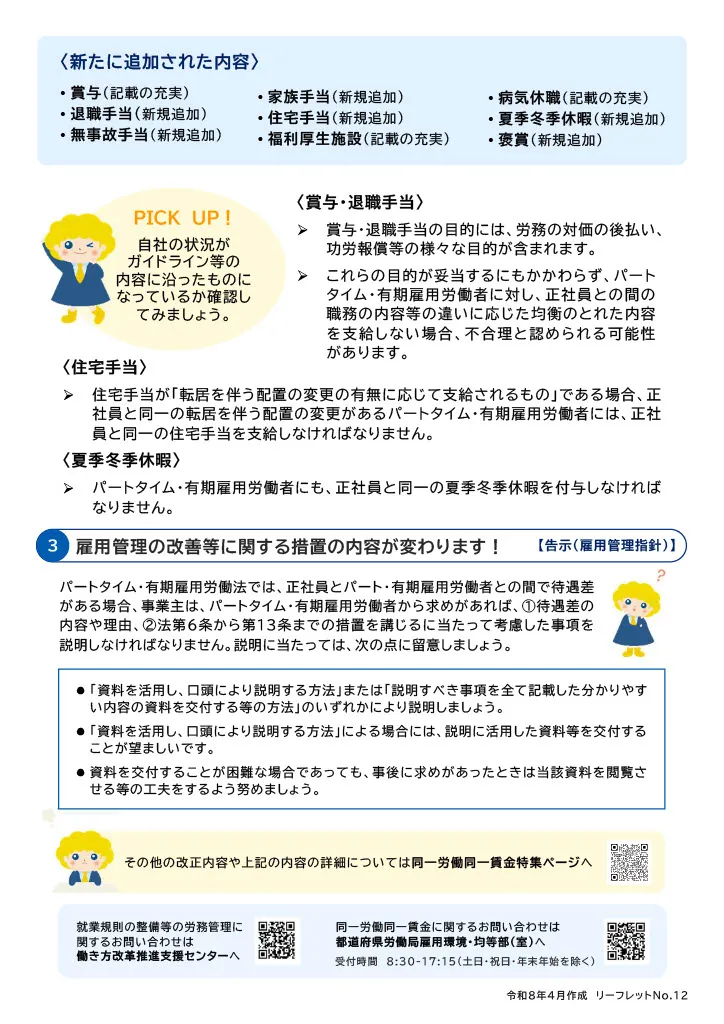
The revised employment management guidelines describe explaining orally with the support of materials, or providing clear materials that set out every matter to be explained, so that the employee can follow the content. Where an oral explanation is given with materials, handing over those materials and related documents is described as desirable.
(Source: Ministry of Health, Labour and Welfare Notification No. 202 of 2026 | Ministry of Health, Labour and Welfare, PDF in Japanese)
Rather than handing over the whole set of work rules and finishing with “it is written in there,” identify the specific item being asked about. For a housing allowance, this order is easier to follow.
- Whether there is a difference between regular staff and the employee in whether the allowance is paid, or in the amount
- What purpose the allowance was created to serve
- What the payment conditions are under the rules
- What differences there are in actual working patterns, such as the possibility of transfer or relocation
- How those differences connect to the payment conditions
Take care with personal information in the materials, and avoid casually including individual names or other employees’ salary amounts.
Decide who handles a question, from the moment it arrives to the answer
A principal who receives a question does not need to provide an immediate answer without first checking the facts. What matters is not guessing in the moment, and instead saying who will check what, and when an answer will come.
- Receive the question
- Identify which pay or benefit item is involved
- Check the rules and how they are actually applied
- Identify the regular employee used for comparison
- Explain using materials
- Confirm any unresolved points and follow up
If the head office sets the system and the center knows the actual duties, you need information from both, not from one side alone.
Editor’s note
It matters not to interpret a question about pay as criticism of the center. There is nothing wrong with a principal being unable to answer on the spot. Being able to say “let me check, and I will come back to you by this date” is what makes the conversation easier to have.
In your records, keep “received” and “agreed” apart
Recording the date of the explanation, the materials used, the questions and answers, and any unresolved points is a practical way to prevent missed follow-ups. An employee’s signature may confirm that materials were received, but it does not signify agreement with the difference in treatment, a guarantee that it is lawful, or a waiver of rights.
In the record fields, keep “I have received the explanatory materials” and “I agree with the content of the explanation” separate, and we suggest leaving space for further questions. This is a management suggestion from the TamagoDaruma editorial team, not a legal requirement to obtain a signature.
Review each pay and benefit item by its purpose and by how the work is actually done
Do not explain differences by job title or employment type alone. Match the purpose of each allowance against how people actually work. Any item you cannot explain should be flagged for further review.
Map who actually carries class responsibility, support work, and opening and closing shifts
On the ground, job titles such as “regular staff,” “part-time hoikushi,” and “childcare assistant” do not always reveal actual responsibility or workload. Even among staff working in the same class, some also handle lesson plans and records, communication with families, preparation for events, judgment calls when an incident occurs, and mentoring of newer colleagues.
There may also be staff who consistently take opening and closing shifts, handling safety checks at opening and closing time and handovers with families, without that reality showing up in job documentation or evaluation. This is not something observed at a particular center; it is a situation worth keeping in mind during a review.
The points to check also differ by role. For hoikushi and childcare assistants, look at class responsibility, records, communication with families, and how far their judgment extends when an incident occurs. For cooks and kitchen assistants, look at responsibility for menu planning, allergy management, and hygiene records. For nursing staff, look at medication, care for children who are unwell, and health planning and records; for maintenance and transport staff, map the scope of vehicle operation and safety management. Look not only at the content of the work but at the degree of responsibility and the scope of change in placement and duties.
- Is the main work content the same, or different?
- How far does judgment and responsibility extend?
- How do the ranges of transfer, class reassignment, and moves to other centers differ?
- Who handles communication with families, records, meetings, and event preparation?
- Which documents do you use to confirm experience, ability, and results?
Rather than relying on the job title printed on the notice, cross-check with the head teacher and principal, who know the actual work.
Review bonuses, allowances, leave, and welfare benefits separately
Whether a difference is unreasonable is judged item by item, taking into account the circumstances appropriate to the nature and purpose of that item. Neither “part-time staff get none of it” nor “after the revision everything matches regular staff” describes how the system actually works.
(Source: Q&A on the equal pay for equal work guidelines and the employment management guidelines | Ministry of Health, Labour and Welfare, PDF in Japanese)
| Pay or benefit item | Purpose of the arrangement | Regular employees | Covered employees | Actual duties and circumstances | Basis for the explanation | Unresolved points |
|---|---|---|---|---|---|---|
| Base pay | Job content, ability, experience, results, and so on | Enter the grade and evaluation method | Enter the hourly rate, grade, and evaluation method | Confirm work, responsibility, and experience | Wage rules, evaluation criteria | Mismatch in what is evaluated |
| Bonus | Deferred payment for work, reward for service, motivation, and so on | Enter the payment conditions | Enter whether paid and how it is calculated | Whether the purpose also applies to covered employees | Bonus rules, calculation materials | The purpose, and the reason for exclusion |
| Opening and closing shift allowance | Compensating for work in particular time slots, and so on | Enter the conditions and the amount | Enter the conditions and the amount | Confirm how often each person actually takes them | Allowance rules, shift schedules | Differences for the same shifts |
| Housing allowance | Support for housing costs, response to placement changes involving relocation, and so on | Enter the payment conditions | Enter whether paid and the conditions | Confirm the scope of transfer and relocation | Rules, placement policy | Putting the purpose in writing |
| Summer and winter leave | Physical and mental recovery, income security, and so on | Enter the number of days and the conditions | Enter the number of days and the conditions | Confirm the relationship with days worked | Leave rules | The basis for the treatment |
| Welfare benefits | Meals, breaks, health, leisure support, and so on | Enter the conditions of use | Enter the conditions of use | Confirm available hours and similar factors | Welfare benefit rules | Indirect or practical barriers to use |
The 2026 revision of the guidelines added or clarified descriptions covering bonuses, retirement allowances, accident-free allowances, family allowances, housing allowances, sick leave and leave of absence, summer and winter leave, and commendations. Even if your center has no arrangement with the same name, this is a prompt to go through bonuses, long-service recognition, leave, and use of facilities one item at a time.
(Source: Q&A on communicating the revised ministerial ordinance and notification | Ministry of Health, Labour and Welfare, PDF in Japanese)
Keep the funding for wage improvement separate from the grounds for a difference
At daycare centers, it is easy to explain pay improvements by saying “it is set by the wage improvement funding” or “the head office decided it.” But the conditions attached to a funding scheme and the grounds for explaining a difference between individual employees are not the same thing.
When you are dealing with the wage improvement add-on funding for childcare staff (shogū kaizen kasan), check that year’s notifications from the Children and Families Agency and your municipality, along with the center’s wage improvement plan, pay rules, and allocation rules. Then map how coverage, calculation, role, experience, and actual working patterns are reflected in them. The treatment can change from year to year, so do not judge from articles written in earlier years.

Use a checklist to track outstanding actions, and the FAQ for common questions
To avoid gaps, manage covered employees, documents, explanatory materials, and assigned staff in a single table. Keep difficult judgments on the list as questions, and take them to an official contact.
Fill in the checklist with your principal, head office, and administrative staff
Mark each of the following as done, action needed, needs checking, or not applicable, and enter who is responsible and the date of the action.
- Organized covered employees by employer, contract period, and prescribed working hours
- Confirmed hiring dates and contract renewal dates
- Compared the current notice against the MHLW model form for the revision
- Included the wording on requesting an explanation, and a contact point staff can actually reach
- Confirmed that the items from the April 2024 revision are also reflected
- Confirmed the delivery procedure for paper and electronic notices, and the conditions for electronic delivery
- Checked recruitment and contract renewal systems, shared folders, and old forms left at each center
- Collected the rules, purpose, payment conditions, and actual practice for each pay and benefit item
- Decided who explains at the center and the head office, how questions are passed on, and the target response time
- Able to record unresolved points, who to ask, the person responsible, and the date
- Took points requiring individual judgment to the Prefectural Labour Bureau or a professional
You do not have to fill everything in perfectly from the start. The point of the table is to make sure an item marked “needs checking” is assigned to someone, with a date for checking it, rather than left blank.
Common questions about renewals, explanations, and who is covered
- Q1. When does the new disclosure become necessary?
- From hiring and labor contract renewals on or after October 1, 2026. You are free to start reviewing pay and benefits and replacing forms before the effective date.
- Q2. Are employees whose contracts are renewed covered?
- Yes. MHLW states explicitly that hiring includes the renewal of a labor contract. Fixed-term full-time staff are also within scope as fixed-term employees.
- Q3. Do we reissue notices to all existing staff who have no renewal due?
- The official materials we checked do not say that reissuing to everyone is required simply because of the revision. The new disclosure applies at hiring and renewal. Informing existing staff is still desirable, and if you are unsure about a case such as an indefinite-term part-time employee, check with the Labour Bureau.
- Q4. How do we assess indefinite-term part-time and fixed-term full-time staff?
- By the contract and the prescribed working hours, rather than the label used at the workplace. An indefinite-term contract is still covered if prescribed weekly hours are shorter than those of regular employees, and a fixed-term contract is covered even at full-time hours.
- Q5. Is an oral explanation enough?
- Not for the new disclosure. Delivery in writing or an equivalent method is required. A difference in treatment can be explained orally with the support of materials, or by providing clear materials that cover every required point.
- Q6. If nobody asks, is there nothing to do?
- No. The new disclosure at hiring and renewal, and the explanation of employment management improvement measures, are still required. Explaining an individual difference is an obligation when an employee asks, but even without a request, providing materials and letting staff know about the right to ask is described as desirable.
- Q7. Do we pay part-time staff every allowance at the same amount?
- Not automatically. Whether a difference is unreasonable is judged from the nature and purpose of each item, together with job content, the scope of change, and other circumstances.
- Q8. Are dispatched hoikushi and staff at public centers treated the same way?
- No. For dispatched hoikushi, the changes come under the Worker Dispatching Act, and you confirm the roles of the dispatching agency and the host center. Local government employees fall outside the Part-Time and Fixed-Term Employment Act, so you follow the municipality’s own personnel system.
- Q9. Can we provide the notice by email?
- Yes, if the employee requests it and the method meets the set conditions, such as being able to print out the record received to create a written document. Also confirm that attachments can be opened and that there is no expiry on storage, and keep a record of what was sent.
If something is unclear, gather your documents and ask
When you consult someone, it helps to bring the written notice of working conditions with personal information removed, the work rules, the pay rules, a list of the pay and benefit items involved, the content of the jobs being compared, current practice, and the questions you want answered. For questions about the Part-Time and Fixed-Term Employment Act, the contact is the Employment Environment and Equal Employment Department or Office of your Prefectural Labour Bureau.

The October 2026 revision is not a job that ends with one added sentence on a form. Putting a contact point in writing also tells staff that they are entitled to ask how their pay and benefits were decided. Even if a principal cannot answer everything on the spot, you can build a process that takes the question seriously, checks with the head office or a professional, and comes back with the reasoning.
From the TamagoDaruma editorial team
This change is not about blaming either the center or its staff. It is a chance to put daily roles, and the pay and benefits attached to them, back into words. Start by opening your current notice and working through covered employees, the contact point, explanatory materials, the person responsible, and the date, one at a time.
This article is a general summary based on public information available as of September 2026. For the lawfulness of an individual difference in treatment, or for revisions to contracts and internal rules, please check with the Prefectural Labour Bureau with jurisdiction or a professional such as a labor and social security attorney (sharōshi).
