
PR | WEL-KIDS Co., Ltd.
This article introduces a free webinar co-hosted by WEL-KIDS Co., Ltd. and TMI Associates.
Japan’s Child Sexual Violence Prevention Act will take effect on December 25, 2026. The law is often described as Japan’s new DBS-style system, drawing a comparison with the UK’s Disclosure and Barring Service.
For childcare and education professionals outside Japan, the law offers an important example of how Japan is building a more systematic framework for preventing sexual violence against children. For operators working in Japan, it also raises an urgent practical question: what should each organization prepare before the law takes effect?
This is not only a criminal-record-check system. The law also affects recruitment, workplace rules, staff training, consultation procedures, communication with parents and children, and the handling of highly sensitive information.
This guide explains the key points in clear terms. It is intended primarily for international professionals in childcare, education, family support, and child safeguarding, as well as operators and administrators working in Japan.
Table of Contents
Japan’s New Child Safety Law Is Not Only About Criminal Record Checks
Japan’s Child Sexual Violence Prevention Act requires more than criminal record checks. It also calls for safeguards, training, consultation procedures, communication with families, and strict information management.
Media coverage often focuses on the phrase “Japan’s DBS-style system.” That comparison is useful, but incomplete. The law is not designed as a one-time screening exercise. Its broader aim is to help organizations build and maintain environments that reduce the risk of child-targeted sexual violence.
What Is the Child Sexual Violence Prevention Act?
The Child Sexual Violence Prevention Act was enacted on June 19, 2024, promulgated on June 26, 2024, and will take effect on December 25, 2026.
The law’s Japanese title may be translated as the “Act on Measures to Prevent Child-Targeted Sexual Violence by School Operators and Private Education and Childcare Service Providers” (Act No. 69 of 2024).
Its purpose is to prevent child-targeted sexual violence in settings where adults provide education, childcare, and related services, and to protect the physical and psychological well-being of children.
For organizations in Japan, this is no longer a distant policy issue. The preparation period is already underway.
Source: Child Sexual Violence Prevention Act | Children and Families Agency
What Does “Japan’s DBS-Style System” Mean?
The phrase “Japan’s DBS-style system” is used by analogy with the UK’s Disclosure and Barring Service. Under the Japanese law, organizations check whether people working in roles involving contact with children have records of certain specified sexual offenses and take necessary preventive measures.
However, criminal record checks are only one part of the framework. Organizations also need to consider staff training, consultation procedures, communication with parents and children, reporting and response rules, and the management of sensitive information.
Preventing Both First-Time Offenses and Reoffending
The framework is often discussed from two perspectives:
- Preventing first-time offenses: reducing the risk of child-targeted sexual violence regardless of whether an individual has a prior record
- Preventing reoffending: reducing the risk posed by individuals with records of specified sexual offenses
For organizations, it is easier to translate these objectives into concrete areas of responsibility.
Four Areas to Review Within an Organization
- Safeguarding measures: staff training, consultation procedures, and communication with parents and children
- Criminal record checks: procedures for confirming whether an individual has a record of certain specified sexual offenses
- Information management: access controls, storage, recordkeeping, disposal, and responses to data breaches
- Operational responsibilities: appointing responsible personnel and clarifying internal roles
Note: This four-part breakdown is an editorial framework designed to help readers organize the practical issues. It is not the formal legal classification used in the legislation.
Do All Childcare and Education Providers Have the Same Obligations?
No. The requirements differ depending on the type of organization and the services it provides.
Schools and licensed childcare centers are among the entities subject to mandatory requirements. Other providers, including tutoring schools and sports clubs, may become covered after applying for and receiving certification.
This distinction is important. It would be inaccurate to assume that every organization working with children has the same legal obligations.
Source: Child Sexual Violence Prevention Act | Children and Families Agency
Important Notice for Organizations Subject to Mandatory Requirements
The recommended deadline for obtaining a GBizID was around the end of April 2026. If your organization has not yet obtained a GBizID or completed the required pre-registration steps, check the latest guidance from your supervising authority and the Children and Families Agency immediately.
Mandatory Requirements and Voluntary Certification
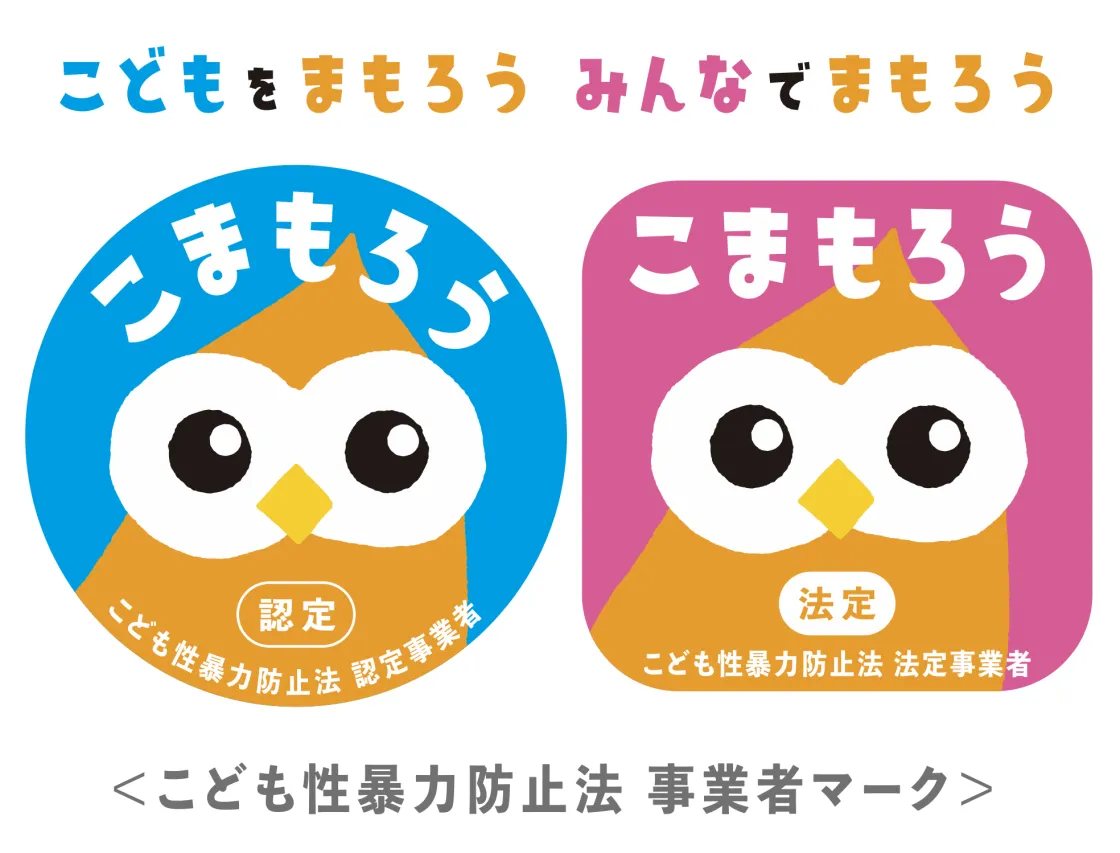
The Children and Families Agency has prepared two provider marks, known as Komamorou marks:
- Statutory provider mark: for organizations such as schools and licensed childcare centers that are subject to mandatory requirements
- Certified provider mark: for providers such as tutoring schools and sports clubs that obtain national certification
The two marks reflect the system’s two-tier structure: mandatory compliance for certain organizations and certification-based participation for other providers.
How Japan’s Main Childcare Facility Types Fit Into the System
Japan has several categories of early childhood education and care providers. For international readers, the following terms are useful:
- Licensed childcare center (hoikuen): a licensed childcare facility, generally serving families that require childcare services
- Kindergarten (yochien): an early childhood education institution
- Certified early childhood education and care center (nintei kodomoen): a center combining elements of childcare and early education
- After-school club (gakudo): an after-school care program for school-age children
Licensed childcare centers, kindergartens, and certified early childhood education and care centers are generally among the organizations subject to mandatory requirements. The precise scope and procedures should still be checked in the official guidance.
After-School Clubs and Unlicensed Childcare Providers Require Separate Review
After-school clubs and unlicensed childcare businesses are listed in the official materials as examples of private education and childcare providers that may become covered through certification.
The applicable requirements may depend on the type of service, operating structure, and contractual arrangements. Organizations should not assume that the same rules apply to every childcare-related service.
When in Doubt, Start With the Official Guidance
The Children and Families Agency publishes the system overview, enforcement guidelines, Q&A documents, provider checklists, and templates.
Online articles can help readers understand the framework, but organizations should confirm their own category and obligations using the latest official materials and, where appropriate, their supervising authority.
Source: Child Sexual Violence Prevention Act | Children and Families Agency
| Organization or service | What to confirm first | Important note |
|---|---|---|
| Licensed childcare center (hoikuen) | Organization category, responsible personnel, and official procedures | Check the latest official guidance |
| Certified early childhood education and care center (nintei kodomoen) | Center type, operating structure, and supervising authority | Confirm the requirements for the specific center type |
| Kindergarten (yochien) | Covered duties and the responsible department within the organization | Coordinate within the school operator or corporation |
| Unlicensed childcare provider | Eligibility for certification and the applicable requirements | Do not assume the same obligations as a licensed childcare center |
| After-school club (gakudo) | Eligibility for certification and the latest official guidance | Do not assume the same obligations as a licensed childcare center |
| Other providers | Official guidance, Q&A documents, and supervising authority | Confirm the requirements for your specific circumstances |
What Should Organizations Prepare Before the Law Takes Effect?
Organizations can begin by reviewing four practical areas: their legal category, recruitment documents and workplace rules, training and consultation procedures, and the handling of criminal-record-check information.
Four Practical Steps
- Confirm your organization’s category and appoint a responsible person.
- Review recruitment documents, workplace rules, and internal procedures.
- Review training, consultation procedures, and communication with parents and children.
- Establish rules for handling criminal-record-check information.
The time required will vary depending on the size of the organization, internal decision-making processes, procedures for revising workplace rules, and training plans.
It would be misleading to say either “there is plenty of time” or “it is already too late.” A practical first step is to identify what your organization has not yet confirmed.
Saveable 10-Point Checklist
- Confirm your organization’s category using the official guidance.
- Appoint a person responsible for implementation.
- Clarify the roles of directors, HR staff, on-site managers, and information managers.
- Review whether recruitment materials and job advertisements need to be updated.
- Review whether pledges, offer letters, and workplace rules need to be updated.
- Check the status of reporting and response procedures.
- Plan staff training.
- Review how your organization will communicate with parents and children.
- Review access controls, storage, recordkeeping, and disposal procedures.
- Write down questions for the webinar or for legal and labor specialists.
This checklist does not confirm legal compliance or replace professional advice. Organizations should review the latest official guidance and consult their supervising authority, legal counsel, labor specialists, or other relevant professionals as necessary.
Step 1 | Confirm Your Category and Appoint a Responsible Person
First, confirm whether your organization is subject to mandatory requirements or operates a service that may become covered through certification. Then appoint a responsible person.
Do not leave the entire process to one director. Clarify who will review each area, including HR, on-site operations, training, and information management.
Step 2 | Review Recruitment Documents and Workplace Rules
The Children and Families Agency publishes templates and reference examples for recruitment notices, job advertisements, pledges, offer letters, workplace rules, reporting procedures, response procedures, and information management rules.
Organizations do not need to start from a blank page. Using the official templates as a reference can make it easier to identify which documents need revision and who should update them.
Source: Templates and Reference Materials | Children and Families Agency
Step 3 | Review Training, Consultation Procedures, and Communication
Safeguarding measures include staff training, consultation procedures, and communication with parents and children. The Children and Families Agency also publishes training materials and templates for informational materials.
Documents alone are not enough. If staff members do not know how to raise concerns or whom to contact when something feels wrong, a consultation process can become a box-ticking exercise.
Step 4 | Establish Rules for Handling Criminal-Record-Check Information
Information related to criminal record checks must be handled with the utmost care. Organizations should limit access to the minimum number of authorized personnel and establish clear rules for recordkeeping, storage, transmission, disposal, and responses to data breaches.
The Children and Families Agency publishes several information-management templates depending on how the information will be accessed and stored.
This does not mean that criminal-record-check information should be stored in a general childcare ICT service. Such information must be handled within a limited framework based on the law. General childcare ICT systems may support peripheral operations such as attendance management, recordkeeping, and communication with parents, but these functions should be considered separately from the handling of sensitive criminal-record-check information.
Source: Templates and Reference Materials | Children and Families Agency
Organizations Subject to Mandatory Requirements Should Check GBizID Guidance Immediately
After the law takes effect, administrative procedures will be handled through the Child Sexual Violence Prevention Act-related system, provisionally known as the Komamorou system. A government-issued business ID, known as a GBizID, is required to register for access.
Organizations subject to mandatory requirements were advised to obtain a GBizID by around the end of April 2026 and to submit provider information, including the GBizID, during the designated registration period from April to July 2026.
If your organization has not yet obtained a GBizID or completed the required registration steps, check the latest guidance from your supervising authority and the Children and Families Agency immediately.
Source: Bulk Registration of Provider Information | Children and Families Agency
Editor’s Note
While reporting on this law, one concern stands out: the goal of “protecting children” can gradually become reduced to “completing the paperwork.”
Templates are valuable tools, but completing a template is not the same as creating a safe environment. Effective safeguards also depend on workplace culture: whether staff members can voice small concerns, ask difficult questions, and report a sense that something may be wrong.
As organizations prepare, it is worth asking a simple question: Is this a workplace where people feel able to speak up?
Free Webinar: Overview and Preparation for the New Law
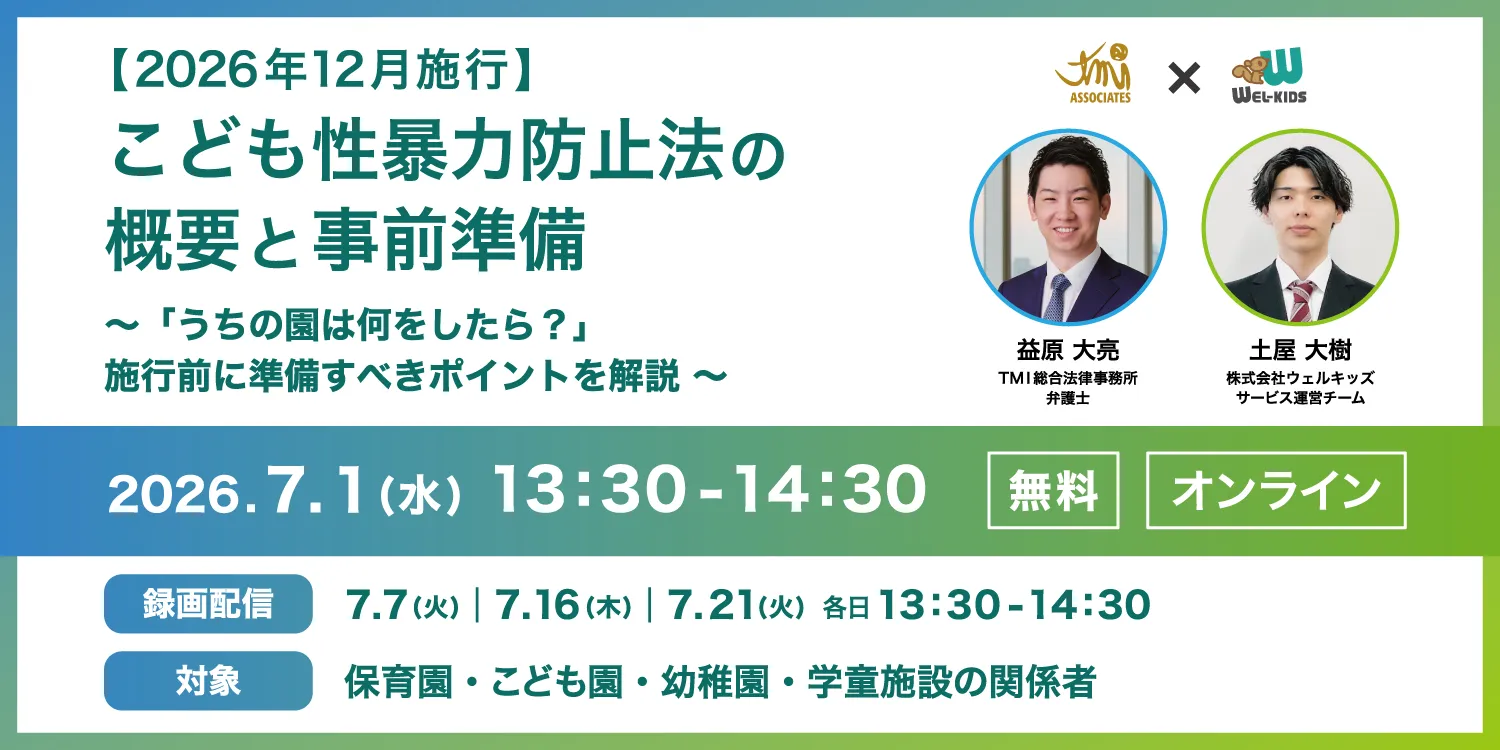
WEL-KIDS Co., Ltd. and TMI Associates are co-hosting a free webinar for childcare operators and administrators in Japan. The webinar explains the law, the organizations it covers, the required measures, and the practical steps to review before implementation.
The legal presentation will be delivered by Daisuke Masuhara, an attorney at TMI Associates and an adviser on the Child Sexual Violence Prevention Act for the Children and Families Agency. He has been involved in the review and preparation of guidelines, templates, and training materials related to the law.
The webinar also includes an introduction to ICT-related support by WEL-KIDS and a Q&A session.
Note for international readers: the registration page is in Japanese. Please check the official page for participation details.
Source: Free Webinar Details | WEL-KIDS PRESS
Who the Webinar Is For
The webinar is intended for directors, board chairs, facility heads, and HR staff working at licensed childcare centers, certified early childhood education and care centers, kindergartens, and after-school clubs in Japan.
Applications from competing service providers may be declined.
What the Webinar Covers
- Overview of the Child Sexual Violence Prevention Act
- Organizations and services covered by the law
- Measures required of providers
- Preparation steps before implementation
- Introduction to ICT-related support by WEL-KIDS
- Q&A session
Participant Benefits
- For all participants: the presentation slides used during the webinar
- For participants who complete the survey: a checklist of steps to review before implementation, prepared under the content supervision of TMI Associates
Free Webinar for Childcare Operators in Japan
- Event: Overview and Preparation for the Child Sexual Violence Prevention Act
- Format: Online via Zoom
- Fee: Free
- Co-hosts: TMI Associates and WEL-KIDS Co., Ltd.
Get a clear overview of the law and the steps your organization should review before December 2026.
Can You Watch the Webinar If You Cannot Attend Live?
Yes. Registered participants can join scheduled replay sessions or access a limited-time on-demand recording. The schedule and delivery method may change, so check the official registration page and the information provided after registration.
Webinar Schedule
| Session type | Date and time |
|---|---|
| Live session | Wednesday, July 1, 2026, 13:30–14:30 JST |
| Scheduled replay | Tuesday, July 7, 2026, 13:30–14:30 JST |
| Scheduled replay | Thursday, July 16, 2026, 13:30–14:30 JST |
| Scheduled replay | Tuesday, July 21, 2026, 13:30–14:30 JST |
| On-demand recording | Available to registrants for a limited period after the event. Details will be provided after registration. |
Frequently Asked Questions
- When will Japan’s Child Sexual Violence Prevention Act take effect?
- The law will take effect on December 25, 2026.
- What is Japan’s DBS-style system?
- The phrase refers to a framework compared with the UK’s Disclosure and Barring Service. Under the Japanese law, organizations check whether people working in roles involving contact with children have records of certain specified sexual offenses and take necessary preventive measures. The law also includes broader safeguarding and information-management requirements.
- Is the law only about criminal record checks?
- No. Organizations also need to review safeguarding measures, staff training, consultation procedures, communication with parents and children, reporting and response rules, and information-management procedures.
- Do all childcare and education providers have the same obligations?
- No. Some organizations, including schools and licensed childcare centers, are subject to mandatory requirements. Other providers may become covered after applying for and receiving certification. Organizations should confirm their own category using the official guidance.
- How are after-school clubs and unlicensed childcare providers treated?
- They are listed in the official materials as examples of private education and childcare providers that may become covered through certification. The applicable requirements should be confirmed for the specific service and operating structure.
- What should an organization review first?
- Start by confirming your organization’s category and appointing a responsible person. Then clarify internal roles for HR, operations, training, and information management.
- Does the Children and Families Agency provide templates?
- Yes. The agency publishes templates and reference examples for recruitment notices, pledges, offer letters, workplace rules, reporting and response procedures, information management, and other areas.
- Are staff training materials available?
- Yes. The Children and Families Agency publishes training materials for staff.
- Should organizations communicate with parents and children?
- Yes. Communication with parents and children is part of the broader safeguarding framework. The Children and Families Agency publishes templates for informational materials.
- Can criminal-record-check information be stored in a general childcare ICT system?
- This should not be assumed. Criminal-record-check information is highly sensitive and must be handled within a limited framework based on the law. Organizations should review the official information-management requirements carefully.
- What should an organization do if it has not yet obtained a GBizID?
- Organizations subject to mandatory requirements were advised to obtain a GBizID by around the end of April 2026. If your organization has not yet done so, check the latest guidance from your supervising authority and the Children and Families Agency immediately.
- Can registered participants watch the webinar if they cannot attend live?
- Yes. Registered participants can use scheduled replay sessions or access a limited-time on-demand recording. Check the official page for the latest details.
- Can an organization make legal or employment decisions based on this article alone?
- No. Organizations should review the latest official materials and consult their supervising authority, legal counsel, labor specialists, or other qualified professionals as necessary.
Start by Identifying What Your Organization Has Not Yet Confirmed
To avoid a last-minute scramble, begin by confirming your organization’s category, appointing a responsible person, and listing the issues that still need review.
The purpose of this law is not to place the entire burden on one director or administrator. It is to build an organizational framework that supports children’s safety.
For TamagoDaruma, the most important point is that the law should not become a paperwork-only exercise. Organizations that use this process as an opportunity to strengthen internal communication and create a culture where staff can speak up will be better positioned to earn the trust of children, families, and the wider community.
Write Down Your Questions Before the Webinar
You will get more value from the webinar if you attend with specific questions:
- Which category applies to our organization?
- Which documents need to be reviewed?
- Who should manage sensitive information?
- How should we communicate with staff and families?
View the Free Webinar Details
Organizations in Japan that want to review the law and the required preparation steps with guidance from a legal professional can use the free webinar as a practical starting point.
View Webinar Details and Register
This article is based on information available at the time of publication. The procedures, schedules, and official guidance may be updated. Organizations should confirm the latest information with the Children and Families Agency, their supervising authority, and qualified professionals before making final decisions.
