
When it comes to parenting information, the question is less “where do I look?” and more “what criteria am I using to choose?” Sorting sources into official public information, practical everyday media, and community-based content — and using each one for the right kind of question — makes it easier to find what you need without collecting more than you can actually use.
Search terms like “parenting resources in Japan,” “parenting apps in Japan,” “Japan parenting blogs,” or “parenting YouTube channels in Japan” return a large number of results. That can feel helpful at first — but the more sources you accumulate, the harder it becomes to know which ones to trust, and information-gathering itself can start to feel like extra work.
For families raising children from birth to age 3 in Japan, there are moments that call for quick decisions: a sudden fever, questions about starting nursery school, introducing solids, developmental milestones, vaccinations, childcare enrollment, and local administrative procedures. Personal accounts and peer communities can provide real comfort, but for medical, developmental, and policy-related questions, official and specialist sources should be your starting point.
This guide is written for parents of babies and toddlers — including non-Japanese-speaking families living in Japan — and covers how to navigate Japan’s parenting information landscape: official sources, apps, media, YouTube, and public support systems. The goal is not to collect more sources, but to decide, by type of question, where you look first.
Table of Contents
Where to find parenting information you can rely on — start by thinking in three categories
Parenting information becomes easier to navigate when you sort it into official public sources, practical everyday media, and community-based content.
One reason searching for parenting information can feel exhausting is that government websites, parenting apps, YouTube channels, social media, and personal blogs all tend to get evaluated using the same criteria. They serve different purposes — so the question is not “which one is most accurate?” but “which type fits what I’m trying to figure out right now?”
For foundational decisions — childcare systems, health and development, public services, childcare facility options — start with government agencies, your local municipal office, and specialist organizations. For the daily texture of parenting — play ideas, sleep routines, nursery prep, parental wellbeing — parenting media, apps, and video content are more practical. And for emotional connection and shared experience — social media and personal accounts serve a different, but genuinely useful, function.
For medical, developmental, and system questions — start with official sources
For questions about fever, child development, vaccinations, health checkups, childcare subsidies, nursery school enrollment, and local support programs, official sources should be your first stop.
The Children and Families Agency (CFA) website covers Japan’s child and child-rearing support system, including national programs and community-level childcare services. Because support content varies by municipality, the CFA site is useful for understanding the national framework, while your local ward or city office’s website is the place to confirm specific procedures, eligibility, and timing in your area.
Source: Child and Child-Rearing Support System | Children and Families Agency
The Maternal and Child Health Handbook Information Support Site covers health and child-rearing information from pregnancy through early childhood, and serves as a useful starting point for understanding infant health checkups and key milestones in the first few years.
Source: Maternal and Child Health Handbook Information Support Site | Children and Families Agency
That said, for questions about a specific child’s health or development, online research alone should not be the endpoint. If concerns persist, please speak with your child’s doctor, your local community health center, your childcare provider, or a specialist service.
For everyday parenting questions — supplement with media, apps, and video
Official sources don’t cover everything you need day to day.
Questions like “what can we do at home with a newborn on a rainy day,” “how do I get nursery school supplies organized,” or “what do other parents do when bedtime stops working” are better answered by parenting media, apps, and video content than by government websites.
Apps are well suited to recording and reminders. Parenting media is good at organizing practical information in a readable format. Video is useful for understanding how something looks in practice — the pace of a play routine, the tone of a caregiver’s voice, the steps in preparing a first food.
That said, the more accessible a source is, the easier it is to assume its advice applies directly to your child and your household. Children’s growth, family environments, childcare facility policies, and local support systems all differ. Everyday information is most useful when treated as a range of options rather than a single correct answer to follow.
For SNS and blogs — read for shared experience, not decisions
Personal accounts and online communities carry something official sources don’t: real voices from people living through the same things.
A post from another parent who was up all night, or whose toddler refused to eat for three days, or who didn’t understand a note from the nursery — these can make a genuinely isolating experience feel less so. That value is real, and it shouldn’t be dismissed.
At the same time, social media and personal blogs are, at their core, individual experiences. What worked for one family may not apply to another — and they should not be the deciding factor for questions about development, illness, medication, vaccinations, childcare systems, or financial support.
Treat personal accounts as “this is one family’s experience” — and bring anything that requires a concrete decision back to official sources or a specialist. That distance is what keeps you from being pulled in too many directions at once.
10 types of parenting information sources for families with children from birth to age 3
For families raising babies and toddlers in Japan, the most practical approach is to combine official sources, local municipal information, childcare apps, and reliable media — and use each for what it does well.
Rather than naming a definitive “best” source, this section breaks down 10 types of information sources by purpose. Think of this less as a ranking and more as a reference map: different questions belong in different places.
1. Children and Families Agency and national government sources

For understanding the overall framework of childcare systems and public support in Japan, government sources — starting with the Children and Families Agency (CFA) — are the right place to begin.
Information about Japan’s child and child-rearing support system, child allowances, community childcare support services, and nursery school enrollment can shift in detail between regions and over time. Private media coverage can become outdated or miss local variation. The CFA site gives you the national-level framework; your municipal office fills in the specifics for where you live.
Government sources can feel dense compared to consumer media. But the first priority is not “easy to read” — it’s “accurate and authoritative.” Readable media is most useful afterward, for helping you understand what you’ve already found.
Source: Children and Families Agency — Official Website
2. Maternal and Child Health Handbook Information Support Site

For health and child-rearing information from pregnancy through early childhood, the Maternal and Child Health Handbook Information Support Site is worth bookmarking early.
The site covers health and child-rearing content from pregnancy through infancy and early childhood, and serves as a starting point for understanding what to expect at infant and toddler health checkups and other key stages in the early years.
Source: Maternal and Child Health Handbook Information Support Site | Children and Families Agency
The site also includes a dedicated section for families from outside Japan who are pregnant in Japan, with information about multilingual versions of the maternal and child health handbook (boshi techo) and multilingual leaflets. For households where Japanese is not the primary language, this is an important resource to check early in pregnancy or soon after arriving in Japan.
Source: For Those Who Become Pregnant in Japan from Abroad | Maternal and Child Health Handbook Information Support Site
3. Your local municipal childcare support pages
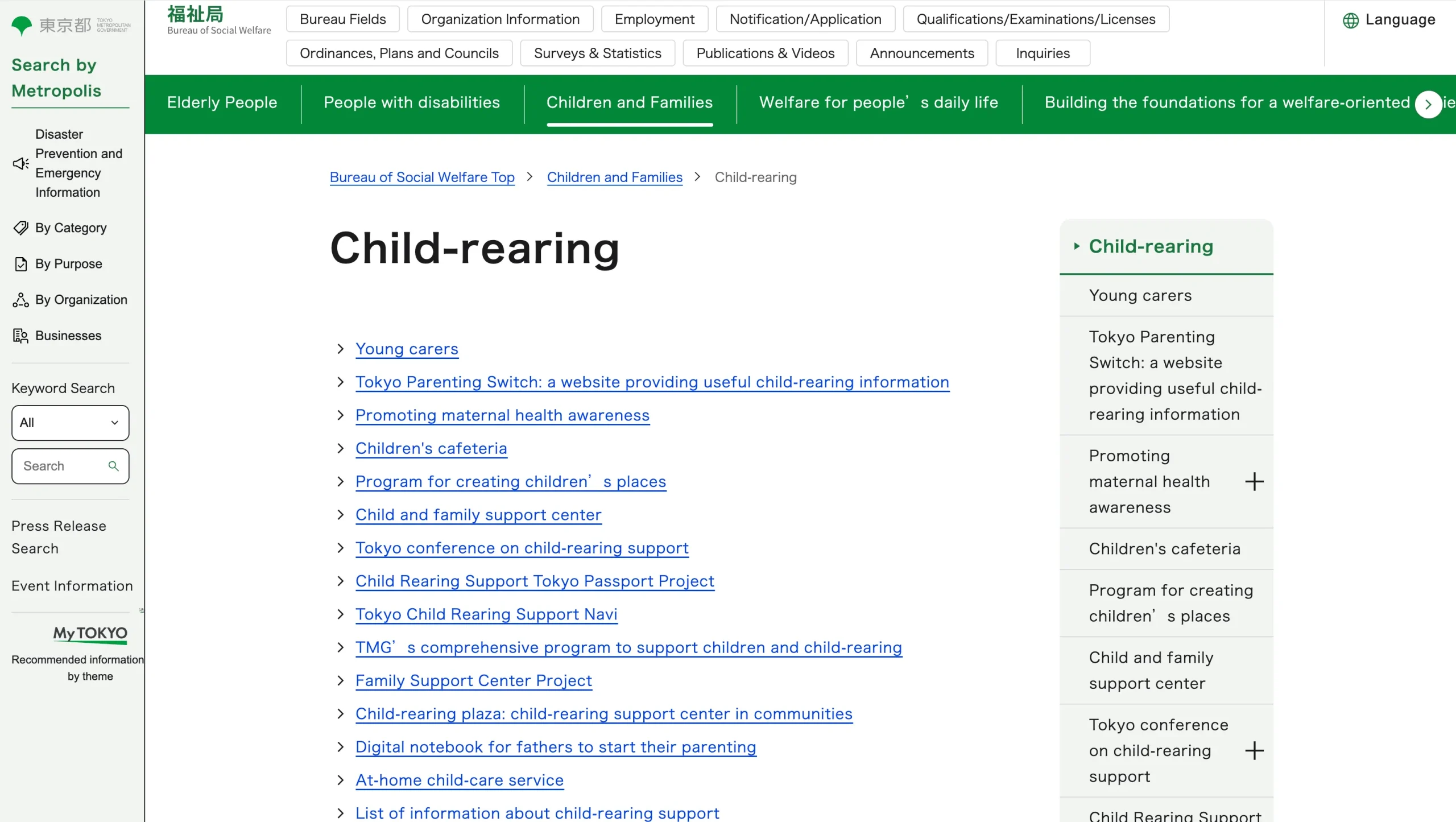
For nursery school enrollment, local procedures, community support services, childcare advice desks, local events, and financial assistance programs — your own ward or city office’s childcare support pages are the right place to look.
Childcare support in Japan varies considerably by municipality. The Tokyo Metropolitan Government Welfare Bureau’s child-rearing support pages, for example, include information on neighborhood family support centers, children’s spaces, community meal programs for children, and parenting support services. But what’s available in Tokyo will differ significantly from what’s available in other cities or rural areas.
Source: Child-Rearing Support | Tokyo Metropolitan Government Welfare Bureau
Tokyo’s pages cannot be taken as a template for other regions. Search your own ward or city name alongside terms like “kosodate shien” (child-rearing support), “hoikuen” (nursery school), “ichiji azukari” (temporary childcare), or “nyujo shinsa” (enrollment screening) to locate your local official pages. Many ward offices also offer multilingual support services — check your local government’s website or call the general inquiry line to find out what language assistance is available near you.
4. Municipal-linked maternal health and childcare apps
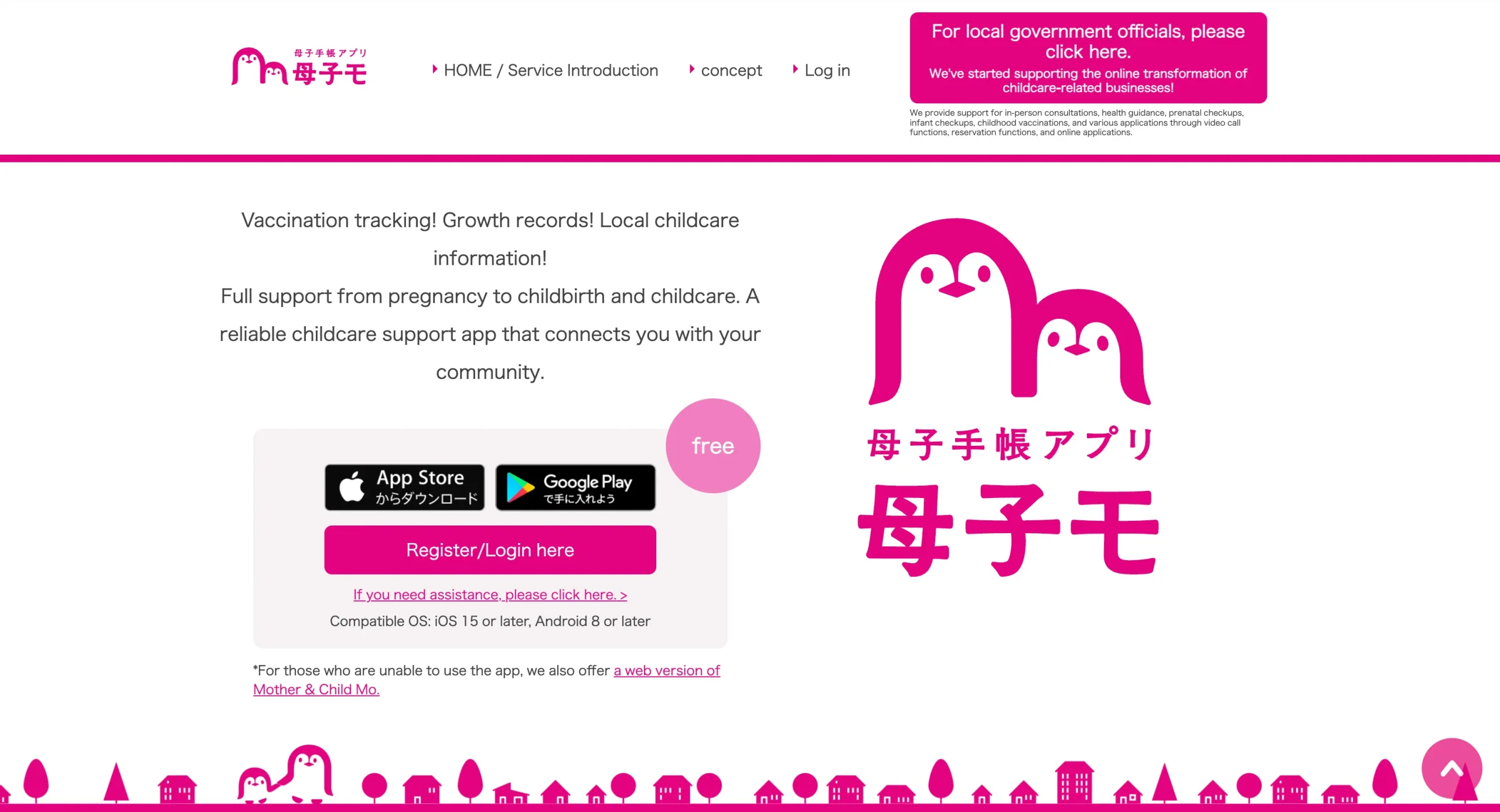
Parenting apps are better suited to managing information than to finding it.
Boshi Mo (母子モ), one of Japan’s widely used maternal health apps, lists features on its official site including pregnancy records, child growth tracking, vaccination management, and delivery of notifications from connected municipalities.
Source: Boshi Mo — Maternal Health Handbook App | Boshi Mo Co., Ltd.
Apps like these can help you stay on top of vaccination schedules, growth records, and municipal announcements without things slipping through the cracks. That said, not all municipalities are connected to the same app, and the features available vary by region. Check the official app site or your local municipal page to confirm what’s supported where you live. Note that most app interfaces and notifications operate in Japanese.
In general, more apps means more to manage. For families with babies and toddlers, keeping app use focused tends to be more practical: one for records, one for municipal updates, and perhaps one general parenting media source — rather than adding more than you actually use.
5. Public broadcaster and institutional childcare content
For video-based parenting information, sources with a clearly identifiable organization behind them are a more reliable starting point than anonymous channels.
Sukucom (すくコム), run by NHK Educational, is a parenting and child-rearing support site that includes content connected to NHK’s educational television programming. It can be a useful resource for parents looking for content to use alongside their children, or for ideas connected to publicly broadcast programs.
Source: Sukucom | NHK Educational
The advantage of video content is that it conveys atmosphere and process in ways text alone doesn’t — the pacing of a play activity, the tone of a caregiver speaking to a child, the steps in preparing a first food. That’s genuinely useful.
At the same time, video tends to feel more authoritative than it may be. For questions about child health, development, or medical decisions, don’t rely on video content alone — cross-check with official sources or speak with a specialist.
6–10. Parenting media, specialist sites, YouTube, blogs, and SNS
Sources 6 through 10 work best as a supplementary layer — filling in what official sources don’t cover in daily parenting life.
- 6. Parenting media: Good for everyday information on weaning, play ideas, nursery prep, and parental wellbeing — organized in a more readable format than official sites. When choosing a source, check who is running the site, the publication date, whether any named expert reviewers are listed, and whether advertising is clearly disclosed.
- 7. Specialist organization sites: Medical institutions, professional bodies, research organizations, and community health centers can be useful sources for health and developmental information. For individual symptoms or specific developmental questions, these are reference points — but they don’t replace speaking directly with a doctor or specialist.
- 8. Official information from hoikuen, yochien, and nintei kodomoen: For anything related to life at your child’s specific facility — the facility handbook, official website, distributed materials, the communication notebook, and information sessions are more accurate than general online articles. If what you find online conflicts with what your facility says, ask the facility directly.
- 9. YouTube: Useful for understanding how activities, routines, or caregiver interactions look in practice. Check that the person or organization behind the channel is clearly identified, that any specialists or childcare professionals involved are mentioned, and that sponsorships or paid promotions are disclosed.
- 10. Personal blogs and SNS: Useful for shared experience and emotional connection. Individual accounts are one family’s story — not a standard to measure against. Posts that make you feel like your child is behind, or that something is wrong if you haven’t tried a particular method, can safely be set aside without guilt.
For Japanese and English YouTube channels focused on children and childcare, we’ve also put together a separate guide:

Comparison table: source types, strengths, and how to use them
| Source Type | Best For | Strengths | Watch Out For | How to Use It |
|---|---|---|---|---|
| National government / public agencies | Systems, support programs, where to get help | Primary source; authoritative | Can be dense and hard to read | Use as the foundation for decisions |
| Municipal government sites | Nursery enrollment, local procedures, area-specific support | Specific to your region | Content varies significantly by municipality | Bookmark your own ward or city office’s pages |
| Maternal and Child Health Handbook site | Pregnancy, infant health checkups, early health milestones | Clear overview of early childhood health information | Individual questions need specialist input | Starting point for health checkup and pregnancy information |
| Parenting apps | Vaccination schedules, growth records, municipal notifications | Easy to track and manage | Features and municipal coverage vary; mostly Japanese-language | Use for record-keeping and reminders |
| Parenting media | Play ideas, daily routines, nursery prep | Readable and practical | Check who runs the site, any expert reviewers, and ad disclosure | Use for everyday options and ideas |
| YouTube | Understanding process, activities, and atmosphere | Visual and intuitive | Easy to be influenced by tone and delivery style | Supplementary reference, not primary source |
| SNS | Shared experience, peer connection | Reduces isolation | Can generate comparison and unnecessary anxiety | Set boundaries on time and purpose |
| Personal blogs | Real-life accounts, prep checklists, personal experience | Authentic and grounded | One family’s experience is not a universal template | Read as reference examples, not rules |
The point of this table is not to choose one source and stick to it. It’s to match the type of question you have with the type of source that fits it best.
For systems and procedures: your municipal office. For health and development: official and specialist sources. For everyday ideas: parenting media. For emotional support and peer connection: community spaces. Sorting this out in advance makes the whole information landscape less tiring to navigate.
How to tell whether a parenting information source is reliable
Reliable parenting information becomes easier to identify when you check who runs the site, the publication date, whether expert reviewers or references are listed, and whether advertising is disclosed.
When choosing parenting media or apps, “popular,” “top of the search results,” or “everywhere on social media” are not enough on their own to confirm reliability.
Top-ranked articles and recommendation lists can include advertising or affiliate content. That’s not inherently a problem — many media outlets are funded this way. But as a reader, developing the habit of asking “who put this together, for what purpose, and when?” is a small investment worth making.
Is it clear who runs the site?
The first thing to check is who is behind the site.
Is it a government agency? A local authority? A medical institution? A childcare company? An individual? The answer changes what kind of information it is and how much weight to give it.
For questions about systems and where to get help, official government or municipal sources are the right starting point. For everyday childcare ideas, content from parenting-focused organizations or childcare professionals can be useful. Sites where it’s unclear who is running them, where the “About” page is minimal, or where it’s difficult to identify who is responsible for the content — these are not well suited to questions about health, development, or public systems.
Is a publication or update date visible?
Parenting information can become outdated — sometimes quickly.
This matters most for system-related content: policy updates, financial support programs, nursery school procedures, municipal support desks, app features, and health or developmental guidance. Checking the publication or last-updated date is a basic but important habit to build.
Older content isn’t always wrong — personal accounts and practical experience can remain relevant for years. But for anything involving procedures, eligibility, or policy, always verify against the most current official source before acting on it.
Are expert reviewers, references, or primary sources listed?
For articles covering health, development, mental health, safety, or childcare policy — check whether a named expert reviewer or reference source is listed.
Note that “reviewed by a specialist” on its own is not a guarantee of accuracy. It’s worth checking which specialist, and what scope of the article they actually reviewed.
Articles that link directly to primary sources make it easier for readers to verify information themselves — and that transparency is a reasonable indicator of editorial care. At TamagoDaruma, for anything involving policy, health, or safety, we prioritize confirming information against official government, municipal, and specialist sources before publishing.
Is advertising, PR, or affiliate content clearly disclosed?
For recommendation articles and product rankings, check whether paid promotion or affiliate relationships are disclosed.
Advertising relationships don’t automatically make content unreliable. Most media outlets are commercially funded in some way. The issue arises when readers accept a ranking or recommendation at face value, without knowing whether the ordering reflects an editorial judgment or a business relationship.
When evaluating apps or services, look beyond convenience — check the organization running it, pricing, the regions it covers, how personal data is handled, and whether any paid content or advertising is clearly labeled.
The goal of this article is not to give you a list of 10 sources to bookmark and be done with it. It’s to help you narrow down what you actually look at — and make those sources count.
How to use apps, blogs, YouTube, and SNS — each for what it does best
Apps work best for management. Media works best for organizing information. YouTube helps you understand how things look in practice. SNS and blogs serve shared experience and emotional connection.
Parenting information sources have different strengths. Treating them all the same — and trying to use all of them equally — is what leads to information overload.
Apps are for records, reminders, and local notifications
Parenting apps are at their best for record-keeping and reminders — not for primary research.
Vaccination schedules, growth tracking, municipal announcements, and the general logistics of pregnancy and early parenthood are things an app can help you stay on top of without things slipping through the cracks.
Think of apps as tools for not forgetting, rather than tools for deciding. Use an app to see when a vaccination is due, then speak with the clinic if you have questions. Receive a municipal notification through the app, then confirm the full details on your local government’s official pages. That division of labor makes both the app and the official source more useful.
Blogs are for reading as personal accounts, not as instructions
Personal blogs are useful for understanding what other families actually experience — the things official information simply doesn’t capture.
Nursery enrollment preparation, things parents wish they’d bought earlier, weaning struggles, sleep strategies — these real-life details have value that policy pages can’t provide.
But a blog is one family’s experience. What worked in their home, with their child, in their area, may or may not apply to yours.
Read blogs as reference examples, not prescriptions. If an approach doesn’t fit your family’s situation, you don’t need to force it.
YouTube is for seeing how things are done — not for making decisions
YouTube’s advantage over text is that it shows how something actually works in practice.
Parent-child play, craft activities, movement routines, how a caregiver speaks to a toddler, how a first food is prepared — video makes these easier to picture than written descriptions alone.
At the same time, video is persuasive by design. A confident delivery style can make something sound more definitive than it is. If a video makes you feel like you’re doing something wrong, or that a certain approach is essential for a child at your child’s age, it’s fine to set it aside. The same caution applies to anything touching health, development, or medical decisions — use video as context, not as the basis for a decision.
SNS reduces isolation — but comparison is built into the format
Social media can make the early years of parenting feel less solitary.
Another parent who was awake all night. Someone whose toddler refused everything for a week. A post about a confusing message from the nursery school. Finding those voices can make a difficult stretch feel less isolated — and that’s a real benefit worth acknowledging.
At the same time, social media is structured in ways that make comparison almost unavoidable. Child development, meals, sleep, extracurricular activities, how parents divide household responsibilities — scrolling can gradually create the impression that everyone else has worked something out that you haven’t.
If social media is making you more anxious, the problem is usually too much information, not too little. Close the app. Return to an official source. Speak with your nursery or your local support service. Knowing when to step back from social media is part of staying oriented — not a sign of being out of the loop.
How to stop parenting information from wearing you out
The answer is not finding more sources — it’s deciding, by type of question, where you look first.
The impulse to research carefully is understandable. When raising a child from birth to age 3, there are real decisions to make, and the fear of missing something important is genuine.
But searching more doesn’t reliably lead to feeling more settled. Often, more results means more things to worry about.
Match the question to the source — decide this in advance
The most practical way to avoid information fatigue is to decide ahead of time which type of source to go to for which type of question.
- Health, development, and checkups: The Maternal and Child Health Handbook Information Support Site, your local health checkup guidance, your child’s doctor, and specialist services. If anxiety persists after reading, speak with a doctor or contact a local support service — don’t keep searching.
- Systems, financial support, and nursery school: The Children and Families Agency, your local municipal official pages, and Koko de Search (Japan’s national childcare facility search tool).
- Play ideas, daily routines, and nursery prep: Parenting media, official or institution-backed childcare resources, and content from childcare professionals or specialists.
- Parental wellbeing and feeling less alone: Social media, blogs, and community spaces can help. But if comparison is causing distress rather than comfort, give yourself permission to step back — that’s a reasonable response, not avoidance.
For families looking for a specific childcare facility, Koko de Search allows you to search for certified children’s centers (nintei kodomoen), nursery schools (hoikuen), and kindergartens (yochien) by area or nearest station, and includes facility details alongside map information.
Source: Koko de Search | Welfare and Medical Service Network Organization (WAM)
Source: About the Child and Child-Rearing Support Information System “Koko de Search” | Children and Families Agency
When you’re anxious, set a rule about when to stop searching
Anxiety makes it harder to stop — which is exactly when having a rule in place matters most.
Search terms like “development slow,” “night waking when does it end,” “nursery school crying is it cruel,” or “won’t eat weaning” can lead further into worry rather than toward an answer. The more you search, the more alarming language you encounter.
Some ground rules that can help:
- For medical or developmental concerns: if reading multiple articles isn’t reducing your anxiety, speak with a doctor or contact a local health service — don’t keep searching
- For social media: if comparison is making the day harder, that day’s rule is to close the app
- For systems and procedures: go to the municipal official page directly, not a summary article
- For questions about your child’s specific facility: ask the facility before looking for a general online answer
- For late-night anxiety searching: decide that the action item is to reach out to a support service in the morning — not to find an answer right now
For sudden illness or injury outside clinic hours, when you’re unsure whether to seek emergency care, Japan’s pediatric phone advice line #8000 is available. For situations that are clearly urgent, call 119 immediately. Hours and the services available vary by prefecture.
Source: 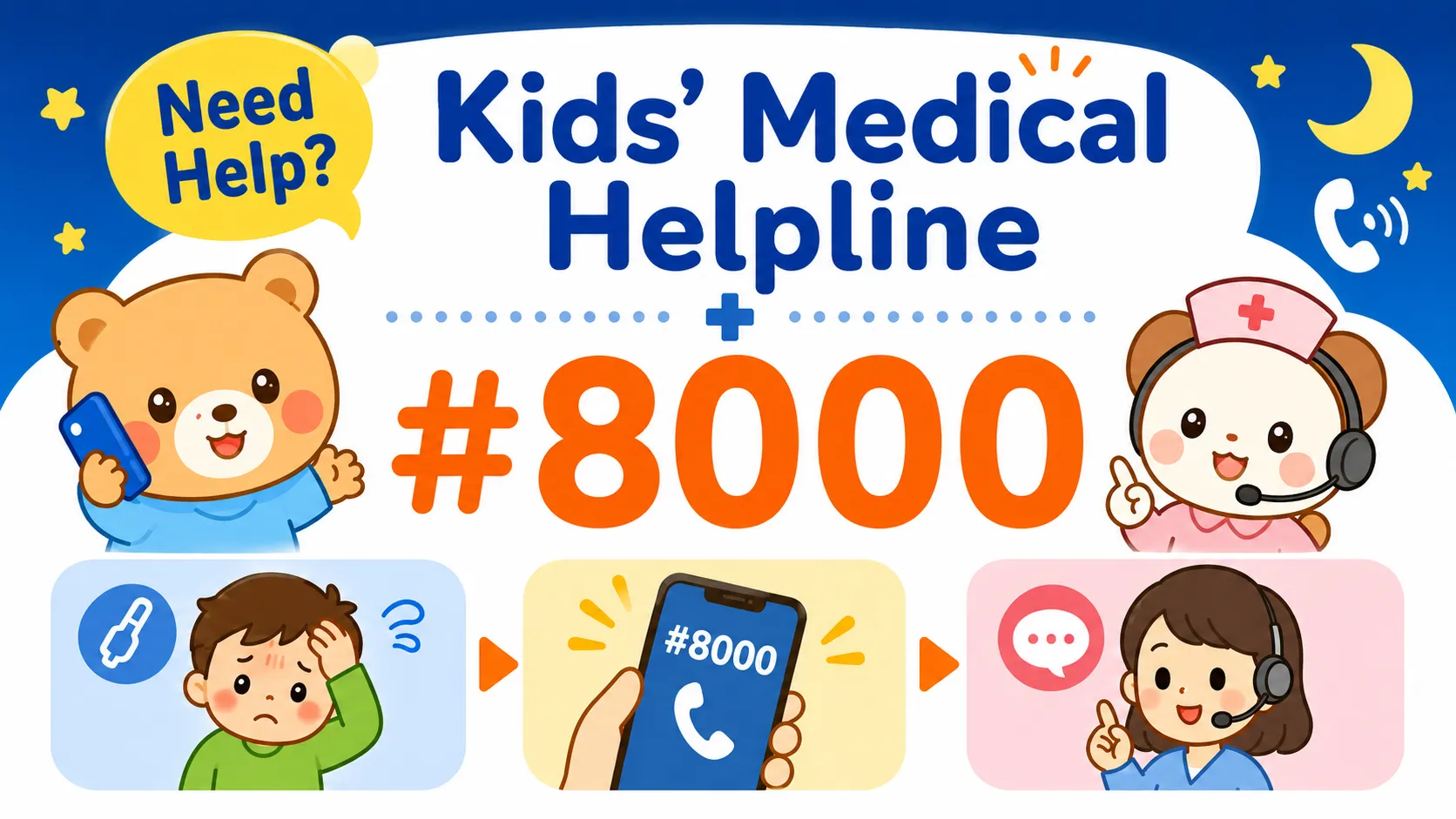
Stopping a search is not the same as being irresponsible. It’s often the clearest path to getting the right kind of help.
A checklist for evaluating parenting information sources
Use this checklist when deciding whether a parenting information source is worth relying on.
| What to Check | What to Look For |
|---|---|
| Is it clear who runs the site? | Government agency, municipal office, medical institution, company, or individual? |
| Is a publication or update date visible? | For system, policy, or app information — is it current? |
| Are expert reviewers or references listed? | Especially important for health, development, and policy-related articles |
| Is advertising or PR clearly disclosed? | Are rankings or recommendations influenced by commercial relationships? |
| Does it apply to your region? | Does it account for municipal variation across Japan? |
| Does it avoid alarming or absolute language? | Watch for phrases like “you must” or “it’s too late if you don’t” |
| Does it point toward a next step? | Can you follow up with a doctor, a nursery, or a local service when needed? |
This checklist is not about approaching information with suspicion. It’s about being able to use it with confidence.
If you find yourself feeling more tired the more sources you add, the first step isn’t finding a better source — it’s deciding the order in which you look.
Finding parenting information in Japan when Japanese isn’t your first language
For families navigating Japan’s parenting information landscape without reading Japanese fluently, official sources and municipal pages — which are more likely to offer multilingual support or be accessible through translation tools — are the safest and most practical starting point.
Japan’s parenting information ecosystem is built primarily in Japanese. That makes information-gathering considerably harder for families whose first language isn’t Japanese — even with translation tools, navigating the system requires knowing what to look for and where to look in the first place.
Japanese-language parenting media can be useful once you understand how the system works, but a direct translation won’t always be enough. Japan’s approach to the maternal health handbook, infant health checkups, nursery school enrollment, and local support services involves procedures and assumptions that aren’t self-explanatory to someone unfamiliar with the system.
Start with official sources that offer English-language or multilingual pages
When searching for Japan’s parenting information in English, official and publicly accountable sources give you the most reliable foundation — and some have multilingual pages or translation-friendly formats.
The Maternal and Child Health Handbook Information Support Site includes a dedicated section for families from outside Japan who are pregnant in Japan, with guidance on multilingual versions of the maternal and child health handbook (boshi techo) and multilingual leaflets. For households that don’t primarily use Japanese, this is one of the most important early checkpoints when starting out in Japan.
Source: For Those Who Become Pregnant in Japan from Abroad | Maternal and Child Health Handbook Information Support Site
Regional variation in Japan applies to you too — check your own municipality
Japan’s childcare support varies significantly between municipalities — and this applies equally to families looking for information in English.
Even within Japan, nursery school application procedures, temporary childcare programs (ichiji azukari), community child-rearing support hubs, financial assistance programs, support desks, and health checkup logistics all differ by area. An English-language overview of Japan’s system is a useful starting framework, but it will not tell you what’s actually available where you live.
When English-language municipal pages aren’t available, using a translation tool to navigate the Japanese version of your local ward or city office’s website is a practical alternative. Many larger municipalities also offer multilingual support services in person or by phone — contact your ward or city office’s general inquiry line to find out what language assistance is available in your area.
TamagoDaruma in English and Japanese
TamagoDaruma publishes content in both Japanese and English, with each version designed around a different reader’s needs and a different set of starting assumptions. The Japanese-language version of this article focuses on how parents who primarily operate in Japanese can choose between Japanese-language media sources, apps, and information platforms. This English version is structured differently: rather than recommending specific Japanese-language media, it focuses on how to locate and navigate Japan’s official information systems — so that parents who don’t primarily read Japanese can still access what they need.
If you do read Japanese and want a more detailed breakdown of specific media, apps, and platforms used by parents in Japan, the Japanese-language version covers those in greater depth. For English-reading families, the most direct path into Japan’s parenting information landscape runs through the official public sources listed in this guide.
Frequently Asked Questions
When searching for parenting information, the key is to match the type of source to the type of question — and for health, development, and public systems in Japan, always start with official sources.
- Where is the most reliable place to find parenting information in Japan?
- For questions about systems, health, development, and childcare facilities, official government sources, your local municipal office, and specialist organizations are the right starting point. For everyday parenting ideas, parenting media, apps, and video content can be useful as supplementary resources.
- Should I download a parenting app?
- If you want to track vaccinations, growth records, and municipal notifications in one place, apps can make that easier. That said, more apps usually means more notifications and more to keep up with. Choose what you actually need and limit it to that. Most parenting app interfaces in Japan operate in Japanese, so factor in whether that works for your household.
- Can I trust parenting information on YouTube?
- YouTube is useful for understanding how an activity or routine looks in practice. For questions about health, development, or public systems, don’t rely on video content alone. Check that it’s clear who or what organization is behind the channel, any specialists involved are identified, and paid promotions are disclosed.
- What should I do when social media is making me anxious?
- Close the app and return to official sources or contact a local support service. Social media is useful for peer connection and shared experience, but the format naturally generates comparison — and comparison tends toward anxiety. Building in time when you don’t look at it is a practical step, not an overreaction.
- What should families raising babies and toddlers check first?
- The Maternal and Child Health Handbook Information Support Site, your local municipal childcare support pages, and national sources like the Children and Families Agency are solid starting points. For finding a licensed childcare facility, Koko de Search is Japan’s official national search tool for nursery schools, kindergartens, and certified children’s centers.
- Is it okay to make health and developmental decisions based on online research?
- Online information alone should not be the endpoint for health or developmental decisions. If you have persistent concerns about your child’s health or development, please speak with your child’s doctor, your local community health center, your childcare provider, or a specialist service — rather than continuing to search online.
- How do I find parenting information in Japan in English?
- Start with official sources that have multilingual pages or are accessible through translation tools. The Maternal and Child Health Handbook Information Support Site is a good first stop — particularly its section for families from abroad who are pregnant in Japan. For local support, your own ward or city office’s pages are essential, and many municipalities offer multilingual assistance. When in doubt, contact your local ward office directly to ask what language support is available.
Summary
Parenting information is not there to create more pressure.
At its best, it’s a tool for identifying the next concrete step — not something that makes the feeling of “am I doing this right?” more acute.
When choosing parenting media or apps, check who is running the site, the publication date, whether expert reviewers or references are listed, and whether advertising is disclosed. For anything touching health, development, or public systems, always bring it back to official sources or a specialist before making decisions.
At TamagoDaruma, our editorial approach is not just to add more content to an already crowded space — it’s to help parents spend less time lost in information and more time finding what they actually need. Knowing which media and apps exist is useful, but more important is having a clear sense of where you look first — and when to stop searching and start asking.
You don’t have to follow everything. When you’re anxious, the move is to narrow your sources — not expand them.
