If you looked at your payslip and thought “What is this child and childcare support levy? Isn’t this supposed to be a benefit? Why is more being taken out of my pay?”, your reaction is completely understandable.
Several official programs in Japan share the word “childcare” (kosodate) in their names, and the overlap is genuinely confusing. This article sorts out the difference between the child and childcare support levy (kodomo kosodate shienkin) and the benefits families can receive, such as the child allowance (jidō teate), Tokyo’s 018 Support, and various childcare support payments. By the end, you’ll be able to see clearly how much is being deducted from your pay and what benefits you may still be eligible to receive.
The child and childcare support levy is not a benefit you receive. It is a contribution toward funding Japan’s measures to address its low birthrate, collected through the medical insurance system. For company employees, it typically shows up starting with the May 2026 payslip.
What you’ll learn in this article
- Why the child and childcare support levy is something you pay, not a benefit you receive
- The difference between the support levy, benefits, support payments, and the child allowance
- A rough guide to how much is deducted from your pay by income level
- If you live in Tokyo, the 018 Support and Kosodate Ouen Plus details you should check
- A checklist for what to confirm once you receive your payslip
Table of Contents
What is the child and childcare support levy? It’s money deducted from your pay, not a benefit
The child and childcare support levy is a contribution toward Japan’s policies for addressing its low birthrate, shared broadly across society and collected through the medical insurance system. It is a separate scheme from any benefit you receive. For those on employee health insurance, contributions begin with premiums for April 2026 (Reiwa 8), and on payslips this levy is commonly reflected from the May payment onward.
The basics of the child and childcare support levy
The “child and childcare support levy” is a funding scheme designed to support Japan’s low-birthrate policies on a stable, long-term basis. It falls under the Children and Families Agency (Kodomo Katei-chō) and was created under the Act Partially Amending the Child and Childcare Support Act and Related Laws (Act No. 47 of 2024, Reiwa 6), enacted in June 2024.
The actual collection is carried out through medical insurers such as the Japan Health Insurance Association (Kyōkai Kenpo) and company health insurance unions. It is a contribution based on law. While it is technically neither a tax nor an ordinary insurance premium, a key feature is that the levy is collected together with your health insurance premium as a single charge.
The funds collected are used as a financial source for the government’s “Children’s Future Strategy Acceleration Plan,” directed toward specific childcare support measures: expanding the child allowance, strengthening childcare leave benefits, and improving childcare services. The money is managed separately from the general budget as a dedicated account, and the revenue and spending are made public.
(Reference: About the Child and Childcare Support Levy System|Children and Families Agency)
Why is “childcare support” money taken out of your pay?
The thinking behind the design is one of shared solidarity: that every generation and every part of the economy supports child-rearing together. A low birthrate is not only an issue for households raising children; it affects the economy, the social security system, and local communities as a whole. For that reason, the cost is spread broadly and thinly across society, regardless of whether you directly benefit.
We’ll be honest about the discomfort we feel here, too. Even if you understand the intent behind the scheme, the sense that “this started without my really knowing” and “the names are far too confusing” is something many parents share. Feeling frustrated or skeptical is a natural reaction. That said, it’s easier to make decisions afterward if you separate the emotion from understanding how the system works. This article is written to help you do exactly that.
Does this apply to people without children and to families raising children?
The child and childcare support levy is a shared contribution collected broadly through the medical insurance system, regardless of whether you have children or your marital status. For those on employee health insurance, the amount is calculated based on the insured person’s standard monthly remuneration and standard bonus amount.
In response to the view that this amounts to a “tax on single people,” the Children and Families Agency explains on its official pages that the effects of low-birthrate measures reach society as a whole.
Naturally, families raising children pay it too. The structure of “paying the levy while also receiving benefits” is one of the things that makes this scheme hard to follow.
(Reference: About the Child and Childcare Support Levy System|Children and Families Agency)
[Comparison Table] What’s the difference between the support levy, benefits, support payments, and the child allowance?
Even though these programs all share the word “childcare,” the support levy is something you pay, while the child allowance and 018 Support are things you receive. Sorting them first into “money you pay” and “money you receive” makes the whole picture clearer.
First, separate “what’s deducted” from “what you receive”
Much of the confusion when you look at your payslip comes from similar-sounding names lined up together: “childcare support levy,” “childcare benefit,” “childcare support payment,” and “child allowance.” The starting point for sorting them out is to separate “what you pay” from “what you receive.”
- Programs you pay into (deducted): the child and childcare support levy
- Programs you receive from: the child allowance, 018 Support, and childcare support payments and grants (a mix of national and local government schemes)
The levy is a mechanism for creating a funding source, while the benefits and allowances are mechanisms for distributing that funding. They simply share the word “childcare” in their names while pointing in opposite directions.
The main differences at a glance
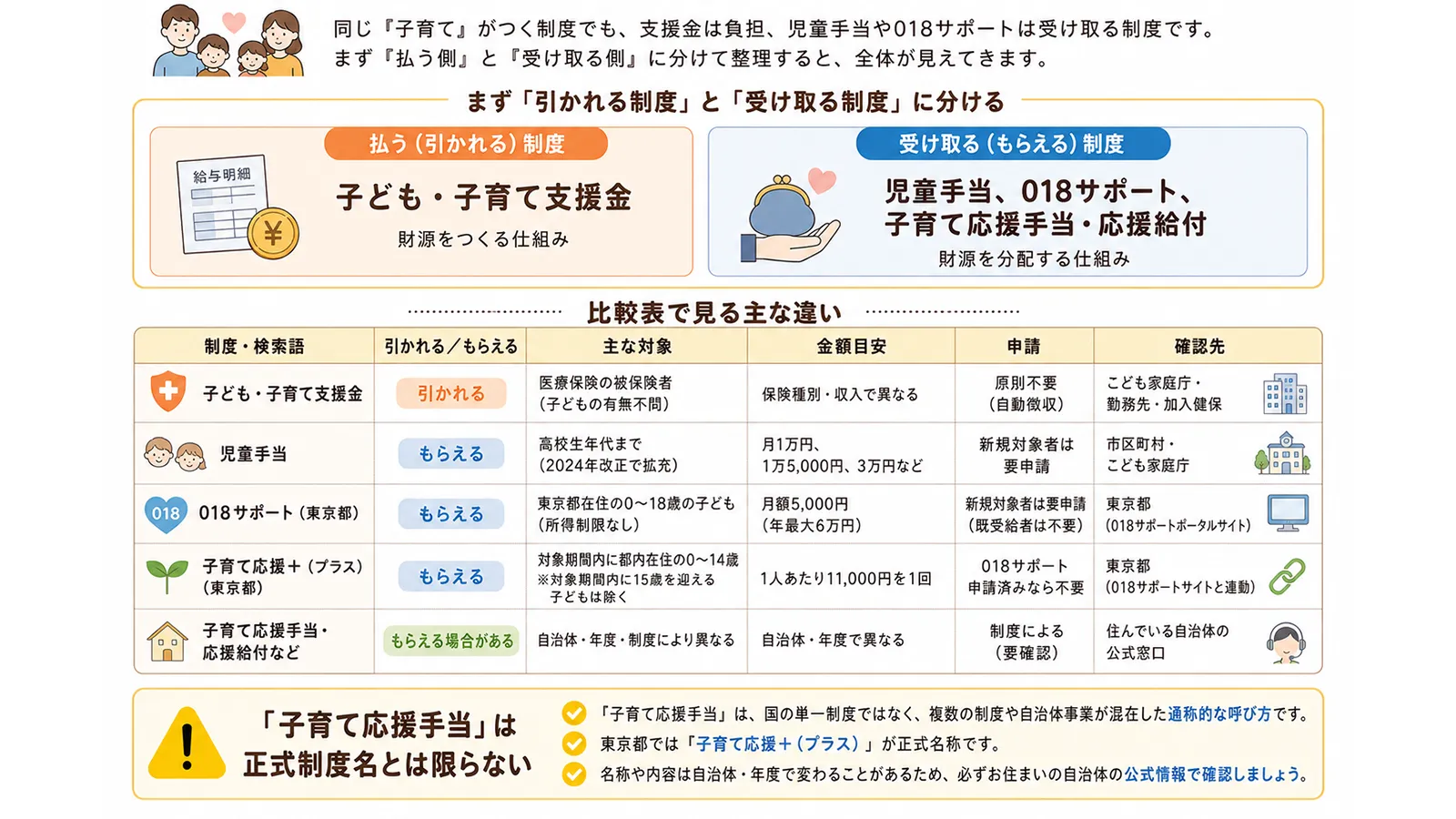
| Program / search term | Pay or receive | Main eligibility | Approximate amount | Application | Where to check |
|---|---|---|---|---|---|
| Child and childcare support levy | You pay | Anyone insured under medical insurance (children not required) | Varies by insurance type and income (see below) | None in principle (collected automatically) | Children and Families Agency, employer, your health insurer |
| Child allowance (jidō teate) | You receive | Up to high-school age (expanded in the 2024 reform) | By age and birth order: ¥10,000, ¥15,000, ¥30,000 per month, etc. | Application required for newly eligible recipients | Municipality, Children and Families Agency |
| 018 Support (Tokyo) | You receive | Children aged 0–18 living in Tokyo (no income limit) | ¥5,000 per month (up to ¥60,000 a year) | Application required for newly eligible recipients (not needed for existing recipients) | Tokyo Metropolitan Government (018 Support portal) |
| Kosodate Ouen Plus (Tokyo) | You receive | Children aged 0–14 living in Tokyo during the eligible period ※Children who turn 15 during the eligible period are excluded |
¥11,000 per child, one-time (no application needed, push-type payment) | Not needed if you’ve already applied for 018 Support | Tokyo Metropolitan Government (linked with the 018 Support site) |
| Local childcare support payments and grants | May be available | Varies by municipality, fiscal year, and program | Varies by municipality and fiscal year | Depends on the program (check directly) | Your local municipality’s official contact |
“Childcare support payment” exists as a similar name across the national government, the Tokyo Metropolitan Government, and individual wards, and the names and contents can change from year to year. Always confirm the exact program name and eligibility requirements through the official information for the area where you live.
“Childcare support payment” is not always an official program name
If you search, the phrase “childcare support payment” comes up often, but this is not a single national program. It’s a casual, catch-all term covering several different national and local government schemes. In Tokyo’s case, “Kosodate Ouen Plus” is the official name of a program that launched in April 2026, and it is a specific, time-limited one-off payment.
“I heard I can get a support payment, but I’m not sure which program that is” is a common point of confusion, and it happens easily in search results too. If there’s a program you’re curious about, the surest approach is not to take a name at face value but to check the list of programs currently running on your municipality’s official site.
How much will be deducted from your May 2026 pay? How to read the amount
For company employees on employee health insurance, the 2026 levy rate is a nationwide 0.23%, and it is generally split evenly between the employee and the employer. As a rough guide for your own share, that’s about ¥575 a month on an annual income of ¥6 million, and about ¥384 a month on ¥4 million (Children and Families Agency estimates).
The basic calculation for company employees
For company employees and public servants on employee health insurance (Kyōkai Kenpo, a company health insurance union, or a mutual aid association), the 2026 levy rate is a nationwide 0.23%. The Children and Families Agency explains that this 0.23% is, in principle, split between employer and employee, with the company covering half.
Your own monthly share can be estimated with the following formula.
Standard monthly remuneration × 0.23% ÷ 2 = your estimated monthly share
Example: if your standard monthly remuneration is ¥300,000 → ¥300,000 × 0.0023 ÷ 2 = ¥345 per month
The levy is also collected from bonuses in the same way, not just your monthly pay (standard bonus amount × 0.23% ÷ 2).
(Reference: About the Child and Childcare Support Levy System|Children and Families Agency)
Estimated amounts by annual income (for employee health insurance)
| Approximate annual income (total standard remuneration: pay + bonus) |
Estimated monthly share (FY2026) |
Estimated annual share (FY2026)※ |
Reference monthly figure (FY2028 estimate) |
|---|---|---|---|
| ¥2 million | About ¥192 | About ¥2,304 | About ¥350 |
| ¥4 million | About ¥384 | About ¥4,608 | About ¥650 |
| ¥6 million | About ¥575 | About ¥6,900 | About ¥1,000 |
| ¥8 million | About ¥767 | About ¥9,204 | About ¥1,350 |
| ¥10 million | About ¥959 | About ¥11,508 | About ¥1,650 |
※The estimated annual share is calculated by our editorial team as 12 months based on the Children and Families Agency’s monthly estimates. Your actual share will vary depending on your standard monthly remuneration and bonuses.
The FY2028 (Reiwa 10) column shows reference estimates published by the Children and Families Agency. These may change depending on factors such as wage increases.
(Reference: Estimates by annual income for each medical insurance system (FY2026)|Children and Families Agency)
If you’re enrolled in Kyōkai Kenpo
Under Kyōkai Kenpo (the Japan Health Insurance Association), the 0.23% levy rate applies to general insured persons from premiums for April 2026 (Reiwa 8), payable in May. The actual amount deducted from your pay varies depending on your standard monthly remuneration, bonus amount, and your employer’s collection method, so check your payslip or your employer’s guidance.
(Reference: About Kyōkai Kenpo’s child and childcare support levy rate|Japan Health Insurance Association)
If you’re on a company health insurance union, a mutual aid association, or National Health Insurance
The same nationwide 0.23% levy rate set by the government applies to large companies’ health insurance unions and public servants’ mutual aid associations. However, because each insurer’s premium rate differs, the total amount on your payslip will differ too. The surest approach is to check the guidance materials from the insurer you’re enrolled in.
For self-employed people and freelancers on National Health Insurance (NHI), the levy amount is set under the ordinances established by your municipality, based on the income of the household or individual. You become subject to contributions from April 2026 (Reiwa 8), but the specific start date and amount vary by municipality. Check with your municipality’s NHI contact or official site.
Where do you look on your payslip?
Many people say, “I looked at my payslip but I can’t find where it’s listed.” Here are the places to check.
- A new item in the deductions section: cases where it appears as a separate line such as “child and childcare support levy”
- Within the health insurance premium breakdown: cases where it’s combined as a component of the health insurance premium
- Guidance materials from your employer: if your employer has issued guidance materials or an internal notice, check those as well
The Children and Families Agency asks insurers to “make efforts to display the support levy amount in a clearly distinguishable way,” but how far payroll systems have adapted varies from company to company. If the display on your payslip is hard to read, asking your general affairs or HR department is the most reliable way to find out.
If you live in Tokyo, check 018 Support and Kosodate Ouen Plus too
If you’re a parent living in Tokyo, it’s worth checking 018 Support and Kosodate Ouen Plus, which are separate from the national scheme. While you’re understanding the “paying in” side through the levy, it’s just as important not to overlook benefits you may be able to receive.
What is 018 Support?
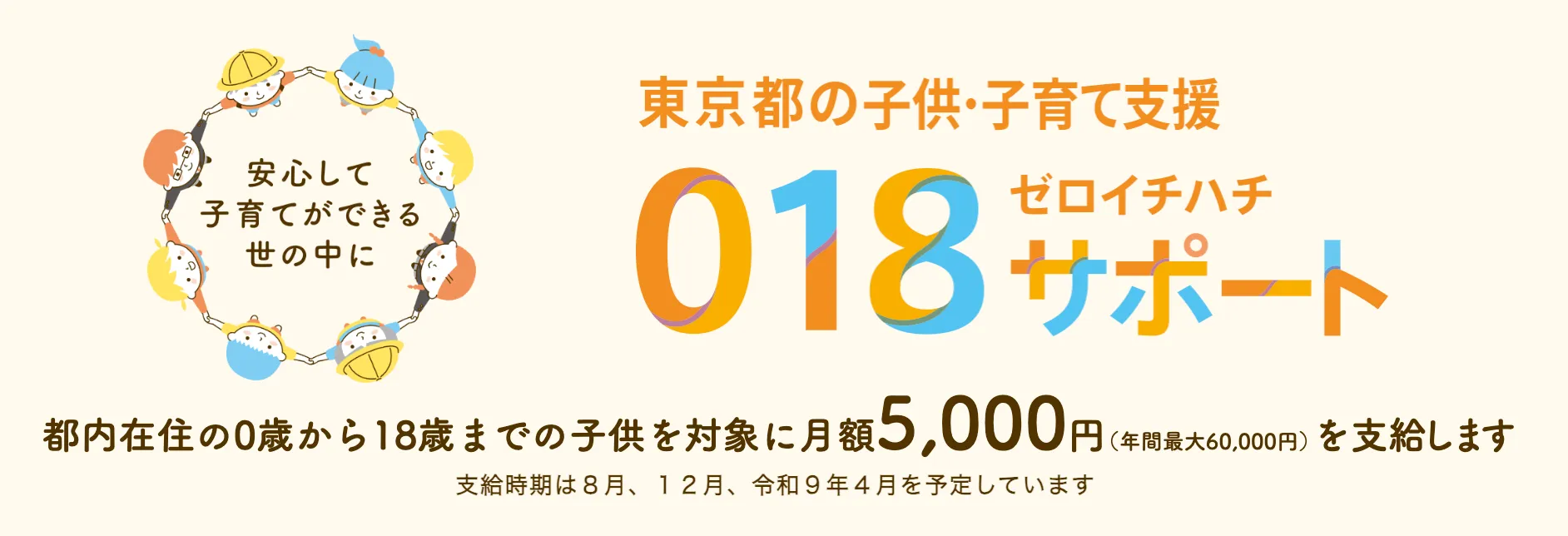
018 Support is a childcare support benefit run independently by the Tokyo Metropolitan Government. It pays ¥5,000 per month per child (up to ¥60,000 a year), with no income limit, to children aged 0 to 18 living in Tokyo (until the first March 31 after they turn 18).
For FY2026 (Reiwa 8), payments are made three times a year.
- August 2026: for April–July (up to ¥20,000)
- December 2026: for August–November (up to ¥20,000)
- April 2027: for December–March (up to ¥20,000)
If you have already applied for and are receiving 018 Support, you don’t need to apply again. People who become newly eligible (such as those moving into Tokyo or after a baby is born) do need to apply.
(Reference: Frequently Asked Questions|018 Support|Tokyo Metropolitan Government official site)
What is Kosodate Ouen Plus?
Kosodate Ouen Plus is a temporary payment from the Tokyo Metropolitan Government, introduced as rising prices squeeze household budgets. It pays ¥11,000 per child, one time, to children aged 0 to 14 living in Tokyo during the period from February 2, 2026 to April 1, 2027 (children who turn 15 during the eligible period are excluded). Payments began on April 13, 2026.
In principle no application is needed; it’s a push-type payment, and if you’ve already applied for 018 Support it’s paid automatically. If you haven’t applied for 018 Support yet, when you receive it depends on the timing of your application.
(Reference: About Kosodate Ouen Plus|018 Support|Tokyo Metropolitan Government official site)
Check your ward or city’s own support too
Individual wards and cities also have their own childcare support measures. Since the name, amount, eligibility, and application method all differ, the surest approach is to search your ward or city’s official site for terms like “childcare support benefit,” or to contact the office directly.
What should you check once you receive your payslip? A 5-minute checklist
After confirming how much of the levy is being deducted, also review the application status of the benefits you can receive. The point is not to stop at “paying in” but to avoid overlooking what you may be eligible for.
Payslip checklist
- Checked whether a new item (such as “child and childcare support levy”) has been added to the deductions section
- Checked whether the levy amount is included in the health insurance premium breakdown
- Confirmed my own standard monthly remuneration and checked that it isn’t far off from the estimated share
- Checked whether my employer has issued guidance materials explaining the system
- Confirmed which type of insurance I’m enrolled in (Kyōkai Kenpo, a company health insurance union, or NHI)
Benefit application status checklist
- Checked whether I’ve applied for the child allowance, and confirmed the latest expansion (extended to high-school age, increased amount for a third child)
- If living in Tokyo, checked whether I’ve applied for 018 Support
- If I have a child eligible for Kosodate Ouen Plus (aged 0–14 living in Tokyo during the period from February 2, 2026 to April 1, 2027), checked whether I’ve applied for 018 Support
- Checked my municipality’s own support (subsidies and benefits)
What to confirm with your employer, insurer, or municipality
If your payslip shows no line for it, or the amount seems off, contact the following.
- About the deduction amount and payslip display: your employer’s general affairs or HR department
- About the levy rate and details of your insurance: the health insurance union or Kyōkai Kenpo you’re enrolled in
- For self-employed people and freelancers on NHI: your municipality’s NHI contact
- For 018 Support questions: the Tokyo 018 Support Benefit Call Center (0120-056-018)
Frequently asked questions|Questions about the childcare support levy and benefits
Here we sort out the questions people search for most, such as whether it’s a tax and whether people without children pay it, in a Q&A format.
- Q1. Is the child and childcare support levy a tax?
- No, it’s not a tax. It is a contribution based on law. While it is technically neither a tax nor an ordinary insurance premium, in practical terms it feels close to an insurance premium because it’s collected together with your health insurance premium. Calling it a “tax increase” isn’t accurate; it falls under a “new social-insurance-style contribution.”
- Q2. Will it definitely be deducted from my May 2026 pay?
- Under employee health insurance, contributions begin with premiums for April 2026 (Reiwa 8). Many companies collect social insurance premiums the following month, so the levy is reflected from the May pay, but the start month differs depending on whether your employer collects “the following month” or “the same month.” Check your own company’s method with your general affairs or HR department.
- Q3. Do people without children pay it too?
- Yes. It’s a shared contribution collected broadly through the medical insurance system, regardless of whether you have children or your marital status. The Children and Families Agency explains that, from the standpoint of stabilizing society as a whole through low-birthrate measures, the scheme is designed so the cost is shared broadly, regardless of whether you directly benefit.
- Q4. Do families raising children pay the levy too?
- Yes, families raising children pay it. At the same time, they can receive benefits such as the child allowance and 018 Support, so it’s important to understand both sides: what you pay and what you receive.
- Q5. Are the support levy and the child allowance the same thing?
- They’re entirely different schemes. The childcare support levy is a funding scheme on the “paying in” side, while the child allowance is a benefit on the “receiving” side. The relationship is that the funds collected through the levy are also used to expand the child allowance.
- Q6. What’s the difference between 018 Support and the childcare support levy?
- 018 Support is a benefit on the “receiving” side, run independently by the Tokyo Metropolitan Government (¥5,000 a month). The childcare support levy is a “paying in” scheme collected through the medical insurance system. 018 Support is for households with children living in Tokyo, and it’s completely separate from the levy.
- Q7. Is the childcare support payment the same nationwide?
- No, it’s not a single unified nationwide program. Payments temporarily run by the national government and payments run independently by local governments are mixed together, and the names, amounts, and eligibility differ significantly. We recommend confirming with the official information for the area where you live.
- Q8. How should self-employed people and freelancers check this?
- If you’re on National Health Insurance, the levy amount and the collection start date vary by municipality. You become subject to contributions from April 2026 (Reiwa 8), but for the details, check with your municipality’s NHI contact or official site.
- Q9. What should I do if the levy isn’t shown on my payslip?
- It may be combined as part of the health insurance premium breakdown, or the display may differ depending on how far your payroll system has adapted. First, check with your employer’s general affairs or HR department.
- Q10. Where can I find out which benefits I’m entitled to?
- For national programs, the surest sources are the Children and Families Agency (www.cfa.go.jp); for Tokyo programs, the 018 Support site (018support.metro.tokyo.lg.jp); and for a municipality’s own programs, your ward or city’s official site.
Editor’s note|For anyone left uneasy after looking at their payslip
It’s natural to feel uneasy when you look at your payslip. By separating the emotion from understanding how the system works, your next step becomes clearer.
Editor’s note
Once you look into the intent behind the scheme, it makes sense. But the feeling that “there should have been a more careful explanation in advance” and “the names are far too confusing” honestly hasn’t changed for us, even now. Parents raising children in particular are sensitive to monthly expenses. When programs all share the word “childcare,” whether something is a benefit or a cost could have been designed to be far easier to understand.
It’s natural to feel frustrated or to have questions. But once you’ve sorted through the emotion, turning your attention to “so what can I actually receive?” brings the full picture of your household finances into view. Many people are in a position to pay the levy while also receiving both 018 Support and the child allowance. First understand the “paying in” side, then check the benefits you can receive. Moving in that order is the best you can do right now.
Summary|First, separate “what’s deducted” from “what you can receive”
Feeling unsettled by the levy is natural. Once you understand the “paying in” side and then check the application status of the benefits you can receive, the full picture of your household finances comes into view.
Three things to check today
- Look at the deductions section of your May payslip and find out how much of the levy is being deducted
- Confirm which type of insurance you’re enrolled in (Kyōkai Kenpo, a company health insurance union, or NHI)
- Check the application status of the child allowance, 018 Support, and your municipality’s support
It’s not the case that “you’re simply losing out by paying the levy.” Not overlooking the benefits you can receive is the first action parents should take at this time. At TamagoDaruma, we’ll continue to review this article whenever the system changes or is updated, to deliver information that helps families avoid being thrown off by it.
Primary sources and reference links
- Reference: About the Child and Childcare Support Levy System|Children and Families Agency
- Reference: About Kyōkai Kenpo’s child and childcare support levy rate|Japan Health Insurance Association
- Reference: 018 Support official site|Tokyo Metropolitan Government
- Reference: About Kosodate Ouen Plus|018 Support|Tokyo Metropolitan Government
- Reference: Guide to the Child Allowance System|Children and Families Agency
※This article is based on official information as of May 2026. The details, amounts, and payment conditions of the systems may change. Please confirm the latest information with each primary source.
If you’d like a more detailed consultation or information suited to your area, feel free to reach out through the TamagoDaruma contact form.