Indoor play for 2-year-olds is easier to keep up with when you choose activities based on how much energy you actually have left. On hot or rainy days, do a quick safety check and keep switching between short activities.
Extreme heat, rainy days, times when infections are going around — when the days you can’t get outside start to pile up, plenty of parents find themselves wondering, “What are we going to do at home today?”
Around age two especially, children want to move their bodies but still can’t judge danger well on their own. They want to play, but noise and falls indoors are real concerns, and the parent may be running on very little energy. On days like that, the point of indoor play isn’t to deliver “ideal early education” — it’s to find something your household can actually manage without strain today.
This guide sorts indoor play ideas for 2-year-olds into three levels based on how much energy the parent has: “next to none,” “a little,” and “plenty.” It covers activities that work even on hot or rainy days, safety-check points, a comparison table, and an FAQ.
In its three-month forecast for July–September 2026, the Japan Meteorological Agency projects that warm air is likely to cover the country, particularly in the first half of the period, with above-average temperatures expected in eastern Japan, western Japan, Okinawa, and Amami. Rather than pushing through outdoor play on hot days, having a household plan for how to spend time indoors is a genuinely practical form of preparation for parenting through the coming months.
(参照:Three-Month Outlook, Nationwide | Japan Meteorological Agency)
Table of Contents
Pick Indoor Play for 2-Year-Olds by Parent Energy Level
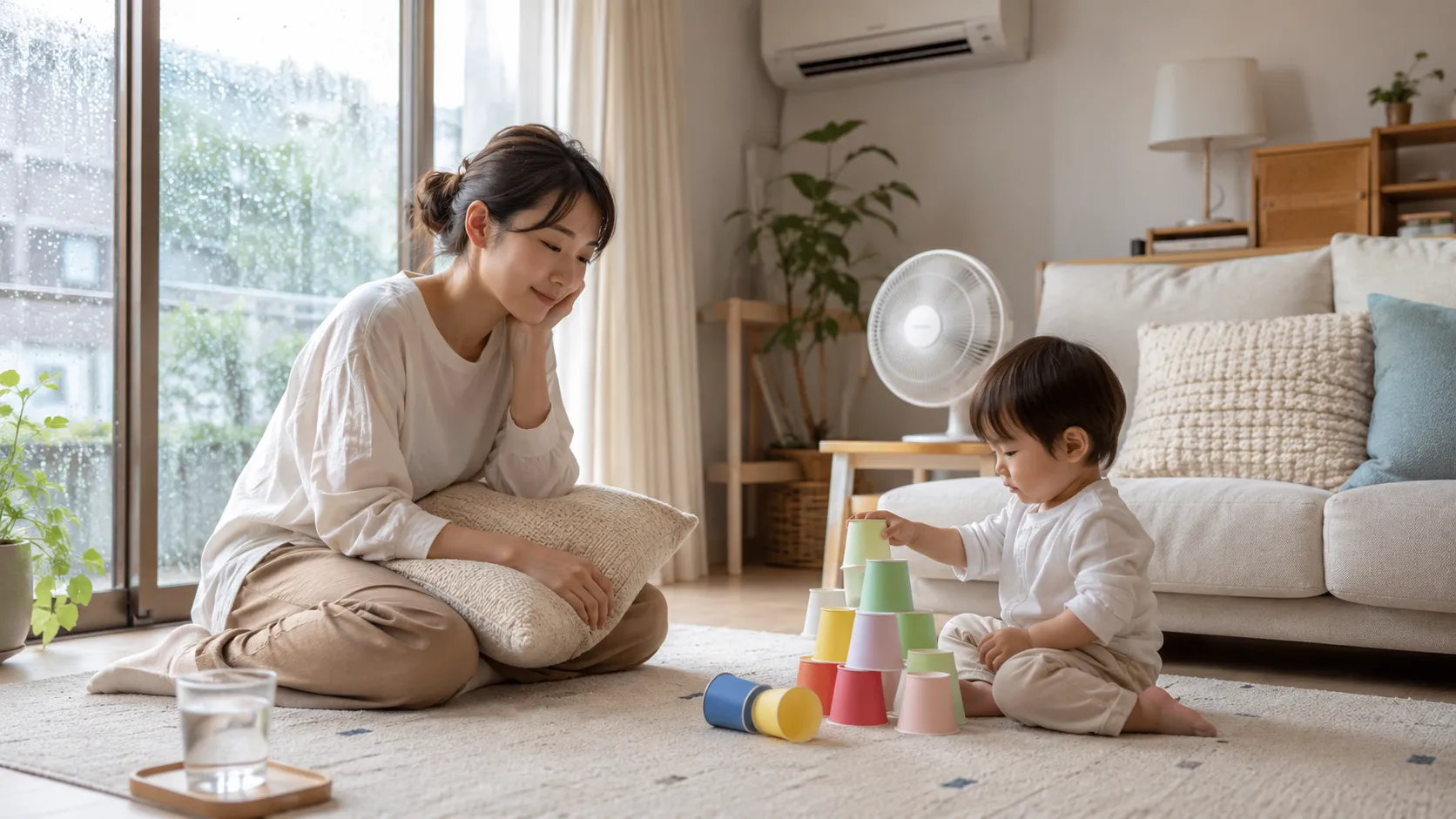

For a 2-year-old, what matters isn’t an ideal activity — it’s whether your household can actually carry it out today. Choosing based on how much energy you have left keeps things sustainable.
Search “indoor play ideas for 2-year-olds” and plenty of activities come up. But in real households, the biggest factor isn’t whether you have the right materials or how educational something is — it’s the parent’s energy.
Editor’s Note
A lot of activity round-ups assume too much: that the parent has energy, time to prepare, and room to clean up afterward.
But real parenting doesn’t usually look like that. After work, while tending to a younger sibling, on a night of too little sleep, on a day when the heat has worn the parent out too — the 2-year-old still wants to play. That’s why this guide treats “what can the parent actually do today” as just as important a measure as “what’s good for development.”
Indoor play for a 2-year-old doesn’t require the parent to bring full energy every time. Play you can watch while seated, play that just needs a few words, play where you move together — each has its place.
How We Chose These Activities
This guide looks at indoor play for 2-year-olds through six criteria:
| Criterion | What to look at |
|---|---|
| Parent’s physical effort | Can you supervise while seated, or does it require moving with the child? |
| Prep time | Can you start right away, or does it need materials or space set up first? |
| Clean-up load | Is the clean-up manageable once play is over? |
| Safety check | Is it easy to check for choking, falling, tipping, or burn risks? |
| Noise | Does it work in an apartment or during evening hours? |
| Toddler fit | Does it involve imitating, touching, stacking, arranging, or moving — things a 2-year-old naturally does? |
The low-effort activities here aren’t “lesser” options — they’re often what makes a hard day manageable. Time spent with your child doesn’t need to be treated like an event every single time.
If anything, households that keep a few low-effort activities on hand tend to get through hot or rainy days at home more steadily.
“Short, Repeated, and Easy to Switch” Is Enough for 2-Year-Olds
It’s fine if a 2-year-old can’t concentrate on one thing for long. It’s more realistic to have a few activities on hand that wrap up in five minutes and to switch between them.
Japan’s National Childcare Guidelines for nursery centers (Hoikusho Hoiku Shishin), which set the standards nursery centers follow, state that childcare for children age one to under three should help them grow familiar with their surroundings and enrich their senses through seeing, hearing, and touching, and that they should enjoy play by taking an interest in toys and picture books. The guidelines also position repeating picture books and simple words, along with back-and-forth pretend play, as important experiences at this stage.
(参照:National Childcare Guidelines for Nursery Centers | Ministry of Health, Labour and Welfare)
In other words, what matters in play for a 2-year-old isn’t how polished the result looks — it’s touching things, imitating, and doing it again.
Stacking and knocking down. Sticking and peeling off. Hiding and finding. Reading and imitating. Repetition that looks simple like this is meaningful play for a 2-year-old.
What Should You Check First for Indoor Play on Hot or Rainy Days?
Before starting to play, check the room temperature, hydration, the floor, furniture, and small objects. Doing the safety check first helps the parent stay calm too.
For indoor play on hot or rainy days, check “is this a safe environment to play in” before deciding “what to play.” This isn’t a big production — 30 seconds before you start is enough.
When a 2-year-old is having fun, they may suddenly run, climb, throw things, or put things in their mouth. That’s exactly why how fun an activity is and how safe it is need to be considered together.
On extremely hot days especially, being indoors doesn’t remove the risk of heatstroke. Japan’s Ministry of Health, Labour and Welfare calls on households to adjust indoor temperature with air conditioning, check room temperature frequently, refer to WBGT readings (a heat-index measure used in Japan’s official heatstroke warnings), and drink water regularly whether indoors or outdoors, even without feeling thirsty.
(参照:Preventing Heatstroke | Ministry of Health, Labour and Welfare)
Take Heat Precautions Indoors Too on Extremely Hot Days
For indoor play on extremely hot days, start by setting up the indoor environment.
Here’s what to check:
- Is the room temperature being adjusted with air conditioning or a fan?
- Is the child sweating excessively?
- Can the child get water when needed?
- Is direct sunlight coming in strongly?
- Is the child so absorbed in play that they’re forgetting to take breaks?
Japan’s Ministry of the Environment runs a heatstroke prevention information site providing the heat index (WBGT) and heatstroke warning alerts. For fiscal year 2026, this information is scheduled to be provided from April 22 through October 21. On extremely hot days, it’s worth checking not just before going out, but also as a reference for deciding how to spend a day at home.
(参照:Heatstroke Prevention Information Site | Ministry of the Environment)
That said, the point here isn’t “don’t do anything on hot days.” On days when it’s hard to go outside, it matters to vary the pace — brief bursts of movement indoors, activities using the hands, cooling down with a picture book.
The 30-Second Check to Avoid Choking, Falls, and Burns
Before starting indoor play with a 2-year-old, here’s a 30-second check worth running through.
| What to check | What to look for |
|---|---|
| Floor | Are there small parts, marbles, batteries, coins, or slippery paper on the floor? |
| Furniture | Are corners easy to bump into, or is furniture arranged in a way that’s easy to climb? |
| Windows/balcony | Is there anything nearby that could be used as a foothold, and can the child reach it unsupervised? |
| Drinks/appliances | Are hot drinks, cords, irons, or similar within reach? |
| Materials | Is it small enough to put in the mouth, or are there torn/broken parts? |
| Parent’s capacity | Is this an activity you can also manage the clean-up for? |
Japan’s Children and Families Agency publishes a handbook, “Protecting Children from Accidents,” which covers accidents that commonly happen unexpectedly to children from birth to age six, along with prevention methods and what to do if one occurs. Keeping this kind of official accident-prevention information in mind for play at home makes it easier to prepare calmly, without becoming overly anxious.
(参照:About the Child Accident Prevention Handbook | Children and Families Agency)
The Consumer Affairs Agency also warns that supervision alone can’t always prevent children’s falling accidents, and that advance precautions matter. Points like not leaving anything near windows or balconies that could serve as a foothold, and checking the age range and usage instructions for furniture and play equipment, apply directly to indoor play at home too.
(参照:Watch Out for Children’s Falling Accidents — It Happens in an Instant. Prevent Accidents with Advance Precautions | Consumer Affairs Agency)
Indoor Play for 2-Year-Olds on Days When the Parent Has Next to No Energy
On days when the parent is worn out, activities you can supervise while seated are enough. Choose ones with light prep and light clean-up.
On days when the parent has next to no energy, things tend to go better if you don’t overthink “I have to make sure my child really enjoys this.”
At this level, what you want is play you can watch over while seated. A little talking, a little prep, a little clean-up. Having a few of these on hand can be a lifesaver in the evening or on a day of too little sleep.
For a 2-year-old, an activity doesn’t need to be flashy — the feeling of “I did it myself” or “I got to do it again” is enjoyable on its own.
Sticker Stick-and-Peel Mission

Sticker play is an indoor activity that works well on days when the parent has next to no energy.
Set out paper, an empty box, a paper plate, or an old envelope, and you can get started just by saying things like “try sticking one here” or “can you stick it inside the circle?” A 2-year-old enjoys not just sticking stickers but also peeling them off, lining them up, and layering them in the same spot.
It helps not to aim for a finished product. Trying to make something look neat will wear the parent out. It’s fine if the stickers end up scattered everywhere, or if the same one gets stuck on over and over.
The things to watch for are sticker size and keeping track of them. Stickers that are too small, or peeled-off fragments, can lead to choking, so an adult should stay nearby and check the floor for any left behind once play is over. The Children and Families Agency also warns about choking and swallowing hazards from fragments of packaging film and stickers.
(参照:Choking and Swallowing Accidents | Children and Families Agency)
Paper Cup Stacking and Nesting

Just stacking paper cups, knocking them over, putting things inside them, or lining them up is enjoyable play for a 2-year-old.
Paper cups are light, easy to handle, and don’t tend to make a loud noise even when things go wrong. Just a short comment from the parent — “look how tall it got,” “it fell over,” “it went inside” — makes it easy for the child to keep repeating the play.
The key here is for the parent not to decide too rigidly how the cups should be used. A child might turn cups you set out for stacking into a hat, or hand them out to stuffed animals instead. That’s a natural way for a 2-year-old’s play to unfold.
Replace any cups with torn edges so the child doesn’t cut their hand on them. Stepping on a cup can make the floor slippery, so it’s reassuring to set a boundary for where the play happens.
Stuffed Animal Caretaking Pretend Play
Pretend play caring for a stuffed animal is an indoor activity the parent can easily join while seated.

Phrases like “let’s go to sleep,” “here’s your dinner,” or “let’s go to the hospital” turn everyday routines into play. Around age two, children watch adult behavior closely. Just turning a piece of daily life into play — laying the stuffed animal down, tucking a cloth over it, having it hold a spoon — is enough.
What’s good about this activity is that conversation happens without the parent needing to move much. Even if the child can’t explain things well in words yet, they can express feelings through expression and movement.
Japan’s National Childcare Guidelines also list enjoying verbal back-and-forth within pretend play as part of the content appropriate for this age. At home, rather than drilling correct words, it’s about right to simply respond — “is that so,” “you put it to sleep.”
(参照:National Childcare Guidelines for Nursery Centers | Ministry of Health, Labour and Welfare)
Picture Book Imitation Reading

Picture book imitation reading is something you can do without trying to read it “properly.”
When an animal appears, imitate its sound. When a vehicle appears, say “vroom vroom.” When food appears, pretend to eat it. That alone is plenty enjoyable for a 2-year-old.
You don’t need to feel you have to read to the end. Going back a page partway through, or lingering on the same page over and over, still counts as meaningful if that’s where your child’s interest is.
If you’d like to explore picture books and word play further, related articles on TamagoDaruma may help.




Indoor Play to Try on Days When the Parent Has a Little Energy
On days with a little more energy, working in play that uses the hands and the senses adds a sense of satisfaction. How easy something is to clean up matters too.
On days with a little energy, try activities that need a bit of prep and a bit of clean-up.
That said, you don’t need to overthink “since we’re doing this, it should look educational” or “it should turn into something worth keeping.” For indoor play at this age, the experience itself — touching, tearing, arranging, moving things with the hands — is what matters.
At this level, children tend to get absorbed easily, but the activities also tend to make more of a mess. Deciding on a play boundary before starting lightens the load on the parent.
Ripping Newspaper and Tossing Balls of It
![[Kids Loved It] Newspaper Play in a 2-Year-Old Class Was a Huge Hit! #nurseryteacher #parenting #kindergarten](https://i.ytimg.com/vi/_ZHFef3M5nk/hqdefault.jpg)
Ripping up newspaper or scrap paper is an indoor activity good for letting off energy, and it’s easy to work in on rainy days or days you can’t get outside.
Tear it, roll it into a ball, put it in a bag, throw it in a box. One material offers several ways to play. The sound and feel of tearing paper is easy for a 2-year-old to grasp, and it comes with a sense of accomplishment.
It’s enough for the parent to say things like “look how long that got,” “it’s small now,” or “you tossed it in.” It also builds awareness of color, size, and shape.
The things to watch for are keeping paper out of the mouth and making sure it doesn’t make the floor slippery underfoot. Spreading it across the whole floor makes clean-up a lot of work, so it helps to set a boundary first — for example, keeping it to a picnic sheet or mat.
Towel Roads and Toy Car Play
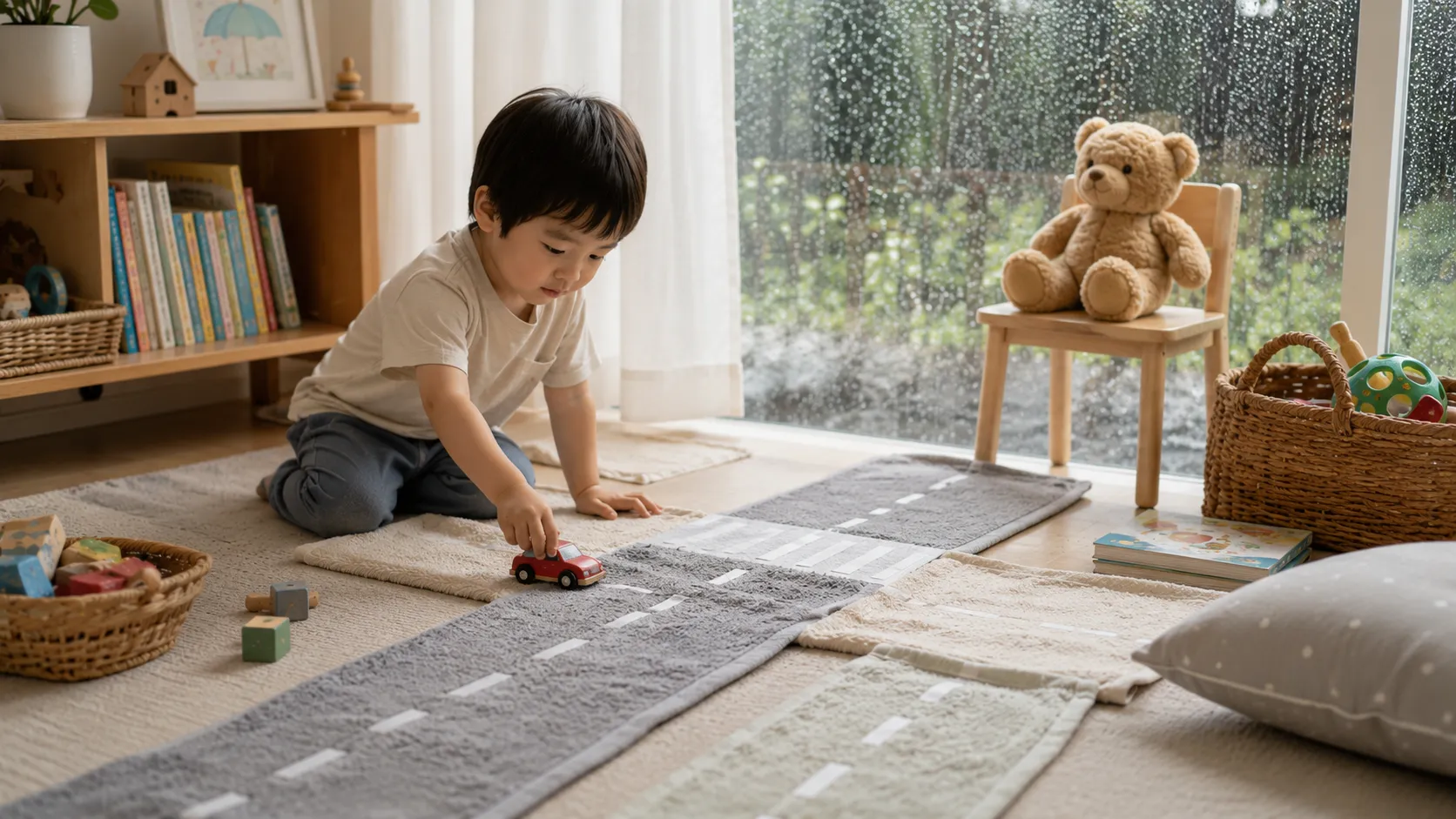
A towel road is an indoor activity that works even in a small room.
Lay face towels or handkerchiefs on the floor as roads and run toy cars or stuffed animals along them. If the parent sets up a bit of shape — a straight road, a winding road, a tunnel, a parking lot — the child can develop the play freely from there.
One advantage of this activity is that it works well in an apartment. Rather than running around, the child can play with their hands while seated, which keeps the noise down.
On a floor where the towel could slide, make sure the child doesn’t stand on it while playing. If you’re using toy cars, also check the age recommendation and whether any parts are broken.
Clothespins and Large Clip Play

Clothespins and large clips are well suited to a 2-year-old who wants to use their hands.
Clip them onto a paper plate, cardboard, or the edge of a towel, then take them off, then line them up. When the parent demonstrates with “try clipping it here,” the child wants to imitate.
This activity does call for a safety check, though. Since fingers can get pinched, avoid ones with too much spring force. Small clips or damaged ones can lead to choking, so it’s safer to leave those out.
When using everyday household items rather than toys, make it a rule that an adult stays nearby and that items get put away as soon as play is over.
On Days the Parent Has Plenty of Energy, Add Full-Body Indoor Play
On days with plenty of energy, use a futon or towels to create a safe boundary and enjoy movements like crawling through, crossing over, and walking.
On days when the parent has a bit more to give, adding full-body indoor play increases how satisfying a day stuck indoors feels.
Japan’s Ministry of Education, Culture, Sports, Science and Technology’s Guidelines on Physical Activity in Early Childhood state that it’s desirable for young children to move their bodies enjoyably for a total of 60 minutes or more each day, centered on a variety of play, including activities at home and in the community as well as at kindergartens and nursery centers.
(参照:Guidelines on Physical Activity in Early Childhood | Ministry of Education, Culture, Sports, Science and Technology)
What matters here is not reading this as “60 minutes of continuous exercise.” For a 2-year-old, it’s more natural to switch between short activities repeatedly and end up covering that much active time as a result.
Also, always decide on a safe boundary before starting any physically active indoor play. Jumping off a sofa or bed isn’t recommended, since it carries a fall risk.
A Mini Obstacle Course with a Futon and Cushions
![[Highly Recommended] Indoor Play — Safe, Fun, No Prep Needed! Endless Towel Play #childcare #nursery #nurseryteacher #parenting #indoorplay #activeplay](https://i.ytimg.com/vi/5s1lHXvezgM/hqdefault.jpg)
A mini obstacle course using a futon and cushions is an activity that makes it easy to use the whole body at home.
For example: walking across a futon, stepping over cushions, dodging around a rolled-up towel, crawling through like a tunnel. No complicated equipment is needed.
The key is to keep it low, short, and soft. If it’s too tall, a 2-year-old may get excited and want to jump off. To enjoy this safely, center it on movements like stepping over, crawling through, and rolling, rather than climbing.
Before playing, check the corners of nearby furniture, how slippery the floor is, and the paths siblings might move through. If the parent starts to get tired, it’s fine to switch straight to a picture book or stuffed-animal play.
Animal Walk Game

The animal walk game is full-body play that needs no preparation.
Say things like “let’s walk like a bear,” “waddle like a penguin,” or “hop gently like a rabbit,” and move the body while imitating animals. A 2-year-old can enjoy this even without imitating perfectly.
In an apartment or during evening hours, avoid movements with a lot of jumping and switch to quieter ones — penguin walk, turtle walk, tiptoeing along.
This activity does require the parent to move a little too. Don’t force it on a tired day — keep it as an option for days when you have more energy.
Treasure Hunt at Home

A treasure hunt at home is indoor play that draws on the pleasure of “finding things” that 2-year-olds enjoy.
Hide things that are too big to put in the mouth — a large card, a stuffed animal, a piece of cloth, building blocks. Just saying “where’s the bear?” or “let’s find the red card” is enough to get the child walking around the room and playing.
It’s best to hide things a little lower than the child’s eye level. Avoid hiding places that tend to lead to danger, such as near windows, near a balcony, on top of shelves, or near stairs.
With just a little preparation from the parent, this activity draws out the child’s joy of moving around and discovering things. If you make “putting the found items back in the box” part of the game afterward, clean-up gets a little easier too.
Choosing Among 10 Indoor Play Ideas for 2-Year-Olds, by Comparison Table
Choose activities not just by how fun they are, but by prep, clean-up, safety, and noise. Pick whatever fits today’s situation.
Here’s a summary of the indoor play ideas for 2-year-olds covered so far, organized by parent energy level.
Even if you’re reading this like a ranking, it’s worth choosing based on what’s easiest to use in your household today, rather than which activity is “the best.”
Comparison Table of Indoor Play by Parent Energy Level
| Activity | Parent energy | Prep | Clean-up | Noise | Main things to watch for | Good for |
|---|---|---|---|---|---|---|
| Sticker sticking/peeling | Next to none | Low | Low | Low | Choking, where stickers go, checking for fragments | Days when the parent needs to stay seated |
| Paper cup stacking | Next to none | Low | Low | Somewhat low | Tearing, stepping on cups, slipping | Days you want to switch activities quickly |
| Stuffed animal caretaking | Next to none | Low | Low | Low | Not using too many small props | Tired evening hours |
| Picture book imitation | Next to none | Low | Low | Low | An environment where books won’t get thrown | Before bed, cooling down |
| Ripping newspaper | A little | Medium | Medium | Medium | Not putting it in the mouth, not slipping on it | Letting off energy on rainy days |
| Towel road | A little | Low | Low | Low | Not slipping on the towel | Small rooms, apartments |
| Clothespin play | A little | Low | Low | Low | Pinched fingers, choking, small parts | Days for using the hands |
| Futon obstacle course | Plenty | Medium | Medium | Medium | Falls, collisions, not making it too tall | Days with energy to spare |
| Animal walk | Plenty | Low | Low | Medium | Floor, furniture, noise | Days the parent can move along too |
| Treasure hunt at home | Plenty | Medium | Low | Low | Hiding spots, small items, avoiding windows | Afternoons when the child is getting bored |
This table isn’t meant to sort activities into “good” or “bad.”
For example, doing the futon obstacle course on a day the parent is exhausted might be fun, but it also raises the risk of accidents and adds to the clean-up load. On the other hand, sticker play or picture book imitation may look plain, but they’re practical activities that help a household get through today.
Editor’s Note
Indoor play at home should be designed around more than just “what’s good for the child’s development” — it should also account for whether the parent is in a state to supervise safely. The more tired the parent is, the more it matters to choose activities that are less prone to accidents and easier to clean up, rather than flashier ones.
If you’d like to explore summer craft activities further, the following article on TamagoDaruma may help.

Free Download: “Indoor Play Cards for 2-Year-Olds”
The content in this guide becomes even more practical when turned into “Indoor Play Cards for 2-Year-Olds” that a household can use easily.
If you’re turning it into cards, a format like the following works well:
| Card item | Content |
|---|---|
| Activity name | Sticker play, paper cup stacking, etc. |
| Parent energy | Next to none / A little / Plenty |
| What you’ll need | Focused on items already in the house |
| How to play | Within 3 steps |
| Safety check | Choking, falling, noise, etc. |
| What to switch to next | The next activity for when the child gets bored |
When setting up the free download at publication, it reads naturally to add the link right after the comparison table and again at the end of the article. For nurseries, family-support facilities, and parent-child classes, this can also be adapted into a “Table of Indoor Play for Hot Weather and Rainy Days” for center newsletters or take-home handouts.
Frequently Asked Questions About Indoor Play for 2-Year-Olds
This section answers questions households often have — when play doesn’t hold their interest, when you end up relying on videos, when noise is a concern, and more.
Indoor play with a 2-year-old often doesn’t go as planned. You prepare something and the child loses interest right away. Things get too rowdy and it turns unsafe. The parent gets tired and wants to lean on a video. None of this is unusual.
Here are answers to questions parents commonly find themselves puzzling over.
FAQ
- Q. How long should indoor play last for a 2-year-old?
- A. It’s natural for it to shift every 5 to 15 minutes or so. This is an age when interest moves around easily, so cycling through several short activities is more realistic than trying to hold a child’s focus on one thing for a long time.
- Q. Is it a problem if my child gets bored quickly?
- A. Getting bored quickly isn’t necessarily a problem in itself. Changing how you use the same material — stacking paper cups, knocking them down, putting things inside — tends to help interest last longer. If you have ongoing concerns about development, consult your local government’s parenting consultation service or a specialist.
- Q. What should I choose on days I’m exhausted?
- A. Choose activities you can supervise while seated — sticker play, paper cup stacking, stuffed animal caretaking, picture book imitation. There’s no need to force in full-body play on a day you’re exhausted.
- Q. Are there active games that work in an apartment?
- A. Within the animal walk game, quieter movements like the penguin walk, turtle walk, or tiptoeing are a good choice. For jumping or running around, be mindful of the time of day, the condition of the floor, and the noise reaching neighbors.
- Q. Is it bad if I end up putting on a video?
- A. Simply having days when you put on a video isn’t something to blame yourself over. That said, if you’re concerned about long stretches of video becoming a regular pattern, a realistic starting point is adding one short activity — sticker play or picture book imitation — before or after the video.
- Q. Is hydration necessary indoors on extremely hot days too?
- A. Yes. The Ministry of Health, Labour and Welfare calls for regular hydration whether indoors or outdoors, even without feeling thirsty. A 2-year-old absorbed in play may not ask for water on their own, so it’s up to the adult to bring it up.
- Q. Can children’s centers or parenting support centers still be used on extremely hot days?
- A. In some cases, yes, but opening status, reservations, hours, crowding, and closure days vary by municipality and facility. Check the facility’s official site or your local government’s page for the latest information before heading out, and stay mindful of the heat during the trip there too.
- Q. What should I check first to prevent choking or falls?
- A. Check small items on the floor, potential footholds near windows and balconies, furniture corners, hot drinks, and cords first. A 2-year-old especially may climb somewhere unexpected or change how they’re playing, so setting up the environment in advance matters as much as supervision itself.
- Q. Is it bad for development if my child can’t play outside for several days in a row?
- A. A few days without outdoor play alone isn’t a reason to assume it’s harmful to development. There will be days you can’t go out because of extreme heat, being unwell, or the weather. Working in experiences like walking, crawling through, stepping over, touching, and imitating indoors, even a little at a time, helps. If concerns persist, consult your child’s doctor or your local government’s consultation service.
Indoor play for a 2-year-old isn’t something a parent needs to plan hard for every single time. Hot days, rainy days, exhausted days — every household has its own circumstances.
What TamagoDaruma wants to prioritize isn’t pushing “activities that are good for the child” onto parents — it’s giving parents and children more options for getting through today a little more easily.
If the parent has next to no energy, play you can watch while seated is enough. With a little more to give, try activities for the hands and senses. On days with plenty of energy, set up a safe boundary indoors and add movement.
Indoor play for a 2-year-old isn’t about creating a perfect day — it’s a small aid to help parent and child move into the next stretch of time without strain. Especially on hot or rainy days, it helps to have a few activities on hand at home that let you think, “this is enough for today.”
Points worth keeping in mind for daycare drop-off and daily life at nursery on extremely hot days are explained in more detail in the following article.

If you’d like to add to your collection of hand-play songs for use at nursery or at home, this article may help too.