
When choosing a Christmas gift for an elementary school child (ages 6–12) in Japan, it helps to narrow your options by three things: how they like to play, who they play with, and your budget. Once you have a shortlist, check the minimum age shown on the packaging and what’s included in the box. If you also confirm batteries and anything else sold separately, your child can start playing the day the gift arrives.
This article compares six toys and games, grouped by what children enjoy: interacting with a character, caring for a character, pretend play, making things, competing with others, and video games. For each one, we’ve summarized the specifications published by the manufacturers and the points worth checking before you buy. Books, sports equipment, and experience gifts are not covered.
This buyer’s guide compares official product information. The products were selected independently by the TamagoDaruma editorial team.
Prices and specifications are based on official information as of October 19, 2026. Please check the retailer’s page for the latest details, stock, and delivery dates before purchasing.
Table of Contents
Choose a Gift by Play Style, Playmates, and Budget
Start by finding out what your child actually wants to do. Even products featuring the same character offer different kinds of fun, and need different things, depending on whether your child wants to care for a character, make something, or compete with others.
Editorial view
When we compared the official information for all six products, most of the points that could lead to a buying mistake had little to do with the products themselves. They were practical details that are easy to overlook: compatibility with older models, batteries sold separately, a doll not included in the set, or a bundle that lets you choose only one game.
That’s why this guide focuses less on features and more on whether your child can enjoy the activities they had in mind on the day they receive the gift.
Check the Product Name and “What They Want to Do”
“My child likes Pokémon” doesn’t tell you whether they want to go on adventures in a video game, interact with the characters, or collect cards. When you ask what they want, also ask what they want to do with it. That keeps your shortlist focused.
If you want the gift to be a surprise, you can browse the toy aisle or official product pages together and notice what catches their interest. Grandparents may find it helpful to check with the parents first about what the child already has and any household rules (such as screen time and where things are kept).
Decide Whether They’ll Play Alone or with Family and Friends
Playing together can mean joining the same game, or taking turns with a toy designed for one player. UNO lets several players join the same game, while a virtual pet is usually cared for by one person at a time.
For toys that link with other devices, your child’s friend also needs a compatible product. Even within the same series, newer models may not connect with older ones. If playing with friends is the goal, check the exact product name your child’s friends own.
Budget for the Product Plus What You Need to Play
Sorted by product price, the items in this guide fall into three groups:
- Under ¥5,000: UNO, Kira Gacha Seal
- Under ¥10,000: Tamagotchi Paradise, RikaPay Supermarket, Pokénade
- A separate category: Nintendo Switch 2, which involves buying the console itself
These prices don’t include batteries, shipping, or extra controllers. Listings may show either the manufacturer’s suggested retail price or an individual retailer’s selling price. When comparing, think in terms of the total, including everything your child will need.
For a look at what’s currently popular among elementary school children in Japan and the background behind those trends, see this related article (in Japanese).

Quick Comparison by Play Style
| Play style | Product | Release date (as announced) | Who they play with | Price (tax incl.) / price type | What to check before buying |
|---|---|---|---|---|---|
| Interacting with a character | Pokémon Mo~tto! Pokénade Monster Ball | November 7, 2026 | Can play alone. Links only with the same product | ¥8,140 (Takaratomy Mall selling price) | Doesn’t link with the earlier Pokénade. Batteries sold separately |
| Caring for a character | Tamagotchi Paradise – Neon Planets | November 21, 2026 | Can play alone | ¥6,380 (manufacturer’s suggested retail price) | Batteries sold separately. Standard device or Premium Set with case |
| Pretend shop play | Licca-chan RikaPay Supermarket | October 24, 2026 | No set number of players | ¥7,480 (suggested retail price) | Doll not included. Batteries sold separately |
| Making and decorating | Kira Gacha Seal Pukkuri Drop | August 1, 2026 | Can make stickers alone | ¥3,999 (suggested retail price) | Can’t be combined with earlier Kira Gacha Seal products |
| Competing with family and friends | UNO (product no. B7696) | On sale | 2–10 players | ¥1,210 (manufacturer’s suggested retail price) | Ages 7+. Whether there are people to play with |
| Video games at home | Nintendo Switch 2 (Japanese-Language System, Japan Only) bundle with a choice of one game | November 12, 2026 | Depends on the game chosen | ¥63,980 (suggested retail price) | Japan-only system. Only one game can be chosen |
Sources for each product are listed in its own section below.
If They Love Interacting with or Caring for Characters, Compare How Each Toy Plays
For toys that let children interact with or care for a character, choose based on what your child does with the toy and what kind of responses they enjoy. Along with their favorite character, consider how the toy is played from day to day.
Pokémon Mo~tto! Pokénade Monster Ball
A good fit for: children who want to pet and talk to Pokémon and enjoy their reactions.
Japanese product name: ポケットモンスター ポケモン も~っと!ポケなで モンスターボール. According to the manufacturer, the main activity is petting or calling out to Pokémon, which respond with voices and reactions. The toy features 177 Pokémon: 7 partner Pokémon and 170 “friend Pokémon.” Children can also care for them, redecorate their room, battle, and go on “outings,” and their activities are saved in a diary. The language can be switched between Japanese, English, and Traditional Chinese in the settings.
What to Check Before Buying
- It doesn’t link with earlier models. It can’t connect with the Pokénade Monster Ball released in October 2025 or the Pikachu Friends Set released in July 2026. If your child wants to play with friends by linking devices, check whether their friends have the Mo~tto! version.
- Four AAA alkaline batteries are sold separately.
- Recommended for ages 4 and up. Takaratomy Mall limits purchases to three units per person or household.
This is not a substitute for Pokémon video games. Before choosing, find out whether your child is looking to interact with Pokémon or to go on adventures and battles.
(Source: Pokémon Mo~tto! Pokénade Monster Ball|Takaratomy Mall)
Tamagotchi Paradise – Neon Planets
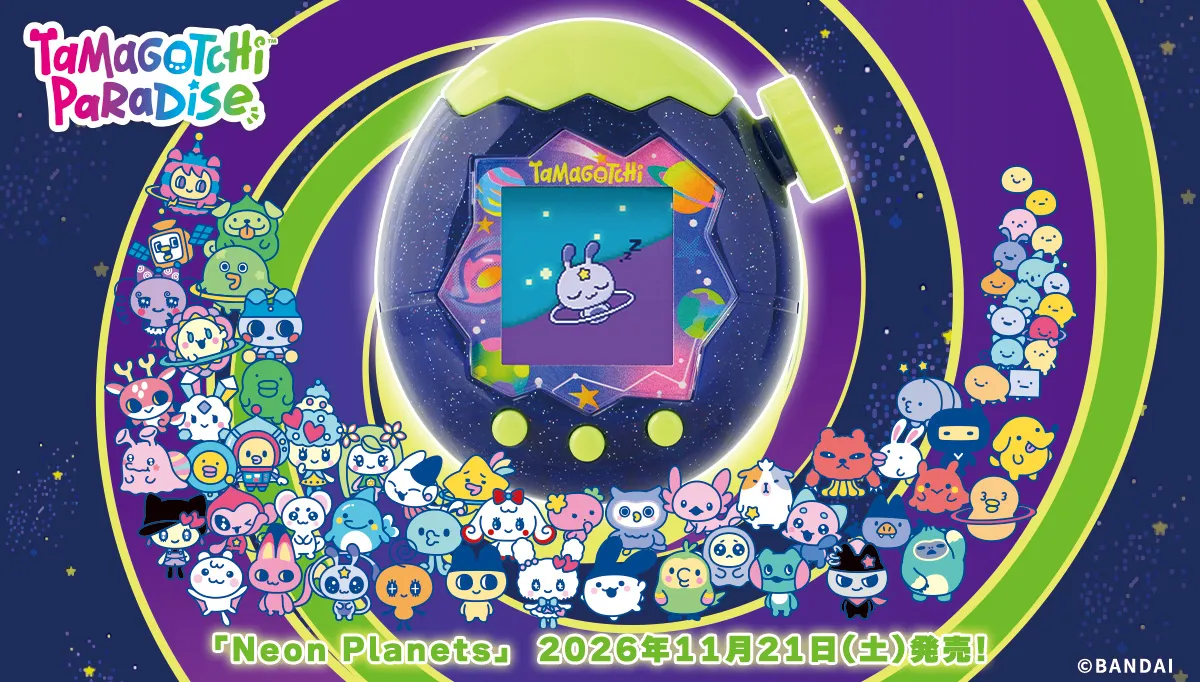
A good fit for: children who’d enjoy caring for a virtual pet every day and watching it grow.
Children care for Tamagotchi characters by turning a zoom dial to move between levels, from cells all the way out to a galaxy. In this version, play begins on “Cosmic Planet.” As children keep raising characters, “New Tamagotchi Planet” and “Tamagotchi Planet” become available too.
What to Check Before Buying
- Recommended for ages 6 and up. Two AAA batteries are sold separately.
- The “Neon Planets Premium Set” (¥8,250) is released on the same day. If you’d like a dedicated case included, consider the Premium Set instead of the standard device. Pre-orders are scheduled to open gradually from November 2.
- Any Tamagotchi Paradise device can link with the others in the series, including other colors. They can’t link with earlier Tamagotchi series.
- The linked “communication mini-games” can’t be played on Pink Land, Blue Water, Purple Sky, Purple Sky Takeshita☆Paradise & Shinako Special Set, or Jade Forest. Check which model your child’s friends have.
- Linking with the separately sold “My Lab Tamagotchi” adds more activities, but the device alone is enough to enjoy raising characters.
(Source: Tamagotchi Paradise – Neon Planets|Tamagotchi Official Site)
(Source: Tamagotchi Paradise – Neon Planets release announcement|Tamagotchi Official Site)
(Source: FAQ|Tamagotchi Paradise Official Site)
Related article (in Japanese):
Both toys offer extra activities when linked to a friend’s device, but which devices they can link with is very different. Pokénade’s Mo~tto! version can’t link with the earlier model, while Tamagotchi Paradise devices can link across the series (with the mini-game exceptions above).
If “playing with friends” is the main reason your child wants one, which model their friends own may matter as much as their favorite character.
If They Love Pretend Play or Crafts, Check What’s in the Set
For pretend-play and craft toys, look at both how the toy is played and what’s actually in the set. Dolls and accessories shown in package photos aren’t always included.
Licca-chan RikaPay Supermarket
A good fit for: children who already love pretending to run a shop or go grocery shopping.
Japanese product name: リカちゃん ピピッ!とリカペイ スーパーマーケット. This playset from the Licca-chan fashion doll line recreates a modern supermarket. Children scan small grocery items at a self-checkout register and pay with “RikaPay” using the included toy smartphone. Collecting 100 points triggers an in-game prize draw. The playset also features 60 sounds, including store announcements. The smartphone is a toy accessory and isn’t connected to any real cashless payment service.
What to Check Before Buying
- A Licca-chan doll is not included. If your child wants to play with a doll, you’ll need one separately, so check whether you already have one at home.
- Three AAA alkaline batteries are sold separately. Recommended for ages 3 and up.
- The playset measures 600 mm wide × 285 mm high × 150 mm deep. Think about where it will be used and stored.
- The first-run limited edition includes four Licca-chan-sized accessories modeled on Nichirei frozen foods. Check the retailer’s page to see whether the item you’re buying is the limited edition.
(Source: Licca-chan RikaPay Supermarket press release|TAKARA TOMY)
Kira Gacha Seal Pukkuri Drop
A good fit for: children who’d rather make their own stickers than collect finished ones.
Japanese product name: キラ★ガチャシール ぷっくりドロップ. This sticker maker is designed like a gacha (capsule-toy) machine. Children set the parts in place and turn the handle, and out comes a 3D sticker with a puffy surface. The main unit comes with drop parts in five shapes and makes 48 stickers. It doesn’t use batteries. Recommended for ages 6 and up.
What to Check Before Buying
- If you’re buying for the first time, choose the main unit (¥3,999).
- It makes 48 stickers. After that, your child can keep going with dedicated refill sets (¥1,799 each; standard and Hello Kitty versions).
- If you already own an earlier Kira Gacha Seal unit, these refill sets won’t work with it. The manufacturer clearly states that this product can’t be combined with the earlier series or the Rame Jewel (ラメジュエル) series.
(Source: Kira Gacha Seal Pukkuri Drop|TAKARA TOMY)
(Source: Kira Gacha Seal Pukkuri Drop press release|TAKARA TOMY)
For details on which main units work with which refill sets, see this related article (in Japanese).

With pretend-play and craft toys, it helps to think about what happens after the gift is opened. RikaPay’s package photos can give a different impression from what’s actually in the box, so it’s worth letting the family know in advance about the doll and the space needed.
Kira Gacha Seal needs refills once all 48 stickers are made. If grandparents are giving the main unit, deciding with the parents whether to include a refill set or leave future refills to the family can prevent misunderstandings.
If They’ll Play with Family or Friends, Compare Player Counts and Setup
For gifts meant to be played together, it’s easier to choose once you’ve thought about who will join in and where you’ll play. Card games and home video games differ a lot in both budget and setup.
UNO, for Families with People to Play With
A good fit for: children who enjoy quick, competitive games with family or friends.
UNO (product no. B7696) is a card game for 2 to 10 players, recommended for ages 7 and up. Players take turns playing a card that matches the previous card’s number, color, or symbol, and the first to run out of cards wins. It also includes blank Wild cards for writing in your own rules. Use an HB or B pencil to write on them; a pencil isn’t included.
What to Check Before Buying
- Whether there are people nearby to play with.
- Whether someone can explain the rules.
- Whether you already have UNO at home.
Some first graders are still 6 and not yet old enough for UNO’s age recommendation of 7. In that case, consider giving it after they turn 7 or choosing a different gift.
(Source: UNO|Mattel Games Japan)
We included UNO as a lower-cost option for families who want a game to play together. At ¥1,210, with no batteries or setup needed, it can be played the same day as long as there are people to play with.
The Switch 2 Bundle, for Families Planning to Buy the Console
A good fit for: families planning to buy a Nintendo Switch 2 console.
This console is the “Japanese-Language System, Japan Only” model. It supports Japanese only and can be linked only to Nintendo Accounts with the country/region set to Japan. If your family’s existing Nintendo Account is registered in another country, check this before buying.
Japanese product name: Nintendo Switch 2(日本語・国内専用) 選べるソフト セット. This console bundle with a choice of one game has a suggested retail price of ¥63,980, in a very different price range from the other products here. Using the download code included in the box, you choose and receive one of three games.
How many people can play, and what else you need, depends on the game you choose. The bundle includes one pair of Joy-Con 2 controllers (left and right).
| Game | How it’s played | Players on one console | With the included controllers | What else you may need |
|---|---|---|---|---|
| Mario Kart World | Racing and battles | 1–4 in TV and tabletop modes; 1 in handheld mode. One controller per player | Up to 2 players, each holding one Joy-Con 2 sideways. Some features, such as rewind, aren’t available in sideways mode | Extra controllers for 3–4 players |
| Nintendo Switch Sports Resort | Sports played with body movement | 1–4 in TV and tabletop modes. Handheld mode not supported | Depends on the sport and whether players take turns. Bowling and archery have modes where up to 4 players share the included controllers. Tennis allows 2 players (one Joy-Con each); boxing in TV mode allows 1 player (two Joy-Con) | Extra Joy-Con for sports that need more controllers than are included |
| Tomodachi Life: Living the Dream (トモダチコレクション わくわく生活) | Watching over Mii characters living on an island | 1 player | Can be played alone | To send Miis or items to each other, a second console and a copy of the game for it |
Nintendo Switch Sports Resort doesn’t support the Joy-Con 2 Grip or the Pro Controller. Because players move their bodies, play in a space clear of objects and people, and use the included wrist straps.
Online play in Mario Kart World and Nintendo Switch Sports Resort requires a paid Nintendo Switch Online membership. The bundle includes a Nintendo Switch Online trial code.
All three games are rated CERO A (all ages) on Nintendo’s official product pages. CERO is Japan’s video game rating system; it describes content, not how difficult a game is to play.
(Source: Mario Kart World product information|Nintendo)
(Source: Nintendo Switch Sports Resort product information|Nintendo)
(Source: Tomodachi Life: Living the Dream product information (Japan)|Nintendo)
What to Check Before Buying
- Redeeming the game requires a free Nintendo Account and an internet connection.
- Once redeemed, the game can’t be changed. The download code is valid until March 31, 2027.
- Families who already own a Switch 2 don’t need the console bundle. Consider buying just the game.
(Source: Switch 2 bundle press release|Nintendo)
(Source: Nintendo Switch 2 (Japanese-Language System, Japan Only) bundle|Nintendo)
Related article (in Japanese):

We’d advise against treating the Switch 2 bundle as an automatic “whole-family gift.” How many people can play with the included controllers varies by game, and only one game can be redeemed.
Decide who will play, and how many, before choosing the game. This helps you avoid choosing the wrong one.
Before Ordering, Double-Check Age Recommendations, Items Sold Separately, and Product Names
Once you’ve settled on a gift, confirm the exact product name and what’s in the set. Checking batteries, anything else you need, compatibility with older products, and the delivery schedule helps avoid surprises when the gift arrives.
Check Age Recommendations and Your Child’s Interests Separately
The minimum age shown on a toy’s packaging indicates that the toy has the safety features needed for children of that age. It isn’t just a rough guideline, so follow it first.
(Source: How to Choose Safe Toys (in Japanese)|Japan Toy Association)
Then, separately, think about your child’s interests and how much help they may need from an adult. Being old enough for a toy doesn’t mean a child will enjoy it. Rather than deciding by grade or gender, prioritize the kind of play your child is absorbed in right now.
For families with younger siblings under 3
Some toys, such as RikaPay (with 50 small accessories) and Kira Gacha Seal, have small parts. Ask older children to help by putting them away out of reach after playing.
Separate What You Need, Optional Add-Ons, and Consumables
Think separately about what you need on the day the gift arrives (batteries, accounts, and so on) and add-ons that expand play (refill sets, extra controllers, and so on).
Check Release Dates, Pre-Orders, and Model Names
The release date and the day the item reaches you aren’t the same. Shipping times for pre-orders vary by retailer, so check with the seller whether it will arrive in time for Christmas. For products with names similar to older models, use the exact product name or product number to tell them apart.
Pre-Purchase Checklist (checked October 19, 2026)
| Product | Ages | Batteries / power | What else you need | Optional add-ons / consumables |
|---|---|---|---|---|
| Pokémon Mo~tto! Pokénade Monster Ball | 4+ | 4 AAA alkaline batteries (sold separately) | Batteries | — |
| Tamagotchi Paradise – Neon Planets | 6+ | 2 AAA batteries (sold separately) | Batteries | My Lab Tamagotchi (for linked play) |
| Licca-chan RikaPay Supermarket | 3+ | 3 AAA alkaline batteries (sold separately) | Batteries. A Licca-chan doll if your child wants to play with one | — |
| Kira Gacha Seal Pukkuri Drop | 6+ | No batteries needed | None | Dedicated refill sets (48 stickers each) |
| UNO (B7696) | 7+ | Not needed | None | HB or B pencil (for writing on blank Wild cards) |
| Nintendo Switch 2 (Japanese-Language System, Japan Only) bundle | All three games rated CERO A | AC adapter included | Nintendo Account (free), internet connection | Extra controllers, Nintendo Switch Online (paid) |
Sources for each item are listed in the individual product sections.
Frequently Asked Questions About Christmas Gifts for Elementary School Kids
- Q1. Asking my child would spoil the surprise. How can I narrow down the options?
- Watching how your child usually plays gives you clues. If they often play pretend, RikaPay might suit them; if they like making things, Kira Gacha Seal might. You can also browse stores or catalogs together and make a note of what they react to.
- Q2. What should grandparents check with the parents before giving a gift?
- The items below are a good starting point. In particular, confirm the exact product name and any products from the same series the child already owns.
Item to confirm Check Exact name of the product they want Color or version (e.g., first-run limited edition, Premium Set, which game) What they already have (older models in the same series, a game console, etc.) What else is needed (batteries, doll, controllers, accounts, etc.) What you’ve agreed with the parents (where it will be kept, game rules, etc.) - Q3. If my child is old enough for the toy, can they play on their own?
- Not necessarily. Some products need an adult’s help with setup or explaining the rules. For the Switch 2, redeeming the game requires an account and an internet connection, so plan to do the first setup together.
- Q4. Should I buy batteries and other separately sold items at the same time?
- If you want your child to play on the day the gift arrives, it’s a good idea to have batteries ready. Check the type and number in the Pre-Purchase Checklist above.
- Q5. If we already own a product from the same series, can we add to it?
- It depends on the product. Some can’t link with or be combined with older models, so check “What to Check Before Buying” for each product.
- Q6. What should I check for a child who isn’t comfortable with Japanese?
- Check on-screen text, audio, and instruction manuals separately.
- Pokénade: Japanese, English, or Traditional Chinese can be selected in the settings.
- This Switch 2 bundle: The console supports Japanese only.
- Tamagotchi Paradise: According to the series’ official FAQ, it can be played in nine languages, including Japanese and English, but changing the language later requires a reset. The Neon Planets product page doesn’t list supported languages, so check before buying.
- UNO: The game uses numbers, colors, and symbols. Having someone who can explain the rules makes it easier to get started.
Popular product names are a useful starting point. Age recommendations and prices tell you what’s suitable, but not what your child will love. If you’re still unsure, our suggestion is to pick whatever is closest to the play your child spends the most time on right now. Gifts that build on everyday play are often the easiest for children to pick up from day one.
Once you’ve narrowed it down to one or two options, confirm the exact product name and what’s in the set.
If grandparents are giving the gift, sharing the product page with the parents makes it easier to talk it over.
