


Table of Contents
Advancing Childcare Safety Through Medical and Practical Expertise
The 31st Annual Meeting of the Japanese Society for the Prevention of Sudden Infant Death (SIDS) is a long-established academic conference dedicated to reducing preventable infant and early childhood deaths through research, education, and interdisciplinary collaboration.
While the society’s core focus lies in pediatric medicine, recent years have seen growing engagement with professionals from early childhood education, childcare services, and social welfare. This reflects a shared recognition that many preventable risks occur not only in medical settings, but also in everyday childcare environments.
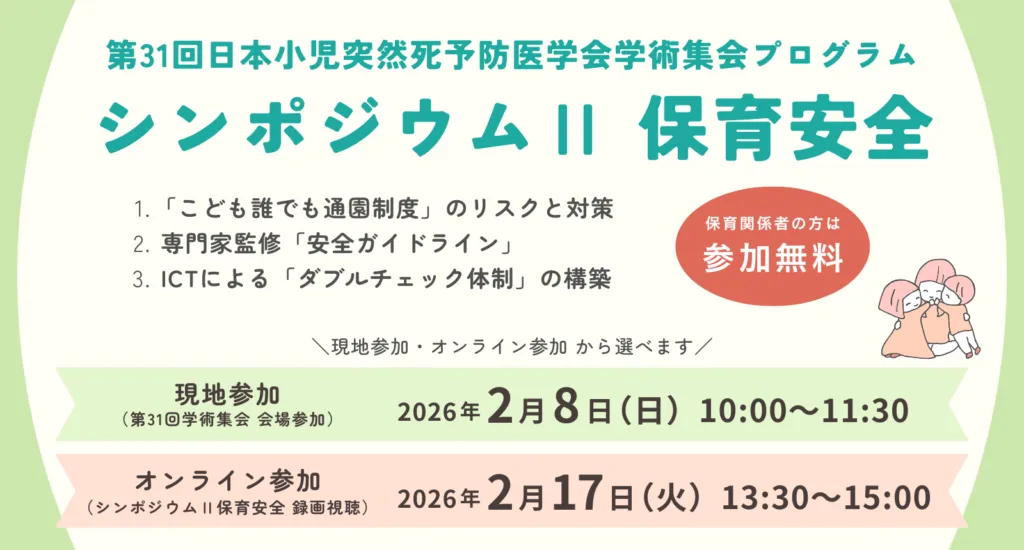
In 2026, this interdisciplinary approach is further strengthened through Symposium II: “Childcare Safety,” an official program designed to translate medical knowledge into practical, field-ready safety strategies.
What Is Symposium II: “Childcare Safety”?
Symposium II is a dedicated session within the academic meeting that addresses real-world safety challenges faced by childcare providers. Rather than focusing solely on theory, the symposium emphasizes actionable frameworks that can be immediately applied in nurseries, daycare centers, and early childhood education facilities.
To ensure broad accessibility, the symposium will be held both on-site and online, allowing participation from childcare professionals across Japan and internationally.
Event Overview
- Conference: 31st Annual Meeting of the Japanese Society for the Prevention of Sudden Infant Death
- Session: Symposium II – Childcare Safety
- On-site Session: February 8, 2026
- Online Session: February 17, 2026
- Format: In-person and online participation
Why Childcare Safety Requires Urgent Attention Today
Childcare environments are undergoing rapid transformation. One significant factor in Japan is the introduction of a new universal childcare access system, commonly referred to as the “Childcare for All” model. This system allows families to use childcare services regardless of employment status and often on a short-term or irregular basis.
While this model expands access and supports diverse family needs, it also introduces new safety considerations for childcare providers:
- Increased numbers of first-time or irregularly attending children
- Limited background or health information at the point of care
- Children adapting to unfamiliar environments and routines
These conditions require childcare facilities to rethink traditional safety assumptions and adopt more robust, system-based risk management approaches.
Key Topics Addressed in the Symposium
Symposium II focuses on three core themes that reflect current and emerging challenges in childcare safety.
- Risk factors associated with flexible and short-term childcare usage
- Introduction of newly developed safety guidelines supervised by pediatric and childcare experts
- Implementation of ICT and IoT-supported double-check monitoring systems
1. Risk Management in Flexible Childcare Systems
Traditional childcare models often assume consistent attendance and stable caregiver-child relationships. Flexible childcare systems disrupt this assumption, increasing the likelihood of miscommunication, incomplete risk awareness, and delayed response to warning signs.
The symposium examines how these risks emerge and how facilities can redesign intake procedures, information-sharing protocols, and daily routines to mitigate them effectively.
2. Expert-Supervised Safety Guidelines for Immediate Use
A central feature of the symposium is the introduction of newly developed childcare safety guidelines, supervised by pediatricians and academic researchers specializing in child development and healthcare.
These guidelines are not abstract recommendations. They are designed as operational tools—covering areas such as sleep safety, environmental checks, observation routines, and escalation protocols—allowing childcare teams to integrate evidence-based practices directly into daily operations.
3. ICT and IoT as a “Double-Check” Safety System
Human observation remains essential in childcare, but it is also vulnerable to fatigue, distraction, and workload pressures. For this reason, many facilities are exploring the use of ICT and IoT technologies as supplementary safety layers.
The symposium introduces practical examples of how technology can support caregivers through double-check systems—enhancing visibility, consistency, and early detection—without replacing human judgment or care.
Speakers and Perspectives
The symposium brings together professionals from pediatric medicine, academic research, childcare management, and technology development, ensuring a multi-dimensional discussion.
- Toshimasa Obonai, MD – Chief Pediatrician, Tokyo Metropolitan Tama-Hokubu Medical Center
- Hiroko Inokuma, PhD – Professor, Komazawa Women’s University
- Yūzen Saitō – Director, Seiwa Gakuen Educational Corporation
- Yasuyuki Toki – CEO, Unifa Inc.
Who Should Attend
- Childcare center directors and safety managers
- Early childhood educators and nursery staff
- Policy makers and administrators involved in childcare systems
- Professionals exploring technology-assisted childcare safety solutions
Registration and Further Information
- Official event details and registration:
https://www.wel-kids.com/press/seminar/wk-seminar-symposium-hoikuanzen/


![Water Play Spots Near Tokyo for Babies and Toddlers [2026]](https://en.tamagodaruma.com/wp-content/uploads/2026/06/tokyo-water-play-450x253.webp "Water Play Spots Near Tokyo for Babies and Toddlers [2026]")