
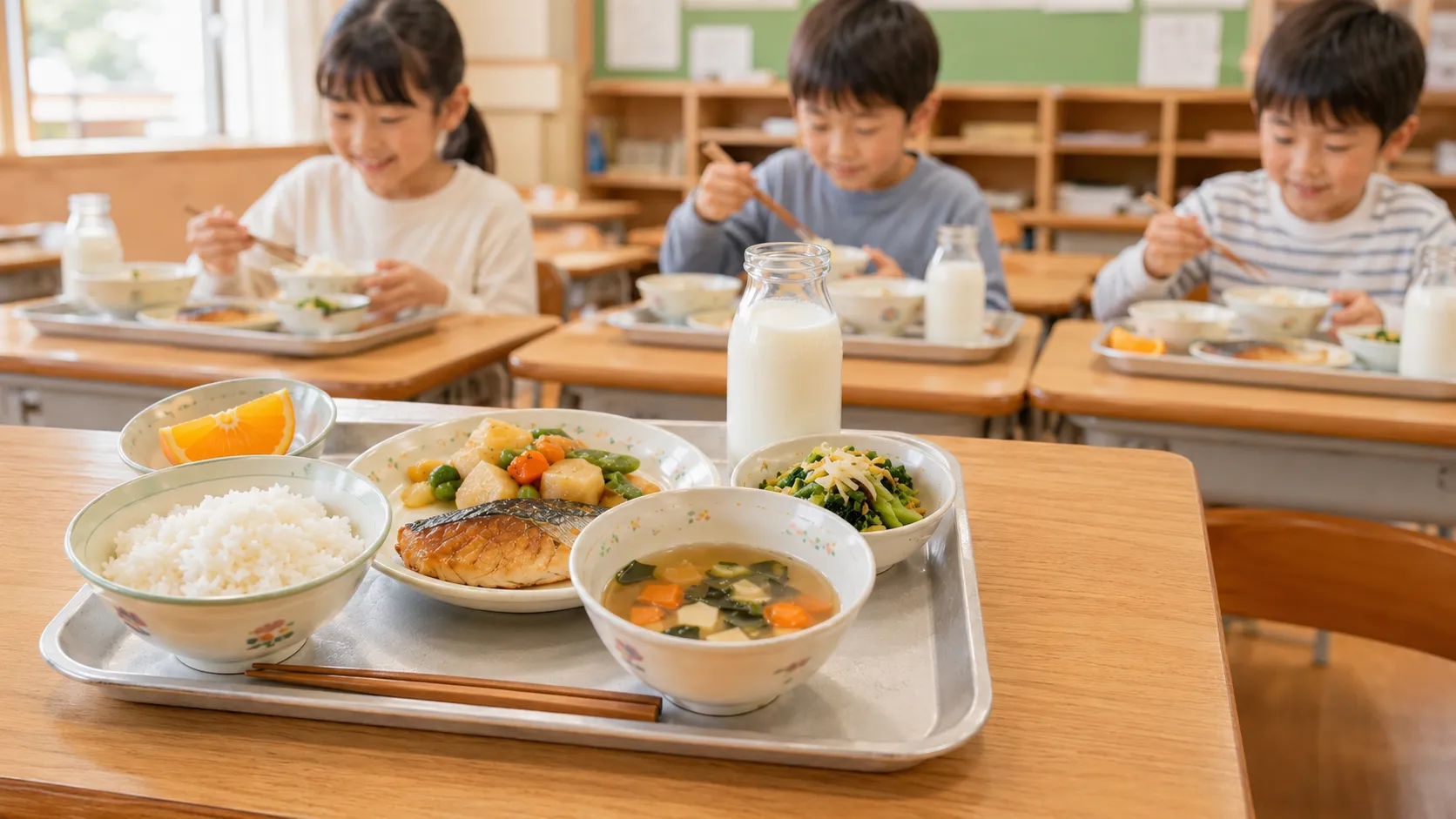
Japan’s school lunch system — along with meal programs at nursery schools — encompasses far more than nutrition. It is part of children’s everyday learning, covering eating habits, serving routines, local food culture, and food safety.
You may have come across the idea that “Japanese school lunch is impressive” or that “kyushoku is unlike anything you see overseas.” Japan’s school lunch and hoikuen (nursery school) meal programs do include elements that go beyond a simple midday meal: planned menus, student-led serving, cleanup routines, regional ingredients, and food culture. But those elements deserve a grounded look — not just admiration.
For families from outside Japan — whether already living here or preparing to move — real questions arise: what will my child actually eat, what happens if they can’t finish everything, and is it possible to discuss food allergies or religious dietary restrictions with the school or nursery?
This article covers the popular menu items found in Japan’s school and nursery school meals in concrete detail, along with the differences between nursery school meals and elementary school kyushoku, how Japan’s shokuiku (food education) framework operates, and how families can bring elements of it into the home kitchen.
The goal is not to hold Japanese school lunch up as something exceptional. For children, food is nutrition — but also comfort, experience, culture, and sometimes a quiet source of pressure. As a parent, understanding how the system works is useful. What matters equally is paying attention to how your own child actually experiences mealtimes.
Table of Contents
What is Japan’s school lunch? — Why it’s treated as a lesson, not just a meal
Japan’s school lunch is designed not only to provide nutrition but as part of children’s everyday education — building eating habits, serving routines, familiarity with local food culture, and food safety awareness through daily practice.
Japan’s school lunch system is not simply about filling children’s stomachs. The School Lunch Act states that school lunch contributes to the sound physical and mental development of students, and plays an important role in developing food literacy and the ability to make informed choices about food. In other words, kyushoku in Japan functions simultaneously as lunch and as a form of food-based education.
Source: School Lunch Act | e-Gov Law Search
When “Japanese school lunch” or “kyushoku” attracts attention internationally, the reasons extend beyond the menus themselves. The fact that students are involved in serving each other, that local agricultural products and regional dishes are incorporated, and that children learn about the origins of ingredients — these are the features that distinguish Japan’s approach to school meals.
That said, there is an important nuance when describing school lunch as “a lesson.” Treating mealtimes as educational gives children a chance to engage with food, culture, and care. But when the emphasis shifts to finishing everything or eating correctly, mealtimes can become a source of pressure for some children.
Thinking about school lunch means paying attention not only to what children eat, but also to how they feel while eating it.
The School Lunch Act and the nursery school meal guidelines — two different frameworks
Elementary school lunch and nursery school meals share a family resemblance, but they operate under different legal frameworks and reflect different priorities.
School lunch at elementary level is administered under the School Lunch Act and the School Lunch Implementation Standards, overseen by the Ministry of Education, Culture, Sports, Science and Technology (MEXT), with the aim of promoting children’s health and advancing food education (shokuiku). The nutritional standards for school lunch represent nationally averaged targets per student per meal — they are intended to be applied flexibly with consideration for individual children’s health and local circumstances.
Source: Partial Amendment to the School Lunch Implementation Standards | MEXT
Nursery school meals, by contrast, place greater emphasis on the developmental stage of infants and young children — their physical growth, daily rhythms, the development of chewing and swallowing, their appetite and willingness to eat. The Children and Families Agency (CFA) has published guidelines on meal provision at nursery schools that organize the purpose and practical approach to feeding in early childhood settings.
Source: Guidelines for Meal Provision at Nursery Schools | Children and Families Agency
| Category | Nursery School Meals (Hoikuen) | Elementary School Lunch (Kyushoku) |
|---|---|---|
| Primary purpose | Supporting growth, development, daily rhythm, and a positive relationship with food | School lunch that supports health promotion and food-related learning |
| Who it serves | Children from birth through preschool age | Primarily elementary and junior high school students |
| What’s included | Lunch, snacks (oyatsu), and age- and development-appropriate food textures and forms | Lunch as the primary meal |
| Serving and support | Primarily staff-led, adjusted by age and development; some facilities involve children in limited ways | Students participate in serving and cleanup at most schools |
| Food education focus | Eating habits, appetite and motivation, the experience of eating safely and happily | Understanding food, developing judgment, local culture, and cooperation |
| What to confirm | Monthly menus, allergy accommodation, food textures, individual adaptations | Monthly menus, allergy accommodation, serving policy, meal fees |
For international families, an important point is not to treat “Japan’s school lunch” as a single uniform system. How meals are handled differs between hoikuen (nursery school), yochien (kindergarten), nintei kodomoen (certified children’s centers), and elementary schools. Before your child starts, always review the facility’s own monthly menu and meal policy directly.
What serving duty teaches — experiencing food as something you prepare, not just receive
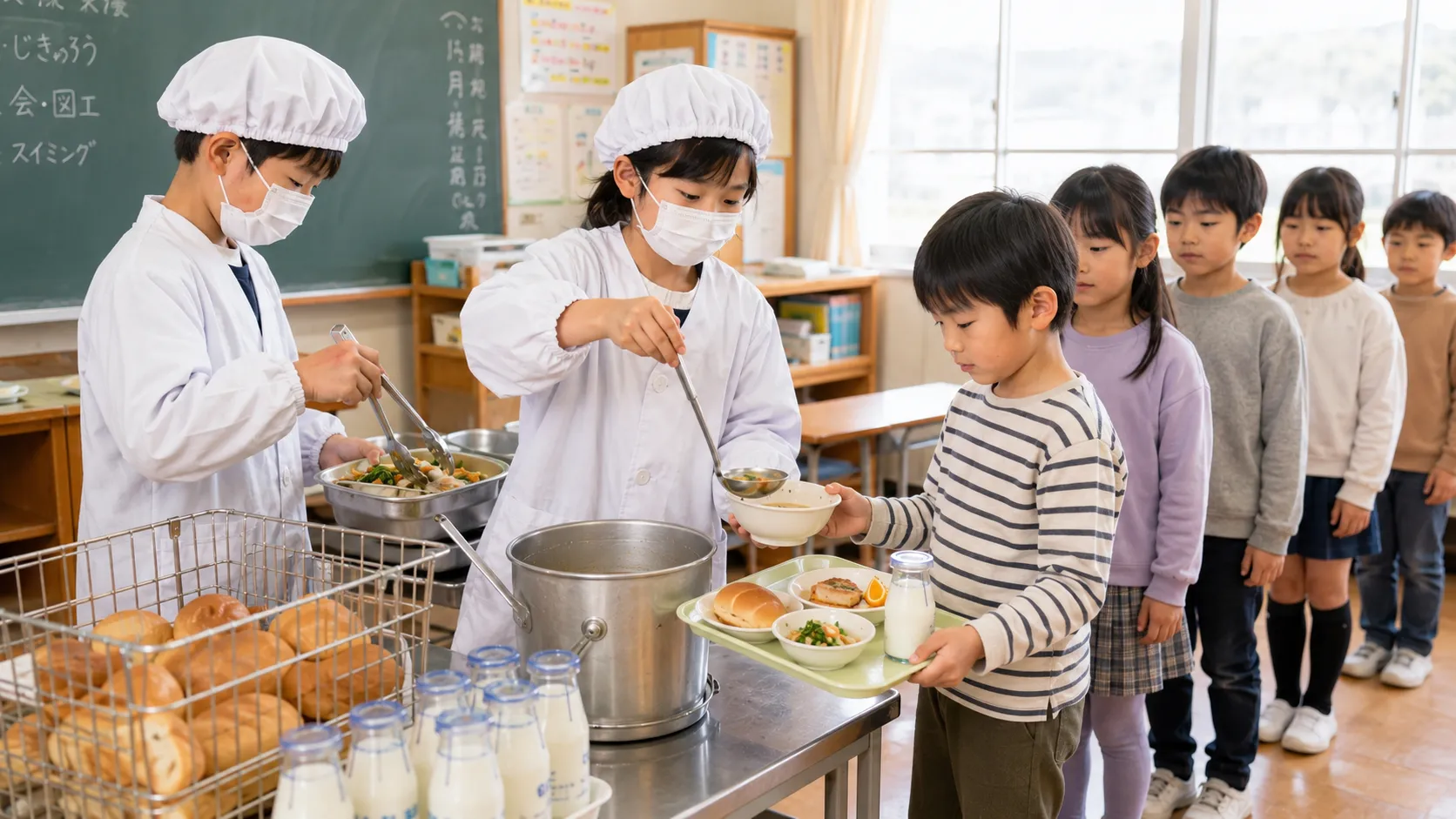
One aspect of Japan’s school lunch that often surprises people from outside Japan is that children themselves participate in serving meals and cleaning up afterward. Practice varies between schools and facilities, but helping serve the meal and tidying up afterward are generally treated as activities that are part of the full experience of eating together.
Taking on a serving role involves several layers of learning: being responsible for a classmate’s meal, not just your own; handling dishes and ingredients with care; understanding that preparation comes before eating; and seeing cleanup as part of the complete meal experience.
It is, in a practical sense, the experience of learning that food doesn’t simply appear — someone has to put it together. Stepping from the receiving side to the preparing side, even briefly, can build a sense of appreciation and a sense of one’s place in a shared routine.
Of course, there are children who find serving difficult, children who are cautious, children who feel anxious about it. That is precisely why the adults involved matter so much. Supporting participation at whatever level a child can manage — rather than simply pushing for speed, neatness, or perfection — is what makes the experience constructive rather than stressful.
Editor’s note
For someone encountering Japan’s school lunch for the first time, one of the most striking things is often the sight of children carrying dishes, ladling out soup, and tidying up afterward.
The serving rotation (haizen toban) is, as I see it, an experience of stepping from the eating side to the preparing side. It’s a way of learning — not in words, but through the body — that a meal is made possible through someone’s effort and attention.
School lunch is an educational experience that extends before and after eating, not just during it. At the same time, I think it’s equally important that the adults around a child are watching to make sure that experience doesn’t become a source of disproportionate anxiety.
Popular Japanese school lunch menus — why age-pan, curry rice, and wakame gohan are so well-loved
Among Japan’s school lunch menus, age-pan (deep-fried sweet bread rolls often coated with kinako, sugar, or cocoa), curry rice, wakame gohan (seaweed rice), fruit punch, karaage (fried chicken), hamburger steak, soft noodles, udon, miso soup, and fish dishes are often cited as menus that children take to most readily.
That said, school lunch popularity rankings shift depending on who conducted the survey, the age range of respondents, the region, and the year. The 2026 Nifty Kids survey placed age-pan first, followed by curry rice and fruit punch. The 2023 Mitsumura Tosho Publishing survey found curry rice at the top among both students and parents, with age-pan second.
Source: Age-pan Tops the School Lunch Popularity List Again — Nifty Kids 2026
Source: Survey on School Lunch Preferences | Mitsumura Tosho Publishing
This article therefore presents these not as a definitive national ranking but as menus that consistently appear across surveys and school lunch culture as familiar favorites.
| Menu Item | Why It’s Widely Enjoyed at School | Food Education Value | Considerations for Home Cooking |
|---|---|---|---|
| Age-pan (deep-fried sweet bread roll) | A special-occasion feel that rarely appears at home — distinctly school lunch | Tends to be remembered fondly; associated with the pleasure of school meals | Adjust frequency and quantity; treat as a special-occasion item rather than a daily staple |
| Curry rice | Easy for children to eat; conveniently combines vegetables and protein in one bowl | Introduces the concept of combining a staple grain, protein, and vegetables in a single dish | Reduce spice level; adjust texture of ingredients to suit child’s age |
| Fruit punch | Feels dessert-like; carries a festive, celebratory quality | A way into enjoying fruit in a more appealing format | Keep sweetness moderate; use as an opportunity to enjoy fruit rather than as a sweet treat |
| Wakame gohan (seaweed rice) | Can be more approachable than plain white rice for some children, due to its mild savory flavor | Introduces seaweed and the tastes of Japanese cuisine | Watch sodium content; start with small portions |
| Karaage and hamburger steak | Popular protein-based mains that pair naturally with rice | Introduces the idea of pairing a protein main with side dishes and soup | Pair with vegetables and soup to round out the meal |
| Soft noodles, udon, ramen-style | Noodles are easy to eat; often carry strong nostalgic associations with school lunch | Can introduce a wider range of ingredients through the broth and toppings | Watch sodium in the broth; adjust noodle length and ingredient size for young children |
| Miso soup and tonjiru (pork and vegetable soup) | A constant presence in Japanese school and nursery menus | Introduces dashi stock, miso, and seasonal vegetables in an everyday meal setting | Vary the ingredients; an accessible entry point for food education at home |
| Fish dishes and simmered Japanese-style dishes | Children may not choose these at home, but school lunch provides a regular encounter | Introduces fish, bones, dashi, and the flavor profile of traditional Japanese home cooking | Don’t force it; repeated, relaxed exposure over time is more effective than pressure |
Age-pan — the deep-fried sweet bread roll that feels like a school lunch exclusive
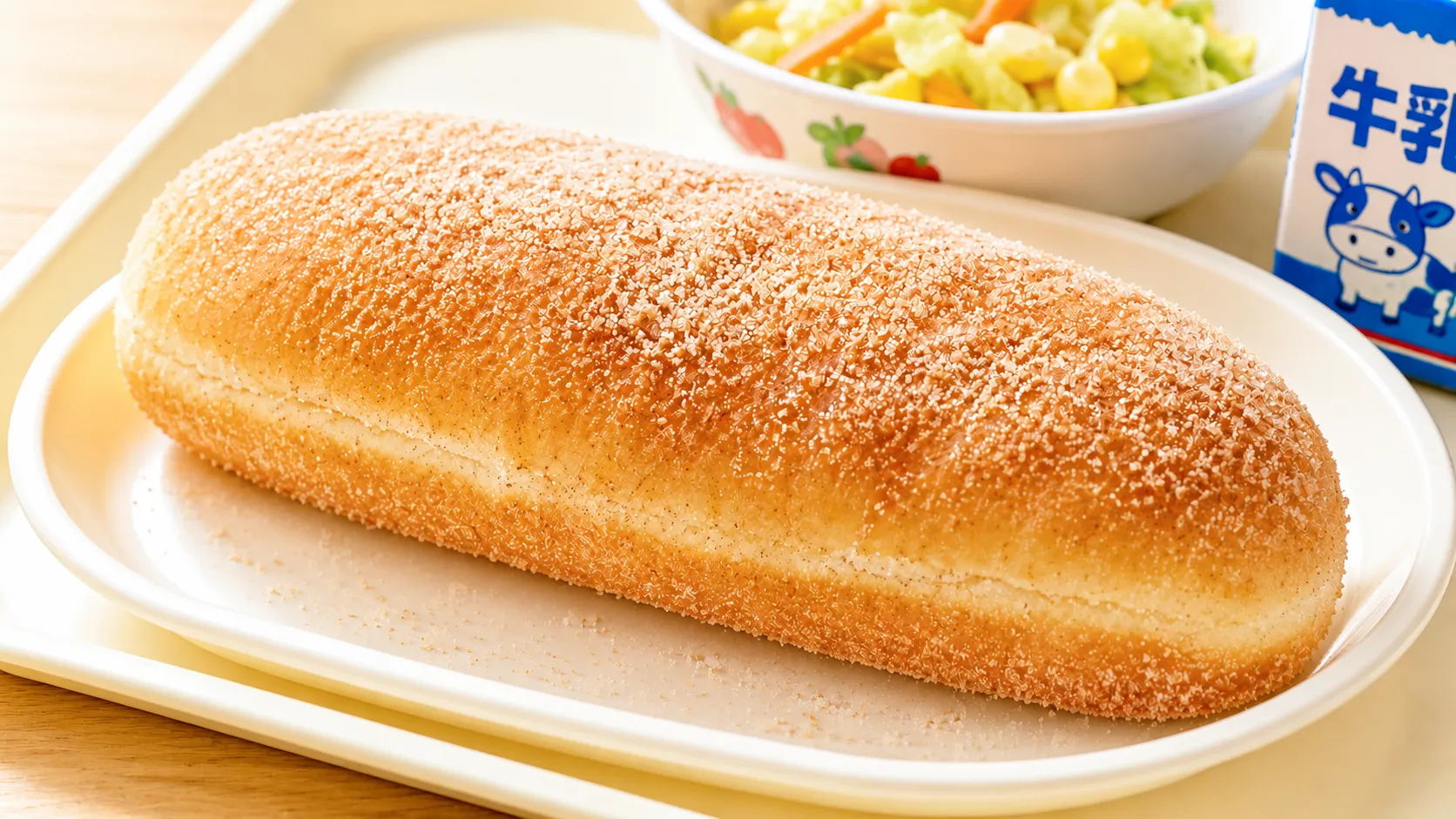
Age-pan is one of the most consistently named favorites in Japanese school lunch surveys. In both the 2024 and 2026 Nifty Kids surveys, it ranked first among preferred school lunch menus.
Source: Age-pan Tops the Favourite School Lunch Menu List — Nifty Kids 2024
Part of what makes age-pan memorable is precisely that it rarely appears on the home table — it has a school lunch quality that sets it apart. Typically coated in kinako (roasted soybean powder), sugar, or cocoa, it lands somewhere between a bread roll and a dessert in the experience of most children.
Age-pan does involve oil and sugar, and as a home dish it works best as an occasional recreation of a school memory rather than a regular part of daily eating. Adjusting the frequency and portion size makes sense if you’re bringing it into the home kitchen.
Curry rice — a generational school lunch classic
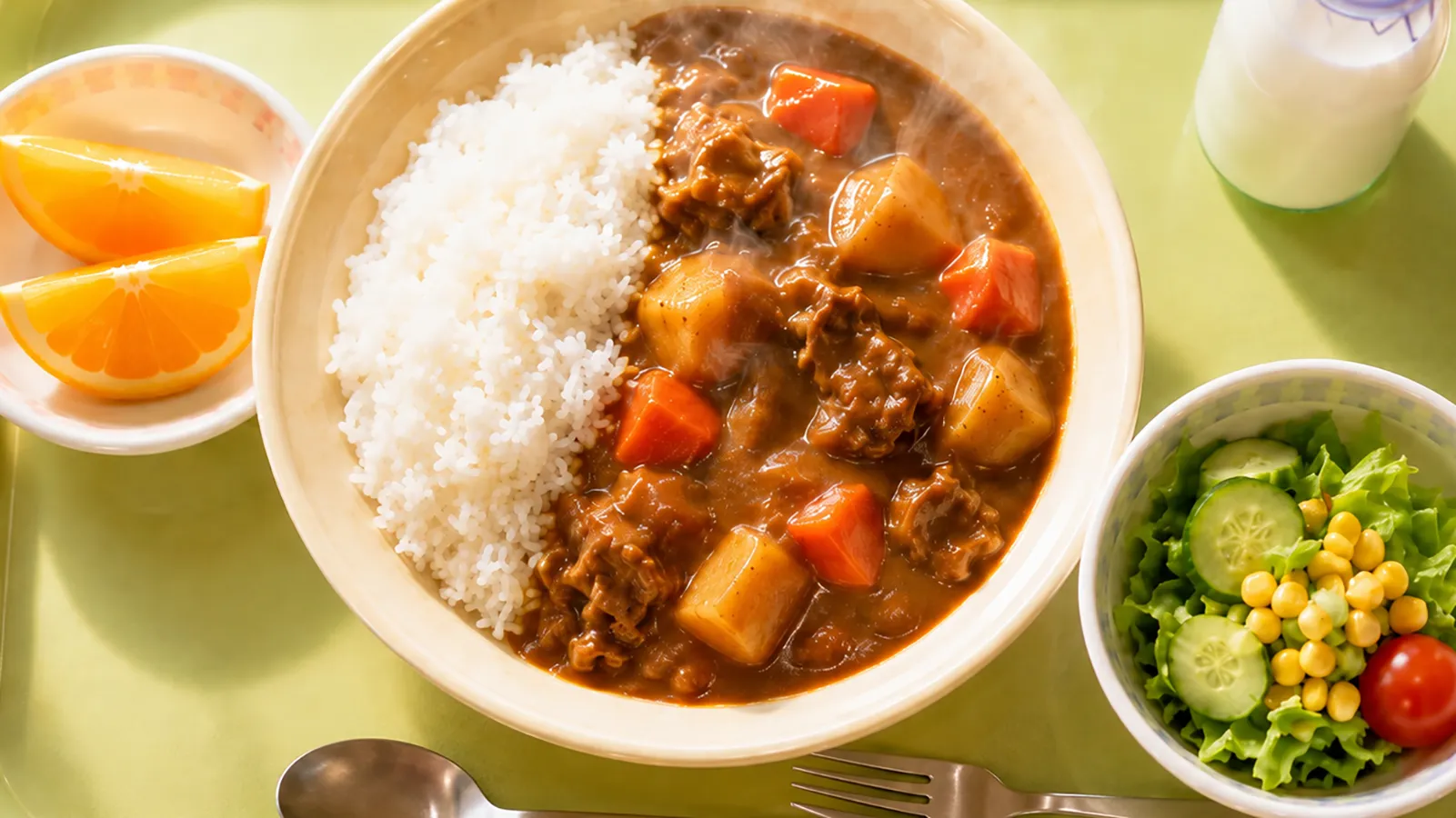
Curry rice has long been a staple of Japanese school lunch. The 2023 Mitsumura Tosho Publishing survey found it ranked first among both students and parents as a preferred school lunch item.
Its enduring place on the school lunch menu comes down to practicality as much as popularity: it’s easy for children to eat, and it conveniently brings vegetables, protein, and a grain together in a single dish. Carrots, onions, potatoes, and meat in one bowl also makes it relatively straightforward to recreate at home.
For nursery school and preschool-age children, reducing the spice level and cooking ingredients until soft are important adjustments. Match the size of ingredients to your child’s chewing ability.
Fruit punch — a dessert-style dish that brightens the lunch table
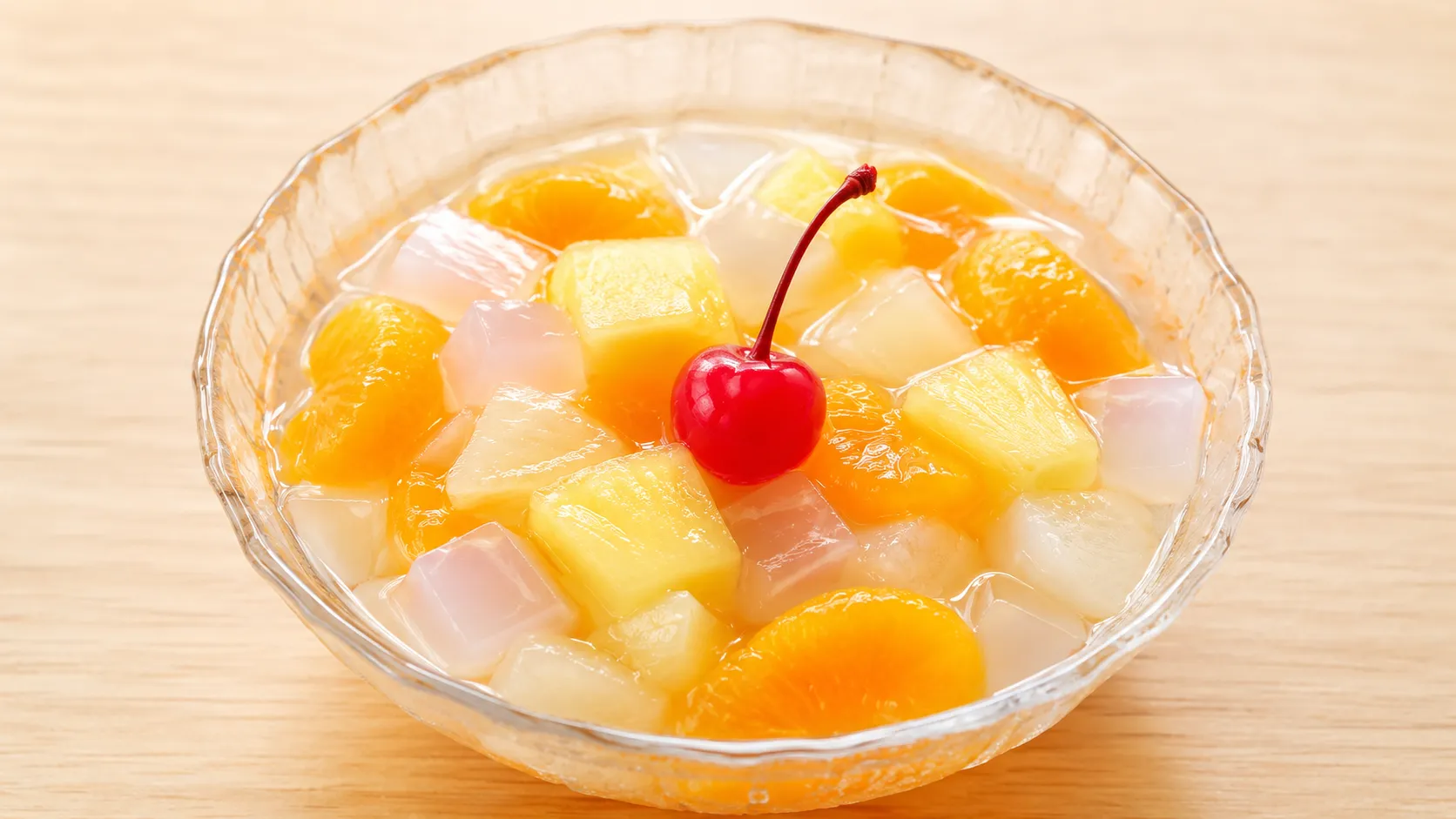
Fruit punch is one of those school lunch dishes that tends to be remembered with particular warmth. The 2026 Nifty Kids survey placed it among the top preferred school lunch menus.
Typically containing fruit pieces and jelly, it adds a slightly celebratory note to lunchtime. Schools and nurseries think carefully about portion size and pairing when they include it. At home, keeping sweetness measured and using it as a way to enjoy fruit — rather than as a dedicated sweet — is a reasonable approach. If there are food allergies in your household, check the ingredients of any fruit or jelly components carefully.
Wakame gohan — the simple seaweed rice that stays in the memory
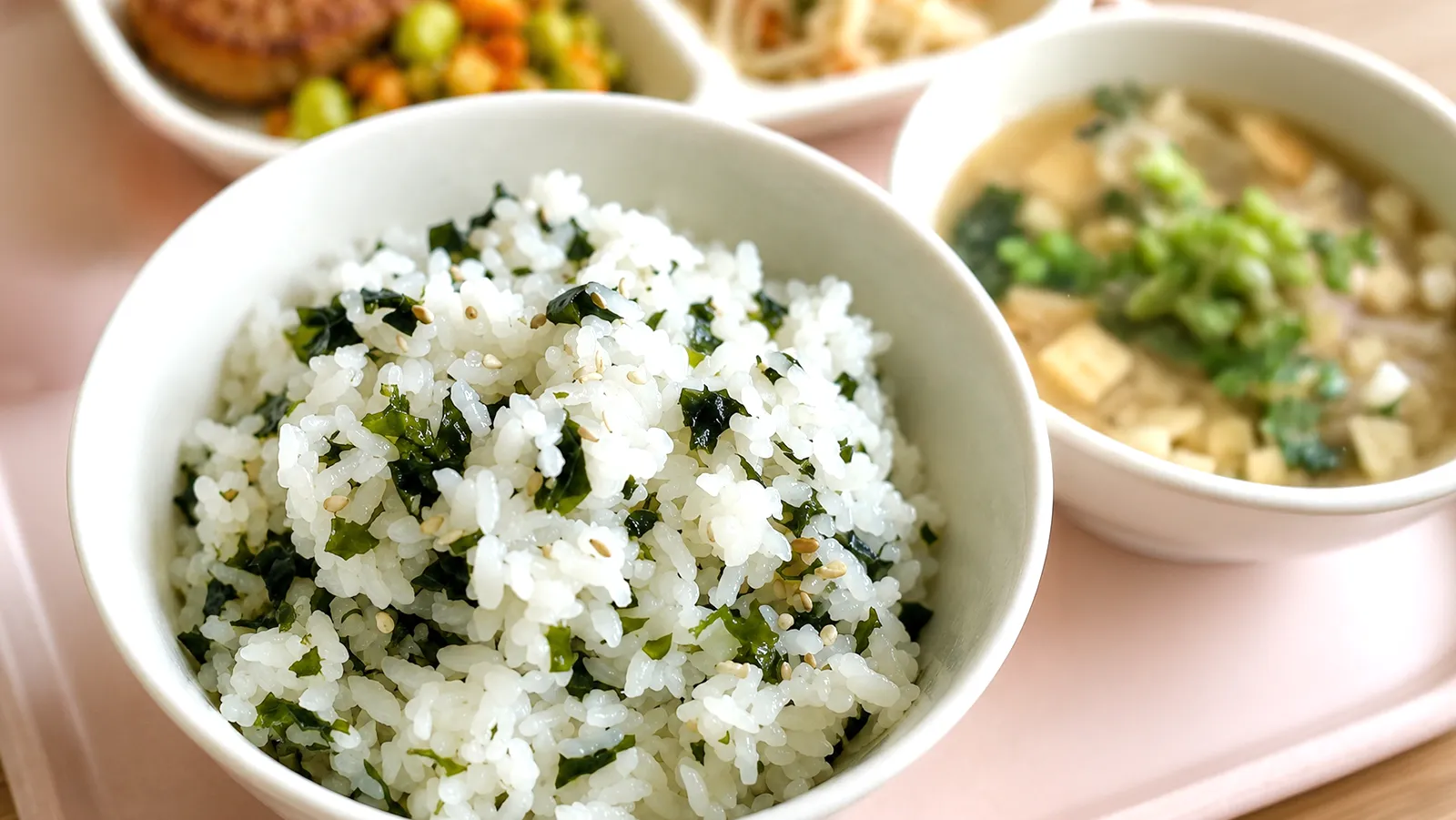
Wakame gohan (rice mixed with wakame seaweed) is often described as one of those quietly iconic school lunch dishes. Its mild saltiness and aroma can make it more approachable than plain white rice for some children who struggle with plain steamed rice.
From a food education perspective, encountering seaweed regularly through school meals builds familiarity with sea vegetables and Japanese flavors. At home, pre-made wakame gohan mixes are available, but watch the sodium content — they can run quite salty. Mixed rice dishes in general are a gentle way to introduce ingredients a child might otherwise avoid, though the goal should always be relaxed exposure rather than hiding ingredients.
Karaage and hamburger steak — popular protein mains
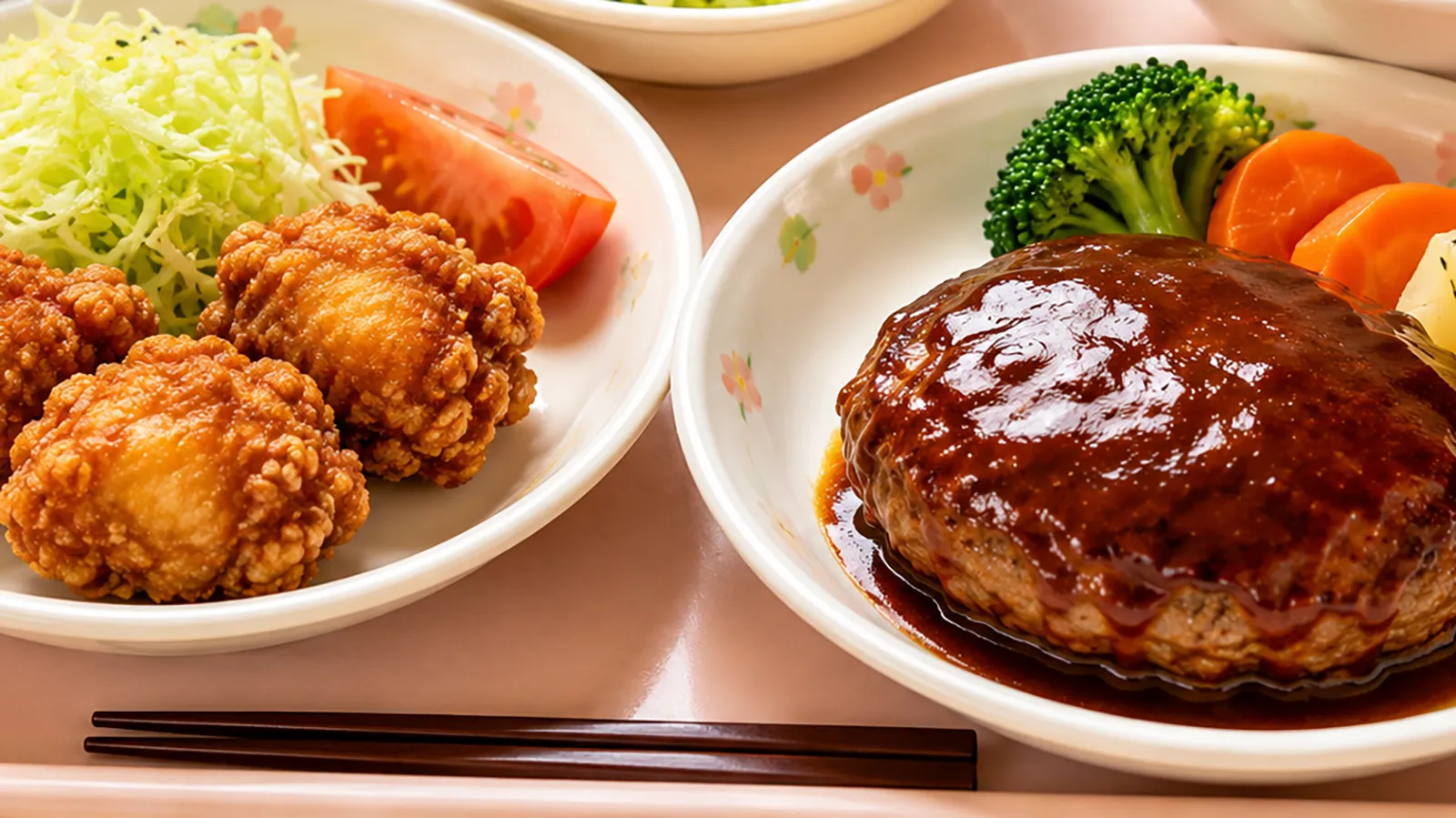
Karaage (Japanese-style fried chicken) and hamburger steak are popular protein-based main dishes in school lunch menus — both pair naturally with rice and are recognized protein sources that fit easily into a planned menu.
School kitchens prepare these dishes within the context of a full, balanced meal — karaage alongside a vegetable side and a soup, hamburger steak with salad and broth. The complete combination is what makes it work nutritionally.
At home, the same principle applies: karaage or hamburger steak alone doesn’t make a complete meal. Adding miso soup and a vegetable side brings it closer to the balanced structure you’d find in a kyushoku-style lunch.
Soft noodles, udon, and ramen-style — noodle dishes with strong nostalgic pull
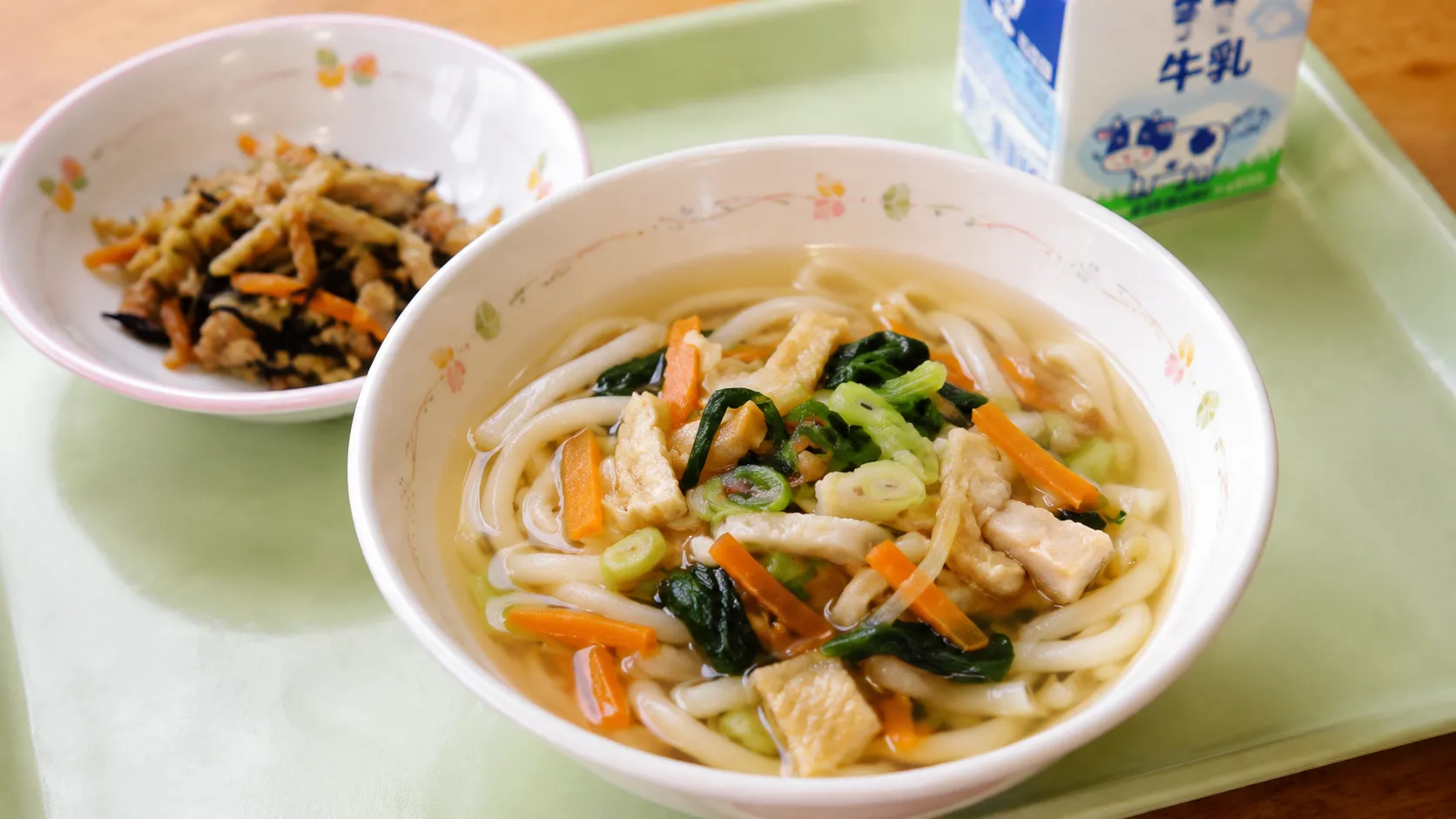
Soft noodles (sofuto men) — served with a sauce or broth — are a distinctly Japanese school lunch creation that carries strong nostalgic associations for many Japanese parents, though availability varies significantly by region and generation.
Udon and ramen-style noodle dishes also appear in school lunch menus and tend to be well-received by children. Noodles are an approachable staple, and their broths and toppings offer a way to introduce a range of vegetables, proteins, and seafood in a format children find easy to eat.
When making noodle dishes at home, keep an eye on sodium — broths can be high in salt. For nursery-age children, adjust the length of noodles and the size of any solid ingredients.
Miso soup and tonjiru — everyday soup dishes that connect to food education
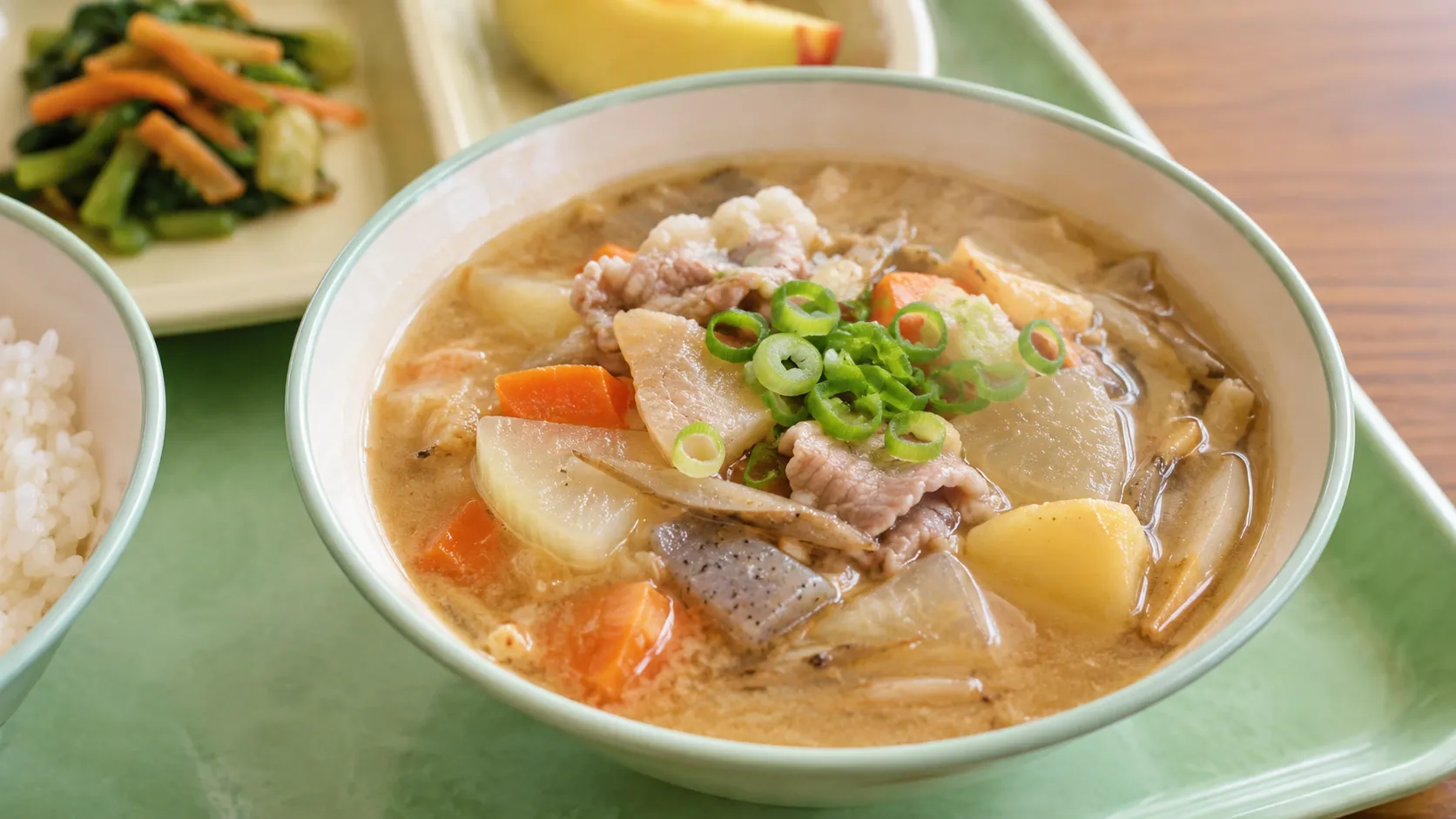
Miso soup and tonjiru (pork and root vegetable soup) don’t tend to top popularity rankings, but they are essential to understanding how Japanese school and nursery meals are structured.
A soup course allows for a wide range of ingredients: tofu, wakame, mushrooms, root vegetables, leafy greens. Becoming familiar with the taste of dashi stock and miso is, in effect, an introduction to one of the foundational flavors of Japanese everyday cooking.
If you’re looking for an entry point for food education at home, miso soup is one of the most practical starting points. Choosing ingredients together with your child, talking about what’s in the bowl, changing the contents by season — these small conversations are exactly what home-based food education can look like.
Fish dishes and simmered Japanese-style dishes — worth encountering slowly, even for picky eaters
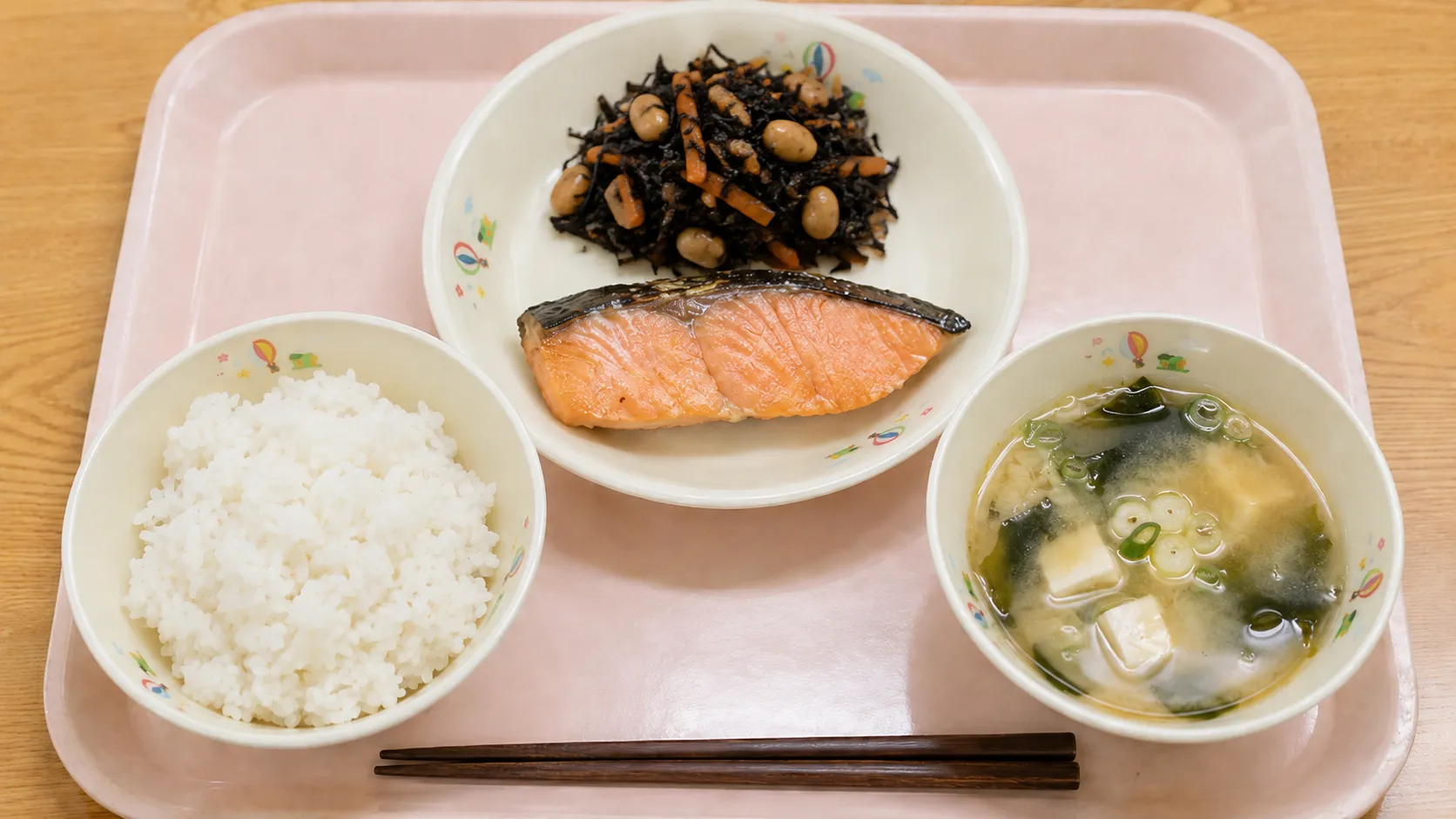
Grilled fish, simmered fish, nikujaga (meat and potato stew), hijiki no nimono (simmered hijiki sea vegetable) — these traditional Japanese-style dishes divide children’s preferences, but they occupy a meaningful place in school and nursery meal planning.
Fish can be difficult for children because of bones, strong smells, and unfamiliar textures. Simmered dishes can take time to get used to visually and texturally. That’s precisely why the experience of encountering them through school meals — seeing them, trying one bite, watching a friend eat them — can gradually broaden a child’s comfort with these foods.
At home, rather than pushing children to eat these dishes, increasing how often they appear on the table — without pressure — is the more effective approach. An untouched plate is not a failure.
Regional variations — how location shapes the menu
Japan’s school lunch menus reflect regional differences. Locally grown vegetables, seafood, rice varieties, regional specialties, and seasonal events can all influence what children eat at school in a given area.
The Ministry of Agriculture, Forestry and Fisheries (MAFF) has noted that incorporating locally sourced ingredients into school meals connects children with the culture and industries of their region, encourages interaction with producers, and cultivates gratitude for food.
Source: Use of Locally Sourced Ingredients in School Lunch | Ministry of Agriculture, Forestry and Fisheries
In Hokkaido, for instance, menus may draw on salmon and local potato varieties. In Okinawa, regional cuisine concepts may be reflected in the menu. In Yamagata, dishes like imo-ni (a regional taro stew) may appear. These choices vary significantly by municipality and facility policy. For the actual menus your child will encounter, the monthly menu plan published by your specific school or childcare facility is the only reliable source.
For readers outside Japan, it’s worth knowing that “Japanese school lunch” is not a single standardized menu — regional food culture is genuinely woven into it.
How menus differ between nursery school and elementary school
Because the age range and developmental stage are so different, the way menus are planned differs between hoikuen and elementary school.
In nursery schools, the ability to chew and swallow, how to use utensils, how much a child eats, daily rhythms, and the development of appetite all require careful consideration. Infant-age classes may require individually adapted food textures based on weaning stage.
By elementary school, a wider range of ingredients, cooking methods, and flavors is incorporated, and the broadening of children’s food experience becomes a more explicit goal. Many children encounter ingredients for the first time through school lunch.
When drawing on school or nursery meals for inspiration at home, there’s no need to replicate them exactly. What matters is light seasoning, manageable piece sizes, appropriate portions, and a relaxed atmosphere at the table.
How Japan’s school lunch maintains safety — nutritional standards and allergy management
Japan’s school lunch system operates under nationally established standards, and allergy accommodation proceeds on the basis of written documentation and individual discussion with parents.
For international families and parents enrolling a child in a Japanese childcare facility or school for the first time, “is the food safe?” and “what happens if my child has allergies?” are significant concerns.
The straightforward answer is that Japan’s school and nursery meals do operate under public standards and guidelines covering nutrition, hygiene, safety, and allergy management. However, the specific implementation varies considerably by municipality and facility. This is why both understanding the framework and confirming details directly with your facility are equally important.
What are Japan’s school lunch nutritional standards?
The school lunch nutritional standards represent the desirable nutritional content per meal for school-age children. MEXT describes these as nationally calculated targets intended to promote students’ health and advance food education (shokuiku).
An important clarification: these standards are not rules requiring every child to consume an identical amount of food. MEXT describes the nutritional standards as national averages per student per meal, to be applied flexibly in practice with consideration for children’s health, physical activity levels, and local circumstances.
Source: Partial Amendment to the School Lunch Implementation Standards | MEXT
In other words, school lunch is nutritionally planned — but there is no expectation that families should treat these standards as fixed daily intake targets at home. Children vary enormously in how much they eat. At home, the nutritional design of school meals can serve as a loose reference point while you adapt to your own child’s appetite and capacity.
Allergy management — what parents should do before enrollment
When a child has food allergies, the appropriate response is not to rely on spoken communication or personal judgment alone — the correct approach is to follow the written process specified by your child’s school or nursery.
The Consumer Affairs Agency publishes information on food allergen labeling requirements for packaged processed foods in Japan. Always verify the latest information through official sources.
Source: Food Allergen Labeling Information | Consumer Affairs Agency
Schools and nurseries typically require written documentation for allergy accommodation — this may include a physician’s diagnosis, a medical management form completed by the doctor, and forms specified by the facility. The exact documentation required and the scope of accommodation available vary by municipality and facility, so confirm all of this before enrollment.
Key items to confirm include:
- How to submit an allergy accommodation request
- Whether a physician’s letter or a medical management form is required
- What options exist: elimination diet, substitute food, or packed lunch from home
- How the facility communicates if an accidental exposure occurs
- How allergy needs are handled for snacks and special event meals
- How to check the ingredient lists of processed foods and seasonings used in cooking
Food allergies can be life-threatening. Do not rely on articles or social media for allergy management decisions — base all decisions on confirmed information from your child’s doctor, the facility, and your municipal office.
Religious and cultural dietary restrictions — what facilities can and cannot accommodate
One of the most common questions from international families is: “Can halal or vegetarian meals be provided?”
At present, neither the School Lunch Act nor the School Lunch Implementation Standards prescribe a nationally standardized approach to religious or cultural dietary restrictions. Whether and how a facility can accommodate these needs depends entirely on the municipality, school, or childcare facility.
Dish names alone can be misleading. Ingredients like pork, beef, alcohol-based seasonings, gelatin, dashi stock, consommé, and processed food components may not be apparent from the menu. A “vegetable soup,” for example, may use an animal-based stock or bouillon.
Useful questions to ask the facility include:
- Does the monthly menu include ingredient information?
- Can the dashi stock and seasonings used in cooking be confirmed?
- Is any accommodation possible for ingredients my child cannot eat?
- Is it possible to bring food from home for some or all meals?
- Can the content of snacks and special event meals be confirmed in advance?
The goal here is not to challenge the facility but to work together toward a shared understanding of what will keep your child comfortable and safe at mealtimes.
What is shokuiku? — Japan’s food education concept and what families can do at home
Shokuiku is Japan’s framework for nurturing children’s physical and mental wellbeing, cultural awareness, and social development through food. School meals are a key site where this is practiced — but it only takes root when school and home work together.
When you hear “food education in Japan,” you might picture nutrition classes or factual lessons about ingredients. But for children, shokuiku is something much more embedded in daily life.
Serving your own portion. Eating alongside friends. Taking a cautious look at a vegetable you’ve never tried before. Putting away the dishes. Learning the names of ingredients. Noticing the people who prepared the food. These small accumulated experiences are the foundation of what shokuiku means in practice.
What Japan’s Shokuiku Basic Act establishes
The Ministry of Agriculture, Forestry and Fisheries (MAFF) describes shokuiku as “the basis of life itself” and as the foundation of intellectual, moral, and physical development. It is defined as the process of cultivating — through a wide range of experiences — the knowledge about food and the capacity to make food choices necessary to practice healthy eating throughout one’s life.
Source: What Is Shokuiku? | Ministry of Agriculture, Forestry and Fisheries
This definition makes clear that shokuiku is not simply “teaching children to eat nutritiously.” It encompasses the ability to choose food, knowledge of food culture, appreciation for the people involved in producing and preparing food, and a sense of care for one’s own body.
At TamagoDaruma, we don’t think of shokuiku as “teaching children to eat correctly.” We think its center should be a child safely encountering food, building a relationship with it at their own pace.
When school lunch becomes a lesson — chopsticks, ingredient origins, and the meaning of eating
School lunchtime contains many small moments of learning that go beyond simply eating.
Reading a menu that lists where ingredients come from. Learning how to hold chopsticks. Trying a tiny bite of a vegetable that usually doesn’t go over well. Eating food that was grown locally. Participating in serving and cleanup. Each of these connects to food literacy in its own way.
That said, the question of whether children are required to finish everything deserves careful thought. Many adults carry memories of being firmly told not to leave anything on their plate. Today, however, there is greater awareness of the importance of accounting for developmental variation, food allergies, sensory sensitivities, and psychological pressure.
Encouraging children to have eating experiences is important. But pushing them to finish everything should not become the objective. Eating is a lived experience that depends on a foundation of feeling safe.
Three steps for shokuiku at home
When school or nursery bears all of the responsibility for food education, its effects remain limited. Connection with what happens at home is what allows a child’s relationship with food to genuinely deepen.
Step 1: Look at the monthly menu together
A simple question — “What did you eat today?” — opens a conversation about ingredients, dish names, seasons, and regional food. Putting the monthly menu on the refrigerator is enough to change the texture of family conversation around food.
Step 2: Re-create a kyushoku-style dish at home
When a child says “I really liked that at school today,” that’s an opening for food education at home. Start with something manageable — curry rice, wakame gohan, miso soup, nikujaga — and bring it to the home table.
Step 3: Build the habit of naming ingredients
Saying “this is daikon” or “this is spinach” as small, repeated moments adds up. When the same ingredient appears at school, the experience of “oh, I know this” is waiting. Shopping at the supermarket is its own form of food education.
For international families in Japan — what to confirm before enrollment
Understanding how Japan’s school lunch system works — and making early contact with teachers, the school nutritionist, and your school or nursery — makes it considerably easier to ensure your child’s food environment is safe and comfortable.
For international families, Japan’s nursery school and elementary school meal systems can be difficult to navigate. Monthly menus are typically published in Japanese only, and ingredient details for dashi stocks, seasonings, and processed foods may require specific inquiry.
Food allergies, religious dietary restrictions, vegetarian or vegan diets, and questions about dairy in particular are worth raising early — before enrollment if possible.
What to confirm at a food-related meeting before enrollment
Beyond allergy and religious food concerns, it’s also worth sharing: ingredients your child dislikes, food habits and culture from your home context, how much your child tends to eat, and whether your child takes longer than average to finish a meal. Communicating this in advance helps teachers and staff understand your child’s situation from the first day.
There is no need to hold back. Food is a daily matter. Raising these questions before enrollment is preparation for your child’s wellbeing — not an imposition.
What to check on the monthly menu plan
The monthly menu plan is the primary document for understanding what your child will eat. A typical plan covers the main grain, protein dish, vegetable side, soup, snack, milk, and any special event meals for the month.
For international families, dish names alone may not tell the full story. Dashi stock, bouillon, gelatin, processed sauces, and seasonings may contain ingredients that aren’t apparent from the menu title. Questions like “does this dish contain pork?” or “what is the stock made from?” or “can I see the ingredient list?” are concrete and practical — they are the clearest way to get useful answers.
Confirming the facility’s approach to uneaten food and pressure to finish
It is not unusual for children to leave food on their plate, to have dislikes, or to feel uncertain about unfamiliar ingredients.
Before enrollment, it’s useful to ask how the facility handles uneaten food and whether there is a policy around encouraging children to finish everything. Knowing this in advance gives you a realistic picture.
At home, telling your child “it’s okay if you can’t eat everything” and “you can tell the teacher if something isn’t working” provides reassurance. Meal policies vary between facilities, so parents should also confirm this directly with their specific school or nursery.
Finding out how to reach the school nutritionist or nutrition teacher
It’s easy to assume that food-related questions can only go to the homeroom teacher. Depending on the facility, however, it may be possible to speak directly with a school nutritionist or nutrition teacher — or with kitchen staff.
For questions requiring specialist knowledge — allergies, specific ingredients, the possibility of bringing alternative food from home — identifying the right contact point early is useful.
Sharing Japan’s school lunch culture with your child
Serving rotations, rules around second helpings, how to hold chopsticks, milk cartons, miso soup, dashi, and regional specialties — school lunch in Japan contains many elements that may be unfamiliar to children from international families.
Rather than framing these as “strange” or “complicated,” treating them as an opportunity for both parent and child to learn about Japanese daily life can turn school lunch into a space for intercultural understanding.
Of course, there is no reason to push through food that cannot be eaten or situations that cause genuine distress. The priority is always identifying what your child needs in order to feel settled — and building those options in advance through communication with the school or nursery.
Pre-enrollment checklist: school and nursery lunch questions to ask
For international families and households with any food-related concerns, this checklist covers the key questions to raise before enrollment.
- Confirmed the procedure for submitting an allergy survey or medical management form
- Confirmed how the monthly menu plan is distributed or published
- Checked whether the monthly menu includes allergen or ingredient information
- Confirmed the scope of individual food allergy accommodation with the teacher and school nutritionist
- Identified who to contact regarding religious or cultural dietary restrictions
- Asked how to check dashi stocks, gelatin, processed foods, and seasonings
- Confirmed the meal fee payment method and whether any fee waiver applies
- Noted the date of any school lunch tasting events or observation days
- Asked the school or nursery about their approach to uneaten food and whether children are expected to finish everything
- Shared in advance which ingredients your child cannot eat
- Confirmed in which situations bringing food from home is possible
- Identified the best way to reach the school nutritionist or nutrition teacher
This checklist is not a tool for pushing demands onto a facility. It’s a framework for building shared understanding between your family and the school or nursery — so that your child’s mealtimes can begin safely and comfortably.
Where to start when bringing Japanese school lunch ideas into your home kitchen
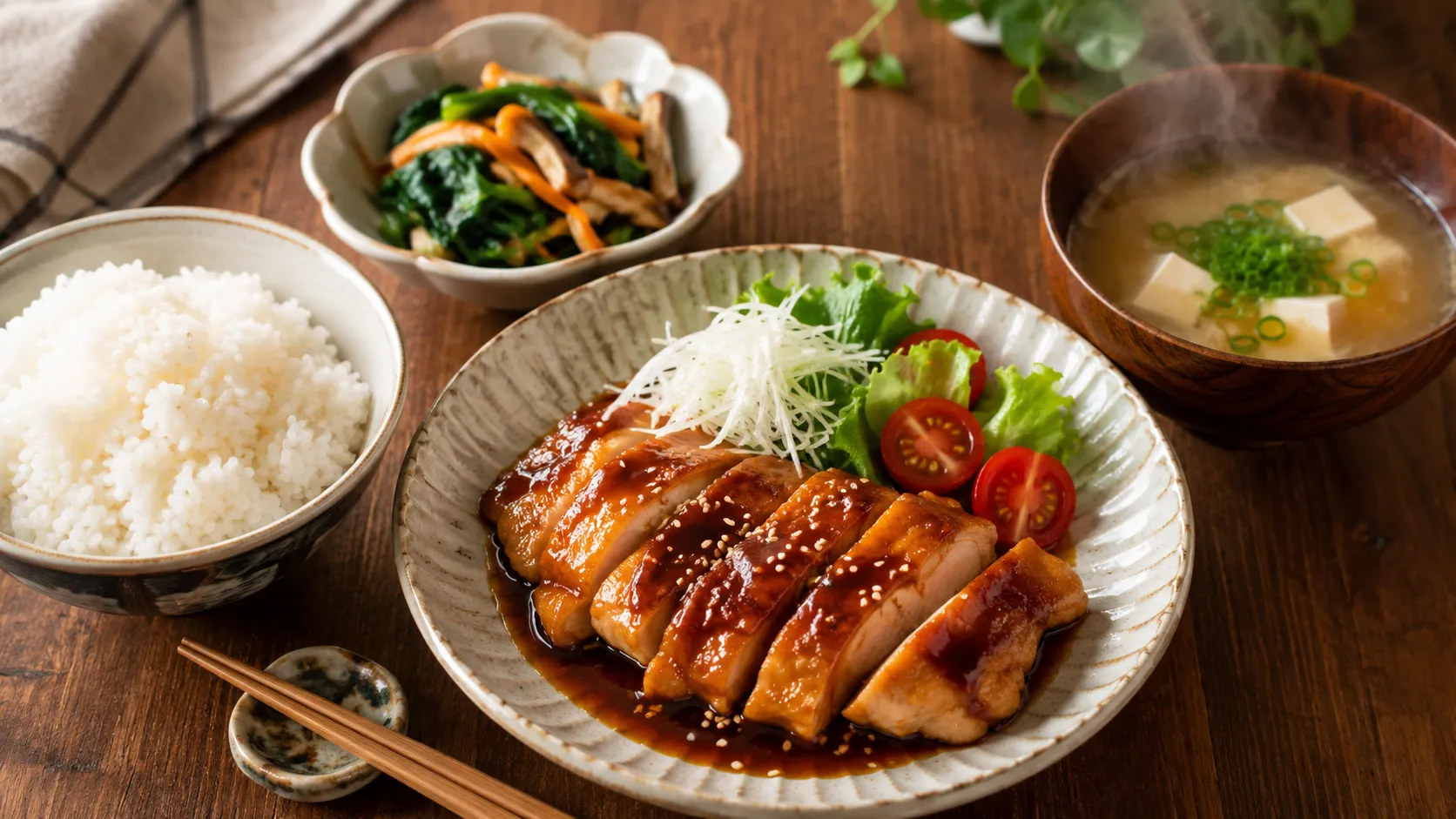
There’s no need to fully recreate school meals at home. Loosely following the basic structure — a grain, a soup, a protein main, a vegetable side — is enough.
If you want to bring elements of Japan’s school and nursery meal approach into your home kitchen, there’s no need to aim for a perfect reproduction from the start. The real value of kyushoku lies less in any specific dish and more in the underlying structure of the meal.
A staple grain or bread. A protein-based main dish — meat, fish, egg, or tofu. A vegetable-based side. A soup or broth. Holding this combination loosely in mind is enough to move toward a school lunch-style table, without needing to execute it precisely every day.
For families with busy schedules, setting “ichiju sansai every single day” as a strict goal tends to become exhausting. Home meals should prioritize sustainability over completeness. A table that actually gets used regularly, however imperfectly assembled, is worth more than an ideal that only holds for a week.
The basic structure of a kyushoku-style meal at home
For thinking about a kyushoku-inspired home meal, the following structure is a useful guide:
- Grain: steamed rice, bread, udon, or mixed rice
- Main dish (protein): fish, chicken, tofu, egg, or meat-based dish
- Side dish (vegetable): dressed vegetables, simmered dish, or salad
- Soup: miso soup, clear soup (osumashi), or a broth-based soup
Some example combinations:
- Steamed rice, teriyaki chicken, dressed carrot salad, miso soup
- Mixed rice, simmered tofu, hearty miso soup with vegetables
- Udon noodles, vegetable-filled tamagoyaki (rolled omelette), fruit
- Curry rice, warm boiled vegetables, yogurt
- Steamed rice, grilled fish, simmered hijiki, miso soup
The goal here is not to increase the number of dishes. What matters is that your child can come to the table without anxiety, that they can try at least one thing without pressure, and that mealtime doesn’t become something either of you dreads.
Easy popular menu examples to make at home
Curry rice, miso soup, teriyaki chicken, nikujaga (meat and potato stew), dressed vegetable salads, mixed rice, and udon are among the most accessible kyushoku-inspired dishes to try at home.
Curry rice is a one-bowl dish that makes it easy to get vegetables in alongside protein and a grain. For young children, reduce the spice and cook the ingredients until soft and tender.
Miso soup is one of the most practical entry points for food education at home. Tofu, wakame, daikon, carrot, onion, mushrooms — varying the ingredients naturally brings in seasonal variety.
Teriyaki chicken and nikujaga both pair well with rice and offer a gentle introduction to Japanese seasoning. Keep the seasoning from getting too strong or salty.
Dressed vegetable sides are a category many children resist. Rather than coaxing, start with a small portion on the plate, let them look at it, and model eating it yourself. That’s enough for now.
Age-appropriate considerations for home cooking
When preparing kyushoku-style meals for children at home, developmental stage matters.
For infants and toddlers, size, firmness, stickiness, round shapes, bones, skin, and fibrous textures all require attention. For ingredients that carry a risk of choking or aspiration, refer to guidance from your municipal health service or specialist, and adjust preparation to match your child’s developmental stage.
For ingredients being introduced for the first time, or where you have concerns about allergies, do not proceed on your own judgment — speak with your child’s doctor or a specialist as needed.
In children’s meals, “nutritionally good” is not the only criterion that matters. Factor in ease of eating, safety, your child’s developmental readiness, and what is manageable for your household.
A week of kyushoku-style meals — a home planning template
If you’d like to bring Japan’s school and nursery meal approach into your weekly home routine, a simple weekly template can reduce the mental load of daily meal planning.
| Day | Grain / Staple | Main Dish (Protein) | Side Dish (Vegetable) | Soup |
|---|---|---|---|---|
| Mon | Steamed rice | Teriyaki chicken | Dressed carrot salad | Miso soup |
| Tue | Udon noodles | Tofu dish | Warm boiled vegetables | Broth soup |
| Wed | Mixed rice | Grilled fish | Simmered hijiki (sea vegetable) | Miso soup |
| Thu | Steamed rice | Nikujaga (meat and potato stew) | Dressed cucumber | Clear soup (osumashi) |
| Fri | Curry rice | Boiled vegetables | Fruit | Broth soup |
A template like this is not meant to fix your meals permanently — it’s meant to reduce the decision-making burden day by day. If a child doesn’t eat something, or if the week doesn’t go according to plan, that’s fine.
Home meals don’t need to be held to school lunch standards. The aim is to borrow a little of the structure and bring it into a table that works — sustainably — for your family.
Frequently asked questions about Japanese school lunch
Here we address common questions from parents about school lunch content, food education, allergy management, meal fees, and home cooking.
- Q1. What is Japanese kyushoku?
- Kyushoku is Japan’s school lunch system. Beyond nutritional management, it incorporates food education (shokuiku) elements including student-led serving and cleanup, local and regional ingredients, and food culture — making it part of daily educational life rather than simply a midday meal.
- Q2. What is the most popular school lunch menu in Japan?
- Age-pan and curry rice consistently appear near the top in multiple surveys. However, rankings shift depending on the survey’s target group, age range, survey year, and region — no single list represents a fixed national ranking.
- Q3. What is the difference between nursery school meals and elementary school kyushoku?
- Nursery school meals prioritize infant and early childhood development — growth, daily rhythm, appetite, and the experience of eating happily. Elementary school lunch is connected to health promotion and food-related learning for school-age children.
- Q4. How does Japan handle food allergies in school and nursery meals?
- Schools and nurseries work from written documentation — typically a physician’s diagnosis, a medical management form, and facility-specific paperwork. The scope of accommodation varies by facility. Always confirm the full procedure before enrollment.
- Q5. Is there still pressure on children to finish everything on their plate?
- Policies vary by facility. While encouraging eating experiences is common, the importance of responding to individual children’s health, developmental stage, appetite, and sensory needs is increasingly recognized. If this is a concern, confirm the facility’s approach before enrollment.
- Q6. How much does kyushoku cost? Is it free in some areas?
- Meal fees and any fee-waiver programs vary by municipality and school. MEXT surveys show that some local boards of education have implemented free school lunch programs, but the scope and conditions differ by area. Check with your local board of education for current information.
- Q7. Can halal or vegetarian meals be accommodated for children from international families?
- There is no nationally standardized requirement for these accommodations. Whether and how a facility can respond depends entirely on the municipality and facility. Contact the school or nursery you plan to enroll with as early as possible, and ask about both the range of accommodation available and the possibility of bringing food from home.
- Q8. How can I recreate popular Japanese school lunch menus at home?
- A practical starting point is the basic structure: a grain or staple, a protein-based main dish, a vegetable side, and a soup. Exact recreation isn’t necessary — working toward the structural pattern, in a form that’s sustainable for your household, is the more useful goal.
A note from the editor — on school lunch as something more than a meal
School lunch is a time for nutrition, a time for daily life, and a time when children meet society in a small but real way.
TamagoDaruma Editor-in-Chief
The question that stayed with me while putting this article together is: what is school lunch actually for children?
It’s a time to eat. A time to talk. A time to practice serving. A time to sit with a vegetable you’re not sure about. And occasionally, the best day of the week because your favorite dish is on the menu.
Japan’s school lunch system carries all of these at once. It’s not just a lesson taught in class about food — it’s something absorbed through daily experience, through the body, through repetition.
At the same time, school lunch is not always easy for every child. There are days when the dish is something they can’t face, days when the portion feels like too much, days when keeping up with the pace of everyone else is hard. That’s why, as a parent, I think it’s worth paying attention not just to whether everything was eaten, but whether your child felt safe and settled during that time.
School lunch is neither an extension of the home table nor a substitute for it. It is its own space — where children meet food, and through food, meet the world around them. Knowing that, I think, makes it a little easier to know how to be involved as a parent.
Summary
Japan’s school and nursery meal system encompasses far more than nutrition — it includes food education (shokuiku), the formation of eating habits, local food culture, and safety management. Popular menus like age-pan, curry rice, wakame gohan, fruit punch, karaage, hamburger steak, and miso soup are entry points into that system. Behind them lies a framework designed to nurture children’s physical development and social awareness through food.
That said, there is no need to idealize Japan’s school lunch as a flawless system. Actual menus and accommodation practices vary considerably by municipality, school, and childcare facility. If you have concerns about allergies, religious dietary restrictions, cultural food practices, limited food acceptance, or small appetite, raise them with the facility before enrollment.
What families can do at home is not to perfectly replicate school meals, but to look at the monthly menu together, try one dish a child mentioned enjoying, respond to food dislikes without criticism, and gradually build experience with eating. These small engagements are what home-based food education actually looks like.
TamagoDaruma sees school meals as both “a place families can entrust with confidence” and “a place where families and the school community support a child’s relationship with food together.” Understanding how the system works allows anxiety to be turned into concrete questions and dialogue. Let’s work toward making children’s mealtimes a safe and steady part of their learning — one day at a time.
References
- Source: School Lunch Act | e-Gov Law Search
- Source: Partial Amendment to the School Lunch Implementation Standards | Ministry of Education, Culture, Sports, Science and Technology (MEXT)
- Source: Guidelines for Meal Provision at Nursery Schools | Children and Families Agency (CFA)
- Source: What Is Shokuiku? | Ministry of Agriculture, Forestry and Fisheries (MAFF)
- Source: Use of Locally Sourced Ingredients in School Lunch | Ministry of Agriculture, Forestry and Fisheries (MAFF)
- Source: Food Allergen Labeling Information | Consumer Affairs Agency
- Source: Age-pan Tops the School Lunch Popularity List Again — Nifty Kids Survey 2026
- Source: Age-pan Tops the Favourite School Lunch Menu List — Nifty Kids Survey 2024
- Source: Survey on School Lunch Preferences | Mitsumura Tosho Publishing
This article is based on information available at the time of publication. Systems, legislation, meal fees, allergy accommodation, and responses to religious or cultural dietary restrictions vary by municipality and facility. Please confirm the latest information with your local municipal office, childcare facility, school, doctor, or relevant specialist.
