
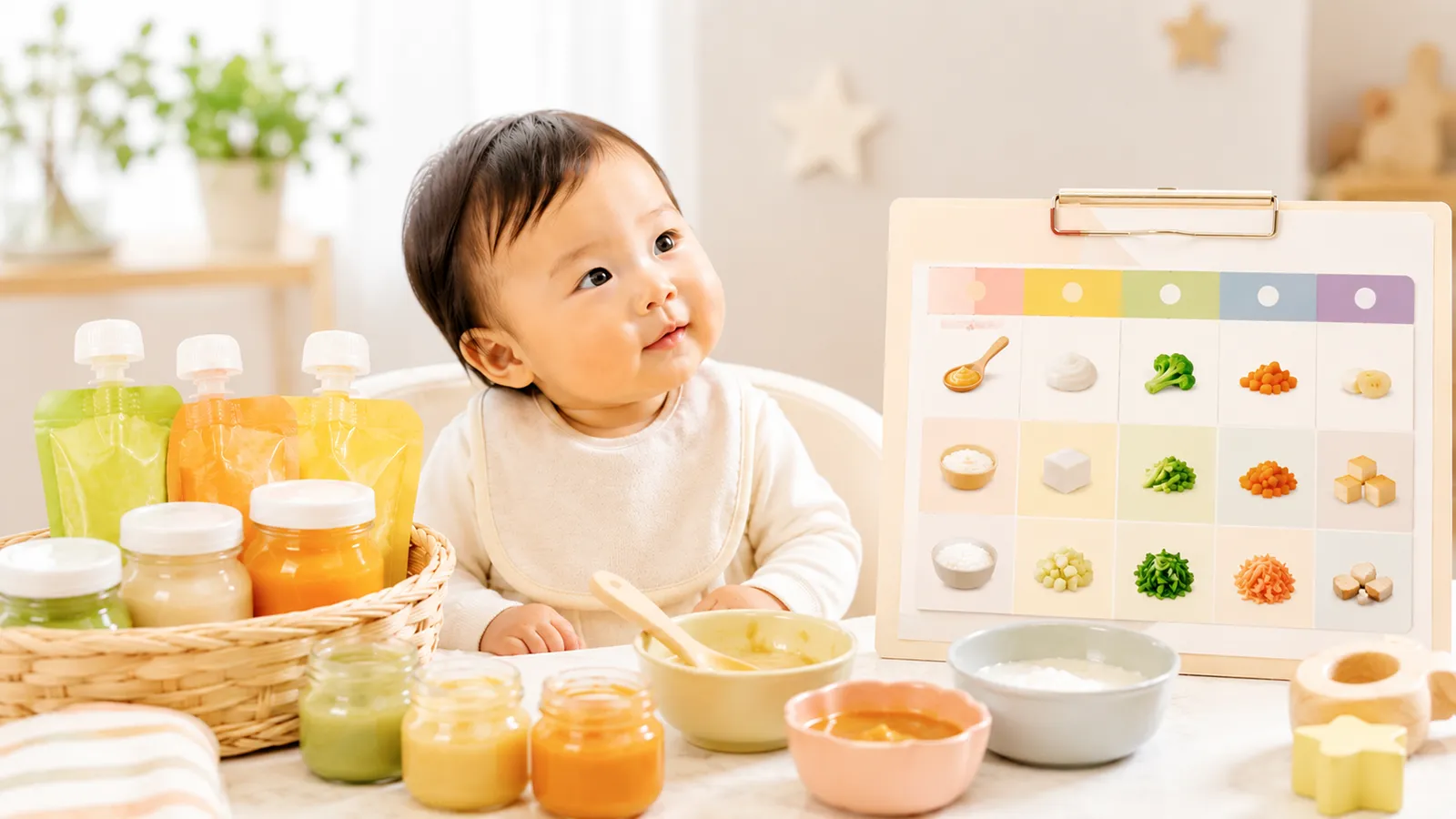
Kewpie’s baby food line is scheduled to end production at the end of August 2026. Since sales will wind down store by store as stock runs out, a more realistic response than panic-buying is to organize the details — your child’s age, eating stage, food texture, allergy labeling, and where you plan to use it — and then trial alternatives in small amounts.
Plenty of families have leaned on Kewpie’s baby food over the years. A trip away from home, an evening when daycare pickup ran late, a meal on a day when someone wasn’t feeling well — this is a product that has quietly carried families through a lot of “no time to spare” moments. In June 2025, Kewpie announced that it would end its baby and toddler food business, known in Japanese as ikuji-shoku. The discontinuation covers all 72 products, including the jarred items and the Niko Niko Box range. Production ends at the end of August 2026, and sales will wind down gradually depending on remaining stock.
“Is there anything that can replace it?” “How do I choose a product that fits my child’s age?” “Is it safe if my child has allergies?” — this article walks through those questions one by one.
(Reference:Notice of Discontinuation of Baby Food Production and Sales|Kewpie Corporation)
Table of Contents
When does Kewpie baby food end? Start by checking the official information
Production of Kewpie baby food ends at the end of August 2026. Sales, however, will vary by store and by product depending on stock levels. It is not the case that everything will vanish from shelves on August 31, 2026 — products still in stock may remain available for a while after that.
The announcement came on June 12, 2025. Kewpie has set roughly a one-year window between the announcement and the end of production, describing it as a way to keep the burden of a sudden supply stop to a minimum. This year is meant to be a period in which families can keep buying and look into alternatives at the same time.
What’s the difference between ending production and ending sales?
This is a point that confuses many people. “Ending production” means the maker stops producing the affected products. “Ending sales” means that, after that point, products will gradually disappear from stores and online once stock runs out.
In other words, even after the end of August 2026, you may still be able to buy these products in supermarkets or online while stock lasts. On the other hand, the more popular items may sell out sooner. Because the exact “how long can I buy this” date differs by product and store, checking with the maker or the retailer is the surest way to know.
How far does the discontinuation reach?
The product group is described as all 72 items, including the jarred products and the Niko Niko Box range. The entire baby food line is affected. For the precise scope of the products, please check Kewpie’s official announcement directly.
(Reference:Notice of Discontinuation of Baby Food Production and Sales|Kewpie Corporation)
Editor’s note
When I first read the announcement, what I felt wasn’t surprise so much as a quiet “ah, I see.” The official statement points to a tough market environment — sluggish sales volume for the line, and rising prices for raw materials and energy. Taking in the wider shifts around raising children and the infant-food market, this feels less like one company’s problem alone.
That said, speaking from a perspective close to the ground, this is more than a product simply going away. It means that one of the things that made you think “as long as I have this, we’ll be fine” when you reached for the shelf on a tired evening is now gone.
Before you stock up, what should you check first?
Before rushing to buy in bulk, it’s worth pausing. Baby food has a best-before date and needs storage space. More than anything, there’s a real risk that your child will decide “not this one” and refuse to eat it. To reduce misfires in your search for alternatives, we suggest first organizing the details of the product you currently use.
Make a note of what you like about your current product
The first thing to do when choosing an alternative is to put into words “what was good about the current product.” Rather than a vague “it has to be Kewpie,” this is the work of pinning down what exactly your child liked about it. Useful information to note down includes the following:
- Product name and recommended age
- Ingredients used (whether it’s a staple, a side dish, or a dessert)
- Texture and firmness (purée / finely chopped / with soft lumps, etc.)
- How easily your child eats it, and their preferences
- What the allergy labeling says
- Type of container (jar / pouch / cup, etc.)
- Whether it can be stored at room temperature
- Whether it’s easy to use on the go
Just having these notes makes it easier to compare when choosing an alternative.
Don’t buy in bulk right away — trial candidate alternatives in small amounts
Children’s food preferences vary a lot from one child to the next, and even with products aimed at the same age, “eats it or doesn’t” is something you can’t know without trying. Rather than buying a large supply and then finding “my child wouldn’t eat it,” it’s more realistic to trial one or two products in small amounts.
There’s the best-before date to consider too. Even if you’re stockpiling for emergencies, your child may not eat an unfamiliar product when a crisis hits either. For stockpiling, the “rolling stock” approach — keeping a slightly larger supply of products your child has actually eaten — works well.
A five-point checklist before choosing an alternative
Before you pick up an alternative, check the following.
- Does it match your child’s current age and food texture (purée, finely chopped, soft lumps, etc.)?
- Does it contain any first-time ingredients? (Introduce first-time ingredients one at a time.)
- Have you checked the allergy labeling? (The ingredient list, plus per-item and combined allergen labeling.)
- Where will you use it? (At home / on the go / daycare / emergency stockpile.)
- Is it close to the taste, shape, and firmness your child is used to?
The basics of choosing a replacement baby food
Choose a replacement baby food by checking not just the brand name but the recommended age, food texture, ingredients, allergy labeling, storage method, and where you’ll use it. Start by trialing small amounts, and switch over while watching how well your child eats it and whether it suits their preferences.
How do you choose a replacement baby food by age?
When choosing an alternative, thinking in terms of “finding something that matches the age and food texture” rather than “switching brands” opens up more options. Age labels are only a guide. Development varies from child to child, so it matters not to judge by the age number alone but to also check how your child is actually eating.
(Reference:Support Guide for Breastfeeding and Weaning (2019 revised edition)|Ministry of Health, Labour and Welfare)
Around 5–6 months|Check smoothness and first-time ingredients
The period when weaning (rinyushoku) is just beginning. Smoothly mashed purées are the mainstay. At this age, there are many ingredients your child is eating for the first time. When trialing a new product, start with something as close to a single ingredient as possible, and proceed while checking for any allergic reaction.
Wakodo, Pigeon, and others also sell age-appropriate freeze-dried, pouch, and strained (urakoshi) products. Because the formats and lineups carried vary by maker and by period, check each maker’s official site for the latest information.
For the types of ingredients and how to proceed, we recommend moving forward while checking with your regular pediatrician or your local government’s childcare consultation desk.
Around 7–8 months|Check lump size and ease of eating
The period when a firmness your child can mash with their tongue is the guide. Some texture starts to appear, and combinations of ingredients increase too.
When choosing an alternative, check that the lump size and firmness aren’t very different from what your child currently eats. A sudden switch to something firmer can lead to food refusal. We suggest trialing a small amount before switching over fully.
Around 9–11 months|Check the combination of staples and side dishes
The period when a firmness your child can mash with their gums is the guide. Many families start being mindful of the balance among staples, side dishes, and desserts.
This is also an age when outings and travel become more frequent. Pouch types are light and easy to use, but since you can’t keep an opened one as is, whether the portion per serving is right becomes a point to check.
From 12 months and toddler food|Check the strength of flavor and the amount
Once a child passes one year, they move on to toddler food. Sharing from the adults’ meals becomes possible in some cases, but there are still situations where you’ll want to use commercial toddler food.
When choosing toddler food, you need to watch the strength of the flavor. Processed foods aimed at adults can be too high in salt and sugar for infants and young children. Look for products labeled “toddler food” or “from 1 year” when choosing.
| Age guide | Food texture guide | What to look at | Labeling to check | Suited use |
|---|---|---|---|---|
| Around 5–6 months | Smooth purée | Close to a single ingredient? | Recommended age / ingredient list | At home |
| Around 7–8 months | Texture you can mash with the tongue | Lump size / combinations | Recommended age / allergy labeling | At home / on the go |
| Around 9–11 months | Firmness you can mash with the gums | Balance of staple + side dish | Net contents / storage method | On the go / for daycare discussions |
| From 12 months | Soft solids | Strength of flavor / amount | Toddler-food labeling / ingredient list | At home / on the go |
※Age labels are only a guide. Consult your regular pediatrician or a registered dietitian according to your child’s developmental stage.
How should you compare alternative brands?
To the question “what should I use instead of Kewpie,” there’s no single answer of “this brand is the best.” The product you should choose changes depending on your child’s age, whether they have allergies, and where you’ll use it. Rather than comparing brands, choosing along the axis of “is this easy to use in this situation” is more useful for actual day-to-day parenting.
Compare along “where you’ll use it” rather than “brand”
| Use | What to prioritize | Suited format | Points to check |
|---|---|---|---|
| At home | Age fit / nutritional balance / ease of eating | Jar / pouch / freeze-dried | Age / ingredients / amount |
| On the go | Easy to open / easy to feed | Pouch / cup | No spoon needed? / finish-in-one-go portion? |
| Bringing to daycare | Whether it fits the facility’s rules | Easy to bring unopened | Check with the facility in advance |
| Emergency stockpile | Room-temperature storage / best-before date / familiarity | Retort pouch / freeze-dried | Whether hot water or water is needed |
Check the main brands and where to buy at the time you read this
At present, the main baby food and toddler food makers other than Kewpie include Wakodo (Asahi Group Foods), Pigeon, Ezaki Glico, and Snow Brand Beanstalk. Each has age-based product lines, available in supermarkets, drugstores, online stores, and through co-ops. Product lineups can change over time. Please check each maker’s official site for the latest information.
- Reference:Baby Food Product Information|Wakodo (Asahi Group Foods)
- Reference:Baby Food Product Information|Pigeon Corporation
The Japan Baby Food Council has set voluntary standards for baby food, baby drinks, and baby snacks, including agreed rules on labeling for target age, how to use the product, and allergen information. Even when choosing products from member companies, in the end, check each product’s ingredient list, allergy labeling, and recommended age.
(Reference:Efforts Toward Safety and Reassurance: Baby Food Voluntary Standards|Japan Baby Food Council)
Where do you look on allergy labels and Japanese-language labels?
If your child has allergies, choosing an alternative needs one extra checking step. Each time you change products, the basic rule is to check the ingredients and allergy labeling from scratch.
For allergies, check the ingredient list and the allergy labeling
For processed foods in Japan, labeling based on food labeling standards is required for ingredients that carry a high risk of triggering food allergies. With the revision of the food labeling standards on April 1, 2026, the “specified raw materials” that must be labeled now number nine items. These are shrimp, cashew nuts, crab, walnuts, wheat, buckwheat (soba), egg, milk, and peanuts. (Note that this list differs from the allergen lists used in the EU or the US, so don’t assume it matches what you may be used to.)
In addition, 20 items are recommended for labeling as “items equivalent to specified raw materials”: almond, abalone, squid, salmon roe, orange, kiwifruit, beef, sesame, salmon, mackerel, soybean, chicken, banana, pistachio, pork, macadamia nut, peach, yam, apple, and gelatin. The allergy-labeling system is reviewed periodically. Check the Consumer Affairs Agency’s information for the latest details.
(Reference:Information on Food Allergy Labeling|Consumer Affairs Agency)
When checking a label, it’s important to check the ingredient list field and the allergy labeling shown either per item or in a combined list. Because the labeling method varies by product, with a product you’re buying for the first time or one that has been renewed, don’t rely on memory alone.
Don’t judge by an “allergy-conscious” label alone
There are cases where people see a label like “allergy-conscious” or “○○-free” and feel reassured, but caution is needed. For example, even if there’s a “○○-free” label, if products containing other allergens are made in the same factory, the risk of cross-contamination isn’t zero. In that case, there may be a precautionary statement such as “products containing ○○ are produced in this manufacturing facility.” This precautionary statement is voluntary on the maker’s part, not mandatory, so the absence of one doesn’t necessarily mean it’s safe.
If you’re worried about allergies, we recommend not only checking the label but also consulting your regular pediatrician or a registered dietitian before choosing a product.
Check first-time products and ingredients carefully
When you change products, the ingredients included change even for products meant for the same age. Check the ingredient list to see whether any “first-time ingredient” is included before trialing it. If allergy symptoms are suspected, or if you’re uneasy about a first-time ingredient, don’t decide on your own — consult a pediatrician, a registered dietitian, your local government’s childcare consultation desk, or similar.

How do you choose differently for outings, daycare, and emergencies?
The points to choose by change scene by scene, differing from use at home. For outings, prioritize ease of feeding; for daycare, check the facility’s rules; for emergencies, prioritize shelf life and familiarity.
For outings and travel, look at the container and ease of feeding
When you’re out, the assumption is that there are no cooking facilities. Check whether a separate spoon is needed, whether you need to transfer it to a plate, whether it can be carried at room temperature, and whether it’s a portion you can finish in one go right after opening.
Pouch types are light and easy to carry, and some can be fed straight from the pouch. Some cup types come with a spoon. When traveling, in addition to the number of meals you’re planning, having one or two servings in reserve to cover transit delays and spills gives peace of mind.
Whether you can bring it to daycare — check with the facility
Whether you can bring commercial baby food to a daycare (hoikuen) varies greatly depending on the facility’s policy, its meal-service setup, and local government guidelines. Don’t decide based on “other families use it, so it’s fine” — check in advance with the childcare staff or dietitian in charge. Even when bringing it is allowed, unopened products are often specified.
For emergencies, think in terms of rolling stock
When preparing baby food as an emergency stockpile, what matters is “stockpiling products your child is used to eating.” In a crisis, both the environment and meals differ from usual. In such situations, there are many children who won’t eat something with an unfamiliar taste or texture.
As an approach to stockpiling, “rolling stock” is practical. It’s a method of keeping a slightly larger supply of products you use regularly and replenishing what you’ve used. It also reduces the risk of items expiring. Products that store at room temperature, are easy to manage by best-before date, and are familiar to your child make good stockpile candidates.
For freeze-dried types that need hot water, you need to account for situations where water isn’t available in a disaster. Considering room-temperature, ready-to-eat products alongside them gives peace of mind.
(Reference:Food Stock Guide for Disaster Preparedness|Ministry of Agriculture, Forestry and Fisheries)
For international families|The bare minimum to look at on Japanese baby food labels
For international families raising children in Japan, baby food labels written only in Japanese can feel difficult.
Here we organize how to read the labeling you’ll want to check at minimum when choosing a product.
Age labeling|What “from around 〇 months” means
The “from around 5 months” or “from around 7 months” written on the package indicates a guide age.
It means the product is designed with the ease of eating and nutritional balance for a baby of that age in mind. In English it corresponds to “From around 5 months,” but it isn’t a guarantee that your child can definitely eat it once they reach that age. Check it against your child’s developmental stage.
Ingredient list|genzairyo-mei
The “ingredient list” (genzairyo-mei) field on the label is the list of foods used. They’re written in order from the largest amount used. A translation app can confirm things to some extent, but the translation accuracy for ingredient names and additive names can be uneven. If your child has allergies, don’t judge by translation alone — consider contacting the maker or consulting a professional.
Allergy labeling|allergen information
When an allergen is included, it’s written after the ingredient name in a form such as “(contains wheat)” or “(contains milk components)” (per-item labeling). Or there are cases where allergens are gathered together at the end of the ingredient field (combined labeling). If your child has allergies, judging by translation alone carries risk. When a judgment is difficult, we strongly recommend contacting your regular doctor or the maker’s customer service desk.
Frequently asked questions
- Q1. Until when can I buy Kewpie baby food?
- Production ends at the end of August 2026. The end of sales varies by product and store depending on stock levels. You can buy it while stock lasts, but check with each retailer for the specific end-of-sale timing.
(Reference:Notice of Discontinuation of Baby Food Production and Sales|Kewpie Corporation) - Q2. Should I stock up now?
- Rather than buying in bulk, it’s more realistic to note the features of the product you currently use and trial candidate alternatives in small amounts. Consider the best-before date, storage space, and your child’s food preferences too. If your goal is an emergency stockpile, rolling stock — keeping a slightly larger supply of products your child is used to — works well.
- Q3. Which brand should I choose for an alternative?
- More than the brand name, it’s important to choose by age, food texture, allergy labeling, and where you’ll use it. Products from companies that belong to the Japan Baby Food Council, such as Wakodo (Asahi Group Foods) and Pigeon, are labeled with target age, allergen information, and so on based on the voluntary standards. Check each maker’s official site for the latest lineup.
- Q4. If the age is the same, is any product fine?
- Age labels are only a guide. Check the type, shape, firmness, and amount of the ingredients, as well as how well your child is eating. We recommend trialing a first-time product starting with a small amount.
- Q5. What should I check if my child has allergies?
- Each time you change products, check the ingredient list and the allergy labeling. Don’t judge by an “allergy-conscious” or “○○-free” label alone — it’s important to also check precautionary statements (information about other products made in the same factory). If you have concerns, consult a professional such as a pediatrician or registered dietitian.
- Q6. Can I bring commercial baby food to daycare?
- It varies by facility, local government, and meal-service setup. If you’re considering bringing it, check in advance with the childcare staff or dietitian in charge.
- Q7. Is it okay to prepare baby food for emergencies?
- Products that store at room temperature, are easy to manage by best-before date, and are familiar to your child make good stockpile candidates. Manage them with rolling stock and check best-before dates regularly. Freeze-dried types need hot water, so it gives peace of mind to also consider ready-to-eat types.
- Q8. What should families who aren’t comfortable with Japanese look at?
- Prioritize checking the recommended age, ingredient list, allergy labeling, storage method, and best-before date. Translation apps can help, but if your child has allergies, don’t judge by translation alone — we recommend contacting the maker or consulting a doctor.
Summary
The end of Kewpie’s baby food marks a turning point in a 65-year history. For many families, it may carry meaning beyond a simple product change.
Still, there are options for alternatives. If you organize the age, food texture, allergies, and where you’ll use it, you can find something that suits your own family. Without rushing, trialing small amounts as you go, use this as time to build mealtimes with your child carefully.
Using commercial baby food is not cutting corners. It’s a choice parents make to protect their time with their children, and a practical way to keep meals manageable on difficult days. There’s no need to feel any guilt about that at all.
If there’s anything you’re unsure about or any decision you’re hesitating over, we recommend consulting your regular pediatrician, your local government’s childcare consultation desk, or a registered dietitian.
*The information in this article is current as of the time of publication. Product lineups and the allergy-labeling system are subject to change. Please check each maker’s official site and the Consumer Affairs Agency’s information for the latest details.
