
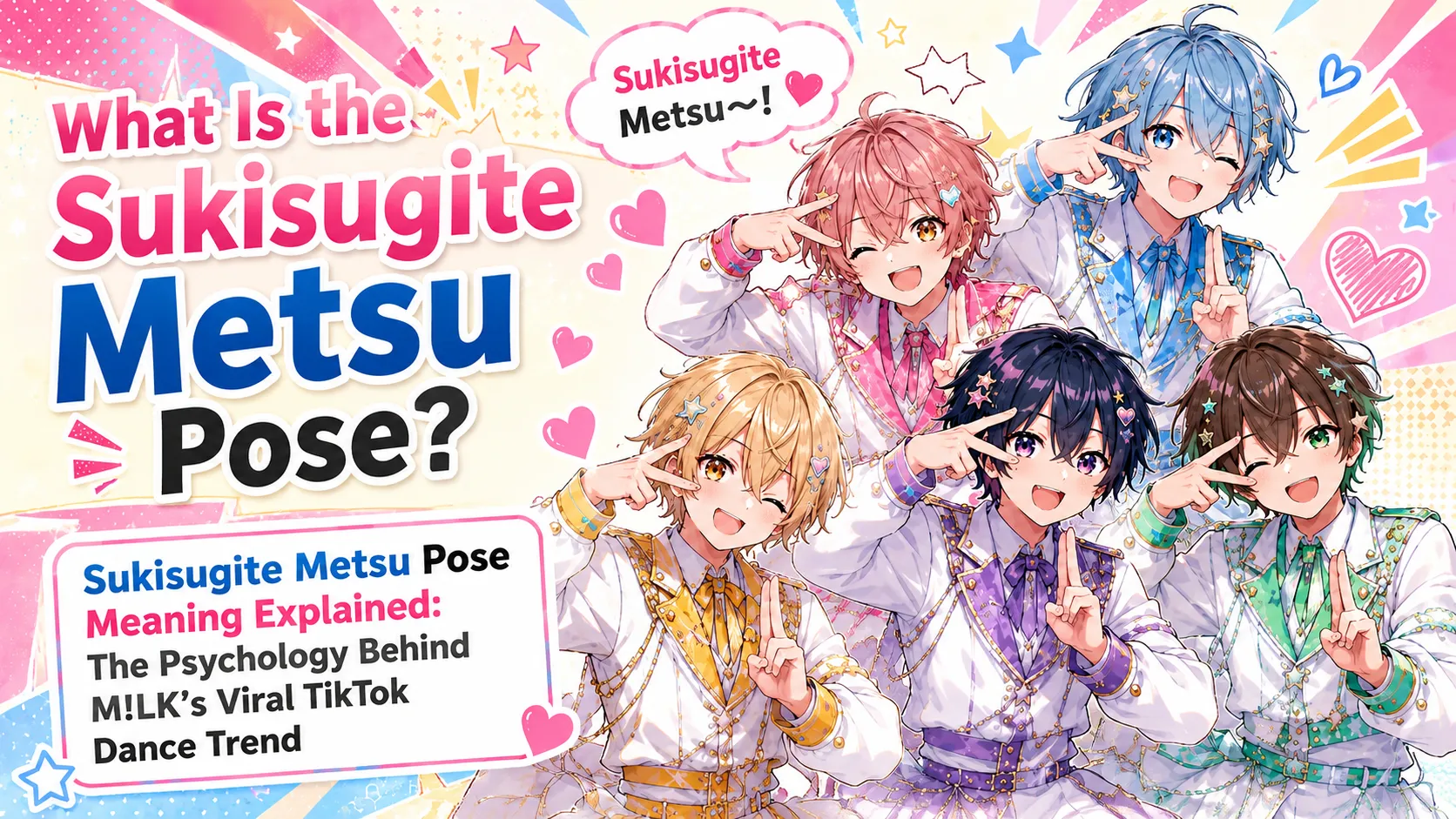
From a socio-psychological perspective, the “Sukisugite Metsu” (perishing from overwhelming love) pose is a fascinating case study in adolescent non-verbal communication and the psychology of modern “stan” (Oshi) culture. Originating from the Japanese dance vocal group M!LK, this viral TikTok trend involves forming a heart shape before dramatically collapsing or covering one’s face. While it appears as a simple, comical gesture, psychologists note that such exaggerated physical expressions serve a vital function in youth social bonding and identity formation. By visualizing the abstract feeling of being overwhelmed by affection, adolescents are able to safely navigate and share intense emotions—a phenomenon closely related to “cute aggression” and parasocial love. This guide explores the behavioral meaning, origins, and psychological significance of the Sukisugite Metsu pose, offering practical insights into how digital-native generations use viral choreography to foster empathy and interpersonal connection.
The “Sukisugite Metsu” pose is a striking piece of choreography from M!LK’s song Sukisugite Metsu! (“I Love You So Much I’m Perishing!”). It spread rapidly across social media platforms, capturing the imagination of young audiences worldwide. The pose depicts someone so overwhelmed by love that they physically “collapse”—a relatable, playful exaggeration of intense affection. Its accessibility and inherently emotional quality are precisely why it went viral. This article explains the Sukisugite Metsu pose meaning, its origins, how to perform it, and why it resonates so deeply as a form of emotional expression in youth culture.
Table of Contents
What Is the Sukisugite Metsu Pose? Origins, Background, and Basic Facts
The Sukisugite Metsu pose originated from the song Sukisugite Metsu! by the five-member Japanese dance vocal group M!LK. The pose captures the feeling of loving someone so intensely that your very existence feels like it might dissolve—a sentiment that has become deeply resonant within Japanese stan culture psychology and beyond. Playfully exaggerated yet emotionally sincere, it has become a defining gesture in youth social media culture, used in photos and short videos as a shared expression of overwhelming affection.
Why “Sukisugite Metsu!” Perfectly Captures the Psychology of Overwhelming Love
The song Sukisugite Metsu! was released as a digital single to mark M!LK’s 10th anniversary, functioning as a pure love anthem for the group’s milestone year. The word “metsu” (滅) carries the meaning of “to perish” or “to be extinguished,” and within the song’s lyrical world, it conveys an explosive emotion: “I love you so much, I feel like I might cease to exist.” This concept maps closely onto what developmental psychologists call emotional overwhelm in parasocial relationships—a well-documented experience among adolescents who form deep attachments to artists or public figures.
The song blends M!LK’s signature funky, upbeat pop production with lyrics about love so intense it becomes almost unbearable—yet the mood remains joyful and affirming. This tonal balance between “too much” and “fun” is part of what makes it so effective as a vehicle for adolescent nonverbal communication. Listeners immediately recognized the feeling, and the song’s broad cultural resonance ignited a major social media trend.
How the Song Became a Viral Trend: Release Timeline and the Spark That Started It
@noa.s1126 好きすぎて滅!!!!! ♬ 好きすぎて滅! – M!LK
The track was first released as a digital single on October 27, 2025, and later packaged in a double A-side physical single, Bakuretsu Aishiteru / Sukisugite Metsu!, on February 18, 2026. Before the official drop, a preview of the audio was seeded on TikTok through M!LK’s official account and individual member posts, immediately generating organic momentum.
Videos of fans performing the signature choreography—especially the dramatic “metsu” collapse—spread at extraordinary speed. Influencers and celebrities joined with their own “dance challenge” videos, and by late 2025 through early 2026, the track had claimed the No. 1 spot on TikTok’s music chart for three consecutive weeks, with over 100,000 user-generated posts. The M!LK TikTok dance trend had officially become a defining cultural moment for Japan’s digital-native generation.
Where the Name Comes From: How Choreography Became a Cultural Gesture
The name “Sukisugite Metsu pose” derives directly from the song’s most memorable lyric: “Maji gyun gyun gyun, sukisugite metsu!” (“Seriously, my heart is pounding, pounding, pounding—I love you so much I’m perishing!”). The choreography at this climactic moment involves forming a heart shape, then dramatically covering one’s face or crumpling forward as if physically undone by affection.
This sequence—heart gesture followed by comedic emotional collapse—is what became known as the Sukisugite Metsu pose. It is now widely used in photo booth sessions, social media posts, and live concert settings as a spontaneous, relatable way to express intense love or admiration. Its meaning transcends the song itself, functioning as a versatile emotional shorthand in youth communication.
The Psychology Behind the Sukisugite Metsu Pose: What It Really Means
The Sukisugite Metsu pose is more than a dance move—it is a psychologically meaningful form of adolescent nonverbal communication that encapsulates the experience of emotional overwhelm. Unlike earlier hand-heart gestures, which communicate “I send you love,” this pose communicates something more nuanced: “Your existence is so powerful that I am being destroyed by it.” Understanding this distinction is key to grasping why the pose resonated so deeply across youth culture.
Cute Aggression, Emotional Overwhelm, and Why Exaggeration Helps Adolescents Process Intense Feelings
The core of the Sukisugite Metsu pose lies in its use of the concept of “metsu”—perishing or being extinguished. In the context of modern Japanese stan culture psychology, “metsu” echoes the popular phrase “tōtokute shinu” (dying from something being too precious), which is itself a playful expression of “cute aggression.” Cute aggression—the urge to squeeze or mock-harm something overwhelmingly adorable—is a well-documented psychological phenomenon. Researchers suggest it serves as a regulatory mechanism: when positive emotions become too intense to process cognitively, the body seeks a physical outlet.
The Sukisugite Metsu pose offers exactly that outlet. By physically dramatizing the collapse brought on by overwhelming affection, adolescents externalize an internal emotional state that would otherwise be difficult to articulate. The comedy of the gesture—the exaggerated “I can’t go on”—makes intense feelings socially safe to express. Rather than suppressing or trivializing emotion, the pose gives it a performable shape. This is why psychologists who study emotional expression in youth see such viral gestures as genuinely valuable tools in adolescent development.
Social Bonding Through Shared Gestures: Why This Pose Works for Fans, Couples, and Friends
@niziu_official 滅ッッッ❤️🔥 #MAYA #MIIHI #NiziU #WithU #Mステ ♬ 好きすぎて滅! – M!LK
A key reason the Sukisugite Metsu pose spread so far beyond M!LK’s existing fanbase is its remarkable versatility as a tool for social bonding through shared gestures. In fandom contexts, it offers fans a physical vocabulary for expressing the intense emotions of “oshi” (stan) culture—standing in front of merchandise, at a concert venue, or beside a poster of a beloved artist. For couples, it functions as a playful, affectionate way to say “you overwhelm me.” Among friends, it operates as a full-body reaction to something adorable or impressive.
Crucially, the pose is most naturally performed in the company of others. Its comedic, reactive quality makes it ideal for group photos and collaborative short videos, which lowers the psychological barrier to participation and encourages repeated, communal use. In developmental psychology, this kind of shared physical ritual strengthens group identity and empathy—a process that is especially significant during adolescence, when peer belonging is a central developmental need.
The Emotional Language of the Pose: Embodying Overwhelm, Bashfulness, and Joyful Surrender
What separates the Sukisugite Metsu pose from simpler gestures is that it communicates a whole emotional sequence, not just a single feeling. The gesture begins with warmth—the heart—and transitions into bashfulness, overwhelm, and finally a kind of joyful surrender. This arc mirrors the internal experience of parasocial love and intense admiration that many adolescents feel but struggle to verbalize.
The physical elements reinforce this emotional narrative: slightly bent knees suggest the body giving way; hands covering the face suggest an inability to look directly at the source of affection; and the overall posture—slightly turned, weight falling backward—suggests being overcome. In social media video formats, creators often amplify this by using slow motion or soft-focus effects at the moment of “collapse,” heightening the dramatic and emotional impact. The humanity of the gesture—its visible vulnerability—is precisely what makes it endearing and widely shareable.
How the Sukisugite Metsu Pose Spread Across Social Media
The viral trajectory of the Sukisugite Metsu pose offers a clear illustration of how digital-native youth use choreography and gesture to build community and shared identity online. What began as promotional choreography for a J-pop single evolved into an independently circulating internet gesture with its own cultural life. Understanding this spread reveals a great deal about the psychology of viral youth trends in the short-video era.
From Dance Challenge to Everyday Pose: How TikTok Transformed a Choreography into a Cultural Symbol
On TikTok and Instagram Reels, the Sukisugite Metsu pose gained traction primarily through “dance cover” videos, where creators performed the song’s choreography and punctuated it with the dramatic final pose. The pose became a recognizable flourish—a shared punchline that viewers instantly understood and wanted to replicate.
Beyond full dance covers, the pose migrated into “camera roll” video formats—popular short-video styles where the screen cuts between different scenes or expressions in time with the music, often ending with the Sukisugite Metsu as a climactic finale. Critically, the pose can be performed seated, using only the upper body, which makes it accessible to virtually anyone regardless of dance ability. This low barrier to entry was instrumental in driving the explosive growth in participation and view counts that characterised the M!LK TikTok dance trend.
How Fans Use the Pose in Oshi Culture and Relationship Content
The Sukisugite Metsu pose proved especially well-suited to two of social media’s most popular content categories: fan (oshi) culture posts and relationship content. In fan contexts, creators typically stage the pose against a backdrop of merchandise collections, live concert venues, or fan-made shrines—communicating the experience of being overwhelmed by devotion to an artist or fictional character. This is a direct expression of Japanese stan culture psychology: the act of collapsing from adoration externalizes an inner emotional state that fans deeply recognize and validate in one another.
In relationship and friendship content, the pose functions as a visual expression of “I can’t handle how much I love you”—conveying depth of feeling with humor and warmth. Rather than simply showing affection, the pose dramatizes being conquered by it, which communicates a more profound level of emotional investment. This nuanced quality resonated strongly with younger audiences, for whom authenticity and emotional depth in self-expression are high social values.
Hashtag Communities and Fan-Driven Campaigns: How Shared Gestures Build Long-Term Connection
The hashtag ecosystem surrounding the pose—particularly #sukisugitemetsu and #metsupose—became community hubs where fans shared their best takes and discovered others’. Official accounts and M!LK members engaging directly with fan content created a positive feedback loop that sustained the trend’s momentum well beyond typical viral timelines.
Fan communities also organized their own campaigns tied to concert dates and anniversaries, collectively posting Sukisugite Metsu photos as a shared ritual of celebration. This kind of coordinated behavior illustrates how a single gesture can function as a “social glue”—fostering a sense of belonging and collective identity that transcends any one platform or moment. From the perspective of social bonding through shared gestures, the Sukisugite Metsu pose is a textbook example of how digital communities sustain emotional cohesion through participatory ritual.
How to Do the Sukisugite Metsu Pose: Step-by-Step Guide for Photos and Videos
While the Sukisugite Metsu pose looks instinctive once you know it, getting the nuances right—particularly the emotional quality of the gesture—takes a little practice. The goal is not simply to strike a pose, but to embody the feeling of being lovably overwhelmed. Here is a practical, step-by-step guide to performing the pose effectively for both photos and short videos.
Step 1: Hand Position and Placement Around the Face
Begin by forming a heart shape at chest level. You can use the classic finger heart (crossing thumbs and index fingers) or a larger two-handed heart—choose whichever feels natural. Then, on the “metsu” beat, move your hands toward your face. Options include covering one side of the face with a single hand, or cupping both palms against your cheeks as though holding your own face together under pressure.
Positioning the hands close to the face naturally creates a flattering, face-framing effect—a practical bonus. Angling your palms slightly inward, as if cradling your face gently, adds a sense of tenderness that photographs beautifully and reinforces the “overwhelmed by something precious” emotional register central to the pose’s meaning.
Step 2: Facial Expression—The Most Important Element
Of all the components of the Sukisugite Metsu pose, facial expression carries the most psychological and visual weight. The goal is to convey a conflict between joy and emotional overload. The most effective expression involves softening the eyes—lowering the outer corners slightly—while gently furrowing the brows, creating a “happy but helpless” quality. This is the visual signature of cute aggression: delight so intense it looks almost painful.
Alternatives include squeezing the eyes shut with a melting, blissful smile, or half-hiding the mouth behind one hand while letting a shy smile escape. For video content, transitioning from a neutral or composed expression into a sudden “emotional collapse” creates a compelling before-and-after dynamic that emphasizes the moment the feeling becomes overwhelming—making it ideal for short-form video editing.
Step 3: Body Angle and Posture Tips for the Most Flattering Result
The key to a visually compelling Sukisugite Metsu pose is avoiding a flat, upright stance. Turn your body approximately 30–45 degrees away from the camera, shift your weight slightly backward, and allow your knees to soften inward—as if your body is beginning to yield under the weight of the emotion. This creates the “on the verge of collapse” silhouette that makes the pose so instantly recognizable.
Position the camera slightly above eye level and angle your gaze upward for a naturally appealing result. Beginners should practice the full sequence—heart formation, hand-to-face movement, and body softening—in front of a mirror before photographing. For still images, the ideal shutter moment is just before the hands fully cover the face, capturing the gesture mid-motion for natural dynamism. For video editing, a warm, slightly saturated color grade complements the song’s cheerful, pop-bright aesthetic.
The Sukisugite Metsu Pose in M!LK’s Music Video and Live Performances
To fully appreciate the Sukisugite Metsu pose, it is worth studying it in its original context—M!LK’s performances. The music video and live concert settings reveal how professional performers translate emotional expression in youth into choreographic art, and offer a masterclass in how a gesture can carry different shades of personality and meaning depending on the performer.
Key Moments in the Music Video Where the Pose Appears
@milk_official マジぎゅんぎゅんぎゅん好きすぎて滅❣️ #山中柔太朗 #MILK #好きすぎて滅 ♬ 好きすぎて滅! – M!LK
The music video’s most visually arresting moments occur at the chorus, when all five members execute the Sukisugite Metsu pose in unison against the MV’s colorful, fantastical set design. The synchronized delivery of the “Maji gyun gyun gyun, sukisugite metsu!” sequence creates a powerful visual impact—simultaneously comedic and emotionally genuine—that encapsulates everything the pose is meant to communicate.
The close-up solo shots of each member performing the pose are especially instructive for fans who want to replicate it. These segments allow viewers to observe each member’s individual approach: the precise moment the hands move toward the face, the direction of the gaze, and the subtle gradations of expression. Many fans report watching these sections repeatedly, studying the micro-details as a way of deepening their connection to their favorite member—a behavior that reflects the intimacy-building function of shared choreographic rituals in adolescent parasocial relationships.
Individual Expression: How Each Member Personalizes the Pose
One of the most fascinating dimensions of the Sukisugite Metsu pose—from both a performance and psychological standpoint—is how clearly each member’s personality emerges through what is ostensibly the same gesture. Leader Yoshida Masato delivers a high-energy, full-smile version bursting with exuberant happiness; Yamanaka Jutaro offers a softer, slightly languid quality that reads as quietly romantic. Shiozaki Taichi’s version is physically dynamic and comedically broad; Sono Shunta’s reads as genuinely bashful and warmly human.
This individual variation is not incidental—it is central to the pose’s appeal within Japanese stan culture psychology. Fans analyze and debate whose version of the pose best captures a particular emotional nuance, and this interpretive activity itself deepens fan engagement and community discourse. The fact that a single choreographic gesture can support such a range of individual expression speaks to its richness as a vehicle for adolescent nonverbal communication.
The Pose as Live Concert Ritual: Collective Emotional Expression at Scale
In a live concert setting, the Sukisugite Metsu pose transforms from a social media gesture into a large-scale ritual of collective emotional expression. At the song’s chorus, audience members set down their light sticks and perform the pose in unison with the members onstage—a spontaneous call-and-response that generates a powerful sense of shared identity and belonging. Accounts of M!LK’s 10th anniversary concerts describe the moment as profoundly moving: an entire venue full of people simultaneously enacting the same gesture of joyful emotional surrender.
This kind of synchronized physical participation is well understood in the psychology of crowds and live performance as a mechanism for producing “collective effervescence”—a term coined by sociologist Émile Durkheim to describe the heightened sense of connection and transcendence that arises when individuals move or act in unison. The Sukisugite Metsu pose, in this context, is far more than a trend. It is a communal language—a physical affirmation that loving something deeply, and being undone by that love, is something to celebrate together.
Conclusion: Why the Sukisugite Metsu Pose Matters Beyond the Trend
The Sukisugite Metsu pose, born from M!LK’s joyful pop anthem, is a culturally and psychologically significant phenomenon in contemporary youth expression. By giving a performable, shareable shape to the experience of being overwhelmed by love or admiration, it has become far more than a viral dance challenge. It represents a new chapter in the evolving vocabulary of adolescent nonverbal communication—one in which vulnerability, humor, and intensity coexist as equally valued emotional registers.
Its endurance beyond a single trend cycle reflects something deeper: a generational shift in how young people choose to express and celebrate their emotional lives. Rather than performing composure, the Sukisugite Metsu pose invites its participants to perform the beautiful, relatable loss of it. In doing so, it offers a genuinely positive model of emotional expression in youth—one that affirms the value of feeling deeply, sharing honestly, and finding community in the experience of being, joyfully, overwhelmed by love.
