
Japan’s babysitting market was estimated at approximately ¥32 billion nationwide in 2020, with projections of ¥64.7 billion by 2025 and ¥100 billion by 2030. These figures are based on market forecasts derived from Poppins Holdings IR materials, not from official government statistics.
Separately, Yano Research Institute has reported Japan’s broader baby-related business market at ¥4.657 trillion for 2025. This figure covers a wide range of sectors — baby products, food, clothing, toys, licensed daycare centers (hoikuen), babysitter services, and more — and should not be read as equivalent to the babysitter-only market.
(Source: Q. Babysitter market projected at ¥100 billion — what’s the growth potential for Poppins, the sector’s only listed company? | Notes on Reading Financial Statements)
(Source: Baby-Related Business Market Survey (2026) | Yano Research Institute)
This article organizes what Japan’s babysitting sector looks like today — market size, industry trends, policy frameworks, subsidy programs, and safety considerations — for childcare service providers, educational businesses, and family support organizations considering this field.
Table of Contents
Is Japan’s Babysitter Market Actually Growing?
Japan’s babysitting sector has meaningful room to grow, supported by rising dual-income households and demand for flexible childcare that licensed daycare alone cannot cover.
When thinking about babysitter demand in Japan, it’s worth noting that “a substitute for hoikuen” doesn’t capture the full picture. Licensed daycare centers (hoikuen) form the backbone of everyday childcare for many families — but the daily reality of parenting doesn’t stop there.
Consider sudden overtime at work, school pick-up and drop-off, a parent coming down with illness, managing younger siblings during an older child’s event, postpartum exhaustion, or a child who isn’t yet enrolled in daycare and needs a few hours of supervision. Families have needs that consistently fall outside what the formal system covers. If Japan’s babysitting sector is going to grow, the question is how well — and how safely — providers can address those in-between moments.
Market Projections Forecast ¥100 Billion in Total Market Size by 2030
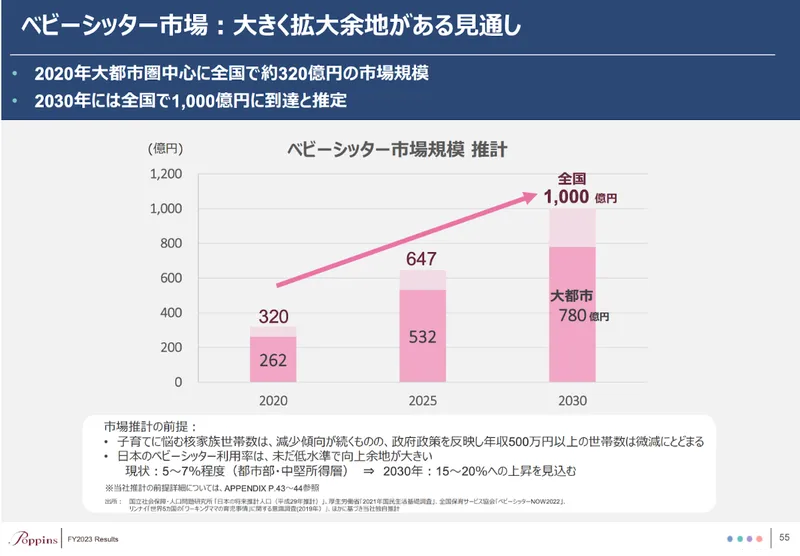
There is no single, official government statistic that tracks Japan’s babysitting market on its own. Based on projections derived from Poppins Holdings IR materials, the market stood at approximately ¥32 billion nationwide in 2020, with forecasts of ¥64.7 billion by 2025 and ¥100 billion by 2030.
The same projections break down urban figures separately: approximately ¥26.2 billion in major metropolitan areas in 2020, rising to an estimated ¥53.2 billion by 2025 and ¥78 billion by 2030. This suggests that demand in urban areas — particularly in major cities — represents the largest share of anticipated growth.
These figures are from a listed company’s investor relations materials, not from government statistics. If you plan to use them in a business plan or investment proposal, confirm the assumptions behind the projection, how “major metropolitan areas” is defined, the scope of services included, and the year the estimate was produced before citing them.
The Takeaway: Demand Is Growing, but Not Uniformly
Dual-income households have become the norm in Japan. According to data from the Japan Institute for Labour Policy and Training (JILPT), dual-income households reached 13 million in 2024 — an increase of 220,000 from the previous year. The number of households where both spouses work 35 hours or more per week reached 4.96 million, up by 1.04 million from a decade earlier in 2014.
(Source: Status of Dual-Income Households | Japan Institute for Labour Policy and Training (JILPT))
The normalization of dual-income households is a clear structural driver of demand for childcare services overall. But it doesn’t automatically translate into babysitting market growth. Families combine multiple options: licensed hoikuen, yochien (kindergartens for ages 3–5), nintei kodomoen (certified early childhood centers integrating daycare and kindergarten functions), spot care at registered facilities, family support networks, help from grandparents, and remote work arrangements.
Within that mix, babysitters tend to be well-suited to the following situations:
| Type of Demand | Typical Situations | Why Babysitters Are Well-Suited |
|---|---|---|
| Sudden short-term care | Unexpected work demands, medical appointments, family events, parent illness | Highly adaptable to each family’s specific circumstances |
| Pick-up, drop-off, and short-session support | Daycare or activity pick-up and drop-off, a few hours of supervision | Flexible on an hourly basis |
| Postpartum and infant-stage support | Postpartum rest, managing older siblings, assistance when going out | Directly reduces the burden within the home |
| Corporate employee benefit demand | Supporting employee work-childcare balance | Easily integrated into employer retention strategies |
| Demand linked to municipal subsidy programs | Temporary care, co-care arrangements, addressing childcare waitlists | Lowers both the psychological and financial barriers to access |
The relevant question for providers isn’t only “will this sector grow overall?” — it’s “which families, in which time slots, facing which particular needs, can we serve safely and well?”
Three Questions to Ask Before Looking at Market Size
When evaluating Japan’s babysitting sector, at minimum these three dimensions need to be assessed separately:
- Demand: Are there genuine, recurring gaps in family life — dual-income scheduling conflicts, postpartum recovery needs, sudden childcare emergencies, early-morning or late-night requirements, pick-up and drop-off gaps — that existing services don’t adequately cover?
- Policy frameworks: Are there programs that meaningfully support access — municipal babysitter support programs, the corporate babysitter voucher program (企業主導型ベビーシッター利用者支援事業), the Universal Early Childhood Access Program (Dare Demo Tsuen), and related initiatives?
- Safety infrastructure: Is there a complete operational foundation — staff recruitment standards, training programs, identity verification, emergency procedures, parent communication protocols, insurance coverage, and incident response policies?
As editor-in-chief, this third point is the one I want to emphasize most. In childcare market analysis, it’s easy to lead with phrases like “there’s clear demand,” “subsidies are available,” and “there’s room to enter.” But for a parent, this isn’t a market question — it’s a question of who they can trust with their child. Before market viability, what needs to be designed is trustworthiness.
Why Do Babysitter Market Size Figures Differ Depending on the Source?
The differences come from whether you’re looking at babysitting alone, the broader childcare services market, or the entire baby-related economy.
Search “Japan babysitter market size” and you’ll find a wide range of figures and research reports. Comparing them without checking what each actually covers is a reliable way to reach the wrong conclusions.
The projections derived from Poppins Holdings IR materials put the babysitter market at approximately ¥32 billion in 2020, with forecasts of ¥64.7 billion by 2025 and ¥100 billion by 2030. Yano Research Institute’s figure for Japan’s baby-related business market in 2025 is ¥4.657 trillion.
Both figures are useful for understanding different slices of the childcare and baby economy — but they are measuring entirely different things. The first is a growth forecast for the babysitter-specific market. The second is the total scale of Japan’s baby-related economy, which includes baby goods, food, clothing, daycare, babysitting, and more.
The Babysitter Market and the Baby-Related Market Are Not the Same Thing
For the babysitter-only market, projections derived from Poppins Holdings IR materials indicate approximately ¥32 billion nationwide in 2020, rising to a forecast of ¥64.7 billion by 2025 and ¥100 billion by 2030. For major metropolitan areas specifically, the corresponding figures are ¥26.2 billion in 2020, ¥53.2 billion by 2025, and ¥78 billion by 2030.
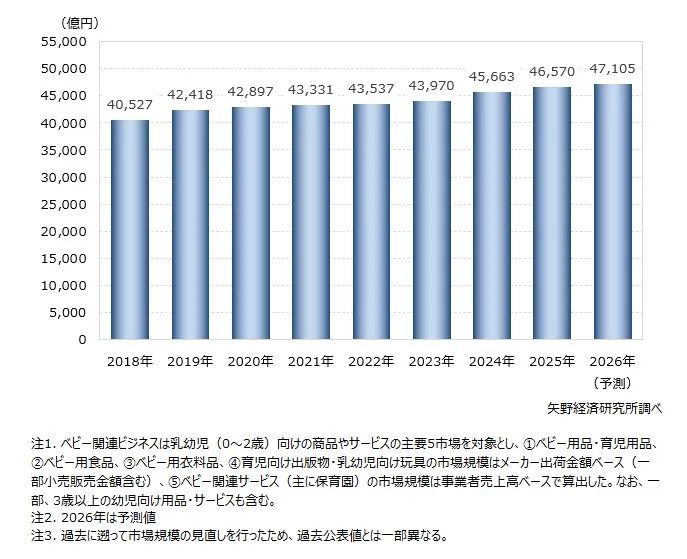
In May 2026, Yano Research Institute published a survey on Japan’s baby-related business market, reporting the 2025 total at ¥4.657 trillion — a 2.0% increase from the prior year. This is the scale of the entire baby-related business sector, not the babysitter market alone.
(Source: Baby-Related Business Market Survey (2026) | Yano Research Institute)
Yano Research Institute’s “2025 Baby-Related Market Marketing Yearbook” lists its scope as including baby and childcare products, food, clothing, publications and toys, and related services — with related services defined to include hoikuen (licensed daycare), babysitter services, and maternity classes, among others.
(Source: 2025 Baby-Related Market Marketing Yearbook | Yano Research Institute)
In other words, the fact that the baby-related market is large does not mean that babysitting as a specific service is growing at the same scale or pace.
This is an important point for anyone building a business case in this space. A large headline market figure looks compelling in an investment proposal or internal pitch. But using it without verifying scope leads to plans built on the wrong foundation.
Market Size Figures by Source: A Comparison
When reviewing any market size figure, what matters is not the number itself but what that number includes.
| Source / Data Origin | Market Size / Key Figures | Scope | How to Use It | Caution |
|---|---|---|---|---|
| Market forecast based on Poppins Holdings IR materials | 2020: approx. ¥32B; 2025 est.: ¥64.7B; 2030 est.: ¥100B | Babysitter market | Reference for babysitter-specific market growth trajectory | Treat as an IR-based projection, not an official government statistic |
| Urban metro segment of the same forecast | 2020: ¥26.2B; 2025 est.: ¥53.2B; 2030 est.: ¥78B | Major urban babysitter market | Gauge the scale of metropolitan demand | Verify how “major urban areas” is defined in the source and what assumptions underlie the projection |
| Yano Research Institute: Baby-Related Business Market | 2025: ¥4.657 trillion | Broad market including baby goods, food, clothing, toys, hoikuen, babysitting, and more | Reference for the overall scale of Japan’s baby economy | Not a babysitter-only figure; do not compare directly to babysitter market projections |
| Children and Families Agency: Work and Childcare Reconciliation Program | Policy information, not market size data | Corporate-led childcare programs and corporate babysitter support programs | Reference for employer benefits and work-family balance demand | Confirm current-year program terms; details may change annually |
| Babysitter Voucher Portal | Standard FY2026 voucher: ¥2,300 per ticket | Vouchers under the corporate babysitter voucher program | Track employer-route demand drivers | Discount amounts and operating rules vary by fiscal year |
| JILPT dual-income household data | 13 million dual-income households in 2024 | Employment structure among married-couple households | Background data for understanding demand context | Does not reflect actual babysitter usage rates |
Among the above, the ¥32 billion, ¥64.7 billion, and ¥100 billion figures for the babysitter market are projections presented in reference to Poppins Holdings IR materials. The ¥4.657 trillion figure from Yano Research Institute covers the entire baby-related business sector and should not be read as equivalent to babysitter market size.
What to Check When Reading Market Size Figures
When evaluating babysitter market size data, confirm at least these four points:
- Scope: Does the figure cover babysitting only, or does it include licensed daycare centers, baby products, and other services?
- Year: Policy changes and subsidy revisions can affect market dynamics; don’t use outdated figures without checking for updates.
- Source type: Government statistics, industry associations, private research firms, and company disclosures have different purposes, methodologies, and definitions.
- Parent-side reality: Even if a market is large in aggregate, uptake won’t grow if parents find the service too expensive, opaque, or difficult to access.
At TamagoDaruma, when we look at the babysitting sector, we always ask not just how large it is — but whether the conditions for parents to use it safely and confidently are actually in place.
What Policy Drivers Are Fueling Demand?
Demand in Japan’s babysitting sector is being shaped by rising dual-income households, the Dare Demo Tsuen program, and growing corporate and municipal support that makes access more realistic for families.
Policy matters enormously in this sector, because babysitter services tend to be expensive for families paying entirely out of pocket. Subsidies and voucher programs can meaningfully lower the threshold for first-time or occasional use.
That said, programs change from year to year and vary by municipality. Always check current official sources for eligibility, age limits, usage caps, application procedures, and which providers are approved under each program before proceeding.
Rising Dual-Income Households and Diversifying Childcare Needs
The growth in dual-income households is the structural foundation of babysitter demand. According to JILPT data, dual-income households in Japan reached 13 million in 2024, up from the previous year.
(Source: Status of Dual-Income Households | Japan Institute for Labour Policy and Training (JILPT))
Even families whose children are enrolled in hoikuen can find that daycare doesn’t cover everything. Early-morning drop-off before the center opens, late pick-up after closing time, business trips, sudden meetings, hospital visits, a parent’s own illness — each family has its own version of the “childcare gap.”
That gap is where babysitter demand lives.
But it’s worth resisting the impulse to treat dual-income families as a single bloc. Full-time employees, part-time workers, remote workers, shift workers, self-employed parents, single-parent households, and families with or without grandparent support all have very different needs.
The relevant question for providers isn’t “there are more dual-income households, so demand exists” — it’s “which type of working family is currently underserved, in which time slots, and in what specific situations?”
Is the Universal Early Childhood Access Program a Competitor or a Complement?
Japan’s Children and Families Agency (CFA) describes the Universal Early Childhood Access Program — known as Dare Demo Tsuen (こども誰でも通園制度) — as a program that allows children aged six months to under three years who are not yet enrolled in licensed childcare to use hoikuen and similar facilities for up to a set number of hours per month.
(Source: Universal Early Childhood Access Program (Dare Demo Tsuen) | Children and Families Agency)
For Japan’s babysitting sector, this program can function as either a competitor or a complement — depending on the family and the situation.
There is competitive overlap in the short-session care space. If families can use a nearby hoikuen for a few hours a month under this program, some may opt for that over hiring a babysitter.
At the same time, the Dare Demo Tsuen program is center-based. In-home supervision, pick-up and drop-off, early-morning or late-night care, sibling management, and personalized support when a parent is away or unwell are all areas where babysitters remain a better fit.
As editor-in-chief, I’d rather frame this as “families now have more options” than as a zero-sum competition. For parents, the label on the program doesn’t matter — what matters is whether there’s something usable on the day they actually need it.

Corporate and Municipal Subsidies Make Babysitter Services More Accessible
Japan’s Children and Families Agency (CFA) outlines a set of work-childcare reconciliation programs under its policy portfolio, including a corporate-led childcare program (企業主導型保育事業), a corporate babysitter voucher program (企業主導型ベビーシッター利用者支援事業), and a small-business childcare environment improvement program. These place babysitter access within the context of employer-supported work-family balance.
(Source: Work and Childcare Reconciliation Support Program | Children and Families Agency)
The Babysitter Voucher Portal provides information on the corporate babysitter voucher program for FY2026, including a change in the standard voucher value to ¥2,300 per ticket, usable at a rate of one ticket per ¥2,300 of fees charged. Up to two tickets can be used per session, per child, per day.
(Source: FY2026 Babysitter Dispatch Service Guide | Babysitter Voucher Portal)
At the municipal level, Tokyo Metropolitan Government’s Bureau of Social Welfare administers a babysitter support program (ベビーシッター利用支援事業) that covers sudden, temporary childcare needs arising in daily life, as well as co-care arrangements where a babysitter supports a parent who is present at home. The program subsidizes part of the cost when a ward or city government provides fee reductions to eligible families.
(Source: Babysitter Utilization Support Program (Temporary Care Support) | Tokyo Metropolitan Bureau of Social Welfare)
Programs like these reduce both the financial and psychological threshold to first-time use. Full out-of-pocket cost can make sustained use difficult for many families; a subsidy can make the initial experience — and the return visit — more realistic.
That said, providers should be careful not to build their entire model around subsidy availability. Programs can change. Coverage varies by municipality. A service that only makes sense with a subsidy is not a sustainable service. The goal should be to design something families will genuinely value whether or not financial support is available.
Before Entering This Market, Build a System Parents Can Trust
Before it is a growth opportunity, babysitting is a field where children’s safety and parental trust are the operating conditions.
Market size and policy drivers are worth understanding. But in babysitting services, the single most important thing to examine before entering is safety infrastructure. This is a service where you are trusted with children’s lives — and where parents start from a position of anxiety, not assumption.
Japan’s Children and Families Agency (CFA) provides guidance for families on what to verify when using babysitter services, including: gathering information in advance, conducting an introductory meeting, confirming the provider’s name, address, and contact details, verifying identity documents, and checking whether the provider has completed the required registration with prefectural or municipal authorities. This is guidance written for parents — but for providers, it’s a map of exactly what parents are worried about.
(Source: Key Considerations When Using Babysitter Services | Children and Families Agency)
Registration, Unlicensed Childcare Facilities, and In-Home Visiting Care: What to Confirm
Depending on your service structure, operating a babysitter business in Japan may require registration as an unlicensed childcare facility (認可外保育施設) or compliance with in-home visiting childcare (居宅訪問型保育) standards. The specific requirements depend on service type, the region you operate in, the age group you serve, and the specific content of your offering. Always verify the current requirements through official government and municipal sources before proceeding.
What matters here is not just having the right qualifications on paper. In babysitting services, legal compliance, required registrations, training standards, insurance, safety management, and parent communication need to work together to form something a parent can actually trust.
If you plan to participate in municipal subsidy programs, those programs typically carry their own certification requirements, training standards, service eligibility conditions, and operational rules. Tokyo Metropolitan Bureau of Social Welfare, for example, publishes a list of certified providers for its babysitter support program, along with training requirements for practitioners working under it.
(Source: Babysitter Support Program: Certified Provider List | Tokyo Metropolitan Bureau of Social Welfare)
(Source: Babysitter Support Program: Required Training for Practitioners | Tokyo Metropolitan Bureau of Social Welfare)
Hiring, Training, Background Verification, and Insurance: Building the Foundation
In babysitting services, the people you send into families’ homes define the quality of what you offer. Moving too fast on hiring leads to safety management and parent communication problems that are costly to correct later.
At a minimum, providers should have clear, documented positions on all of the following:
| Item | What to Establish |
|---|---|
| Hiring criteria | Work history, qualifications, experience, personal character, and approach to working with children |
| Identity verification | Identity documents, home address, contact information, required paperwork |
| Training | Safety management, child development knowledge, parent communication, and emergency protocols |
| Insurance | Liability insurance and other coverage mechanisms for incidents |
| Record-keeping | Handover notes before and after each session, care logs, incident records |
| Emergency response | Procedures for child illness, injury, natural disaster, or loss of contact with parents |
| Parent communication | Scope of service, what is and isn’t included, fees, and cancellation terms |
Telling parents “we take safety seriously” isn’t enough. They need to understand what criteria you use when hiring, what training your staff receive, and specifically who does what if something goes wrong — explained in plain, accessible language.
Editor’s Note: Build Trust Before Chasing Numbers
Editor’s Note
This is a market analysis article — but there’s something I want to say plainly.
Looking at babysitter services purely as a “growth market” is a little dangerous. Because when a parent is searching for a babysitter, they usually don’t have much slack. They have to get to work. An urgent matter came up. Their body is exhausted after childbirth. There’s no one nearby to ask. In those moments, the question they’re asking is: “Is there someone I can trust with my child?”
What providers need to offer in that moment isn’t just convenience. It isn’t just affordable pricing. It’s a trustworthy explanation, a human face on the operation, readiness for emergencies, and genuine care for the child.
TamagoDaruma sees growth in the childcare support sector as a genuinely positive development. But the more a market grows, the more critical it becomes to design that growth around children and families — not around the opportunity alone.
Where Is Demand Concentrated in Japan’s Babysitting Sector?
The clearest opportunities lie not in replacing hoikuen, but in providing flexible, responsive support tailored to each family’s specific situation.
When entering the babysitting sector, starting with a clearly defined service scope is more practical than attempting to meet all possible demand at once. Narrowing your focus makes it easier to define your target age group, operating hours, coverage area, service content, pricing, and the type of staff you need to recruit.
Emergency Cover, Short Sessions, Late-Night and Early-Morning Care, and School Run Support
The distinctive strength of babysitter services is their adaptability to individual family circumstances. This is where they add value that formal daycare and spot-care facilities find hard to match — in the time slots and situations those systems weren’t designed for.
Examples: the day a parent can’t make it to hoikuen pick-up in time, the day they need to go to the hospital alone, the day they’re working from home but need a few uninterrupted hours, the day a sibling has a school event and the younger child needs to stay home.
These are everyday needs. They aren’t dramatic. But for parents, they’re genuinely pressing. Providers who can build a reliable track record in these situations have a path from one-off bookings to regular arrangements.
That said, late-night, early-morning, and school-run services carry a higher safety management burden. Transportation incidents, key handovers, the parent being unreachable, a sudden change in a child’s condition — the list of things that need to be written into clear protocols grows. “We can be flexible” is a weaker message than a clear statement of what you will and won’t do. Defined limits, as it turns out, tend to build more confidence than unlimited availability.
Postpartum Support, Multiple Births, and Sibling Care
The postpartum period and the early infant stage carry invisible burdens that are hard for outsiders to see: nursing, sleep deprivation, managing an older child, medical appointments, household management, and preparations for returning to work — all at once. Parents in this phase can reach a point of exhaustion that doesn’t announce itself.
Postpartum support and sibling care are meaningful service areas for babysitting providers. But they require more than childcare skill alone — they call for communication that is genuinely sensitive to parental mental load.
What that looks like in practice: a parent resting while the babysitter plays with the baby, structured time for an older sibling while a newborn sleeps, accompanying a parent on an errand, or co-care where the babysitter supports a parent who is present but overwhelmed. Tokyo Metropolitan Bureau of Social Welfare’s babysitter support program specifically includes co-care — where a babysitter supports a parent at home — within its eligible use cases.
(Source: Babysitter Utilization Support Program (Temporary Care Support) | Tokyo Metropolitan Bureau of Social Welfare)
One thing that matters deeply in this space: not passing judgment on the parent. Using a babysitter is not a sign that a parent is cutting corners. It’s a choice not to carry everything alone. The way providers communicate about their services should reflect that — clearly and consistently.
Corporate Benefits, Municipal Partnerships, and Childcare Facility Collaboration
Babysitting services don’t have to operate exclusively as a direct-to-consumer (B2C) model. Corporate employee benefits, municipal partnerships, and collaboration with childcare facilities are all viable channels.
For employers, supporting employees with babysitter access is a concrete measure for work-childcare balance, talent retention, and return-to-work support. Japan’s Children and Families Agency (CFA) includes the corporate babysitter voucher program (企業主導型ベビーシッター利用者支援事業) as part of its work-family reconciliation policy framework.
(Source: Work and Childcare Reconciliation Support Program | Children and Families Agency)
For municipalities, babysitting service providers can be useful partners in addressing sudden temporary care needs, reducing childcare waitlist pressure, supporting postpartum recovery, and providing connections for isolated families.
For childcare facilities, an external babysitter partner can handle pick-up and drop-off, post-closing support, home visit follow-up, and parent support functions that fall outside what a facility’s own staff can realistically cover.
In all B2B and partnership contexts, trust is the prerequisite. Any proposal to a local government or employer needs to cover not just pricing and convenience, but your safety standards, training protocols, record-keeping practices, incident response procedures, and personal data handling policies.
The Risk of Subsidy Dependency and How to Design a Sustainable Service
The current policy tailwind is a reason to grow well — not a reason to delay building something that can stand on its own.
In the babysitting sector, subsidies are a meaningful factor. Vouchers and municipal fee reductions lower the cost to families, which makes first-time use and occasional use more realistic.
But subsidy programs can change with annual budgets and policy priorities. Providers need to design a service that families will value regardless of whether financial support is available.
Plan for the Scenario Where Subsidies End
Both the corporate babysitter voucher program (企業主導型ベビーシッター利用者支援事業) and municipal babysitter support programs are genuinely useful for families. But the terms — voucher amounts, eligible users, usage caps, approved providers — are subject to change.
Providers should not rely solely on subsidy-inclusive pricing as the core of their value proposition. Building lasting relationships with families — relationships strong enough that they continue using the service on their own — and designing a pricing structure that is viable without subsidy support should be developed in parallel.
This is especially important for providers who use subsidy program availability in their advertising or sales approach. If program conditions change, you will need to explain that change to families. Make sure you are consistently directing families to official sources to verify current program details, so that no one ends up with false expectations about what is covered.
Key Principles for Building Demand That Doesn’t Depend on Subsidies
To build real, self-sustaining demand, these principles are useful:
- Build repeat usage through regular care arrangements: Create conditions where families use you routinely — not only when they’re scrambling to find someone last minute.
- Stabilize revenue through corporate contracts: Reducing dependence on individual household bookings through ongoing employer contracts provides more predictable income.
- Invest in babysitter quality and retention: This sector tends to face staffing challenges. Building working conditions that people want to stay in is a competitive advantage, not just a management obligation.
- Define your service area clearly: Sick-child care, school runs, postpartum support, families with multiples, corporate clients — being clear about where you specialize makes everything else easier to operate well.
- Communicate clearly to parents: Pricing, safety practices, scope of service, and cancellation terms should be easy to understand. Clarity is itself a form of trust.
Subsidies provide a useful tailwind. But the core value of any babysitting service — what makes families come back and recommend it to others — isn’t the policy environment. It’s being the service a family can genuinely rely on.
For Providers: A Checklist for Citing Market Research Responsibly
When including market size figures in a business plan or proposal, presenting the source, definition, and year together is not optional — it’s what makes the data usable.
The babysitting sector is a space where data definitions vary significantly between reports. Citing a market size figure without checking what it covers can undermine the credibility of the entire document it appears in.
Five-Point Checklist Before Citing Any Market Figure
Before including babysitting market size data in a business plan, investor document, or internal proposal, confirm the following five points:
- Research institution and publication year: If the year is old, search for a more recent edition or update.
- Definition of “babysitter market”: Check whether the figure includes home cleaning services, school runs, platform commission fees, or licensed childcare centers.
- Research methodology: Was the figure produced through surveys, interviews, statistical modelling, or company disclosures? The method affects how the number should be interpreted.
- Citation terms and copyright: Paid research reports carry licensing restrictions. Confirm whether quoting specific figures is permitted before including them.
- Alignment with your own business: Does the market definition actually encompass what your service offers? If not, the figure is not describing your market.
A List of Reliable Primary Sources
When building content or documentation around Japan’s babysitting sector, combining the following types of sources provides a solid foundation across both market data and policy context:
| Type of Information | Reference Source | What It Covers |
|---|---|---|
| Babysitter market projections | Market forecast based on Poppins Holdings IR materials | A reference point for babysitter-specific market growth projections |
| Overall baby-related market | Yano Research Institute | The outer scale of Japan’s broader baby economy, including goods, hoikuen, and babysitting |
| Subsidy voucher programs | Babysitter Voucher Portal | Voucher amounts, eligibility conditions, and updates by fiscal year |
| Dual-income household trends | JILPT; Statistics Bureau, Ministry of Internal Affairs and Communications | Background data on the social drivers of babysitter demand |
| Universal Early Childhood Access Program | Children and Families Agency | Program eligibility, objectives, and operational framework |
| Municipal subsidies | Tokyo Metropolitan Bureau of Social Welfare; official municipal websites | Regional subsidy programs, eligibility criteria, and provider requirements |
| Safety verification when using services | Children and Families Agency | What parents should check before and when using a babysitter |
Market size figures add weight to a business case. But figures that circulate without their source, definition, and year attached have a way of being misread — and misread data leads to decisions built on the wrong premise. Presenting data with its provenance intact is both good practice and a mark of credibility.
Frequently Asked Questions
Key questions on market size, regulation, subsidies, entry, and safety — answered for those navigating Japan’s babysitting sector.
- Q1. How large is Japan’s babysitter market?
- Based on projections derived from Poppins Holdings IR materials, Japan’s babysitter market stood at approximately ¥32 billion nationwide in 2020, with forecasts of ¥64.7 billion by 2025 and ¥100 billion by 2030. These are not official government statistics — they are market projections based on a listed company’s investor relations materials. The ¥4.657 trillion figure from Yano Research Institute covers the entire baby-related business sector — a much broader scope than babysitting alone — and the two figures should not be compared directly.
- Q2. Why do babysitter market size figures vary so widely between sources?
- Because different sources are measuring different things. Babysitter-only market projections, overall childcare services market data, and the broader baby-related business sector all have different scopes. When reviewing any figure, always confirm the publication year, the scope of services included, and who produced the estimate.
- Q3. Will the Universal Early Childhood Access Program (Dare Demo Tsuen) reduce demand for babysitters?
- There may be overlap in the short-session care space. However, the Dare Demo Tsuen program (こども誰でも通園制度) is center-based, using licensed childcare facilities. In-home supervision, pick-up and drop-off support, early-morning and late-night care, and sibling management are areas where babysitters remain the more appropriate option. The relationship between the two is partly competitive, partly complementary.
- Q4. Does access to subsidies make it easier to enter this market?
- Subsidies lower the cost to families, which can support first-time and occasional use. However, program conditions vary by municipality and change from year to year. Providers need to build a service that families will genuinely value even without subsidy support in place.
- Q5. Are there specific qualifications required to operate a babysitter business in Japan?
- Required qualifications and registration obligations depend on the structure of your business, the services you offer, the age group you serve, and your region. Qualifications alone are not sufficient — providers need to confirm applicable legal filing requirements, training standards, and insurance coverage through official government and municipal sources.
- Q6. Is there demand for babysitter services outside major cities?
- Demand exists in regional areas, but takes a different shape from urban markets. Beyond population size, assess the availability of licensed childcare in the area, the presence or absence of extended family support networks, local transportation conditions, municipal subsidy programs, and postpartum support gaps. A service model built for Tokyo may require significant adaptation for regional deployment.
- Q7. Will babysitter subsidy programs continue?
- Whether programs continue, and on what terms, depends on annual budget decisions and policy review. When incorporating subsidy programs into a business plan, model both scenarios: one where subsidy support is in place, and one where it is not.
In Summary: The Right Question Isn’t “Will This Market Grow?” — It’s “How Can Families Be Better Supported?”
Japan’s babysitting sector has room to grow, supported by rising dual-income households, demand for care that falls outside formal childcare systems, postpartum support needs, and an expanding framework of corporate and municipal subsidy programs.
For market size, the projections derived from Poppins Holdings IR materials — approximately ¥32 billion in 2020, forecast at ¥64.7 billion by 2025 and ¥100 billion by 2030 — are the most cited babysitter-specific reference point. These are not government statistics and should be treated as indicative projections rather than confirmed figures.
The ¥4.657 trillion figure from Yano Research Institute covers the entire baby-related business sector — including baby goods, food, clothing, hoikuen, and babysitting services — not babysitting alone. In business decision-making, these two figures should not be conflated; always read them with their scope and source clearly understood.
At TamagoDaruma, what we hold most important is the perspective of increasing the options that parents can genuinely rely on.
Babysitter services are not a mere convenience. For a parent heading to work, a parent exhausted after childbirth, a family hit by a sudden emergency, a household with no one nearby to call — babysitter services are a real, practical lifeline.
That’s why what providers need to build is not fast market entry. It’s a system of trust that families can count on.
Look at the market size. Understand the policy programs. Make sense of the subsidies. But in the end, come back to how children and families can be supported, safely. In the babysitting sector, keeping that sequence right is what responsible childcare service development requires.
