



The “Birth Leave Support Benefits” (Shusshoku-go Kyugyo Shien Kyufukin) starting in 2025 is attracting attention as a new program to support working families after childbirth. This system aims to encourage “parental leave immediately after birth,” primarily for fathers, and to reduce the financial burden.
The program is more flexible and easier to use than previous childcare leave benefits, and is expected to have a significant impact on work-style reforms for families. This article provides a clear explanation of the overview, eligibility requirements, and important considerations for Birth Leave Support Benefits.
Table of Contents
What Are Birth Leave Support Benefits?

Birth Leave Support Benefits is a new program that started in April 2025, designed to help parents feel secure and focus on childcare immediately after birth. It’s an “add-on type” benefit that can be received in addition to the existing childcare leave benefits, providing robust support during a period of significant financial anxiety.
The program has a clear purpose of encouraging fathers to take parental leave, aiming to create an environment where couples can cooperate in postpartum childcare. When eligibility requirements are met, a portion of wages at the start of leave is additionally provided, making it easier to secure time for childcare.
Key Points of Birth Leave Support Benefits
Start Date
Applies to leave taken from April 2025 (Reiwa 7) onwards.
Purpose: To establish an environment where parental leave is easier to take, promoting “dual-earning, dual-parenting” where both parents share childcare responsibilities.
Eligible Recipients
Must be enrolled in employment insurance.
In principle, both parents must take parental leave (including postpartum paternity leave).
Must meet specific requirements (such as leave period).
If the spouse is self-employed, freelance, or otherwise not an employed worker, the individual may still qualify if they meet the requirements.
Benefit Amount
An additional 13% benefit rate is added.
Combined with the existing childcare leave benefit (67% benefit rate), the total benefit rate becomes 80%.
Why It Equals 100% Take-Home Pay
Benefits are tax-free.
Social insurance premiums are waived during parental leave.
Due to these tax exemptions and waivers, the take-home amount effectively equals approximately 100% of pre-leave wages.
Payment Period
Primarily covers “birth-time childcare leave (postpartum paternity leave)” within 8 weeks of the child’s birth, or childcare leave for a certain period after maternity leave (14 days or more total).
Application Process
In principle, application forms are submitted to Hello Work through the employer.
Applications and payments are typically processed at the same time as childcare leave benefits.
Important Notes
Be aware that there is a cap on the payment amount.
This program is specifically designed to provide enhanced support during the postpartum weeks, recognizing that “how families spend the weeks after birth” is critically important.
It’s being widely promoted as part of work-style reform initiatives.
Benefits Paid When Both Parents Take Parental Leave
A key feature of this program is that eligibility is established when “both parents take parental leave,” not just one.
Specifically, when either the father or mother takes parental leave, and the other also takes 14 days or more of leave within a certain period after birth, the benefit becomes applicable.
Eligibility requirements differ by parent: fathers must take parental leave within 8 weeks of the child’s birth, while mothers must take 14 days or more of childcare leave within 8 weeks after maternity leave ends.
The program is designed with the principle that couples cooperate in postpartum childcare, intending to prevent the burden from falling on just one parent.
However, if the spouse is unemployed, self-employed, freelance, or otherwise not an employed worker, this falls under “cases where spousal parental leave is not required,” and the individual’s parental leave alone satisfies the requirements.
Similarly, spousal parental leave is not required in cases of single-parent households, when the spouse does not have a legal parent-child relationship with the child, when separated due to spousal violence, or when the spouse is on maternity leave.
What the program emphasizes is “creating a system for the entire family to welcome the child and supporting time spent on childcare.”
It accommodates many family structures, including dual-income households with stay-at-home spouses, couples where one is employed and one is freelance, and single-parent households including single mothers. Since couples can coordinate their schedules for leave, it also helps reduce the burden on mothers.
This is a highly valuable program as support for multiple parents to take the first steps in childcare together.
Added On Top of Existing Childcare Leave Benefits
Birth Leave Support Benefits are provided “in addition to” existing childcare leave benefits.
Traditional childcare leave benefits provide 67% of pre-leave wages, and with social insurance premiums waived, take-home pay reaches nearly 80%. However, this new program adds approximately 13% of the daily wage amount, with a maximum of 28 days of payments.
As a result, when requirements are met, “take-home pay comes close to the full amount” in some cases, significantly reducing anxiety about income loss.
The first month after birth is an extremely demanding period with childcare, housework, and physical recovery overlapping, making additional benefits during this time highly meaningful.
Applications are basically submitted through the employer after parental leave begins, and the process shares commonalities with existing childcare leave benefits, so complexity is minimal.
This program clearly aims to strengthen financial support and make it easier for couples to start childcare together.
Differences from Traditional Childcare Leave Benefits
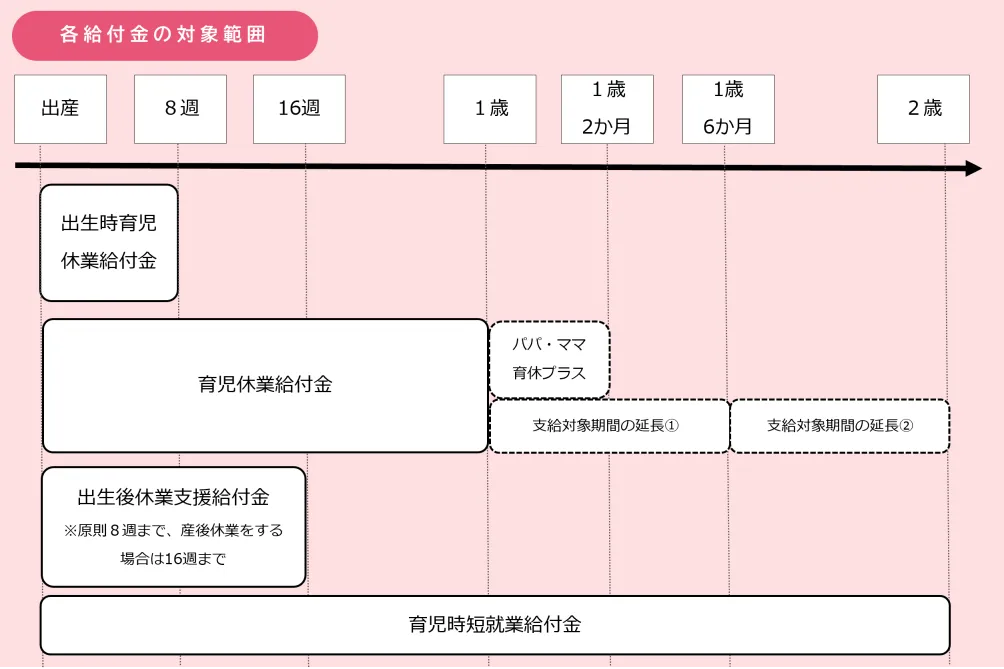
Birth Leave Support Benefits is a new program created to strengthen existing childcare leave benefits.
Traditional childcare leave benefits had the challenge of “significant income reduction,” which has been particularly cited as a factor preventing fathers from taking parental leave.

The new program resolves this issue by adding to the benefit amount specifically during the period immediately after birth, creating a system where take-home pay effectively approaches the full amount.
Understanding the differences from the traditional system makes it easier to plan for your family and provides significant support for couples to confidently begin parental leave.
Traditional System: 67% of Pre-Leave Wages (Approximately 80% Take-Home)
Traditional childcare leave benefits provided 67% of the daily wage amount before leave began.
Furthermore, since social insurance premiums (health insurance and employee pension) are waived during this period, actual take-home pay recovers to approximately 80%.
However, some income reduction was unavoidable, and especially for those who are the primary earners in their households, the hurdle for taking parental leave remained high.
Many voiced concerns that “it’s difficult because income decreases,” even when wanting to be involved in childcare. This was a factor in fathers’ parental leave uptake rates remaining stagnant.
How to supplement the “income reduction” problem of the traditional system has been an ongoing challenge.
The new program clearly addresses this exact issue, with explicit intent to provide robust support during the crucial postpartum period.
New System: Raised to Approximately 100% Take-Home Pay
With the newly launched Birth Leave Support Benefits, cases have emerged where take-home pay becomes “nearly the full amount” through additional benefits on top of the traditional “67% payment + social insurance premium waiver.”
This additional benefit, paid for 28 days after birth, allows parental leave to be taken without significant reduction in living expenses, greatly reducing psychological burden compared to before.
The first month after birth is a critical period when the mother’s physical recovery and the family’s daily rhythm stabilize, and maintaining income creates an environment where fathers can actively participate in childcare.
Additionally, for employers, it makes it easier for employees to take parental leave, promoting understanding throughout the workplace.
If the movement spreads that “parental leave is easier to take when income doesn’t decrease,” it directly reduces the burden on entire families.
How the 13% Birth Leave Support Benefit Add-On Works
Birth Leave Support Benefits provide an additional 13% of pre-leave wages.
This 13% figure, combined with traditional childcare leave benefits (67%), calculates to “80% + approximately 20% in waivers = effectively close to 100%,” allowing take-home pay to remain nearly unchanged from before parental leave.
Payment is provided for 28 days in principle, designed to provide robust support immediately after birth.
In terms of calculation, since it’s paid in addition to traditional childcare leave benefits, there are no special additional procedures, and the reassuring aspect is that applications can be submitted through the employer.
Additionally, since this period is when household finances tend to be most unstable, having the add-on benefit protects daily life and creates an environment where parents can focus on childcare.
It plays an important role as “financial encouragement” to make it easier for couples to take parental leave.
Who Is Eligible?

Understanding who is eligible for “Birth Leave Support Benefits” is very important for maximizing use of the program.
This system primarily targets “insured persons enrolled in employment insurance,” centered on workers such as company employees and public servants.
On the other hand, those who are not employment insurance policyholders, such as self-employed individuals and freelancers, are generally ineligible.
Furthermore, another major condition for receiving benefits is that “both spouses take parental leave.”
In other words, not only the individual but also the spouse’s parental leave uptake becomes a related requirement, so confirming eligibility requires comprehensive verification of the household situation.
Insured Persons Enrolled in Employment Insurance (Company Employees, Public Servants, etc.)
The most fundamental condition for eligibility in this program is “being an insured person under employment insurance.”
Specifically, this includes company employees, public servants, and workers employed under regular employment contracts who are enrolled in employment insurance.
The benefit eligibility requirements specify that “the insured person meets certain standards such as wage payment status before the start of leave,” and employment insurance enrollment status and wage payment records are verified during application.
Additionally, the benefit application process flows through the employer submitting to the relevant Hello Work office, and environments where companies and public service organizations have established procedures tend to proceed more smoothly.
In other words, if you are an employment insurance policyholder, you likely have a high possibility of utilizing the system, and it’s important to first confirm your employment insurance enrollment status and wage situation.
Self-Employed and Freelancers Are Generally Ineligible
On the other hand, self-employed individuals and freelancers are often not employment insurance policyholders, so they are generally ineligible for this program.
In the benefit system design, the premise is that “insured persons take parental leave and receive benefits,” and business owners, sole proprietors, and freelancers who are not enrolled in employment insurance generally do not meet the eligibility requirements.
However, if a spouse is an employment insurance policyholder and meets exceptional conditions specified in the system (for example, situations where the spouse cannot take parental leave), there are cases where they may exceptionally become eligible.
Therefore, even if self-employed or freelance, we recommend first consulting with your employer or Hello Work to verify based on your family structure, work style, and employment insurance enrollment status.
Both Spouses Taking Parental Leave Is a Basic Condition
This benefit has another important condition: “the insured person and their spouse each take 14 days or more of parental leave for the same child.”
In other words, since both parents taking parental leave becomes an eligibility requirement, household planning and coordination are required.
However, when the spouse is unemployed, self-employed, freelance, or otherwise not an employment insurance policyholder, or in cases of separation, divorce, or similar circumstances, “exception provisions where spousal parental leave is not required” are established.
This allows households where both parents’ leave is difficult to still have opportunities to utilize the program, so it’s important to verify eligibility through Hello Work or your employer.
Sharing the number of days and timing of parental leave with your spouse and discussing “who will take leave when” will provide peace of mind.
Detailed Explanation of Eligibility Requirements
To receive Birth Leave Support Benefits, multiple conditions must be met, including the timing and number of days of parental leave, as well as the period of employment insurance enrollment.
The program’s purpose is to “create an environment where both parents can support each other during the postpartum period while caring for the child,” with particular emphasis on the 8 weeks immediately after birth.
The required number of parental leave days is clearly defined for each parent, and verification is also conducted on whether employment insurance enrollment has reached a certain number of years.
Understanding these requirements makes it easier to organize specific leave schedules and establish a system to reliably receive benefits.
Fathers Must Take 14 Days or More of Parental Leave Within 8 Weeks After Birth
A major point of Birth Leave Support Benefits is the requirement that “fathers take a total of 14 days or more of parental leave within 8 weeks after birth.”
These “14 days” can be consecutive or split, and requirements can be met by taking multiple short periods.
Fathers’ early involvement in childcare is considered extremely important not only for distributing housework and childcare burdens but also for supporting mothers’ physical recovery.
Therefore, this program strongly encourages leave immediately after birth.
Additionally, either “parental leave” or “postpartum paternity leave (formerly birth-time childcare leave)” qualifies, allowing flexible selection based on family circumstances.
If work coordination is difficult, an effective method is to take short periods multiple times totaling 14 days or more.
To reliably utilize the program, consult early with your employer as the expected delivery date approaches and share your schedule for peace of mind.
Mothers Must Take 14 Days or More of Parental Leave Within 8 Weeks After Maternity Leave
For mothers, there is a requirement to “take 14 days or more of parental leave within 8 weeks after maternity leave ends.”
Maternity leave (8 weeks postpartum) is a legally mandated rest period, and the period “secured as parental leave” after that becomes the eligibility condition for this program.
For mothers, the months after birth are an extremely demanding period where physical recovery and childcare overlap, and these 14 days play an important role in securing time needed for recovery.
For mothers too, the 14 days do not need to be consecutive and can be taken in divided periods without issue.
The merit is that burden can be adjusted easily according to return-to-work timing and family circumstances.
Additionally, when fathers and mothers take parental leave during the same period, it makes it easier to establish postpartum daily rhythms and creates mental space. It’s important to create a reasonable leave plan according to postpartum physical condition and prospects for returning to work.
Employment Insurance Coverage Period Must Generally Be 2 Years or More
To receive Birth Leave Support Benefits, “having 2 years or more of employment insurance coverage period in principle” is an important eligibility requirement.
This is a standard for confirming whether the insured person taking parental leave has been working continuously for a certain period, and it relates to the stable operation of the employment insurance system.
The 2-year count is based on “months when wages were paid,” and even with job changes or contract renewals, if employment insurance enrollment hasn’t lapsed, it may be counted cumulatively in some cases.
This requirement establishes a system that prevents abuse of benefits through short-term employment while ensuring that long-term workers reliably receive support.
However, there are exceptional cases where 1 year or more may qualify, or judgments may differ depending on work style at the start of parental leave, so specific enrollment period must be verified with your employer or Hello Work.
Understanding your enrollment status early leads to smooth applications and makes it easier to plan parental leave.
Frequently Asked Questions and Resolving Concerns
The Birth Leave Support Benefits and parental leave systems can seem complex, and when actually taking leave, concerns like “What happens here?” or “Am I eligible?” often arise.
In particular, common questions shared by many parents include how benefits are handled after returning to work, whether temporary or contract workers are eligible, tax treatment, and concerns about returning to work.
Properly understanding the system makes it easier to plan household finances and take parental leave with confidence.
Here, we carefully answer frequently asked questions to help reduce anxieties before and after parental leave.
Q1: “Do Benefits End When I Return from Parental Leave?”
Birth Leave Support Benefits are paid “during the period of parental leave,” so benefits end when you return to work.
Specifically, the additional 13% provided by this new program targets 28 days after birth, so it doesn’t continue after returning to work.
However, like traditional childcare leave benefits, if you partially return to work or switch to shortened work hours, benefits may continue if certain conditions are met.
How benefits change varies depending on work hours, wages, and return timing, so consulting early with your company representative or Hello Work provides peace of mind.
Understanding in advance how benefits work after returning helps establish household financial prospects and reduces anxiety about returning to work.
Q2: “Are Temporary and Contract Workers Eligible?”
Temporary and contract workers are eligible if enrolled in employment insurance. Employment status doesn’t matter; “whether you are an employment insurance policyholder” is the most important condition.
However, depending on the temporary placement and contract period, how enrollment periods are calculated may vary, requiring verification.
Employment insurance calculates enrollment periods on a “monthly basis,” so if temporary contracts have been renewed and work continues without gaps, enrollment periods accumulate and eligibility requirements are often met.
Additionally, since the temporary staffing agency handles procedures, for temporary workers “the staffing agency company” becomes the point of contact.
Similarly for contract workers, if contracts continue to be renewed, enrollment periods are often satisfied.
Since the program is accessible even for non-regular employment, it’s important to first verify your insurance enrollment status.
Q3: “Are Benefits Taxable?”
Both childcare leave benefits and Birth Leave Support Benefits are “tax-free.” Therefore, no income tax or resident tax applies.
Additionally, since social insurance premiums are waived during parental leave, the actual take-home feel is often lighter burden than usual.
However, since the following year’s resident tax is calculated based on the previous year’s income, cases can occur where “if the parental leave period is short, the following year’s resident tax is higher than expected.”
This is due to the system’s structure, and the parental leave benefits themselves are not taxed.
Furthermore, take-home pay changes depending on when post-return salary returns and dependency status, so consulting with your company’s general affairs department or tax office provides peace of mind if concerned.
This is not a program where you lose money on taxes, so you can use these benefits with confidence.
Q4: “I’m Anxious About Returning to Work After Parental Leave…”
Returning after parental leave is a time when many people feel anxious.
It’s natural for concerns to pile up around balancing work and childcare, workplace understanding, changes in job duties, and time management.
To make the return smooth, it’s important to first share “post-return work style” with the company early.
More companies are offering options like shortened work hours, remote work, and work duty adjustments, and advance consultation leads to smoother returns.
Additionally, using familiarization daycare before returning or reviewing role divisions within the family allows preparation of daily rhythms.
While the first day back has many unfamiliar aspects, most people gradually adjust. Using consultation services or occupational health physicians as needed and finding ways to continue work and childcare without strain leads to peace of mind.
Summary
Birth Leave Support Benefits is an important program that financially supports families immediately after birth.
By providing add-on benefits in addition to traditional childcare leave benefits, a system has been established where take-home pay approaches nearly the full amount, making it easier for both parents to take parental leave.
Eligible recipients are employment insurance policyholders, with an important condition being that both parents take parental leave for a certain period.
Understanding the application process and post-return handling allows confident use of the program.
Consult early with your employer or Hello Work regarding concerns and questions, and it’s important to establish the optimal balance of childcare and work for your family.


