


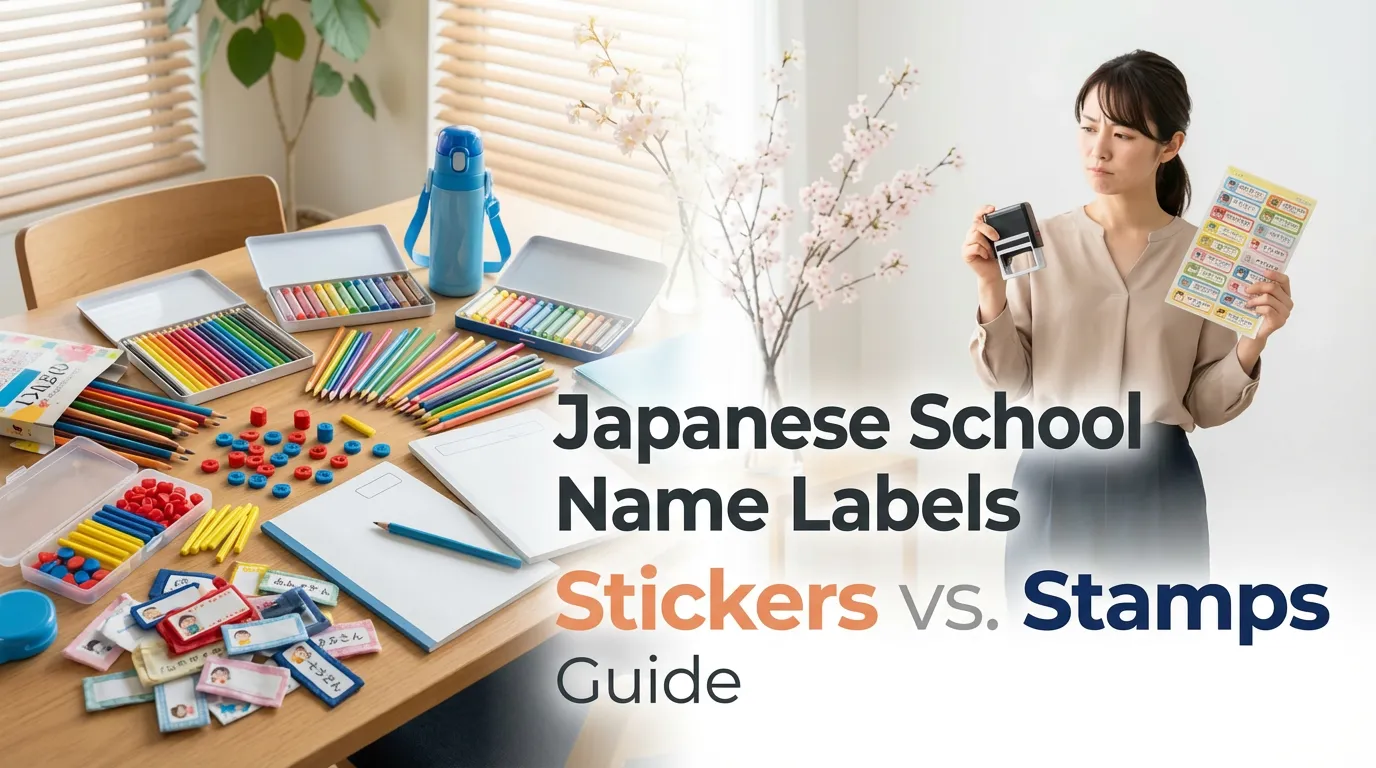
Preparing for Japanese elementary school (Nyugaku Junbi) involves a notorious rite of passage for parents: the “name-labeling hell.” From tiny math set pieces (ohajiki) to individual crayons and clothes, labeling hundreds of school supplies can be incredibly overwhelming. Balancing parent’s mental well-being with children’s developmental needs requires highly practical, time-saving strategies. This comprehensive guide compares the ultimate Japanese school name labels—stickers, stamps, and label makers—to help you maximize your time performance (Taipa). Supported by organizational experts and developmental insights, you will learn how distinct labels, like icon-based stickers, not only save you hours but also foster your child’s independence by helping them easily identify their belongings. Discover the most efficient hybrid labeling methods to conquer your back-to-school preparation without the stress.
Table of Contents
How to Survive the Japanese Elementary School Name-Labeling Rush
As the spring enrollment season approaches, many parents in Japan discover that labeling school supplies is far more demanding than it first appears. What seems like a simple chore quickly becomes a time-consuming ordeal stretching across entire weekends.
With dual-income households now the norm in Japan, parents have less free time than ever. The key to getting through Japanese elementary school preparation is not sheer determination—it is smart time management, or Taipa (short for “time performance”), the Japanese concept of maximizing value from every minute you invest.
How Many Items Actually Need Name Labels? (The Answer Will Surprise You)
Most parents assume name-labeling involves a handful of pencils and a backpack. The reality is far more daunting. Once you review your school’s official supply checklist, the total number of items requiring individual labels can reach into the hundreds—sometimes topping 500 pieces.
- Stationery: 12 pencils, 12–24 colored pencils, and 16 crayons—each labeled individually
- The Sansu Set (Math Manipulatives—the final boss): Ohajiki counters, counting sticks, and arithmetic flash cards alone can add up to several hundred pieces
- Clothing and fabric items: PE uniforms, indoor shoes, drawstring bags, handkerchiefs, and socks (both left and right)
- Miscellaneous: Umbrella, water bottle, lunch box, cup, and emergency hood
The sansu set—Japan’s standard elementary math manipulative kit—deserves special mention. The ohajiki counters are roughly one centimeter in diameter, and parents are expected to write a child’s full name on every single one. Without the right tools, this task alone can consume hours of a parent’s weekend.
Why Handwriting Everything Is the Least Efficient Option
It may seem like grabbing a permanent marker is the cheapest and fastest route. From a pure time-performance perspective, however, handwriting is often the costliest choice you can make. Here is why:
The Hidden Time Cost
At an average of 20 seconds per item across 500 pieces, you are looking at nearly three hours of focused writing—before accounting for setup, breaks, mistakes, and redo’s. The real-world time investment is almost always higher.
Durability Failures and Rework
Permanent markers on fabric bleed and fade through repeated washing. Text on plastic surfaces wears away from friction. Having to re-label items after school starts is exactly the kind of double-handling that kills your time efficiency.
Cognitive Fatigue and Frustration
Writing legibly on a one-centimeter ohajiki is a test of patience that few parents enjoy. Ink smears, crooked lettering, and aching hands are common complaints. The mental energy drained from this process is a real cost that compounds across the entire labeling session.
The Three-Tool Strategy: Name Stickers, Stamps, and Label Makers

The most efficient approach to Japanese school supplies labeling is not to pick one tool and apply it universally—it is to use the right tool for each category of item. Experienced Japanese parents and organizational experts consistently recommend a hybrid strategy combining three core tools:
- Name sticker labels: Best for small, flat surfaces like math set pieces, stationery, and fine-motor items
- Name stamps: Best for fabric and absorbent materials such as socks, towels, and cloth bags
- Label makers (Tepra): Best for durable, long-lasting labels on water bottles, tool boxes, and storage items where a clean, consistent look matters
By deploying each tool where it performs best, parents routinely cut what would be a full day of hand-labeling down to just a few focused hours. The sections below break down each tool in detail.
Name Stickers vs. Stamps vs. Label Makers: 2026 Comparison Guide
To label Japanese school supplies efficiently, you need to understand exactly what each tool does well—and where it falls short. No single product covers every situation perfectly. Here is a structured breakdown to help you decide which tools belong in your back-to-school kit.
At a Glance: Speed, Durability, and Value Compared
Name Sticker Labels
Speed: Fastest (peel and stick—no writing, no drying time)
Durability: High (waterproof and dishwasher-safe options widely available)
Cost: Mid-range (higher per-unit cost, but time savings are significant)
Best surfaces: Plastic, metal, paper, and general stationery

Name Stamps (Onamae Stamps)
Speed: Fast (stamp continuously in a rhythmic workflow)
Durability: Moderate (may fade gradually through repeated washing)
Cost: Low (one-time purchase; ink refills extend use almost indefinitely)
Best surfaces: All fabric types, diapers, notebooks, and paper goods
Label Makers (Tepra / Tape Writer)
Speed: Moderate (requires text input and printing time)
Durability: Highest (laminated tape resists water, heat, and abrasion extremely well)
Cost: Highest (upfront cost for the device plus ongoing cartridge expenses)
Best surfaces: Water bottles, tool boxes, textbook spines, and household storage
Which Tool Is Right for Your Family’s Lifestyle?
If you want to finish as fast as humanly possible: Choose name sticker labels
For tasks like labeling the sansu math set, pre-printed name stickers offer unmatched speed. Working with tweezers, experienced parents get into a satisfying rhythm that no other method can match.
If you have multiple children and want long-term value: Choose name stamps
A quality onamae stamp set purchased once will serve you through multiple children and all six years of elementary school. Swapping ink pads or adjusting character sizes makes it easy to adapt for each child. For families thinking about long-term return on investment, stamps deliver the best balance of time and cost efficiency.
If you love organization and plan to use labels beyond school: Choose a label maker
Smartphone-connected label makers let you design labels during commute time and print them in batches when you get home. Beyond Japanese school supplies labeling, you will find constant new uses for a label maker throughout your home—making it one of the most practical long-term investments in this category.
The most effective strategy combines all three: stickers for the math set, stamps for fabric items, and a label maker for high-use durable goods. This hybrid approach is increasingly recognized as the gold standard for Japanese elementary school preparation.
Name Sticker Labels: The Fastest Way to Label Japanese School Supplies

Name sticker labels remain the most popular Japanese school name labels on the market, and for good reason. Pre-printed with your child’s name before they arrive, they require zero writing on your part. The entire action is peel, place, press—and you are done. For time-pressed parents, that simplicity is genuinely transformative.
Key Benefits: Instant Application and Child-Friendly Icon Designs
The primary advantage of name sticker labels is pure speed. There is no ink to apply, no drying time to wait for, and no skill required to produce a clean, professional-looking result. Every label looks identical, which matters when you are labeling 500 items and consistency helps children recognize their belongings at a glance.
Modern Japanese name sticker labels come with a wide range of icon designs—animals, vehicles, flowers, stars, and more. From a developmental psychology perspective, these icons serve an important function beyond aesthetics. Young children who are still learning to read their own names in hiragana or kanji can instantly identify their belongings by their personal icon. This visual shorthand supports early independence and reduces the likelihood of lost items—a meaningful benefit that goes well beyond convenience for parents.
Drawbacks: Curved Surfaces and Reorder Lead Times
Name sticker labels do have limitations worth planning around. Cylindrical items like pencils can cause label edges to lift, especially at the ends. Once lifted, dust and debris enter under the adhesive layer, accelerating peeling. For curved surfaces, choosing thinner, high-tack specialty stickers designed for pencils and round objects is strongly recommended.
The other practical concern is inventory management. Unlike stamps or label makers—which produce output on demand—sticker labels are a finite resource. During peak enrollment season in Japan (typically February through April), online orders for custom name stickers can take one to two weeks to arrive. Running out mid-project with no backup is a real risk for parents who wait until the last minute.
Iron-Free Tag Stickers: A Modern Alternative for Clothing
Labeling fabric used to mean ironing—a slow, multi-step process involving heating, pressing, and cooling time. The growing availability of no-iron tag stickers has changed that for many families. These stickers press firmly onto clothing care tags by hand, bond without heat, and resist both machine washing and tumble drying.
The practical upside is flexibility. You can label a freshly dried shirt on the spot without ever setting up an iron. Many parents now keep a sheet of no-iron tag stickers nearby during laundry routines, labeling items as they fold rather than setting aside dedicated labeling sessions. This kind of workflow integration is exactly what Taipa-focused preparation looks like in practice.
Name Stamps for Japanese School Supplies: The All-Purpose Labeling Tool

Name stamps—known in Japan as onamae stamps—are the second pillar of efficient Japanese school supplies labeling. The concept is simple: press an ink-loaded rubber stamp bearing your child’s name onto any surface. But the versatility this approach delivers is remarkable. In 2026, onamae stamp sets remain highly regarded by Japanese parents and labeling professionals for their ability to handle materials that stickers simply cannot.
Key Benefits: Works on Almost Anything, Lasts Through Elementary School
The defining strength of name stamps is surface versatility. Using fast-drying oil-based ink, a single stamp set can handle notebooks and paper, cotton socks and towels, plastic lunch boxes and rulers, and even disposable diapers used at after-school care programs. No other labeling tool covers this range in a single purchase.
Because stamps do not “run out” the way stickers do, they offer a fundamentally different cost model. Refill ink is inexpensive, and the stamp itself will survive thousands of uses. Many sets include characters in hiragana, kanji, and romaji, allowing parents to switch labeling styles as their child progresses through school—hiragana in Grade 1, kanji by Grade 3 or 4. One investment genuinely carries you from enrollment to graduation.
Drawbacks: One-Shot Placement and Drying Time
Stamping requires more attention than sticking. Uneven pressure, a tilted stamp, or excess ink can produce blurry or skewed results—and on fabric, there is essentially no way to correct a mistake. On some plastic surfaces, errors can be removed with a solvent cleaner, but that process adds time and defeats the efficiency you are trying to gain.
Ink dry time also deserves consideration. Even fast-drying formulas require a short window before items can be safely stacked or stored. Labeling dozens of items at once means spreading them out across a table or floor to air-dry, which requires workspace planning. For parents hoping to blitz through the entire labeling project in one sitting, this is a logistical detail worth preparing for in advance.
Time-Saving Tip: Switch to Self-Inking (Shachihata-Style) Stamps
Traditional onamae stamps require you to press the stamp face against an ink pad before each use. Self-inking stamps—modeled after the popular Japanese Shachihata-style design—contain ink internally and re-ink automatically with each press. Eliminating the ink-pad step dramatically increases stamping speed.
For high-volume tasks like flash cards, counting sticks, or daily diaper labeling, this efficiency gain compounds quickly. The rhythmic, continuous stamping motion that self-inking stamps allow is one of the most satisfying time-saving hacks in the entire Japanese school preparation toolkit.
Item-by-Item Labeling Guide: The Best Tool for Every School Supply
Understanding each tool’s strengths is only half the battle. The real Taipa gains come from applying the right tool to each specific item on your school supply list. Here is a practical reference guide based on surface type, item size, and durability requirements.
Pencils and Crayons: Why Small Name Stickers Win Every Time
Labeling 12 pencils and 16 individual crayons is one of the first challenges parents encounter. Both items share the same problem: they are thin cylinders. Handwriting slips on the curved surface, and stamp faces do not conform evenly to a rounded form, causing characters to print incompletely.
The clear solution is purpose-made pencil name stickers—extremely narrow, elongated labels designed specifically for cylindrical school supplies. Applied correctly, they wrap cleanly around the barrel without bubbling or lifting. The result is uniform, legible, and durable.
To work faster and more accurately, use tweezers instead of your fingers. Tweezers let you position the sticker precisely without your skin oils contaminating the adhesive layer. Applying labels near the eraser end rather than the sharpening end also keeps them away from the most frequently handled area of the pencil, extending adhesion life significantly.
Clothing and Fabric Items: The Iron-Free Tag Sticker vs. Stamp Decision
Fabric labeling generates more debate among Japanese parents than any other category. When evaluated purely on time efficiency, the clear winner for items that have a sewn-in care tag is the no-iron tag sticker. Pressed firmly onto the smooth label surface, these stickers bond tightly, offer excellent legibility, and survive regular machine washing. No ironing setup, no cooling time, no mess.
Stamps, while fast, carry a risk on fabric: the weave texture can cause ink to bleed unevenly, and repeated laundering may fade the impression to the point of illegibility. This means potential rework—exactly the outcome Taipa strategy aims to avoid.
The practical rule of thumb: if the item has a tag, use a no-iron tag sticker. For tag-free items like plain socks or seamless athletic wear, switch to an onamae stamp or flock-transfer iron-on labels (which adhere at a higher temperature but deliver exceptional durability). Using the appropriate method for each fabric situation prevents the disappointment of labels failing mid-year.
Lunch Boxes and Water Bottles: Waterproof Labels That Actually Last
Daily washing makes lunch boxes, cups, and water bottles the most demanding environment for any Japanese school name label. Inexpensive stickers or standard stamps applied here will degrade within weeks, forcing you to re-label—which is the worst possible outcome for time efficiency.
For these items, choose laminated waterproof name stickers explicitly rated for dishwasher use, or print labels using a label maker with strong-adhesive, heat-resistant tape. Many premium Japanese name sticker brands now offer labels that remain intact through hundreds of dishwasher cycles, and parent reviews consistently confirm their long-term reliability.
One quick preparation step makes a measurable difference: before applying any sticker to a food container or water bottle, wipe the surface with an alcohol wipe to remove oils and residue. This single action significantly improves adhesive bonding and reduces the chance of labels peeling at the edges—eliminating one of the most common sources of mid-year re-labeling.
Notebooks and Textbooks: When Handwriting Is Actually the Fastest Option
Efficiency-focused thinking can sometimes lead parents to over-engineer simple tasks. For textbooks and composition notebooks—large-surfaced items you only have a few of—handwriting with a marker is genuinely the fastest approach.
Consider the workflow: locate the right sticker sheet, find the correct size, peel carefully with tweezers, and position accurately. In the time that process takes, a marker write-on-the-cover approach is already finished. For items with plenty of writing space and moderate durability requirements, tool-free handwriting wins on pure speed.
Textbooks are also replaced each school year, so long-term adhesion is not a meaningful concern. The most time-efficient labeling strategy treats each category individually rather than applying one method across everything. Recognizing when handwriting is the right call is part of what separates a smart preparation plan from an overly complicated one.
How to Label a Sansu Math Set in Under an Hour
The sansu set—Japan’s standard elementary math manipulative kit—is widely regarded as the hardest part of Japanese school supplies labeling, and for good reason. Opening the box reveals a daunting collection of tiny, individually labelable components. With the right approach, however, this task is very manageable within about an hour.
What Is Actually Inside a Sansu Set?
The sansu set (算数セット) is a boxed kit issued to Japanese first-graders for hands-on arithmetic learning. A standard set includes:
- Ohajiki counters—small, flat discs roughly one centimeter in diameter, used for basic counting; a typical set includes around 30–60 pieces
- Kazoe-bo counting sticks—thin flat sticks bundled in groups for place value exercises; usually 100 or more pieces
- Keisan card arithmetic flash cards—individual cards for addition and subtraction drills, often 100 to 200+ cards per deck
- Play money (plastic coins), a clock face model, dice, and geometric shape tiles
Combined, these components often total several hundred individually labelable pieces. The ohajiki counters are the most notorious—their small, slightly concave, flower-shaped surface makes clean labeling with any tool a genuine challenge. Without a purpose-built strategy, this single component can consume an hour on its own.
The Right Gear Makes All the Difference: Sansu-Specific Stickers and Tweezers
The solution to the sansu labeling challenge is purpose-designed name stickers sized and shaped for each component type. Reputable Japanese name label retailers sell kits calibrated to match specific sansu set manufacturers—tiny circular stickers for ohajiki, ultra-narrow strips for counting sticks, and appropriately sized rectangles for flash cards and plastic coins.
Tweezers are not optional for this task—they are essential. Attempting to peel and place one-centimeter stickers with fingertips introduces skin oils to the adhesive, reduces grip accuracy, and causes stickers to fold or misalign. With tweezers, placement becomes fast and precise. Most specialty sansu sticker kits include a pair; if yours does not, purchase them separately before starting.
One important mindset adjustment: resist the urge to achieve perfect label placement on every piece. For items that are used internally and rotated frequently, a slightly off-center label that clearly displays the child’s name is entirely acceptable. Prioritizing speed over perfection—while maintaining legibility—is what allows parents to finish the entire sansu set within a single session rather than across multiple evenings.
Summary: The Smartest Approach to Japanese School Name Labels
Japanese elementary school preparation requires labeling hundreds of individual items—a task that can easily consume days if approached without a clear strategy. The key insight is simple: no single tool handles every surface well, but using the right tool for each category eliminates rework, saves hours, and keeps stress levels manageable.
Use name sticker labels for stationery, math set components, and small flat items. Use onamae stamps for fabric items and absorbent surfaces where stickers cannot grip. Reserve your label maker for water bottles, tool boxes, and storage where maximum durability and a uniform appearance matter most. For the sansu set specifically, investing in a purpose-made sticker kit with tweezers is the single highest-impact efficiency decision you can make.
This hybrid labeling strategy—combining the three core tools based on material type—is the approach recommended by experienced Japanese parents, school preparation guides, and organizational specialists alike. Apply it methodically, prepare your supplies in advance to avoid shipping delays, and you will be fully ready for enrollment day with time and energy to spare.


