


On rainy days — especially during Japan’s rainy season — many parents know the feeling: reaching for the phone and searching, “it’s raining again today, what do we do?”
Look up indoor play ideas and you’ll find endless lists. But by the next morning, you’re right back in the same spot. That repetition wears you down, little by little.
This article gives you a simple way to break that loop: a ready-made system for choosing what to do. We’ve sorted activities by age, by time, and by how much energy you have left as a parent, and we’ve also prepared a free PDF “Rainy-Day Indoor Play Bingo Sheet” that lets your child pick a square themselves. We hope you’ll keep this article close as a usable tool, so you don’t have to think everything up from scratch each day of the rainy season.
Table of Contents
Rainy-day indoor play gets easier when you turn it into a “don’t-decide-every-day” system

The videos in this article are Japanese-language examples, but the activities are simple enough to follow visually. The hardest part of rainy-day indoor play often isn’t the play itself. It’s having to decide, again and again, what to do next. Just by getting into a state where “the options to choose from are decided in advance,” like a bingo sheet, both parent and child find it easier to get moving.
Parents get tired on rainy days for more reasons than just “running out of ideas”
Many parents carry the feeling that “I can’t think of any indoor play ideas.” But when you actually listen to them, the cause of the exhaustion is, in most cases, more than just a shortage of ideas.
For instance: the prep is a hassle, so you give up in the end. You got the play started, but the cleanup afterward was hard. Your child wasn’t in the mood and it was over in five minutes. You think “origami will do,” while not being sure it’s the best choice. The guilt of having let them watch TV lingers, little by little.
When these small drains pile up, you start to feel that “whatever I do, it’s going to be hard.” The problem is less a shortage of ideas and more the very fact of repeating the judgment of “which one do I choose” every single day.
The solution isn’t “knowing more good activities” — it’s “narrowing down the candidates in advance so all you have to do is choose.”
In this article, we present play in a “choosable” form
This article sorts activities along the following five axes.
- By age (for ages 2–3, for ages 4–6, for siblings)
- By time (5 minutes, 15 minutes, 30 minutes or more)
- By the parent’s energy (no energy left, a little, plenty)
- Whether it can be done with dollar-store materials
- How it links with the bingo sheet
Based on these, we’ve made a comparison table and a ranking, and we’ve also gathered it all into a bingo-sheet PDF that lets your child choose “which one shall we do today” by themselves. You can start using it with just the comparison table or the bingo sheet.
[Editors’ picks] Rainy-day indoor play ranking|in order of easiest prep
Rainy-day indoor play tends to last longer the less prep it needs, the easier it is to clean up, and the more a child can choose it themselves. Here we present a ranking that the TamagoDaruma editorial team evaluated using our own five axes.
The ranking’s evaluation criteria
How “fun” an activity is differs from child to child. So for this ranking, the editorial team evaluated on our own, with a focus on “ease of keeping it up” from a parent’s point of view.
The five criteria we evaluated are as follows.
- Ease of prep (the effort of getting out and gathering materials)
- Ease of cleanup (the burden once it’s over)
- Whether the child can get into the play easily
- Whether it can be done with dollar-store items or things at home
- Whether the parent’s hands-on input can be kept low
1st place: Indoor play bingo

Activities that score well on all five axes are, in fact, not many. “Indoor play bingo” tops this ranking because it’s both an activity in itself and, at the same time, a “tool for choosing the next activity.”
Using it is simple. Your child picks one square they like from the activities on the sheet, does it, and circles it. When they’re done, on to the next square. You can reuse it for a week, and it cuts down that every-morning back-and-forth of “what should we do today.”
Putting it in a bingo format makes it easier for a child to feel they “chose it themselves,” which can make it easier to get into the play. Even with play at home, just adding a little of that “I’m choosing” feeling rather than “being made to do it” makes it easier for some children to get started.
2nd place: Indoor treasure hunt

Just use things around the house to hide a “treasure,” and have them search based on clues. No materials needed. You can freely adjust the difficulty by age — for a 3-year-old, “under the sofa in the living room”; for a 5-year-old, “read a written hint and search” works too.
Because it doesn’t involve jumping or running around, it’s an activity that’s easier to bring into an apartment compared with play that involves running or jumping. It’s also good for sibling face-offs. The prep takes a little time, but relative to that prep burden, it’s an activity that’s comparatively easy to enjoy for a long stretch (this varies from child to child).
3rd place: Newspaper and paper play

Even just “tearing newspaper to shreds” can be fun play for a 2- or 3-year-old. Rolling it into a ball, ripping it up and throwing it like snow, crumpling it and tossing it into the trash — what you can do is simple, but its strength is that it uses both the body and the hands.
The cleanup looks hard at first glance, but if you decide the rule “when it’s over, put it all in a trash bag and we’re done” at the start, the cleanup itself becomes part of the play.
4th place: Paper-cup and paper-plate crafts

Paper cups and paper plates, available at the dollar store, are a staple craft material. Stacking, lining up, decorating — you can use them in ways that suit the age.
That said, this article doesn’t go into the details of “how to make” things. For specific ideas, see the crafts articles. The role here is to “keep it on hand as one of the candidates for rainy-day indoor play.”
5th place: Pretend-play missions

Pretend play, which starts with a single prompt like “let’s play bakery today” or “let’s play doctor,” is one of the activities that preschoolers find easy to take on. If there are siblings, it’s easy to divide up roles too, and the older child often ends up naturally taking the lead.
Adding the name “mission” gives it a game-like feel and makes it easier to get going. For example, just handing over a simple challenge like “today’s mission: open a restaurant and take orders from the three family members” sets the direction of the play.
[Comparison table] Choosing rainy-day indoor play by age and by time


For ages 2–3, short sensory play, and for ages 4–6, combining play that has rules and a sense of achievement, makes it less likely they’ll get bored even on days of continuous rain. Below, we organize recommendations by age and tips for siblings playing together.
For ages 2–3|play that finishes in a short time
For children of this age, it’s natural to find it hard to concentrate on one activity for a long time. “Having several activities ready that finish in 10 minutes” is more realistic than searching for one activity that lasts an hour.
- Sticker play: just sticking stickers however they like onto a blank sheet of paper. They can play quietly sitting at a table.
- Tearing newspaper: the feel and sound of tearing are fun, and many children concentrate more than you’d expect.
- Color hunt: a cognitive game that starts with just the prompt “let’s find five red things in the room.”
- Towel play: rolling, stacking, draping it over the face and peeking out — you can play with it as a material.
- Drawing on big paper: making it the size of a large poster sheet rather than A4 lets them draw using the whole body.
For ages 4–6|play with rules and a sense of achievement
From around age 4, more children develop the feelings of “playing by the rules” and “wanting to achieve something.” Adding a little challenge or goal to the play can lengthen the time they engage with concentration.
- Indoor treasure hunt: finding treasure based on clues. For a child taking an interest in letters, they can also enjoy reading the clues.
- Rainy-day mission cards: just handing over a sheet with “today’s mission” written on it gives a game-like feel.
- Paper-cup tower: challenging how many levels they can stack. Even when it falls, it turns into laughter.
- Playing shop: lining up goods, counting money, taking orders — they can get into a role and play.
- Bingo play: there’s the fun of looking at the sheet and deciding “what’s next?” themselves.
For siblings|ideas for playing together even with an age gap
Many parents feel it’s hard for siblings with an age gap to “play together,” but if you don’t make “doing the same thing” the goal, it works out surprisingly well.
The key is dividing up roles. Give the older child the role of being “in charge” of something: “in charge of explaining the rules,” “in charge of hiding the treasure,” “in charge of preparing the materials.” Being entrusted with something lets the older child get a sense of achievement appropriate to their age. The younger child takes the role of “the one who chooses” or “the one who tries,” and can join in at their own pace.
Just holding the premise that everyone doesn’t have to do the same task makes it easier to create time playing together.
Comparison table: features by activity
| Activity | Target age | Rough time needed | Prep | Cleanup | Parent’s involvement | Noise | Dollar-store materials |
|---|---|---|---|---|---|---|---|
| Indoor play bingo | Ages 2–6 | 20–60 min | Almost none | Almost none | Low※ | Quiet | Not needed |
| Indoor treasure hunt | Ages 3–6 | 20–40 min | 5 min | Little | Only at the start | Moderate | Not needed |
| Tearing newspaper | Ages 2–4 | 10–20 min | Almost none | One bag | Low※ | Somewhat loud | Not needed |
| Sticker play | Ages 2–4 | 10–20 min | Almost none | Almost none | Low※ | Quiet | ○ |
| Paper-cup stacking | Ages 3–6 | 15–30 min | Almost none | 1 min | Low※ | Moderate | ○ |
| Paper-plate / paper-cup crafts | Ages 4–6 | 30–60 min | 5–10 min | Somewhat more | Together | Quiet | ○ |
| Pretend-play missions | Ages 3–6 | 30–90 min | Almost none | Little | Intro only | Moderate to somewhat loud | Not needed |
| Color hunt | Ages 2–4 | 10–15 min | None | None | Low※ | Quiet | Not needed |
| Drawing on big paper | Ages 2–5 | 20–40 min | 1–2 min | Cleanup required | Low※ | Quiet | ○ |
※Time needed and degree of parent involvement are rough guides. They change greatly with the child’s age, mood, condition, and the materials used. Even for play marked “Parent’s involvement: low,” watching over may be needed depending on age and materials used.


Choosing by the parent’s energy|which indoor play today?
For rainy-day indoor play, it’s fine to choose not just by the child’s age but by how much energy the parent has that day. There’s no need to push yourself to prepare a craft on a tired day, and some days a 10-minute watch-over activity is plenty.
Most articles about indoor play are written from the angle of “what to have the child do.” What TamagoDaruma wants to propose here is a way of choosing based on “which one suits you today.” Precisely because the parent’s state directly affects the quality of the play, there’s meaning in making the parent’s own energy the starting point.
Low-energy days|play that needs very little hands-on help
Tired after work, not feeling well, today it’s all you can do just to be nearby. On days like that, choosing play where you watch over nearby and can keep the parent’s hands-on input low lightens the burden.
- Sticker play: an easy-to-start activity where you just prepare paper and one sheet of stick-as-you-like stickers.
- Coloring: a child who concentrates easily can sometimes work at it quietly for a while.
- Picture-book search: an activity where you just say “pick out three books you want to read today.”
- Pick one square from the bingo sheet: it becomes a prompt for them to look at the sheet themselves and decide what to do.
It’s a situation where you easily carry the feeling of “I couldn’t do anything for them,” but your child spending time safely is, in itself, enough involvement.
Days with a little energy|play together for just 10–15 minutes
On a day when “playing together completely is hard, but I can manage a little,” a form where you help only with the intro and then leave the rest to the child works well.
- Indoor treasure hunt: if you set up the “treasure” and “clue notes” in 2–3 spots at the start, the child does the rest.
- Paper-cup stacking: you can start it just by handing it over with “try how many levels you can stack.”
- Rainy-day mission cards: hand over a one-line challenge like “today’s mission: make the biggest ball you can out of newspaper.”
- The parent does just the intro to pretend play: get into the role just for the first round with “okay, I’ll be the customer,” and the child develops it from there.
Ways of engaging like “being together for 10 minutes” or “helping only with the initial setup” are by no means cutting corners. Rather, they’re also about building the footing for a child to keep moving on their own.
Days with energy to spare|expanding crafts and pretend play
On a day when you have both time and stamina, you can take on play that’s fun even if it needs a little prep.
- Paper-plate crafts: drawing a face, cutting, pasting — you can expand the play even with dollar-store paper plates.
- Cardboard house: if you have a largish box, it becomes a child’s secret base. Just cutting out windows or decorating it can be fun.
- Playing shop: you can develop it to suit the age — writing goods on paper, putting on prices, calculating change.
- Rainy-season wall decorations: make hydrangeas and raindrops out of origami and stick them on the window. It becomes a memory with a sense of the season.
With this kind of play, doing it together with the child — including the prep and cleanup — leaves a “we did it” feeling. Precisely because it’s a day with energy to spare, try being mindful of enjoying the process.
How to think about “today, a video is okay too”
To be honest, more than watching videos itself, it’s “continuing to let them watch while carrying guilt” that wears a parent down.
TamagoDaruma has no intention of dismissing video-watching across the board. What matters is deciding “today, this far” as a family, and building a flow where you can smoothly switch to a different activity afterward.
For example, just making a small routine like “after the video, pick one square from the bingo sheet” lowers the hurdle of switching over. For the child too, having “what’s next” already decided makes it easier to accept.
If you have concerns about your child’s smartphone or video use, materials for parents published by bodies such as the Children and Families Agency are also a useful reference. Because the situation differs from family to family, rather than judging uniformly by time alone, it’s good to think in terms of the balance with sleep, meals, play, and parent-child conversation. For specific guidelines on media use, consulting a pediatrician or a childcare professional is the surest approach.
(Reference:Collection of Awareness Leaflets|Children and Families Agency)
If you’re stocking up at the dollar store, what’s handy to buy?
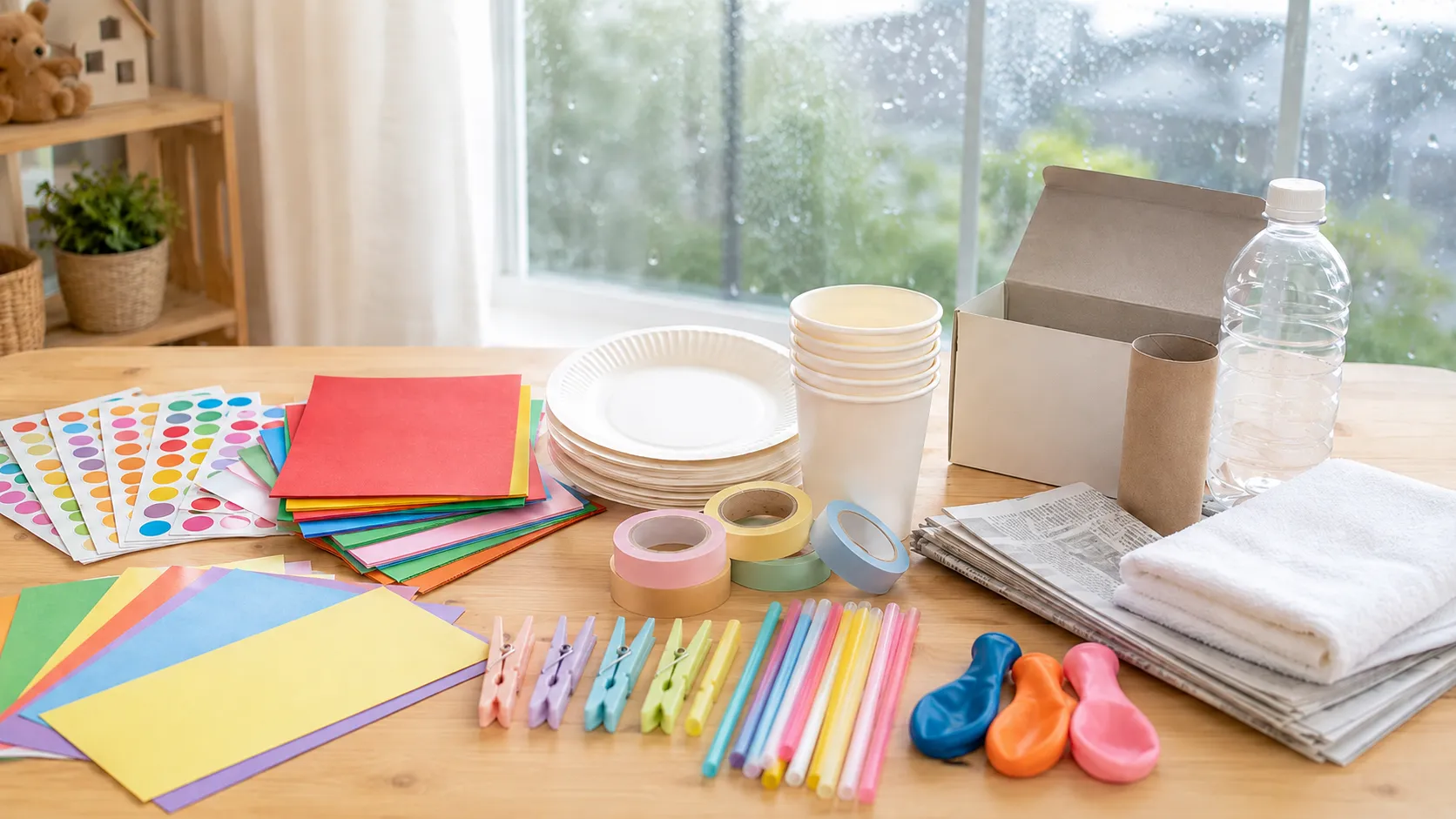

Stocking up on basic materials at the dollar store — in Japan, the 100-yen shop — before the rainy season lets you choose activities without scrambling on a rainy day. Here we focus not on “how to make” but on a prep list of “what to buy.” Specific craft steps are introduced in detail in separate articles.
If you’re buying just these five first
Before the rainy season starts, preparing even just these five items gives peace of mind.
- Stickers (dot stickers, sticker sheets, etc.): easy to use regardless of age, and leftovers can be repurposed for other crafts.
- Origami paper: a staple material with lots in one pack, easy to use for crafts and decorations.
- Paper plates: a versatile material for crafts, playing house, target games, and more.
- Paper cups: a material that’s easy to expand play with — stacking, lining up, crafting.
- Masking tape: useful for all sorts of things — sticking it on walls or the floor to make a course, writing names, temporarily holding craft parts in place.
Some of the activities can be started with materials you can buy at the dollar store or things you have at home.
Things to add if you have room
If you have a little room in your prep, adding the following widens the range of play.
- Colored construction paper: you can make things bigger than with origami paper.
- Large poster paper: usable for drawing on big paper, or making a treasure-hunt map.
- Clothespins: counting, lining up, connecting. Also usable as a fastener for crafts.
- Balloons: the floaty, drifting movement draws children in. Caution is needed regarding accidental ingestion or choking if one bursts into small pieces. Always check the target age and the cautionary notes.
- Straws: usable as a craft material — blowing to move things, connecting, inserting.
Things you can use from home without buying
Even without buying anything new, you can sometimes use things at home as play materials. Just gathering the following in one place “before throwing them out” gives you rainy-season play materials.
- Newspaper: tearing, rolling, ripping. Enjoyable as sensory play too.
- Empty boxes (snack boxes, milk cartons, etc.): they become a craft material in place of cardboard.
- Towels: rolling, stacking, setting up as a target — soft and usable.
- Plastic bottles (washed out): usable for maracas and the like. Take care with handling the cap and with accidental ingestion of small parts.
- Cardboard tubes from plastic wrap: as a tube to roll or stack — usable in play with a little ingenuity.
For detailed craft ideas, see the related articles
Specific craft steps and play variations using the materials listed here are introduced in detail in TamagoDaruma’s crafts articles. This article keeps it to a “prep list,” so if you’re interested, please have a look at those.
Safety checks to keep in mind for indoor play
Even with indoor play, you need to watch out for falls, collisions, accidental ingestion, and heat. Especially from the rainy season into early summer, humidity and temperature rise easily even indoors, so a habit of checking the environment before playing leads to peace of mind.
A 3-second check before playing
Before you start playing, quickly checking the following five points serves as a check to prevent unexpected accidents.
- Whether there’s anything slippery on the floor (toys, towels, school bags, etc.)
- Whether furniture corners stick out into the path of movement (especially for active play)
- Whether the child is at an age where they put small materials in their mouth (ages 2–3 need particular care)
- Whether it’s an environment where they can stay hydrated (keep a cup and drink nearby)
- Whether the amount is something you can finish, cleanup included, without strain (if cleanup becomes harder than the play, next time feels like a chore)
On accidental ingestion and choking in particular, the Children and Families Agency has published a handbook summarizing accidents that tend to happen to preschool children aged 0–6 and how to prevent them. If you’re uneasy about choosing materials, check it as well.
(Reference:Child Accident Prevention Handbook|Children and Families Agency)
How to choose when noise is a concern in an apartment
In apartment buildings, children running around and jumping easily becomes noise for the floor below, and it’s a particular worry on rainy days. At times like that, putting “play that doesn’t make much noise” among your first options also reduces the parent’s own stress.
- Rather than jumping and running play, treasure hunts and mission-card play
- Rather than ball play, play and crafts using towels
- Rather than running-around pretend play, playing shop that can be done on a table
- If they want to move their body, slow movement play using balance and the core (such as moving while stepping only on towels placed on the floor)
The noise problem easily overlaps with “the stress of not being able to play outside,” and becomes a mental drain for the parent. We’d like you to take the very choice of “I chose play that doesn’t make noise” in a positive light.
From the rainy season into early summer, watch out for heat even indoors
During the rainy season, temperature and humidity rise easily at the same time, and in a room with the windows shut, heat builds up readily. It’s easy to feel “we’re not going outside, so it’s fine,” but as the Children and Families Agency’s alerts also show, heatstroke in children needs attention whether indoors or out.
Because children’s body-temperature regulation isn’t as developed as adults’, it’s important, even indoors, to make a habit of checking the room temperature with a thermometer and prompting frequent hydration. If you use air conditioning or a fan, adjust it so the air doesn’t blow directly on the child for long periods.
(Reference:Let’s All Watch Out and Prevent “Childhood Heatstroke”!|Children and Families Agency / Heatstroke Prevention Information Site|Ministry of the Environment)
Free download|how to use the Rainy-Day Indoor Play Bingo Sheet
This bingo sheet is a PDF for children to choose play themselves. It works both as a fix for parents running out of ideas and as a “today’s plan” for a rainy day.
How to use the ages 2–3 version
The ages 2–3 version makes up its squares with pictures and short words. We designed it so it can be used just by “pointing at a picture to choose,” even for children who can’t read yet.
The activities included are mainly ones that finish in a short time — sticker play, tearing newspaper, color hunt, towel play, drawing on big paper, and so on. When one square’s activity is finished, circle it together. That alone leaves the child with a sense of “I did it.”
How to use the ages 4–6 version
The ages 4–6 version is made up of a combination of mission-format play, play with rules, crafts, and pretend play. A child who can read can look at the sheet and choose play by themselves.
“Today I’ll do the treasure hunt,” “tomorrow I want crafts” — being able to have the feeling of the child planning it themselves is the strength of this age. The sense of achievement when all the bingo squares are filled in also becomes motivation to engage.
Using it as a one-week rainy-play chart
You can also use one bingo sheet as a “one-week play plan chart.”
- After getting home from daycare: one square in 15 minutes
- A weekend morning: a 3-square challenge (pick three activities you like and do them all)
- A long rainy holiday: aim to complete one line of bingo over the course of a day
Just having the child hold the choice of “which one shall I do today” speeds up getting into the play. For the parent too, it cuts down the every-morning “what should we do.”
Register and download for free
To lighten the burden of thinking “what should we do today?” every morning, we’ve prepared the Rainy-Day Indoor Play Bingo Sheet for free. There are two kinds: an ages 2–3 version and an ages 4–6 version. Print it out and try choosing one square at a time, parent and child together.
▶ Download the bingo sheet right away

Frequently asked questions about rainy-day indoor play
For rainy-day play, you’ll be fine as long as you choose to suit the age, the living environment, and the parent’s energy. No special prep, and no perfect activity, is needed.
- Q1. On a rainy day, what’s good for a preschooler to play at home?
- The basic is to choose to suit the age and the parent’s energy. For ages 2–3, things that finish in a short time like sticker play or newspaper play; for ages 4–6, things with a sense of achievement like treasure hunts or pretend play, are a good fit. Just “letting them choose from the bingo sheet themselves” makes a good enough start.
- Q2. Are there indoor activities even a 2- or 3-year-old can do?
- There are. Sticker play, tearing newspaper, rolling up towels, color hunt, drawing on big paper, and so on — play that needs little prep and finishes in a short time suits this age. Thinking of it as repeating 10–15 minutes several times makes it easier to put together.
- Q3. What rainy-day play keeps ages 4–6 from getting bored?
- Play with a sense of achievement and rules tends to be easy to take on. Indoor treasure hunts, mission cards, paper-cup towers, playing shop, and the like are good options. Handing over a small challenge in the form of “today’s mission: do ○○” makes it easier to get into the play.
- Q4. Are there activities where noise is less of a concern even in an apartment?
- There are. Treasure hunts, mission cards, sticker play, crafts, and pretend play that can be done at a table don’t make much noise and are easy to bring into an apartment. Avoiding jumping and running play, a “balance-stepping game” of moving while stepping only on towels placed on the floor is also an easy method to adopt.
- Q5. Is it bad to let them watch videos all the time on a rainy day?
- You can’t say it’s “bad” across the board. What matters, more than the watching itself, is deciding rules for time and switching over as a family. Making a small flow like “after the video, pick one square from the bingo sheet” makes switching over smoother. For specific guidelines on media use, consulting a pediatrician or a childcare professional is the surest approach.
- Q6. Can you prepare for indoor play with just the dollar store?
- Many activities can be started with materials you can buy at the dollar store or things you have at home. With five items — stickers, origami paper, paper plates, paper cups, and masking tape — it becomes easy to adapt to several indoor activities. Combining things you have at home, like newspaper and empty boxes, holds the amount you buy down even further.
- Q7. If siblings have an age gap, how should they play?
- Dropping the premise that “everyone does the same thing” makes it easier to put play together. Giving the older child an “in charge” role (hiding the treasure, explaining the rules) and the younger child the role of “the one who chooses, the one who tries” makes it easier for them to play in the same place even with an age gap.
- Q8. How do you use the Rainy-Day Indoor Play Bingo Sheet?
- In the morning or at the start of a holiday, show the child the sheet themselves and have them pick one square. When the activity is over, circle it. That’s all. The ages 2–3 version is designed to be chosen by pictures, and the ages 4–6 version is content you can reuse for a week in a mission format. The PDF can be downloaded from the free download page.
We wanted to hand you a “system for choosing” more than ideas
Editor’s note
What’s hard about parenting on rainy days may be less not knowing the activities and more having to keep thinking, every day.
A parent continuing to judge, every day, “what should I have them do today” is one of the especially draining tasks within parenting. Even a seemingly small judgment, when it continues every day through the rainy season, piles up.
Rather than just lining up play ideas, by turning them into a “tool that children can choose from themselves,” we wanted to remove one of the every-morning judgments for parents and childcare workers.
We’d be glad if, by making your own bingo card, you could get through the rainy season with your children a little more lightly.


