


“The Art of Loving” treats love not as a feeling, but as a skill you keep learning. In parenting, this means seeing your child as a person in their own right—not as an extension of yourself.
You tell yourself it’s “for your child’s own good”—and then find yourself getting too involved in their homework, or becoming increasingly involved in their friendships or decisions about their future. Have you ever caught yourself doing this and felt a flicker of unease about it?
That’s not unusual at all. You worry because you care. You want to step in ahead of time because you don’t want your child to fail. Parental love is often mixed with fear, urgency, frustration, and uncertainty.
But that feeling of “for my child’s good” can, without you noticing, drift toward wanting your child’s choices to follow the path you prefer. That’s where the difficulty in parent-child relationships lives.
Erich Fromm’s classic “The Art of Loving” isn’t a parenting book. But what it has to say about the nature of love offers a lot to think about when it comes to reexamining the parent-child relationship. Working through the core ideas of “The Art of Loving” from a parenting angle, this article looks at where love ends and control begins, what it means not to possess your child, and reflection questions for reconsidering overprotective habits.
Table of Contents
What Is “The Art of Loving” About?

“The Art of Loving” is Fromm’s best-known work, arguing that love isn’t simply a feeling but something to be learned, practiced, and trained in over time.
“The Art of Loving” is Erich Fromm’s book-length work on the nature of love. Kinokuniya, a major Japanese bookseller, lists Erich Fromm as the author and Sho Suzuki as the Japanese translator for the Japanese-language edition; details on current print editions can vary depending on when you buy it, so check the publisher’s or bookseller’s most recent listing before buying or citing the book.
(参照:The Art of Loving (Japanese Edition)—Kinokuniya)
The title itself makes the point: “art,” in the sense Fromm means it, isn’t fine art but a skill—something practiced, trained, and improved over time, the way you’d talk about the art of cooking or the art of conversation. That framing sits at the center of the book: love isn’t simply a feeling that wells up on its own, but something learned, practiced, and worked at.
Applied to parenting, this view is a practical one. Becoming a parent doesn’t come with an instant, fully-formed way of loving well. Living day to day with a child, a parent runs into their own anxiety, anger, impatience, expectations, and guilt again and again—and learns how to love, too, along the way.
Who Was Erich Fromm?

Erich Fromm is known as one of the 20th century’s leading psychoanalysts and social psychologists. HarperCollins, the English-language publisher of “The Art of Loving,” introduces him as a psychoanalyst and social philosopher whose book examines the impact love has on a person’s life.
(参照:The Art of Loving—HarperCollins)
What set Fromm apart is that he didn’t treat love as simply a romantic feeling. He saw it as deeply tied to personality, society, human loneliness, freedom, and independence.
That’s why “The Art of Loving” continues to be read not just as a book about romantic love, but as one that speaks to parent-child relationships, marriage, relationships at work, and how a person relates to themselves.
How Does Fromm Define Love?
For Fromm, love isn’t about possessing another person—it’s an active stance that supports their growth and freedom.
Fromm treats love as separate from simply “liking” someone, or wanting to make them your own. What matters is the stance of genuinely trying to know the other person, caring for them, taking responsibility, and respecting them.
Applied to parenting, this becomes an important question to sit with.
Parents worry about their children. They want good things for their child’s future. They want to help so their child doesn’t struggle. But when that feeling grows too strong, it can turn into moving a child’s will and choices around for the sake of the parent’s own peace of mind.
This is where it helps to draw a distinction between responsibility and control.
- Responsibility means providing the protection, guidance, and support a child needs for their safety and growth.
- Control means directing a child’s choices mainly to relieve the parent’s own anxiety or match the parent’s ideals.
The two can look alike from the outside. Even a simple “do your homework” can either support a child’s daily routine, or push a parent’s own anxiety onto the child.
The same words land differently depending on the stance behind them.
Growth-Supporting Involvement and Controlling Involvement
Applying Fromm’s thinking to parenting, it helps to think of everyday parental involvement along a spectrum—from growth-supporting on one end to controlling on the other.
What’s meant here by growth-supporting involvement isn’t directing a child according to the parent’s wishes, but involvement that supports the child growing into who they are. Controlling involvement, on the other hand, tries to steer a child for the sake of the parent’s own peace of mind, expectations, or ideals.
| Parenting Situation | More Supportive of Autonomy | More Likely to Become Controlling |
|---|---|---|
| Talking about schoolwork | Asking where they feel stuck and offering help | Managing every detail out of the parent’s own anxiety |
| Friendships | Creating a relationship in which the child feels able to talk openly | The parent trying to vet or choose their friends |
| Education and career choices | Offering information and asking what the child thinks | Steering them toward what the parent wants |
| Responding to failure | Supporting small failures as learning experiences | Preventing every situation that might lead to failure |
Of course, what’s needed changes with a child’s age, development, and family circumstances. Respecting a child doesn’t mean asking a young child to make major decisions without age-appropriate guidance. In situations involving safety or health, a parent needs to draw a clear line.
What matters is pausing to ask, just once, before you speak up: Is this for the child’s sake, or is it to ease my own worry?
Mature Love and Blurred Parent-Child Boundaries
Fromm draws a distinction between mature love and relationships built on dependency, where two people remain psychologically fused rather than relating as separate individuals. Mature love is a bond where each person stands as a separate individual while still being connected. In more dependent relationships, the boundary between self and other tends to blur.
In the parent-child relationship, this boundary is especially hard to hold. While a child is young, a parent supports most of daily life—meals, sleep, getting dressed, getting to school or childcare, illness, keeping them safe. There’s a lot a parent has to be involved in.
But as children grow, they gradually become more independent from their parents. They build up experience choosing for themselves, making mistakes, and thinking things through on their own.
That process can come with loneliness and anxiety for a parent. Even so, a child becoming psychologically independent from their parent doesn’t mean love is fading. If anything, it can be seen as the process by which a parent’s love stays with the child as a foundation, and turns into the child’s own strength.
Why Are Love and Control So Easily Confused in Parenting?

A parent’s love and a parent’s control both start from intense concern for the child, which is exactly why they’re easy to mix up in everyday life.
Overprotection doesn’t necessarily come from a cold or distant parent. If anything, a parent who cares deeply about their child can sometimes come closer to overprotecting them.
“I don’t want them to fail.” “I don’t want them to get hurt.” “I don’t want them to struggle later in life.” All of these are common and understandable parental concerns. But when they grow too strong, a parent can end up taking away a child’s chance to have those experiences and make those choices in the first place.
Children learn through small failures. Choosing for themselves, and having it not work out, is what builds the ability to think through what to do next.
This doesn’t mean simply watching and waiting through dangerous situations, of course. Anything involving life, health, or safety is something an adult needs to step in and stop. But if a parent removes every possible failure, the child loses the chance to think for themselves.
A Personal Note on Overprotection
Editor’s Note
Editing articles on parenting and family support, I’ve come to feel that “a parent’s love” and “a parent’s anxiety” aren’t cleanly separable in real households.
A parent may believe they’re acting entirely for their child’s sake, while part of the urgency may also come from their own difficulty sitting with uncertainty. This isn’t a problem limited to a handful of parents—in today’s information-heavy parenting environment, with so much information and so many easy comparisons, it’s a pattern many parents run into.
What matters isn’t blaming yourself as “an overprotective parent.” It’s pausing every so often to check whether what you’re saying right now is supporting your child’s growth, or just settling your own anxiety.
Social media and parenting information sites are full of things parents worry about—early education, extracurricular activities, school and career paths, daily habits, smartphone use, friendships. More information can help, but it also tends to add to the worry of “is my family doing okay, or falling behind?”
That’s exactly why, when taking in this kind of information, it helps to use it to open up more conversation with your child—rather than to manage them more closely.
Comparison Table: Where Caring Ends and Overprotection Begins
The difference between deep care and overprotection comes into focus when you ask whether an action protects the child, or reduces the parent’s own anxiety.
| Example Behavior | Understandable Concern | How It Can Slide Toward Control | A Question Worth Asking |
|---|---|---|---|
| Checking homework in fine detail | Not wanting them to struggle with schoolwork | Taking away the child’s own trial and error, out of parental anxiety | Which parts can my child reasonably manage on their own? |
| Weighing in on friendships | Not wanting them exposed to a bad influence | The parent managing the child’s relationships | Is this a real warning sign, or just my own preference? |
| Steering their education or career choices | Not wanting them to struggle later | Imposing the parent’s preferred future on the child | Did I ask what they want first? |
| Stepping in before a likely failure | Not wanting them to get hurt | Taking away the chance to learn from a small failure | Is this failure actually dangerous? |
| Deciding what to praise | Wanting to encourage good behavior | Only valuing the outcomes the parent wants | Am I noticing the process, not just the result? |
This table isn’t meant to place blame on parents. It’s a tool for looking at your own involvement a little more objectively.
Noticing “that might have been control” isn’t a bad thing. Noticing it creates an opportunity to respond differently next time.


What Does It Mean Not to “Possess” Your Child?
A parent-child relationship that doesn’t possess the child isn’t about a parent giving up responsibility—it’s about protecting their safety while recognizing the child’s own will and personhood.
The phrase “not possessing your child” might sound a little strong. But it’s a genuinely important lens for thinking about the parent-child relationship.
Parents are often among the people closest to a child. That’s exactly why their grades, clothes, way of speaking, friends, and future can start to feel like reflections of the parent.
But a child is not an extension of the parent, and their life is not a chance for the parent to redo their own. A parent’s hopes and a child’s life overlap in places, but they never fully align.
Accepting that gap is the first step toward a parent-child relationship that doesn’t possess the child.
Japan’s Children and Families Agency explains that the country’s Basic Act on Children sets out basic principles for children’s policy, the drafting of a national outline for children’s measures, and reflecting children’s own views in policy. Family life obviously can’t be reduced to what a law says, but the underlying idea—taking a child’s own perspective seriously—is one worth carrying into the home too.
(参照:Basic Act on Children—Children and Families Agency)
Article 12 of the UN Convention on the Rights of the Child, published on Japan’s Ministry of Foreign Affairs site, states that a child capable of forming their own views has the right to express those views freely on any matter affecting them, and that those views should be given due weight according to the child’s age and maturity.
(参照:Full Text of the Convention on the Rights of the Child—Ministry of Foreign Affairs of Japan)
This doesn’t mean giving in to everything a child says. What matters is holding onto a posture of taking the child’s views seriously on things that concern them.
How Much Should Parents Influence Education, Career Choices, and Friendships?
A child’s education, career choices, and friendships are areas where a lot of parents feel the urge to weigh in. They’re also areas that matter for a child’s growing autonomy.
When it comes to education and career choices, it’s important for a parent to gather information. Laying out the options matters too. Sharing financial constraints, commuting distance, or family circumstances is also part of a parent’s responsibility.
But if the direction gets decided by the parent’s wishes alone, without ever asking how the child feels, it becomes harder for the child to develop a sense that they’re choosing their own life.
The same goes for friendships. If there are signs of bullying, violence, exploitation, or other dangerous behavior, an adult needs to step in. On the other hand, managing a child’s friendships too closely based only on the parent’s own preferences or values can limit the child’s chances to develop judgment, resolve conflict, and learn from relationships.
Before you speak up, try checking these three things:
- Is this a matter of safety or health?
- Have I asked how my child actually feels about it?
- Is this intervention only about reducing my own anxiety?
Respecting a child isn’t the same as being permissive. It’s holding a boundary as a parent while still leaving room for the child to choose.

How Can You Check Whether You’re Being Overprotective?
The first step in reconsidering overprotection isn’t blaming yourself—it’s sorting out whether your everyday words to your child are for the child’s sake, or for easing your own anxiety.
The word “overprotective” can land heavily on a parent. Some may feel, “Am I making my child suffer?” or “Am I getting the way I love them wrong?”
But self-criticism isn’t what’s needed here. What matters is getting back to a place where you can reconsider just one moment of today’s involvement.
A parent doesn’t need to be perfect. If anything, the harder you try to be perfect, the more likely you are to demand perfection from your child too.
Parenting Reflection Checklist (Free Download)
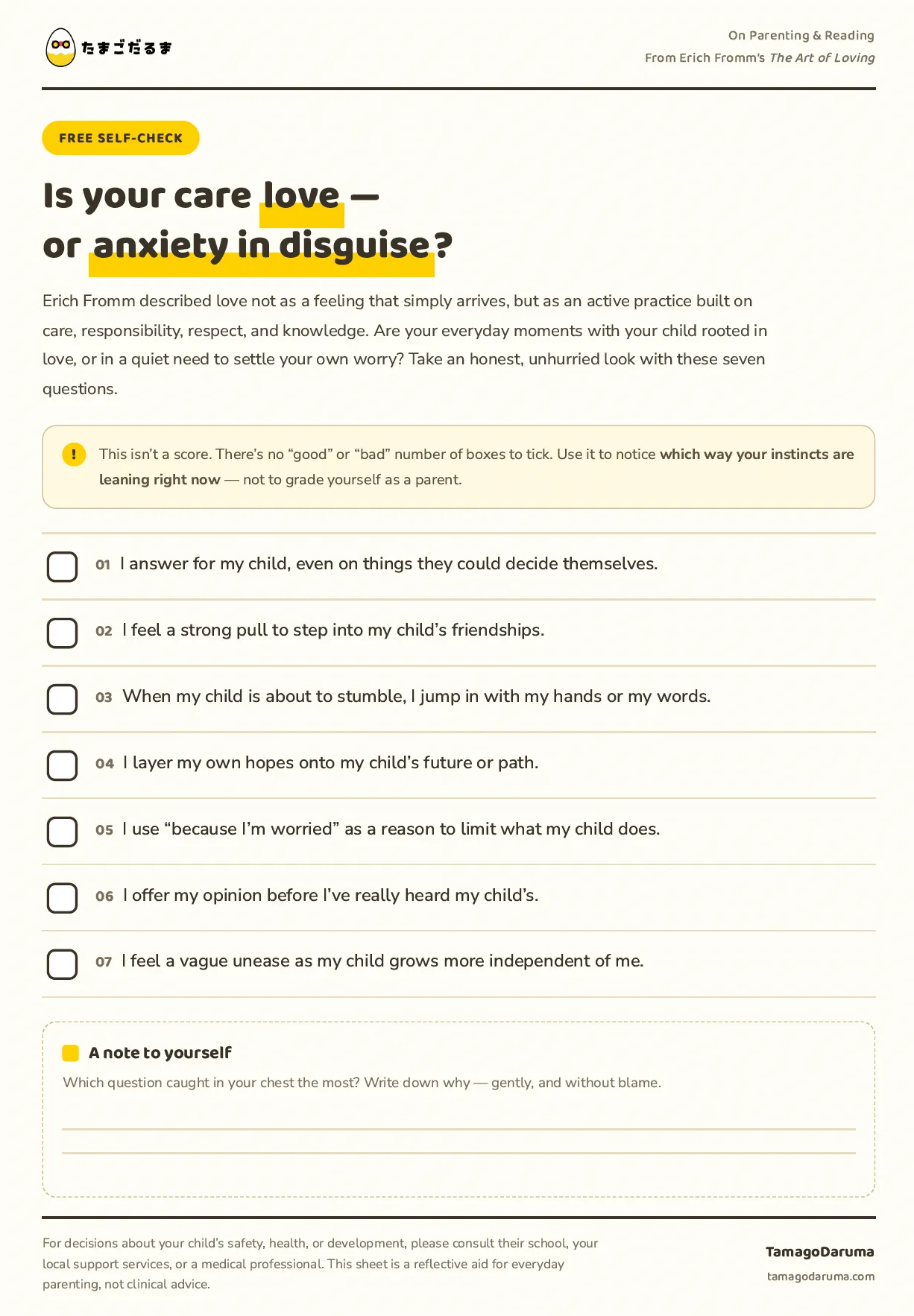

The checklist below is for reflecting on whether your involvement is “love” or “relieving your own anxiety.” Having items that apply to you isn’t something to see as bad in itself. Pick one item that stands out, and use it as a starting point for responding a little differently the next time a similar situation comes up.
- I sometimes answer or decide for my child before giving them time to respond
- I feel a strong urge to weigh in on my child’s friendships
- When I see my child about to struggle with something, I quickly step in, take over, or tell them what to do
- I sometimes impose my own expectations on my child’s education or career path
- I often limit my child’s behavior by saying “I’m just worried,” without always examining why
- I sometimes share my own opinion before asking what my child wants
- I feel a vague anxiety about my child growing more independent of me
- I do not always reconnect or apologize after I’ve spoken too harshly
- I praise only the results and overlook the process or effort behind them
- I notice my own words getting sharper when I’m too exhausted


This checklist isn’t meant to be scored. It’s not a tool for ranking parent-child relationships either. It works best saved or printed, and used as a “pause and reflect” note you come back to now and then.
Before saying something to your child, try checking just these three things:
- Is this about safety or health?
- Are these words only about reducing my own anxiety?
- Can I leave room for my child to choose?
These three questions aren’t a magic fix for the parent-child relationship. But they can help create a brief pause before frustration turns into harsh words.
| What You Might Say | A Different Way to Say It |
|---|---|
| Why can’t you do this? | Where did you get stuck? |
| Hurry up. | What’s left before we can go? |
| I told you so. | What might work better next time? |
| This is for your own good. | I’m worried. What do you think? |
| Forget it, I give up. | Let’s talk again once we’ve both calmed down. |
| Do it properly. | Let’s look at the next step together. |
That said, if you can’t hold back strong anger, can’t stop yourself from using corporal punishment or verbal abuse, or find it painful just to be with your child, please don’t try to carry that alone through reading or self-checking. It can help to talk to your child’s pediatrician, a local family support or parenting consultation service, or—if you’re in Japan—your municipal government’s childcare consultation counter or the Children and Families Agency. Japan’s Children and Families Agency explains that a legal ban on parents using corporal punishment when disciplining a child took effect in April 2020. Corporal punishment and denying a child’s personhood can’t be justified under the words “love” or “discipline.”
(参照:For Child-Rearing Without Corporal Punishment—Children and Families Agency)
Parents are also allowed to reach out for support. Protecting a child also means the parent not becoming isolated.


Frequently Asked Questions
“The Art of Loving” isn’t a parenting book, but it offers a deep frame of reference for reconsidering how you relate to your child.
- Q1. What kind of book is “The Art of Loving”?
- It’s a book by Erich Fromm, known as a psychoanalyst and social psychologist, arguing that love is something learned and practiced rather than simply a feeling. It’s read not only as a book about romantic love, but as a work of thought on relationships in general.
- Q2. Fromm says love is a skill, not a talent—what does that mean?
- It’s the idea that love isn’t something you’re simply born with, and not just a feeling that wells up naturally either—it’s something built through care, responsibility, respect, and the effort of trying to know the other person.
- Q3. What’s the key point when applying this to parenting?
- The key is respecting the child as a person in their own right, rather than someone to be shaped to the parent’s wishes, and supporting their growth accordingly.
- Q4. What’s the difference between overprotection and being deeply caring?
- Deeply caring involvement supports a child’s safety and growth. Overprotection tends to take away a child’s choices and experiences instead, mainly to ease the parent’s own anxiety.
- Q5. What does it actually mean not to “possess” your child?
- It means recognizing that your child’s opinions, choices, and future ultimately belong to them—even when they differ from your own thinking—and not treating their education, career, or friendships as a way to fulfill the parent’s own ideals.
- Q6. Isn’t respecting a child the same as spoiling them or being permissive?
- No. Respect means taking a child’s feelings and opinions into account in a way that fits their age and development. Being permissive means failing to provide the protection or boundaries a child needs. In situations involving safety or health, an adult needs to step in and stop them.
- Q7. Does setting firm limits contradict love?
- Setting firm limits doesn’t contradict love. Dangerous behavior, or behavior that hurts someone else, needs to be stopped. That said, denying a child’s personhood, verbal abuse, corporal punishment, or forcing obedience through fear can’t be justified as love.
- Q8. What age of child is this book relevant for parents of?
- The book itself isn’t a parenting guide aimed at a specific age. Because of that, it has something to offer parents at any stage—from infancy through adolescence and beyond—who want to reconsider their distance and involvement with their child.
“The Art of Loving” offers a perspective: love isn’t just a feeling that shows up on its own—it’s something built through care, responsibility, respect, and attention.
In parenting too, there’s value in pausing every so often to check whether worry and love have quietly turned into control or possession.
There’s no need to be a perfect parent. What matters is the ongoing effort to keep respecting your child as their own person.
Loving a child isn’t the same as making them go the way you want. It means gradually giving them the support, judgment, and freedom they need to live a life of their own.
At TamagoDaruma, our aim with questions like these isn’t to place blame on parents—it’s to help parents and children feel a little more at ease.


