
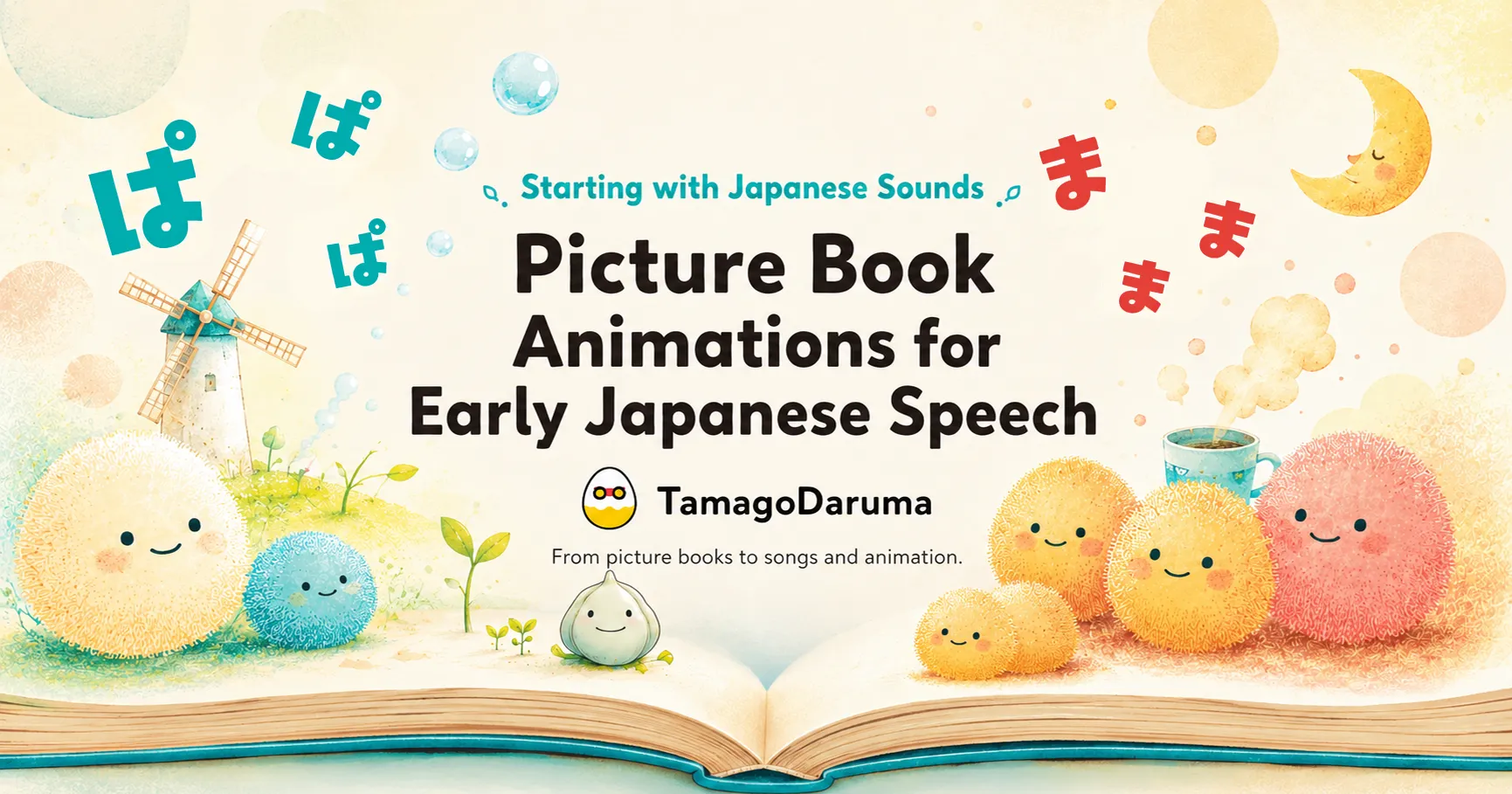
Babies reach spoken language on their own timeline. A good starting point for introducing Japanese sounds is playing with easy-to-copy ones like “pa” and “ma,” together, through picture books and songs.
You may be wondering when babies usually start using words, whether picture books can support language development, or whether it’s normal that your baby isn’t using words yet. Multilingual families in Japan may have an additional question: how do you introduce Japanese sounds without pushing aside the language your family uses most naturally at home?
But reading through that information can end up making you more anxious instead. A child the same age is already saying “mama” and “dada.” Your baby just flips through picture-book pages without listening to the story—though that, too, can be a meaningful way of exploring a book. They seem to enjoy videos, and you find yourself wondering how that affects language development. And in a household where Japanese isn’t the main language, it’s not always clear how to balance Japanese with the language your family communicates in most naturally.
This article treats a baby’s speech not as something to rush, but as something that grows out of parent and child enjoying sound, expression, and repetition together. Alongside guidance drawn from child-development sources, it introduces sound-play ideas developed through TamagoDaruma’s speech picture-book animation project—walking through activities you can do at home, how to use picture books and videos, and where to turn if you’re worried, all at a steady, unhurried pace.
Table of Contents
When Do Babies Start Talking? Individual Differences Worth Knowing First
Babies reach spoken language at very different paces. Rather than focusing on age alone, it helps to look at sounds, responses, understanding, and back-and-forth interaction together.
A baby’s spoken words don’t suddenly appear out of nowhere one day. Crying, making sounds, babbling, looking at a parent’s face, pointing, and using gestures to communicate all build up first. Meaningful words grow gradually out of that accumulation.
The NIDCD explains that a child’s speech and language development moves from communication that starts with crying, through responding to voices and sounds around them, babbling, understanding words, and eventually speech. Babbling around 4 to 6 months is given as an example stage where sounds starting with p, b, and m often appear. That doesn’t mean a baby is guaranteed to make those sounds by that exact age—it’s information meant to be read as a general developmental guide.
(参照:Speech and Language Developmental Milestones—NIDCD)
CDC’s developmental milestones similarly frame a child’s development as something to look at across several areas—social and emotional skills, language and communication, learning and thinking, and movement—not just word count alone.
(参照:CDC’s Developmental Milestones—CDC)
Language Development Starts Before the First Word
Hearing the word “talking” tends to make people think of speaking meaningful words. Words used with clear meaning—”mama,” “dada,” “wanwan” (the Japanese baby word for a dog), “no,” “more”—are certainly the easiest kind of speech to recognize.
But before that come stages like making sounds, imitating, responding to a parent’s voice, and communicating through gestures. When a child makes sounds like “mamama” or “papapa,” they may not yet be calling a specific person. Even so, if they’re moving their mouth, making sounds, and watching how people around them respond, that’s an important experience on the way toward language.
What a parent can do matters more than judging whether something “counts” as speech yet—it’s responding to that sound. If a child says “maa,” a parent says “maa” back. If a child laughs, a parent smiles or laughs back and says, “That was fun!” If a child points at a picture, a parent responds with a short, playful “pa!” That small back-and-forth is what builds the foundation for language.
A Milestone Chart Is Meant to Reassure You, Not Pressure You
Milestone charts can be useful, but treating them as strict deadlines may increase a parent’s anxiety. Reading “an 18-month-old should be able to do this” or “a 2-year-old should be talking this much” can lead you to look at the chart more than the child in front of you.
ASHA publishes communication developmental milestones as information for understanding what to generally expect as a child grows. That said, these guidelines aren’t meant for diagnosing anything at home. If something concerns you, it’s safer to use them as a starting point for a conversation at a health checkup, with a medical provider, or with a specialist.
(参照:Communication Milestones—ASHA)
At TamagoDaruma, we think a milestone chart works better as a tool for finding a reason to ask someone, rather than a chart that adds to your worry. If something concerns you, you don’t have to work it out at home alone.
Why Is Sound Play Starting With “Pa” and “Ma” Easy for Parents and Babies to Enjoy Together?
“Pa” and “ma” are sounds where the movement of the mouth is easy to see, which can make them enjoyable to copy together during face-to-face play. Bring them in as a low-pressure way to get familiar with sound, not to rush speech.
TamagoDaruma’s speech picture-book animation project is built around short, approachable sounds for babies and young children, like “pa” and “ma.” It takes a story structured as a picture book and adds songs and animation, expanding it into something a parent and child can enjoy watching, listening to, and voicing together.
What matters here isn’t getting your baby to say “pa” or “ma” quickly. When the focus shifts to whether a baby can repeat a sound correctly, sound play quickly turns into drilling. Once it’s drilling, a parent starts looking for the “right” answer, and the child finds it harder to respond freely.
What we want to create isn’t a test—it’s time together as parent and child. A “pa” pops out, a “maa” stretches on, the parent laughs, and the child laughs too—and that makes you want to make the same sound again. That cycle is at the center of the speech picture-book animation project.
“Pa” and “Ma” Are for Play, Not Practice
The phrase “encouraging speech” needs a little care. Encouraging isn’t the same as rushing. Supporting communication isn’t the same as prompting a child to perform on cue.
NIDCD’s developmental guidance lists sounds like p, b, and m as examples of babbling. These sounds aren’t unique to Japanese—this article uses their Japanese pronunciation and rhythm as an accessible way to play with sound. That doesn’t mean drilling “pa” and “ma” will make speech come earlier, though—there’s no way to say that for certain. We treat “pa” and “ma” as sound play that’s easy for parents and babies to copy together, not as speech training.
(参照:Speech and Language Developmental Milestones—NIDCD)
If a parent repeatedly asks, “Come on, say pa,” “Say ma,” the sound stops being fun for the child and starts feeling like something they have to answer correctly. In sound play, before your child says anything, try making the sound yourself first, and enjoy it out loud.
- Try saying a short “pa”
- Try putting “pa-pa-pa” to a rhythm
- Try stretching out a “maa”
- Try working in everyday sounds like “manma” (baby talk for food) or “ma, ma, ma”
It’s fine if your baby doesn’t imitate the sound. If your child laughs, that’s enough. Even without making a sound, if they’re watching your mouth, swaying along, or responding at the same moment each time, they’re taking part in their own way.
Pictures, Songs, and Movement Make It Easier for a Baby to Join In
Babies and young children don’t learn language from text alone. Looking at a picture, hearing a sound, feeling a rhythm, watching a parent’s expression, and enjoying the same scene again and again—when these cues layer together, a sound stops being just a sound and becomes an experience.
TamagoDaruma’s speech picture-book animation project builds its story and scenes as a 14-page picture book, then adds songs and animation to that world to develop it into a video. It’s currently introduced as a series starting with “pa-pa-pa” and “ma-ma-ma.”
This isn’t simply because a video is easier to get people to watch. In how parents and children actually live today, children encounter stories and songs in several places—paper picture books, videos, PDFs, social media, and shared moments at a childcare center. That’s exactly why we think it’s worth designing around a story that works as a picture book in its own right, then expanding it into song, animation, and PDF formats.
Editor’s Note
Questions about early speech can weigh heavily on parents’ minds. Search for it, and milestones, word counts, developmental guides, and signs of delay come up one after another. That information is necessary, but too much of it can leave a parent looking at search results more than the child in front of them.
Starting with “pa” and “ma” is a way of returning to something simpler. A sound comes out. A parent responds. The child laughs. The sound comes out again. Before speech, there’s a back-and-forth of sound between parent and child. We wanted to make a picture-book animation that treats that small back-and-forth as something worth paying attention to.
How Can Picture Books Support Early Communication Between Parent and Child?
A picture book isn’t something a baby needs to complete on their own—it’s time spent looking at the same thing together as parent and child. Short sounds, expressions, and repetition are what matter.
Hearing “a picture book that encourages speech” naturally makes you want to expect results. Read this book and they’ll start talking. Repeat this sound and speech will increase. Skip a day and they’ll fall behind. Thinking that way turns picture-book time into something heavy for both parent and child.
At TamagoDaruma, we think of a picture book not as a tool for teaching language, but as time spent looking at the same thing together as parent and child. You don’t need to read every page to the end. You don’t need your child to correctly understand the story.
What matters is noticing and responding to the moments a child reacts. They looked at a picture. They patted the page. They made a sound. They looked at a parent’s face. They laughed at the same scene. A parent responds briefly to that reaction. That’s where an exchange of sound and attention begins.

Focus on “Echoing Back” Rather Than Reading Well
The first thing worth focusing on when using a picture book to support early communication isn’t reading it skillfully. It’s a parent giving a little something back to their child’s sounds and movements.
- If your child says “ma,” echo back “maa”
- If your child says “pa,” echo back “pa”
- If your child points at a picture, respond with a playful “pa!”
- If your child turns the page, say “You turned the page!”
You don’t need to correct everything your child says. Following up with “no, that’s not it, it’s pa” or “say it again” can turn picture-book time into a search for the right answer.
What we’d suggest is responding rather than evaluating. “I heard that.” “That’s fun.” “Want to look again?” “I heard your maa!” When a parent responds, a child feels that making a sound gets something back. That experience leads to the next sound.
Keep It Short and Repeat It, Rather Than Making One Session Long
Picture books and sound play don’t need to run long to be worthwhile. With babies and toddlers, focus doesn’t always last. Sleepy days, cranky days, days when they just flip pages, days when they stop partway through—all of that is expected.
Rather than deciding “we’ll always read one book every day,” it’s easier to keep up with something short, easygoing, and repeatable. A “pa” after getting dressed in the morning. A “maa” before bath time. Just one page before bed. Watching just one scene of a video and making the same sound together. Even on a day you don’t finish the book, having a moment of sharing sound together is enough.
Comparison Table
| Activity | Purpose | Example | Keep in Mind | For Multilingual Families |
|---|---|---|---|---|
| Looking at a picture book | Looking at the same thing together | Pointing at a picture and adding “ma, ma” | No need to read to the end | It’s fine to explain in your home language |
| Copying sounds | Enjoying a back-and-forth of sound | Parent echoes a child’s “ma” with “maa” | Don’t look for a “correct” answer | Introduce Japanese sounds playfully, without replacing the home language |
| Songs and rhythm | Enjoying repetition | Putting “pa-pa-pa” to a rhythm | Don’t make it long | Include songs in the language your family uses at home |
| Animation | Connecting sight and sound | Making sounds together while watching | Don’t just leave them watching alone | Use it as an entry point to Japanese sounds |
| Consultation notes | Organizing your concerns | Recording when and what sounds come up | Don’t self-diagnose | Share at a checkup or consultation |
The most important thing in this table is not looking for a “correct” answer. A picture book meant to support early speech isn’t for checking off milestones. It’s for sharing sound between parent and child.
Is Screen Time Bad for Language Development? What to Keep in Mind
Rather than leaving it entirely to video, combining it with a parent’s own voice and echoing back makes it easier to use as a starting point for shared sound play.
Video and animation is a topic parents tend to have mixed feelings about. Some may feel “maybe it’s better not to show it,” while also noticing “but my child really responds to it,” or feeling a bit guilty about letting them watch for a little while during housework.
At TamagoDaruma, we don’t think video needs to be dismissed outright. At the same time, we wouldn’t recommend relying on video as the primary source of language interaction either. What matters for speech is a child hearing a sound, responding to it, and having someone respond back. Animation can be the starting point for that. But it can’t fully substitute for parent-child interaction.
Watch Together and Add Your Own Voice
When watching the speech picture-book animation, we’d suggest not just putting on the screen and leaving your child to watch alone. When a “pa” sound comes up in the video, try saying “pa” alongside it. If your child makes a sound, try echoing the same sound back right away. If your child points at the screen, respond with “you found it.”
Just that is enough to stop the video from being a one-way experience. The key is that a parent doesn’t need to be a perfect narrator. Even a quiet voice or just a small laugh is enough for a child to experience it as “watching together.”
It’s Fine to Stop When Your Child Loses Interest
A video or picture book doesn’t have to be watched all the way through. A child might stand up partway through. They might wander off to a different toy. They might want to watch the same scene over and over. They might just look at the pictures without responding to the sound. None of that needs to be read as a failure.
Babies and toddlers respond differently depending on their mood, energy, and how they’re feeling that day. What an adult expects the activity to look like, and what a child actually enjoys, can be two different things. Stop when they lose interest. Watch again when they want to. Just enjoy the parts they respond to. That kind of loose approach is what’s easiest to keep up at home.
Checklist
Use the list below for a light, pressure-free look back at today’s sound play. This checklist isn’t for scoring speech. It’s a note for noticing moments of interaction between parent and child.
- There was a sound my child seemed to like
- They watched my mouth at some point
- After making a sound, they seemed to check my reaction
- They responded when a familiar scene came up in the book or video
- I focused on echoing back rather than making them say it
- I stopped when they lost interest, without pushing to continue
- I noted down anything I was concerned about
For Multilingual Families, How Do You Balance Japanese Sounds With Your Home Language?
For multilingual families, it helps to bring in Japanese as a sound to play with, while keeping your home language or languages at the center.
For multilingual families in Japan, on top of general worries about speech, there’s also uncertainty about which language to choose. Should you speak your home language at home? Should you introduce Japanese early? Is it okay to use Japanese at daycare and a different language at home?
Being raised with more than one language doesn’t, on its own, delay a child’s speech or point to a language disorder. A multilingual child’s words and understanding are often spread across each language, so looking at only one language on its own can make it seem like they know less than they actually do overall. If you have ongoing concerns about your child’s communication, hearing, or understanding, it’s still worth bringing them up with a professional, as covered later in this article.
What matters on this topic is not dismissing your home language. Hold your child, sing to them, and express your feelings in whichever language lets you do that most naturally. On top of that, gradually enjoy Japanese sounds through picture books and songs. We think that order helps preserve warm, natural communication between parent and child.
For multilingual families living in Japan, the Maternal and Child Health Handbook Information Support Site provides information on pregnancy, childbirth, and parenting. If differences in language or systems leave you uncertain, checking a public resource like this can also help.
(参照:If You Become Pregnant in Japan as a Foreign National—Maternal and Child Health Handbook Information Support Site)
Start Japanese as “Sound Play,” Not “Study”
When a multilingual family begins introducing Japanese in everyday life, thinking of it from the start as “getting them to learn Japanese” puts a burden on both parent and child. Especially with babies and toddlers, it’s easier to start by treating Japanese as sound play rather than study.
Short sounds and repetitions like “pa,” “ma,” “ba,” “nenne” (baby talk for sleep), and “manma” (baby talk for food) can be easy to say out loud together even for a parent who isn’t confident in Japanese. Families may enjoy playful Japanese baby words like these, while also using ordinary words naturally in everyday conversation. Your Japanese doesn’t need to be perfect. Engage plenty in your home language at home, and let Japanese come in gradually through picture books, songs, daycare, and community settings. That approach makes it easier to protect a sense of security between parent and child.
You Don’t Need to Cut Back on Your Home Language
Some families worry, “Should we speak only Japanese at home too, so our child picks it up faster?” But trying to engage using only a language you can’t fully express yourself in can end up reducing how much you talk with your child and how much feeling passes between you.
At TamagoDaruma, we don’t start from the assumption that you need to cut back on your home language. There’s time spent engaging comfortably in your home language, and on top of that, “pa” and “ma” sound play serves as an entry point to Japanese sounds. We think that positioning comes across clearly for multilingual families living in Japan.
If You Have Concerns About Speech or Language, Where Should You Turn?
If you have ongoing concerns, don’t try to carry them alone as a family. You can turn to toddler health checkups, a pediatrician, local consultation services, or a speech-language-hearing therapist.
Speech develops on an individual timeline. But being told only “there’s individual variation, so it’s fine” doesn’t always make the worry go away. What a parent needs when they’re concerned isn’t just reassuring words—it’s knowing where to turn if you need to.
The NIDCD recommends talking to your child’s doctor if you have concerns about their speech or language. It also explains that because hearing problems can affect language, an evaluation may include a hearing test.
(参照:Speech and Language Developmental Milestones—NIDCD)
What You Can Bring Up at the 18-Month and 3-Year Checkups
Japan’s Children and Families Agency explains that municipal toddler health checkups are important for understanding a child’s health status and supporting and promoting their health. Under Article 12 of the Maternal and Child Health Act, checkups for 18-month-olds and 3-year-olds are carried out by municipalities.
(参照:Initiatives Related to Toddler Health Checkups—Children and Families Agency)
If speech is on your mind, it’s fine to bring it up at a checkup with something like “it feels like they don’t have many words,” “they seem to understand what I say, but don’t say much themselves,” “they sometimes don’t respond much when I call their name,” or “we use more than one language at home.” You don’t need technical terms. What matters is describing your child’s everyday behavior as it actually is.
What’s Worth Noting Down Before a Consultation
Noting down the following before a consultation can make it easier to talk about.
- Roughly when they started making sounds
- What sounds they make most often
- Whether they use words like “mama” or “dada” with a specific meaning
- Whether they point or use gestures
- Whether they respond when their name is called
- Whether they seem to understand simple things you say
- Which language or languages you use at home
- How they behave outside the home—at daycare, with grandparents, and so on
The Japan Speech-Language-Hearing Association explains that language and hearing difficulties can include hearing impairment, difficulties understanding or using language, and speech difficulties. In a consultation about language, it matters to look not only at “speaking,” but also “hearing” and “understanding.”
(参照:Consulting a Speech-Language-Hearing Therapist—Japan Speech-Language-Hearing Association)
You might be told, “let’s keep an eye on it for now.” Even then, if your worry continues, or if something about their hearing, responsiveness, or understanding still concerns you, it’s reasonable to ask again.
Frequently Asked Questions (FAQ)
- Q. When does a baby’s speech start?
- A. It varies from child to child. Some babies say words like “mama” or “dada” around age 1, but rather than judging by age alone, it helps to look at sounds, responses, understanding, and gestures together.
- Q. My baby says “mama” and “dada,” but it doesn’t seem to mean anything. Does that count as speech?
- A. Early sounds without a clear meaning are still an important experience on the way toward language. Rather than rushing to judge whether it “means” something, what matters more is a parent responding to it.
- Q. Does a picture book meant to encourage speech only work if you read it every day?
- A. You don’t need to read for a long time every day. What matters is looking at the same picture together and enjoying the sound and expression, even for a short time.
- Q. What should I do if my child loses interest while I’m reading to them?
- A. It’s fine not to read to the end. Just briefly enjoy the page they looked at, the picture they touched, or the sound they responded to.
- Q. Is showing videos or animation bad for speech development?
- A. Rather than leaving it entirely to video, combining it with your own voice and echoing back makes it easier to use as a starting point for shared sound play.
- Q. Can families where Japanese isn’t the home language still do Japanese sound play?
- A. Yes. It’s natural to keep valuing your home language while letting Japanese in gradually as “sound play” rather than “study.”
- Q. If I think speech might be delayed, where should I turn?
- A. You can start with your municipality’s toddler health checkup, a pediatrician, or a local parenting consultation service. If needed, they may connect you with a specialist such as a speech-language-hearing therapist.
- Q. Is it okay to use sounds other than “pa” and “ma”?
- A. Yes. Any sound your child responds well to, and that’s easy and fun for you to echo back, works fine as sound play in your own household.
“Pa” and “Ma” Sound Play You Can Start Today
There’s no need to rush speech. Start with a small sound-play activity you can do today, as a brief, enjoyable moment of connection with your child.
To close, here are some “pa” and “ma” sound-play ideas you can do at home. The goal isn’t getting your child to say something correctly. It’s hearing, watching, imitating, and laughing at the same sound together as parent and child. These shared moments matter, whether your child joins in enthusiastically or barely responds that day.
Sound-Play Ideas You Can Do in 3 Minutes
About 3 minutes at a time is enough to start. In “mouth copying,” a parent says a slow, playful “pa” during comfortable face-to-face play. It’s fine if the child just watches. If they respond, say something back like “You were watching!” or “I heard a pa!”
In “one-page picture-book sound play,” open a picture book to just one page, point at a picture, and add a short “maa” or “pa.” When your child turns the page, follow their attention and add a simple sound for the next picture.
You can also try a game where your child joins in just for the last part of a song. A parent sings a short melody—”pa-pa-pa, ma-ma-ma”—and leaves a little pause before the final “pa.” Even if the child doesn’t make a sound, it’s enough if the parent ends it with a laugh.
We’d also suggest finding sounds in daily life. “Manma” before a meal, “pa” when opening a door, “maa” before picking your child up—add a short sound to an everyday action. What matters here is not trying to get your child to say it. A parent simply making the sound in an enjoyable way gives the child another chance to watch, listen, and respond.
Free Download: “Pa and Ma Sound-Play Cards”
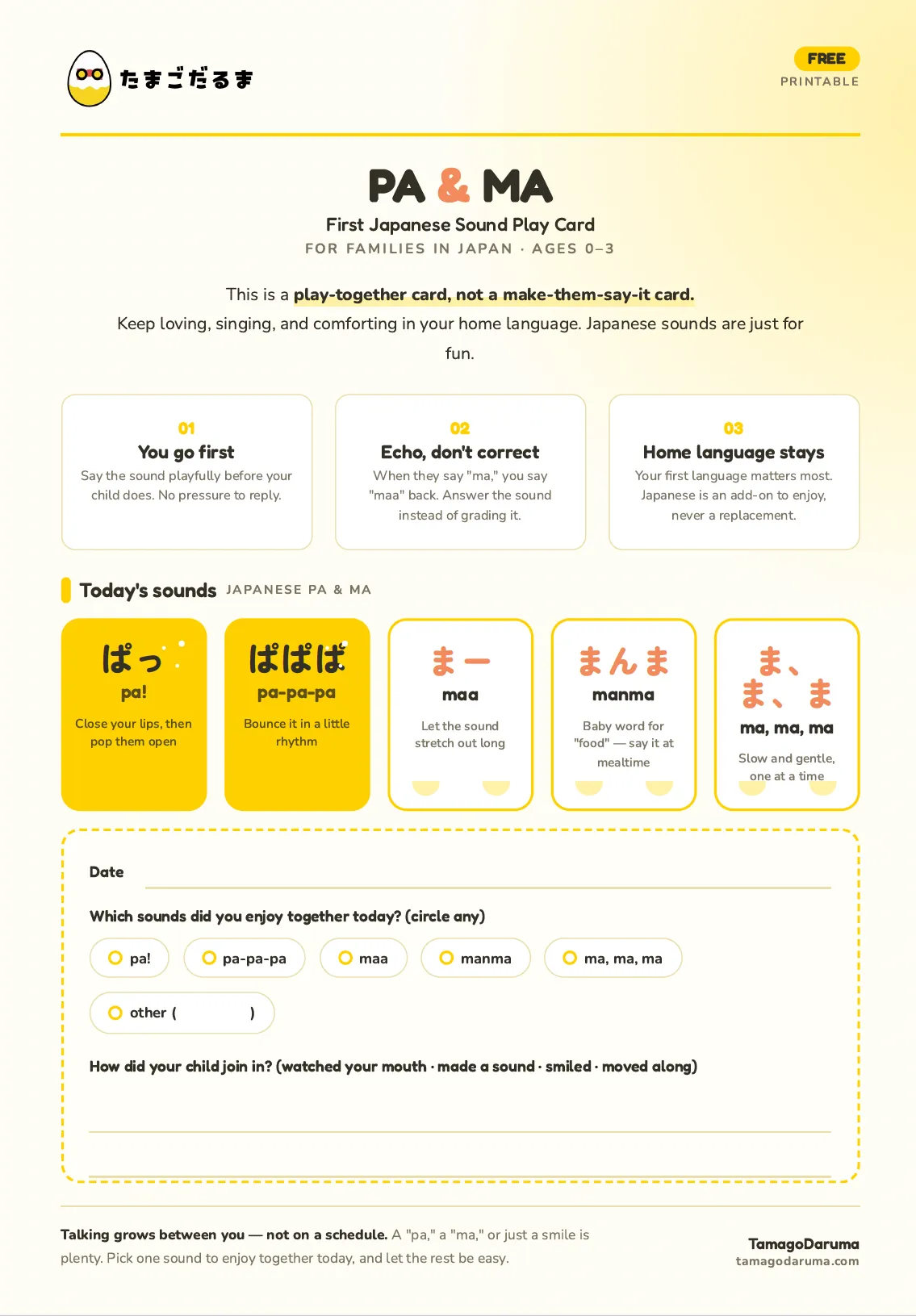
Alongside this article, we’ve also put together a free “Pa and Ma Sound-Play Cards” download. Each card includes sounds like “pa,” “pa-pa-pa,” “maa,” “manma,” and “ma, ma, ma,” along with space to jot down today’s sound and the moment your child responded to it.
These cards are meant to be played with together, not used to make a child perform on cue. This English version, “First Japanese Sound Play Sheet: PA / MA,” offers a way to explore Japanese sounds through play while keeping your home language at the center.

Watch the Speech Picture-Book Animation
TamagoDaruma’s speech picture-book animation project takes an original picture-book series built from short sounds like “pa” and “ma” and develops it into songs and animation. Links to the videos, the finished works, and picture-book PDFs are available as well.
If you’d like to check general speech-development milestones as well, the articles below may help.


A child’s language isn’t something for a parent to rush toward completion. A child makes a sound. A parent responds. They listen again. They watch again. They laugh again. Within that small back-and-forth is the seed of language.
TamagoDaruma isn’t producing content that claims to speed up speech. What we want is to add more options for parents and children to enjoy sounds together without pressure. A “pa,” a “ma,” or even just a smile that hasn’t turned into a sound yet—all of that is fine. Try starting with just one sound to enjoy together in your time together today.
